Skip to content

Photography Gear and Technique / Archived topic

Nikon D7000 Dxo scores

Started by loftus ·

  • 24Posts
  • 24Replies

Read-only discussion

Nikon D7000 Dxo scores

24 posts
  1. Nikon D7000 DXO sensor scores are excellent, only other APC sensor that is slightly higher is the Pentax k2.

    Also interesting is how low cameras like the 7D score comparatively. Tonal range difference is more than 1 stop.


    http://www.dxomark.com/index.php/en/Camera...ors/Nikon/D7000

    Edited by loftus
  2. Yet the photographs from the 7D look great!


    Alex

  3. Nikon D7000 DXO sensor scores are excellent, only other APC sensor that is slightly higher is the Pentax k2.

    Also interesting is how low cameras like the 7D score comparatively. Tonal range difference is more than 1 stop.


    http://www.dxomark.com/index.php/en/Camera...ors/Nikon/D7000


    And the Coke vs Pepsi wars go on....


    Otara

  4. No wars; and users choose cameras for many reasons. I find it interesting though that people tout one brand or another for all sorts of subjective reasons, yet a fairly objective measure like DXO scores is not given much credence. I think it's worth noting that in the last few years Nikon has been pretty consistent in producing arguably the best sensors of any cropped and full frame (35mm) sensor. So when one goes down the list in comparing cameras before purchasing, best sensors is ticked off for Nikon.

    On the other hand I think more than a stop of dynamic range difference between sensors is an important consideration, at least for me it is. I also find it interesting that some cameras that cost more than 6 times the price of the D7000, like the Leica M9 have sensors that by these tests are inferior.

    And how boring would Wetpixel be without these discussions......

    Edited by loftus
  5. No wars; and users choose cameras for many reasons. I find it interesting though that people tout one brand or another for all sorts of subjective reasons, yet a fairly objective measure like DXO scores is not given much credence. I think it's worth noting that in the last few years Nikon has been pretty consistent in producing arguably the best sensors of any cropped and full frame (35mm) sensor. So when one goes down the list in comparing cameras before purchasing, best sensors is ticked off for Nikon.


    I am guessing that while Nikon is producing cameras, the sensors themselves are produced by Sony. It appears that both the new Pentax that scored so well uses a Sony sensor as well which would explain why the Sony, Pentax and Nikon versions all scored about the same. In any case the sensors are far more capable than most photographers.


    Bill

  6. No wars; and users choose cameras for many reasons. I find it interesting though that people tout one brand or another for all sorts of subjective reasons, yet a fairly objective measure like DXO scores is not given much credence. I think it's worth noting that in the last few years Nikon has been pretty consistent in producing arguably the best sensors of any cropped and full frame (35mm) sensor. So when one goes down the list in comparing cameras before purchasing, best sensors is ticked off for Nikon.

    On the other hand I think more than a stop of dynamic range difference between sensors is an important consideration, at least for me it is. I also find it interesting that some cameras that cost more than 6 times the price of the D7000, like the Leica M9 have sensors that by these tests are inferior.

    And how boring would Wetpixel be without these discussions......


    I guess that comes down to how exciting you find Coke vs Pepsi wars.


    For anyone into that, theres the D7000 and 7D forums on DPreview where there are no doubt going to be endless threads poring over this new and exciting development, counter claims saying its all lies, endless 1000% crops at ISO 10000000 with package X Noise reduction, and more pictures of fluffy toys than any sane person should want to see.


    Otara

  7. Nikon D7000 DXO sensor scores are excellent, only other APC sensor that is slightly higher is the Pentax k2.

    Also interesting is how low cameras like the 7D score comparatively. Tonal range difference is more than 1 stop.


    http://www.dxomark.com/index.php/en/Camera...ors/Nikon/D7000


    One of the biggest pet peeves I have about DXOMark is that they don't publish their data (raw files etc). That would be more useful than the "take my word for it" or "cos I say so" methodology.


    DXOmark also doesn't tell you things like how the D700 applies NR to long exposures (can't turn that off) or clips blacks at 1.2:1 S/N, which sucks for astrophotography. Then that overall score thing that is essentially misleading because it doesn't take into account resolution, which can mean having a not so detailed HDR, low noise subject with great color! :) Why not just leave the data to be interpreted by readers themselves instead of ranking them?


    Their data is somewhat useful in looking for flaws of cameras though. Like Canon's 14bit files that have 12bit DR (for that matter all cameras that don't need 14bit past a certain ISO rating), so why glut us with such big files!! But until they release data, their neutrality is always going to be questioned.


    My favorite part of their website is this:


    All Sensor Scores reflect only the RAW sensor performance of a camera body. All measurements are performed on the RAW image file BEFORE demosaicing or other processing prior to final image delivery. DxOMark does not address such other important criteria as image signal processing, mechanical robustness, ease of use, flexibility, optics quality, value for money, etc. While RAW sensor performance is critically important, it is not the only factor that should be taken into consideration when choosing a digital camera.


    Which basically says it all, you can have the best sensor in the world (Sony!), but if your lens sucks, you can't focus quick enough or accurately, or the camera (or lens) breaks down while you are shooting because rain... you're still screwed! :D


    But by all means, Canikon or Niknon wars do make forums more interesting during the down times between camera/lens/housing releases.

    Edited by Drew
  8. I am guessing that while Nikon is producing cameras, the sensors themselves are produced by Sony. It appears that both the new Pentax that scored so well uses a Sony sensor as well which would explain why the Sony, Pentax and Nikon versions all scored about the same. In any case the sensors are far more capable than most photographers.


    Bill

    Nikon apparently use Sony based sensors but modified or tweaked to Nikon specs. Supposedly, though no one really knows, newer Nikon sensors are more and more Nikon designs etc.

    This would explain much of the improved ISO performance of Nikon over Sony.

    I agree that these sensors are extremely capable, and then one can really get into discussions as we always do about it being about the photographer not the camera etc.

    But that is all beside the point, otherwise we all would have stopped buying new cameras a few iterations ago. Compositionally etc, I don't take better or worse images with my daughters D40 than I do with my D700 or D7000. On the other hand, the capabilities of the D700 and D7000 allow me to take photographs in some situations that the D40 simply can't get at all or if it can the quality will be inferior - including low light, better dynamic range - again very noticeable in low light and contrasty lighting, rapid frame rate like when I was on shooting Great Whites breaching, larger enlargements, better range of bracketing for HDR, much, much faster focusing for action, now of course video, and the list goes on.

    Camera sensor quality will definitely not affect the composition of an image, but can make a huge difference in the quality of the final image. As both Canon, Nikon and others have pushed the quality of their sensors, it's absolutely created new photographic options.

    Broadly speaking there are 3 things I pay attention to, megapixels (for enlargement potential) , high ISO ability, and dynamic range. Improvements in any of these create opportunities to capture better quality images in the technical sense than we previously could. With the size of enlargements I do, anything above 12 MP is adequate. High ISO has completely changed how I shoot, and even what I shoot, and dynamic range of all cameras still falls short of what our eyes see and frustrates me at times when I have an image of a sunset or something that does not do the real thing full justice. As monitors improve dynamic range differences will be more noticeable. So I still think a one stop improvement in dynamic range of the D7000 over the 7D is significant , others might think the extra 2MP of the Canon is more important, I have no problem with that. For others the Canon's better video is more important, also OK. For me video is way down the list, mostly because I totally suck at shooting video. Astrophysics, sure, if that's what you need, buy Canon.

    As Drew has said many times, cameras are tools, every one should choose a camera according to what best suits his shooting needs.


    Edited by loftus
  9. Some of it is esoteric and some of it makes you try to do things you couldn't do before. And no camera ever does everything. (Combine the 5D and 7D and I will be happy, until the next one of course :) )


    So I still think a one stop improvement in dynamic range of the D7000 over the 7D is significant , others might think the extra 2MP of the Canon is more important, I have no problem with that. For others the Canon's better video is more important, also OK. Astrophysics, sure, if that's what you need, buy Canon.


    Okay, so now you are pushing Canon :D

  10. Okay, so now you are pushing Canon :)

    Not pushing anything really. :D If Canon suits your needs better, buy it. I have a number of reasons why Nikon suits mine..

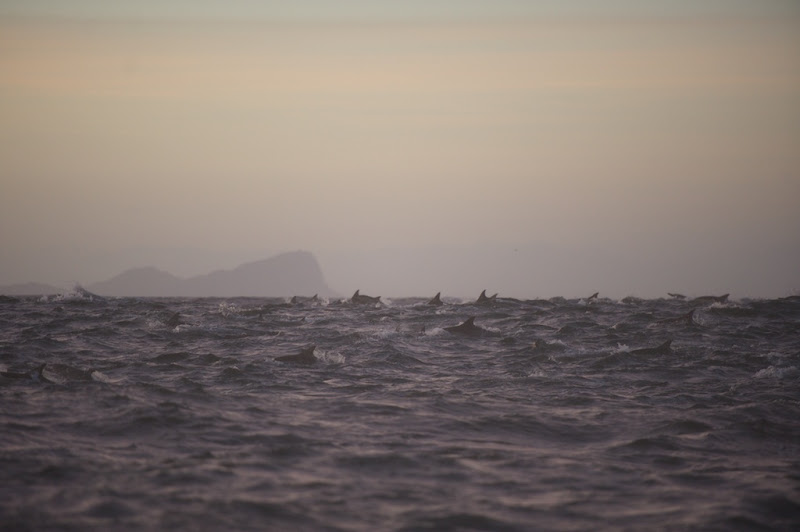
    It's not all esoteric though, sometimes a cameras abilities will allow shots one otherwise could not get. I cite high ISO as one example; and even with my D700 I've had situations where I wished I had even better high ISO ability - like trying to shoot a huge pod of dolphins in False Bay at 6:45 in the am - another stop or two of camera ability would have made a difference..... a D3S would have been nice.


    South%20Africa%202010-08-10.jpg

    Edited by loftus
  11. Astrophysics, sure, if that's what you need, buy Canon.


    You mean you finally admit Canon is the camera center of the universe?!? LOL The only problem is my sister is an aerospace engineer and she uses the iPhone.


    Seriously though, it is funny how Nikon builds in nice features like intervalometers (whassup Canon?!?) in the camera then hampers the camera in timelapse night photography with the black issue and long exposure NR.


    Oh did anyone notice the number of typos in the specs on DXO? How can one trust the numbers when they can't reliably type specs?

  12. Not pushing anything really. :D


    As long you do not push PCs instead of Macs, life is fine :):)


    BTW the False Bay shot is cool even without the higher ISO.

  13. Oh did anyone notice the number of typos in the specs on DXO? How can one trust the numbers when they can't reliably type specs?


    They are French aren't they?

  14. Oh Oh - the "Freedom Fries" are breaking surface again are they ?


    I do have to be careful the Islands that I live in have been annexed by the French several times in the last thousand or so years and more recently their fishermen blockaded our port !


    Great wine though...


    Paul C

  15. Nikon D7000 DXO sensor scores are excellent, only other APC sensor that is slightly higher is the Pentax k2.

    Also interesting is how low cameras like the 7D score comparatively. Tonal range difference is more than 1 stop.


    http://www.dxomark.com/index.php/en/Camera...ors/Nikon/D7000


    DXO scores is generally biased towards Nikon because of the low level quantization method of Nikon cameras and the test procedures of DXOmark.

  16. Were Canon users claiming this in 2004 and 2006? :)


    Just hold up a piece of paper over your screen and cover the results after the end of 2006. DxO then becomes Canon dominated.


    :)

  17. I don't own Canon, Nikon or Pentax cameras at this time but I would like to point out that the PENTAX K-5 (not K2) not only did a little better than the Nikon D7000 in the DxO sensor tests but was only bested by one DSLR the Nikon D3X and three Medium Format cameras, the Phase One P65, P40 and Pentax 645D. The Pentax K-5 also outscored almost every APS-C camera and several "full frame" cameras at PDReview. Add to that the fact that the Pentax K-5 is fully weather sealed, has in camera stabalization and dust busting, 7 FPS up to 20 in raw 14 bit depth and more. The Pentax also has a proprietary 10-17 fisheye which is less expensive with higher IQ than the Tokina, a weather sealed 100 mm macro and 35 mm macro along with a 50 mm macro and a raft of lenses both proprietary and after market. Yet not one housing is made or announced for this camera to date. I don't expect to see Canon and Nikon owners running out to buy this camera but it would be nice to have a few more choices.


    When I left the Nikonos camera line for an SLR film camera it was very hard to find a housing for any Canon camera until Aqutica came along with the F-1 housing. It seems with the number of housing manufactures today some of these smaller camera makers could catch a break and have a chance to show what they can do.


    I will be teaching a Hasselblad sponsored underwater workshop at Cobalt Coast in Grand Cayman January 22 to 29 and I would like to invite Alex to come over and try the Hasselblad system since he will be teaching during the same time period. It would be interesting to compare the 33 X 44 mm sensors and see how they do against the popular brands.


    Many of us have admired Loftus pool work and I would like to make the same offer to Loftus. I would be happy to come to your area from West Palm Beach on a day you have planned a pool shoot to compare the system to what you are using. A studio type setting seems a great place to test the differences in the real world.


    Phil Rudin

  18. Sure would be nice to have a housing for the pentax system.

  19. Were Canon users claiming this in 2004 and 2006? :)


    Just hold up a piece of paper over your screen and cover the results after the end of 2006. DxO then becomes Canon dominated.


    :)


    If you reffering to my remark, then I can just prove it. All you need to do is read this paper by Emil Martinec:

    http://theory.uchicago.edu/~ejm/pix/20d/po...D300_40D_tests/

    And you'l see the reson why DXO scores of Nikon are higher.

  20. If you reffering to my remark, then I can just prove it. All you need to do is read this paper by Emil Martinec:

    http://theory.uchicago.edu/~ejm/pix/20d/po...D300_40D_tests/

    And you'l see the reson why DXO scores of Nikon are higher.


    So Emil Martinec writes a paper on why Canon is better and imagine my surprise -- he shoots a Canon!


    http://theory.uchicago.edu/~ejm/pix/20d/


    And just like DXO, he has lots of charts and figures, but doesn't give you his raw data. Plus, he references five different sources where he has culled data and combined with his to get his results which of course show the Canon (in most cases) to be a more efficient sensor:


    http://www.clarkvision.com/imagedetail/dig...mance.summary/;

    http://astrosurf.com/buil/us/test/test.htm

    http://home.comcast.net/~NikonD70/Investig...acteristics.htm

    http://www.brisk.org.uk/photog/d3summary.html

    http://www.openphotographyforums.com/forum...read.php?t=4784


    And of course each one uses a different source of data, different cameras and different lenses. You CANNOT combine results from 6 different data sources and come to a valid conclusion. This is what gets scientists into trouble. My wife is a research scientist and any results used from another study which are not duplicated in an independent test cannot be combined with other data.


    So tell me, how does this "prove" DXO is biased towards Nikon other than one guy seems to think so? Yes, Emil is a professor in the physics department at the University of Chicago, but I fail to see how this makes him an expert in the mechanics of photography.


    MORE: In one test, he compares resolution of the D300 with a 70-200mm VR lens against the 40D with a 100mm Macro. Now, almost any photographer will tell you a "prime" lens is generally more accurate than a "zoom" lens. I don't know which of those lenses is better, but they are vastly different in purpose. Not to mention he uses a RAW converter and doesn't tell us which one. I would think a better test would be the 105mm Nikon against the Canon 100mm, but then are we really comparing sensor information -or- are we comparing lenses and RAW converters?

    Edited by johnspierce
Backscatter

Account

Navigation

Search

Search

Configure browser push notifications

Chrome (Android)
  1. Tap the lock icon next to the address bar.
  2. Tap Permissions → Notifications.
  3. Adjust your preference.
Chrome (Desktop)
  1. Click the padlock icon in the address bar.
  2. Select Site settings.
  3. Find Notifications and adjust your preference.