Skip to content

Shooting Technique, Workflow and Editing / Archived topic

Adobe Premiere Pro CS5 - an alternative to FCS for the Mac

Started by Drew ·

  • 10Posts
  • 10Replies

Read-only discussion

Adobe Premiere Pro CS5 - an alternative to FCS for the Mac

10 posts
  1. With all the threads about how to transcode AVCHD/.mov files from DSLRs to Pro Res (which flavor?) and issues with that, I thought it's a good time to let people know there is an alternative, in full 64bit processing ability. Right now, there are 3 major NLEs for the Mac: Avid Media Composer, Final Cut Pro and the least known, Premiere Pro from Adobe.


    This V5.0 is a very capable NLE, able to handle many formats natively in the workflow, without the necessary step of transcoding to another codec and/or smaller resolution files to work with 4k. It can do all that natively. In comparison to Final Cut, the specs alone are very impressive and supercede Final Cut on many levels.


    A few things that Premiere Pro can do that FCP can't:

    1. 64 bit: Access to more than 2.5GB of RAM limit FCP has. In fact it'll take as much memory as you can throw at it.
    2. Native* Workflow Support for AVCHD, RedCode, ProRes and 4k resolution editing. *That means straight to the timeline without transcoding!
    3. Faster Rendering/realtime playback with Adobe Mercury Engine. It requires a higher spec machine but the speed advantage is significant


    Just those features alone is enough of a deal breaker for many to adopt Adobe CS5. Then you add full BluRAY authoring, Adobe After Effects (the top compositor and motion graphics program), Photoshop extended (esp nice for ViDSLR users) and of course, most of it is in 64bit for peak performance.


    The UI took a little getting use to, since my own experience came from V2.0 in the 90s! Once you get the hang of it, it's pretty easy. It's not as intuitive as FCP, but that's probably because I've used FCP the most other than Avid. Avid has the tools and is the industry standard for feature film NLE, but it is a more expensive package and doesn't have the complete software package like BD output etc.


    The Adobe CS5 Production Suite consists of:


    Adobe Premiere® Pro CS5

    After Effects® CS5

    Photoshop® CS5 Extended

    Illustrator® CS5

    Flash® Catalyst™ CS5

    Flash Professional CS5

    Soundbooth® CS5

    Adobe OnLocation™ CS5

    Encore® CS5


    So for those who are looking for a better workflow than what is offered by Final Cut, you should have a serious look at Premiere Pro. I've been using it for months mixing in with Color from FCS.


    Final Cut has Color, which is a great color grading app. However, by skipping the ingest transcoding/unwrapping and rendering out to Color, you save some time, especially with the faster rendering. The Color Correction tools in Premiere Pro are very competent, and includes secondary color correction which allows users to grade color more specifically. However, Color is definitely FCS's greatest asset.
    Edited by Drew
  2. It took me the longest time and the most work to do an investigative review of Adobe's CS5. First Adobe flew me up to their headquarters in San Jose, Ca. for a few days with several other 'influencers' and press. Adobe sent me an NFR of their entire Master Collection, NVIDIA sent me their FX4800 graphics card and then Crucial donated about 12 gigs. Had to sell my dual core Mac, do a clean install on a new 8 core, but then a week later Apple announced the 12 core so I returned the 8 core and reinstalled everything on the 12 core which now has the NVIDIA card and 20 gigs ram. http://www.kenstone.net/fcp_homepage/behin...s5_douglas.html

    That said, everything Drew says is correct but there are some caveats.

    The first is that there are only a few NVIDIA graphics cards that are compatible with the Mercury Engine. While CS5 can work without the compatible cards( which are expensive) you will not be able to access the speed and benefits of the Mercury Engine and NVIDIA's CUDA. The Mercury engine will access all your cores and as much ram as you can afford to install and that's great, but it is really only Premier Pro where the Mercury Engine really shines. I absolutely love some of the new features in After Effects however, particularly the Rotobrush Tool which is a feature I have been hoping would come out somewhere for the last 10 years or so. http://www.kenstone.net/fcp_homepage/rotob...s5_douglas.html


    While I have not done any Blu Ray authoring, CS5 now leads the field. In fact, CS5 represents the first real advancement for Adobe in a very long time. Since they are now 64bit integrated applications they have thrown down the gaunlet to Apple whose Final Cut Studio 3 has been justly disparaged as really being Final Cut Studio 2.5 and still can access only 2.5 gigs of memory. Apple promises a new version for 2011 but unless it is also re-written as a 64bit studio, it will disappoint many despite any new bells and whistles that may be included. To re write the 32 bit code foundation of FCP which had been out for a few years under a different name and company prior to Apple's having bought them, is a major and tremendously difficult undertaking but, hopefully, Apple will do so. They are extremely tight lipped. Color is a very deep color grading application which I still have yet to become competent in, but for most editors, the 3 way color correcting tool will do the job. Red Giant also has updated their color grading plug ins like Magic Bullet Looks and Magic Bullet Mojo to be compatible with CS5 while also working fine in FCP.

    Steve

  3. While I have not done any Blu Ray authoring, CS5 now leads the field.


    People should be real careful about replicating from CS5 directly and also be aware that it is not in same league as full blown blu-ray authoring system (compare things like Scenarist, Sony, and the other PC offerings. Some will work in Parallels, Bootcamp, etc. And of course, the question to be asked is how much of the extras are really needed. But yeah, it is way past the Final Cut Suite, though I personally find the Encore interface and workflow very clunky, though it does have some cool features.

  4. Just got off the phone with a diver who wanted editing lessons and he asked about FC and Blu-ray. It occurred to me that I have never had a commercial client who has asked for a master on Blu ray to date.

    Steve

  5. People should be real careful about replicating from CS5 directly and also be aware that it is not in same league as full blown blu-ray authoring system (compare things like Scenarist, Sony, and the other PC offerings. Some will work in Parallels, Bootcamp, etc. And of course, the question to be asked is how much of the extras are really needed. But yeah, it is way past the Final Cut Suite, though I personally find the Encore interface and workflow very clunky, though it does have some cool features.


    When you say from 'CS5 directly,' are you saying that the compression is buggy?


    Apple won't pay the licensing fees for BD for awhile I think. So there's probably no hope of getting BD authoring in FCS. Sonic also dropped all the pro apps for Mac when they bought Roxio. So really, there's only Toast and Encore for BD authoring on the Mac, and if you're the only game in town, you look pretty darn good.


    I have to say Color Finesse is pretty darn good. I like the workflow of Color more but Color Finesse allows many of the tools Color. Best of all it works with CS5 and FCE/P/S.

  6. The first is that there are only a few NVIDIA graphics cards that are compatible with the Mercury Engine. While CS5 can work without the compatible cards( which are expensive) you will not be able to access the speed and benefits of the Mercury Engine and NVIDIA's CUDA.


    I have the Mercury Engine running with a Nvidia GeForce GT425M, even though it's not 'officially' supported. There is a very simple method of changing (adding your GPU card's name) one text file in Premier then being able to enjoy the CUDA speed boost.


    You just need a Nvidia card with at least 748MB of onboard RAM and CUDA capable. This works on both Macs and PCs.


    Link to Mac explanation

    Link to Windows explanation

  7. That's true except with Nvidia's Apple offerings, only the actual cards which qualify for CUDA are available. Your listing is more for PC/Hackintoshes which doesn't apply here.

  8. That's true except with Nvidia's Apple offerings, only the actual cards which qualify for CUDA are available. Your listing is more for PC/Hackintoshes which doesn't apply here.


    NVIDIA's engineer and PR person just called me a few minutes ago and they want to send me their new 4000 Quadro card. It will be considerably less expensive than the FX4800 card they gave me last summer. According to them, the 4000 will be about 10% more efficient than the 4800 card. Not sure what I will do with the FX4800, sell it or give it away, who knows. Both cards demand that the Mac has an identifier of 3.1 or higher so for older Mac Pros, they may not be compatible. You can check your Mac identifier number by going to About this Mac under the Apple Logo, click on the 'more info' and look at the 'model identifier'. My old dual core had a 1.1 identifier and my lastest 12 core has a 5.1

    Once I install the new card, though they say there is a 10% better performance, especially in Premier Pro, since I don't really use PP, I really don't expect to see much difference between the two cards.

    Just thought this news might be of interest to some.


    Steve

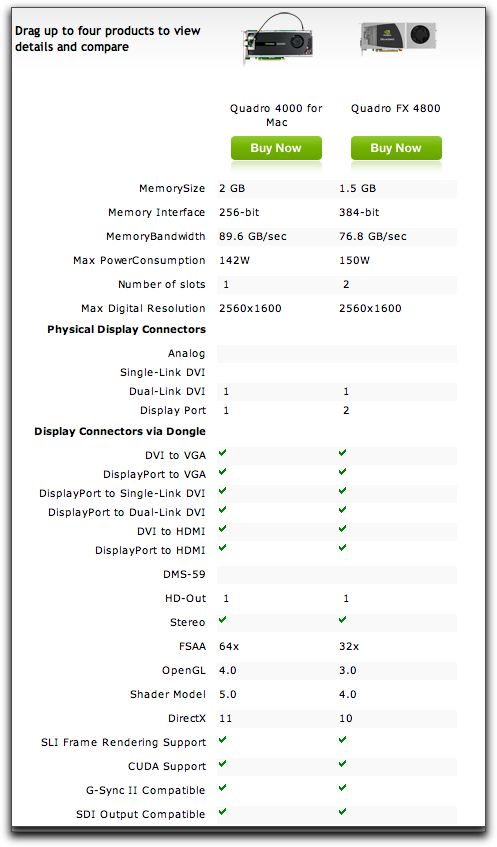
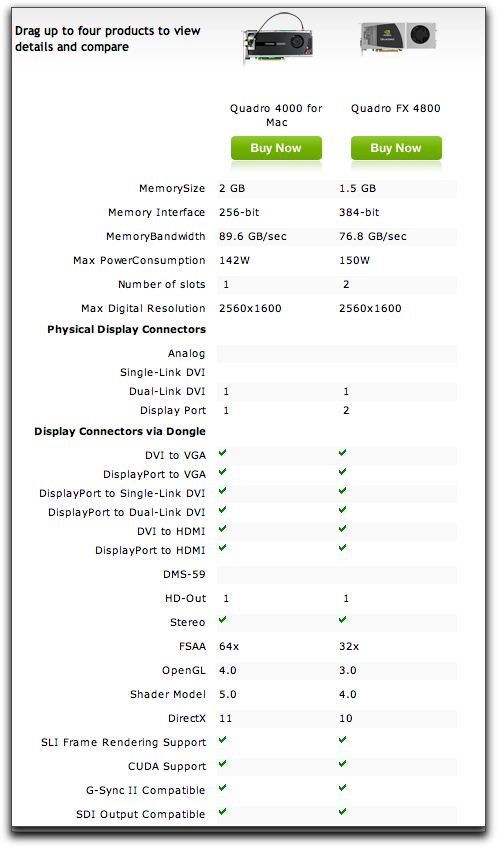
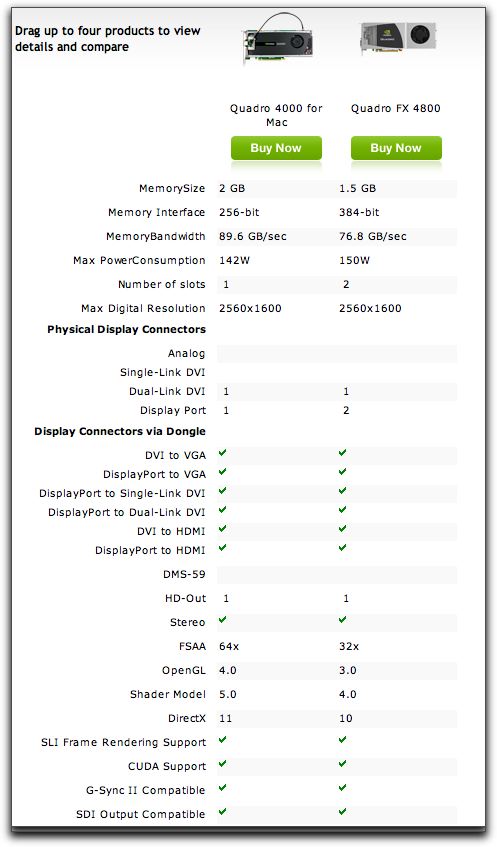
  9. Here is a comparision between the NVIDIA FX4800 card I am now running and the new Quadro 4000 card which was just released. NVIDIA just sent me the 4000 card which I have not yet installed or tested but I thought the specs between the two were interesting. The 4000 card is considerably less expensive yet NVIDIA says there will be a 10% performance improvement.

    Steve

    ps. Sorry, I screwed up the upload and don't see a delete function in the manage attachments.

    post-124-1292004896.jpg

    post-124-1292004932.jpg

    post-124-1292004943.jpg

    Edited by steve
Turtle

Account

Navigation

Search

Search

Configure browser push notifications

Chrome (Android)
  1. Tap the lock icon next to the address bar.
  2. Tap Permissions → Notifications.
  3. Adjust your preference.
Chrome (Desktop)
  1. Click the padlock icon in the address bar.
  2. Select Site settings.
  3. Find Notifications and adjust your preference.