Skip to content

Shooting Technique, Workflow and Editing / Archived topic

Exposure settings for cave diving photography

Started by harrym ·

  • 24Posts
  • 24Replies

Read-only discussion

Exposure settings for cave diving photography

24 posts
  1. What exposure settings are you using for cave diving photographs? I found that I was having to shoot at ISO 600, 1/60 sec, f/3.5 and strobes on manual/full power.


    Nikon d300s

    Inon-Z240 strobes (two) at full power

    No remote slave - yet

    Tokina 10-17mm


    I was unhappy with shooting at 1/60 and f/3.5, either too much blur or not enough depth of field. What exposure settings are you using?

    Do I need to shoot at a faster ISO, or do I need to drop more cash on some slave strobes?


    154802_160065497370845_100001021886622_325271_2513761_n.jpg

    Edited by harrym
  2. What exposure settings are you using for cave diving photographs? I found that I was having to shoot at ISO 600, 1/60 sec, f/3.5 and strobes on manual/full power.


    Nikon d300s

    Inon-Z240 strobes (two) at full power

    No remote slave - yet

    Tokina 10-17mm


    I was unhappy with shooting at 1/60 and f/3.5, either too much blur or not enough depth of field. What exposure settings are you using?

    Do I need to shoot at a faster ISO, or do I need to drop more cash on some slave strobes?


    154802_160065497370845_100001021886622_325271_2513761_n.jpg


    I am shooting a D300 at f/5.6, 1/125th ISO 400 with two YS-250s on around 1/2 power with a sigma 10-20


    I do get a green shift on far-away objects so if the subject is a diver and far back, need to play with WB to make the skin look reasonable.


    What size area are you trying to light up ?


    877998035_LuFSP-M.jpg


    877997769_iwbr2-M.jpg


    877998337_iy9jP-M.jpg


    877998127_zgTbd-M.jpg


    Nick

  3. ...and if the cave is very bright you can use less exposure again


    these are f/6.3, ISO 320, 1/125


    842877009_zg2hh-M.jpg


    842876740_QtSei-S.jpg

  4. So why am I having to shoot at such a high ISO and low speed/wide-open aperature?


    If I shot at f/6.3, ISO 320 and 1/125, the histogram would be shifted far, far left.

  5. So why am I having to shoot at such a high ISO and low speed/wide-open aperature?


    If I shot at f/6.3, ISO 320 and 1/125, the histogram would be shifted far, far left.


    I dont really know the answer to that. My histograms are sometimes far left but the shot looks good. I rarely brighten any of these up (in fact you can see in one of the second set of shots the white rock is blown out a bit)


    I do have some in darker caves where you just have to move i closer and sacrifice the Wideness, these I do sometimes brighten


    Sometimes the histogram is not telling you whats important I guess.


    EDIT: It could also be your strobes I guess. The YS250s are monster strobes. If I shoot full power, they are far too powerful for anything in the foreground. Do you have a chance to borrow a set of those or some other more powerful strobes and try them ?


    Nick

    Edited by limeyx
  6. Harry, are you sure those settings you listed are accurate? Z-240's are powerful, I've found in the caves using those at full power is too much. I think maybe you'll find the histogram is on the left because cave shots are really underexposed shots according to the camera.


    I think much of it has to do with the color of the cave - my shots in Peacock are much brighter than my shots in Ginnie, since the walls are brighter. Also a slave amkes a huge difference. You can see some of my shots were we had one versus not having one (or it not going off.)


    The following shots are done using a 7d, ISO 640, f8, shutter speed of around 1/60th. All shots were done with the strobes on half power +/-.


    cave-1.jpg

    cave-2.jpg

    cave-3.jpg

    cave-4.jpg

    cave-6.jpg

    cave-7.jpg

    cave-8.jpg

    cave-9.jpg

    cave-10.jpg

  7. You've already got some great suggestions/advice/info, and here's my contribution. I've only shot in two cave systems in Mexico, so I have limited experience to draw from here. However, I left the ISO at 100 (my default for all my shooting), and then shot with an aperature between 6.3 and 9.0 (closed down to 6.3 when close to really white rock), and at 1/30th or 1/40th in terms of shutter speed. I was using a DS-160 on the camera (30D in an Ikelite housing) and one DS-160 slave. There was a lot of variability in the exposures depending on how close I, or the model (with the slave) was to the whiter rock. In the darker cave system, the strobes had a lot of work to do - so maybe a higher ISO would have helped.


    Anyway, here are a few images for comparison. Good luck with the cave photography!


    Lee


    IMG_4136.jpg


    IMG_4280.jpg


    IMG_4305.jpg

  8. Forgot to mention... at the apertures noted in my post above, there was plenty of DoF because of the 15mm FE lens. Hope that helps too.


    Lee

  9. What exposure settings are you using for cave diving photographs? I found that I was having to shoot at ISO 600, 1/60 sec, f/3.5 and strobes on manual/full power.


    Nikon d300s

    Inon-Z240 strobes (two) at full power

    No remote slave - yet

    Tokina 10-17mm


    I was unhappy with shooting at 1/60 and f/3.5, either too much blur or not enough depth of field. What exposure settings are you using?

    Do I need to shoot at a faster ISO, or do I need to drop more cash on some slave strobes?


    In my experience ISO has the most effect, I use something between 100-400 and find I generally like the results from the faster end, but when visibility or size of the space are a factor I have to make changes. I use f/3.5 (same lens as you) and I find that shutter speed makes little difference on the cave itself but sometimes there can be other reasons for adjusting. I use 1/125 or 1/250 when outside of ambient light areas most of the time. I sometimes look at the histogram but find it only a slight guide when setting up as it tends to left unless the cave is bright and highly reflective. I find I don't mess with settings on the camera at all in between shots unless I am seeing some sort of a problem, but I adjust the settings on my on-board strobes for almost every shot.


    As others have mentioned something seems off. Is that image you posted heavily cropped? I don't have any experience with those particular Inon's but if I used similar settings and got that close my shot would be blown out. That is a rather dark walled area that you showed and there is the black passage behind the diver would skew the histogram


    Slave strobes help a ton, but it does give a different effect.


    I'm glad to see some cave related talk here. I've found very little help out there on the topic and would love to learn more and share. If anyone wants to do some NW Florida cave photography give me shout. I'm up for spending dives just figuring out lighting, settings, or messing with slaves. Best way to learn is to get in the water and try out different things.


    Here's some photos I've uploaded to my gallery on www.cavediver.net:

    http://www.cavediver.net/forum/gallery/bro...;imageuser=2226

  10. I'm about to launch into some cave diving photography. This thread is a couple of years old now. I'm wondering if any cave diving photographers have updates they would like to share?


    What settings are you using now? Any advice, tips or tricks you would care to share? Do you have a cave photo you love, a story about it's capture? On the whole I find there isn't a tonne of information out there about cave diving photography.


    I'm also interested in any comments you might have regarding the use of fisheye vs rectilinear lenses.

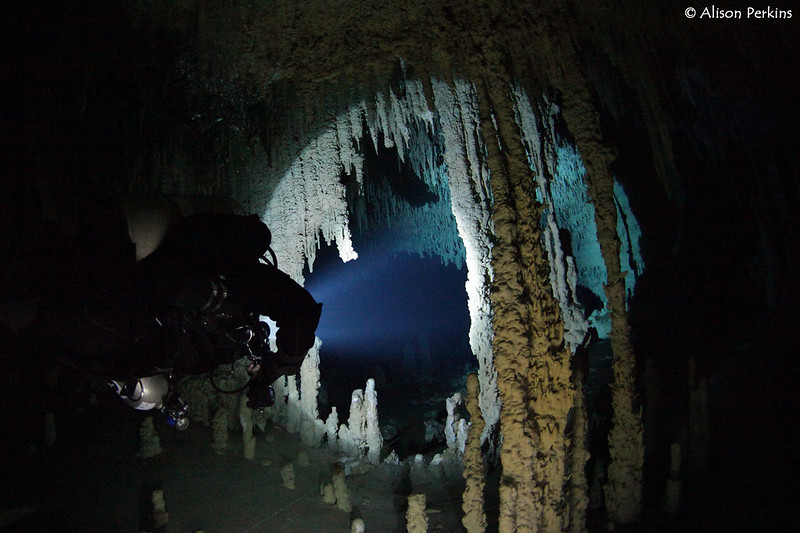
  11. I tried to add this before but Flickr was temporarily down. I took this before I had any camera mounted strobes - so maximum ISO. Not ideal but okay for showing a friend what cave diving is about.


    9677600491_c255241ce5_c.jpg
    Nohoch Nah Chich by Alison Perkins, on Flickr


    Edited by Alison Perkins
  12. Hi Alison,


    from a recent trip to Mexico, here are some tricks I could experience, and happy to share :


    - the dive must be dedicated to photography for the best results (in opposition to shoot while diving)

    - a good, powerfull, wide angle video light carried by the model is important

    - excellent knowledge of the cave gives the good angles, and avoid waste of time

    - most of the times seting were 1/50 at f5, 800 iso, on a 5dMk2, with Tok 10-17mm

    - strobes were at the minimum, sometimes turned-off, sometimes fired at distance. But I've never used the strobes at their max.


    pano from 10 images :

    24vb.jpg


    ddto.jpg


    7az8.jpg


    vi87.jpg


    jclv.jpg


    iqsh.jpg


    c6pi.jpg

  13. Beautifully evocative images Laurent! I love the lighting you have achieved in a challenging environment.


    Thank you so much for taking the time to share your tips.

  14. Hi Alison,


    Well, about the only thing I can add to the excellent points Laurent made, is that it can also be done using the same settings and remote strobes (rather than video lights) - it's just the exposure is a little more difficult to manage. Also, I can't emphasize Laurent's points about knowing the cave and dedicating the dive to photography - just safer that way.


    Laurent, your cave/cenote images are spectacular! Very nice work - I'm properly inspired for my next trip to Mexico!


    Lee

  15. thanks for your comment Alison.

    Lee is right regarding strobes instead of video lights.

    But I see 2 disadvantages :

    you need 4 strobes : 2 triggered + 2 with you

    and you get no clue of the potential shades created by the muuuuuultiples stalactites/stalagmites

    Also, now, a good set of twin heads video light cost a bit more than 1 good strobe.


    Lee, thanks for your comments too.

    I'm glad you like.

    Just an opinion : knowledge of the cave, is not really a safety matter, considering if you are in there it's because you can, because you are trained for and/or well guided.

    I think it's more a matter of going straight to the nice frame, the nice rays of lights, and more generally : photographic considerations.

  16. Thanks for all the great advice. Strobe lighting is what I will be starting out with, as that is the gear I currently have. I have about 250 cave dives in Mexico under my belt, so I'm counting on this experience and knowledge to help me out on this new photographic challenge. Anyone with further tips to share - it's all welcome advice!

  17. Great to see your shots Laurent, and I'm looking forward to yours Alison!


    I shoot with strobes rather than video lights, as you can get a lot more light output for the same money. A focus light is still required but if you are swimming around in the cave without a primary light there's something weird going on. Best to point the primary light at the rocks rather than your buddy's face for focus. Or just pick up their primary light with your AF points. I believe off-camera strobes are essential for getting depth in your cave shots.


    Using strobes makes shutter speed irrelevant in the dark zone - set it to 1/160 or whatever syncs with the strobes and makes the primary torches look good and then don't change it. Set the ISO to the maximum before you see noise in the final images, and then spend the dive rolling the f-stop up and down to suit the passage you are in. Big passage or dark walls means less light bouncing back, lower the f-stop. White walls, small cave, increase the f-stop. Digital makes it easy to review until you work out the range for your equipment and each cave.


    I shoot rectilinear wide angle with the Canon 14mm which I prefer to the bendy corners. The drawback is fuzzy corners at wide open apertures.


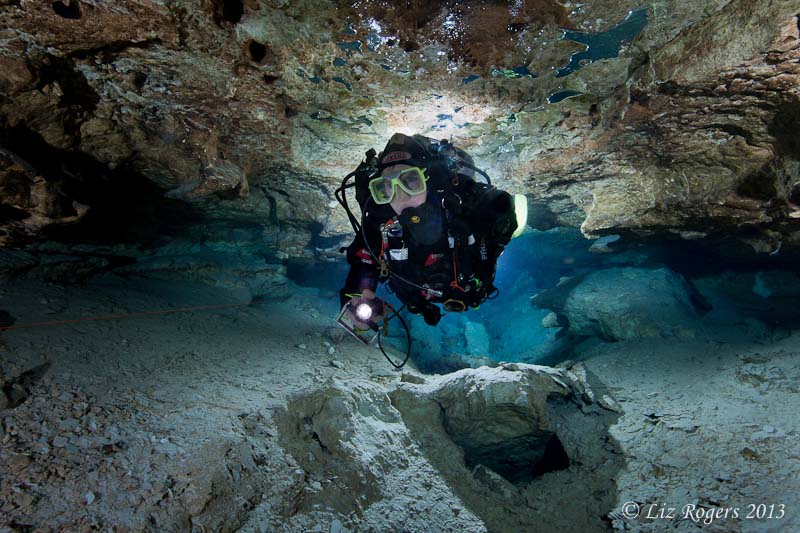
    A couple of recent shots with off camera strobes (Z240s with triggerfish), 5DII, 8" dome and 14mm lens:

    post-26465-0-81619200-1379425099_thumb.jpg

    post-26465-0-25657300-1379425131_thumb.jpg

    post-26465-0-11663500-1379425174_thumb.jpg

  18. Yup, i find offboard strobes to work well too. I used a fast shutter speed and played around with aperture until i could get exposure right. Unfortunately my camera wasn't an SLR so i couldn't play around with iso too much. In one of the shots my left strbe failed but i am still quite happy with the results. I found that fairly open cave was quite nice to shoot in as you get a bit more of the water colour in the background giving a bit of contrast.


    The shots all look like they are the same style, it was my first attempt at cave photography so will hopefully push the envelope a little next time.


    P.S Liz loving the shots coming out of Australia. I'll be over early October to try and get some myself

    post-42104-0-15836900-1379581588_thumb.jpg

    post-42104-0-51973600-1379581623_thumb.jpg

    post-42104-0-61704600-1379581650_thumb.jpg

  19. Hi Laurent, and Alison,


    When I commented about making the dive safer it was because photography can be one of the "contributing factors" in cave diving accidents. By being more familiar with the cave, you can run some of the mental processes in the background (where you are, which direction the exit is, where the line is, stuff like that) while you divert some mental "bandwidth" to the process of making a photo. By purposely planning the dive around photography, my team and I started with mainline penetrations only and only shooting on the way in, the exit was kept simple on purpose. By shooting on the way in, it limits the distance one travels for a shorter, and therefore safer, exit from the cave. The more familiar with the cave I became, the better the images, in part, because I was more comfortable with diverting mental effort from the process of cave diving to the process of making a photo. Slow and steady with a good team is how I got started, and continue to learn.


    Alison, with 250 cave dives you're a lot further along than I am, but I found shooting in the cavern zones a great way to both start shooting in a safer environment, and develop my team members in terms of modeling, directing the remote strobes and keeping our heads "in the dive".


    I'd happily post an image or two from my last trip (June this year), but I'm in reef mode on Bonaire at the moment with no cave images on my travel laptop!


    Hope that helps!


    Lee

  20. Thanks for the tips and photo sharing!


    Liz: the Australian caves will almost be my "local" caves when I move back to New Zealand next year. Maybe I can pick your brain then about photo opportunities at the different sites. Loving your photos.


    Lee: please do share some photos when you get back to civilisation. You're right - the cenotes and cavern zones are fun places to experiment and learn.


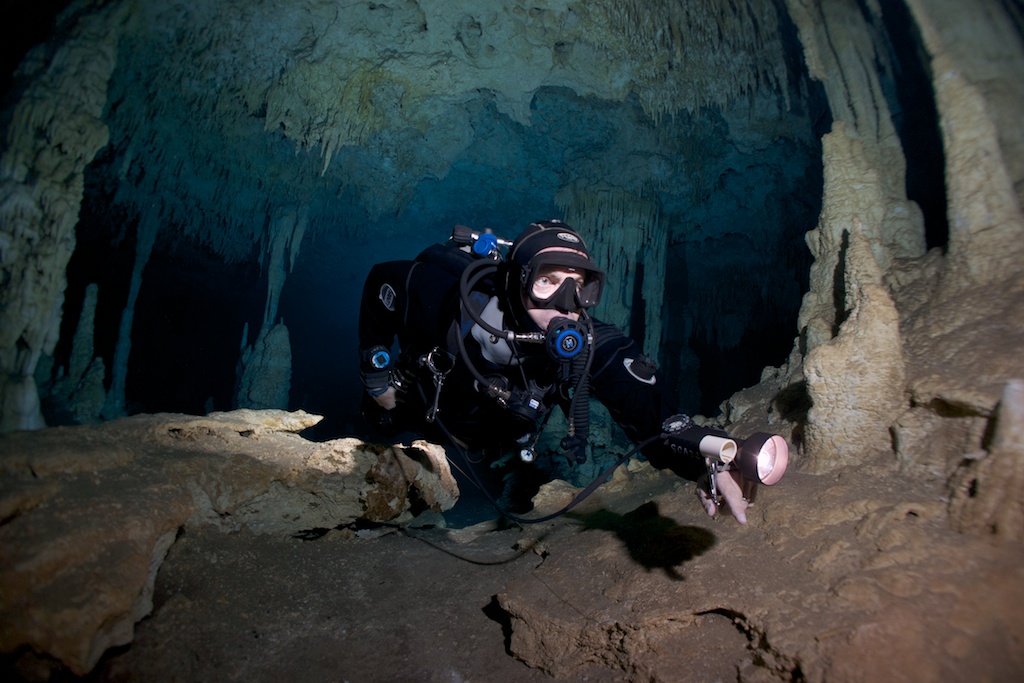
    9839702695_9aa8bc396a_c.jpg

    Seeing green by Ali Perkins, on Flickr

    Edited by Alison Perkins
AOI

Account

Navigation

Search

Search

Configure browser push notifications

Chrome (Android)
  1. Tap the lock icon next to the address bar.
  2. Tap Permissions → Notifications.
  3. Adjust your preference.
Chrome (Desktop)
  1. Click the padlock icon in the address bar.
  2. Select Site settings.
  3. Find Notifications and adjust your preference.