Skip to content

The Galley: General Chat / Archived topic

Defining the path to great Underwater Photography

Started by Steve Williams ·

  • 49Posts
  • 49Replies

Read-only discussion

Defining the path to great Underwater Photography

49 posts
  1. Fortunately, there are also a lot of people who get really bad shots but enjoy a lot... and those are the winners!


    Now there is a thought I can resonate with. Thanks David, great input. Guess I never thought it not being fun.


    Just when I thought I was getting closer too;


    post-4526-1307488817.jpg


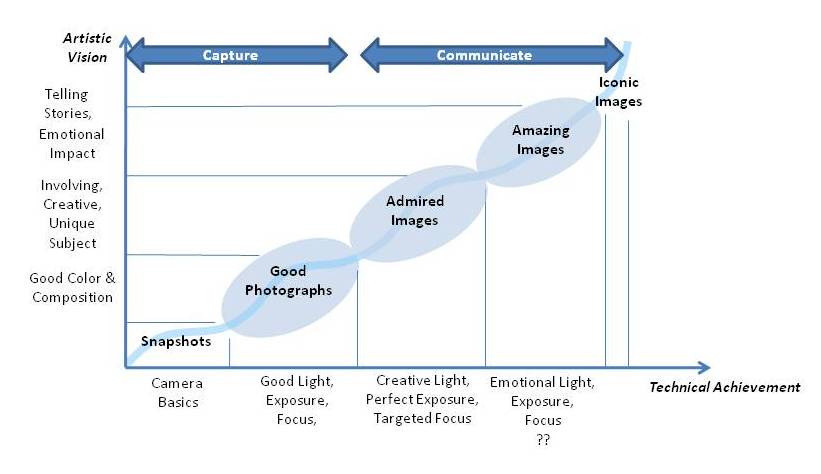
    The ?? marks are still on the technical side of making an "Amazing Image". Any thoughts?


    Cheers,

    Steve

  2. I think one of the unique things about underwater photography is the 'happy accident' that result in the amazing image. Things like the effect of water on light rays, reflections, ripples, bubbles, these are thing that are at once somewhat unpredictable and uncontrollable, but when we discover them just transform the image. I've discovered this in my pool photography as much as in the ocean, and found it's the real magic bullet that makes the genre so much fun. Like a kid in a candy store!

    Edited by loftus
  3.  

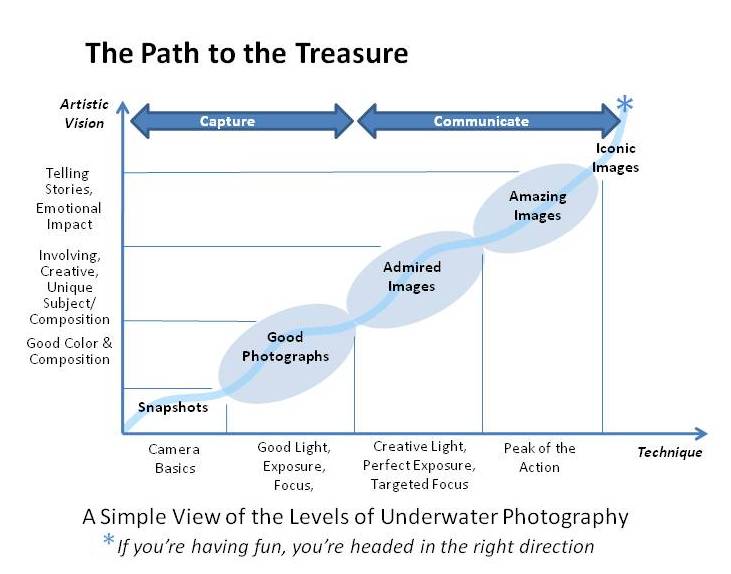
    Great addition Tom! Martin calls it the "Peak of the Action", I'll probably use that term, gives me a chance to promote the book.


    Jeff,

    If I understand what you're describing, you're talking about something different than luck. Shooting in the water brings with it some magic that just doesn't happen on land.


    Thanks guys, new version in work.


    Cheers,

    Steve

  4. Here we go, Version 4.


    post-4526-1307555585.jpg


    Let me know what you think.


    Cheers,

    Steve

  5. Jeff,

    If I understand what you're describing, you're talking about something different than luck. Shooting in the water brings with it some magic that just doesn't happen on land.

    Yes, particularly for wide angle water does things to light to and with light that are magical, light rays from above, those god rays when one looks down into the blue, hall of mirrors types of distortions with reflections etc, etc, etc.

  6. Enjoying the thread.


    I would personally change the X-axis to Experience


    Getting better is an interative process, shoot, review, adjust, shoot again.


    Really great images can developed because the technique is down pat, and the photographer is coaching the subject in some way just to get that little extra special to the image.


    Anyhoo my 2 cents.


    Cheers

    BC

  7. Here is one thought to consider but perhaps not on your chart.

    Its a question perhaps we all asked ourselves and answered in some form.

    Are you a diver taking photographs or a photographer working underwater?


    Recently, I was doing the Kona Manta night dive. Its all controlled by others. You attend, sit with your group, take photo's as the event unfolds. There is very limited ability to control many of the things Alex M. points out. I was a diver taking photo's. I loved it, it was a blast, family has/will enjoy the photo's as perhaps some will here when I get to processing a few. But I was certainly not much in the way of a photographer working underwater. They are good vacation images but not magazine publication images.


    I recently read a trip report about a red sea photo class given by Alex M. There was considerable planning, off camera strobe setups, etc taking place with that group of the course of a week. Those were photographers working underwater.


    Nothing wrong with being either type of person with the camera but there is quite a difference between the approach, thinking, goals, etc.

    Not certain how that fits your chart or presentation but its food for thought.

  8. Hi Dave,

    There are clearly some opportunities there are better than others and I know Alex works very hard to put himself and his friends in great shooting environments. Down to time of day, light angles etc.


    I'm pretty sure though that if you're in the water with a camera it's an opportunity. Much better than sitting at the bar anyway. The alternative would be to leave the camera on the dock and in my humble opinion that's not diving. I think they call that swimming.


    PS - I would love to see what you shot in Kona


    Cheers,

    Steve

  9. Hi Steve,


    I think if you want your chart to represent the development of all underwater photographers, there needs to be a bifurcation in the blue wavey line, somewhere between good and admired photos. With a line continuing horizontally to represent shooting for client/publication.


    Some images that are published fit in the amazing category. But many are simply decent shots that fit exactly the needs of the client (which is what the photographer was asked to do). However these images are often formulaic and artistically uninteresting.


    Pick up any scuba mag, for example, and there will be some images that really resonate and are memorable. And some that visually and artistically are unremarkable, yet they are essential for telling the story. This second type of image would be at the mid level on the the right of your line.


    They do the job asked of them at the time, but it is only a small selection of these that have the graphic power to be memorable, resonate with the public and make the top right of the chart.


    I'd leave you chart as it is. But maybe add a subsequent slide to your talk to explain this common type of image - and development path for underwater photographers - where the focus is more on creating the right product for the job, rather than aspiring to the highest artistic vision. This development path usually proves better for the bank balance!


    Alex

  10. I'd leave you chart as it is. But maybe add a subsequent slide to your talk to explain this common type of image - and development path for underwater photographers - where the focus is more on creating the right product for the job, rather than aspiring to the highest artistic vision. This development path usually proves better for the bank balance!


    Good thought Alex,

    I'm thinking a lot of "Good" images get published and paid for because they meet the customers need as you suggest. The Admired images are the ones that we see winning competitions along with those rare Amazing images that connect with us in a special way. I thought about making the chart proportional to the number of images in each category but the numbers of Amazing and Iconic images would be so small relative to the snapshots and others made that there would be two tiny areas on the right not much wider than the line. Maybe I'll change the slope of the line after Good to show the marked increase in the Artistic side that differentiates the Amazing from the Admired. I reread your chapter The Underwater Photographer (4th) on style again last night. The chart lines up well with your descriptions and thoughts on ways to make our images distinctive. (Probably where I started thinking about it). :)


    This chart meets my goal of having a way to discuss some of the things that new U/W photographers (my audience) should be thinking about if they want to improve their images. Like any good graphic it gives me a chance to talk to it for a while. I can mention your thought about the commercial aspects. In the talk I'll have images coming into frame around it that hopefully illustrate the thoughts. By the way, your talk at BSOUP was wonderful to watch. I loved the way your Amazing images just kept coming.


    Cheers,

    Steve

  11. Folks,

    I wanted to thank you for all the help. My little talk has morphed into two one hour presentations and a whole day dedicated to u/w photo at my local shop. It's going to be done as a fund raiser for the Fin Foundation. The shop has donated the space, and the camera reps for the shop (Sea & Sea, Sealife, etc.) are coming into town. We should get a bunch of new folks interested in U/W photography. If anyone is in the desert southwest Sept 24 be sure and come by. I've been having a ball putting the presentation together.


    Again thanks, Cheers,

    Steve

  12. Folks,

    I wanted to thank you for all the help. My little talk has morphed into two one hour presentations and a whole day dedicated to u/w photo at my local shop. It's going to be done as a fund raiser for the Fin Foundation. The shop has donated the space, and the camera reps for the shop (Sea & Sea, Sealife, etc.) are coming into town. We should get a bunch of new folks interested in U/W photography. If anyone is in the desert southwest Sept 24 be sure and come by. I've been having a ball putting the presentation together.


    Again thanks, Cheers,

    Steve

    How about a DVD for a few bucks for charity; I would love to see it.

  13. How about a DVD for a few bucks for charity; I would love to see it.


    Interesting idea Jeff, I'll have to think about how we could do something like that.


    Cheers partner,

    Steve

  14. I an just imagine Michelangelo charting out the route to a great painting....Porca Madonna!


    Here's my route: Buy the best rig you can afford. Get to a good location. Stay in the water for as long as possible. Take lots of pictures. Practise.

    Edited by John Bantin
  15. Not sure how it fits into the graph ... but I always make a point to emphasise the importance of The Three Cs..... comfort, competency and confidence in the water as an important contributor to improved technique.


    Great discussion BTW.

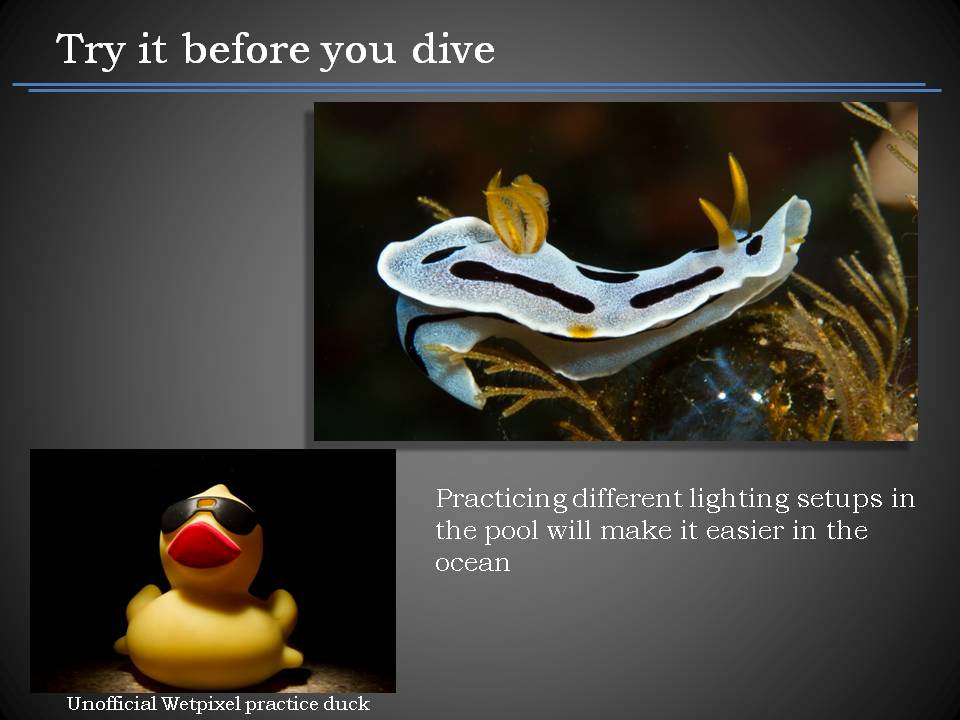
  16. Thanks for the thoughts guys. Agree with you John that trying to explain to new photographer how to be great might be a stretch. I focused on trying to explain the difference between snapshots and good photographs. Then at the end I show them examples of Amazing images from the Fin Foundation photographers. My audience shoots mostly entry level gear so I like that no where does "buy expensive Camera" show up on the chart. Clearly we have more options with better gear but the message I want to send to these folks is that it's not about how much money you spend. I have a section John on practise and preparation with a couple of examples of shots in the pool that led to lighting situations in the ocean. I'm trying to give them some pointers on how to practice. One example;


    post-4526-1309720693.jpg


    I want to make the point that reading the camera manual on the plane to Fiji is maybe not the best path to the treasure.


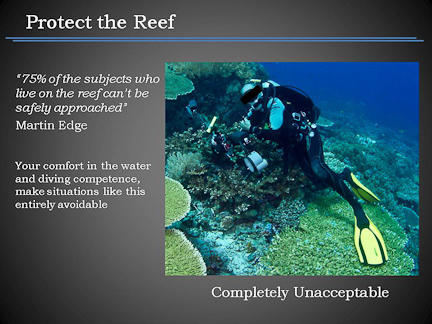
    Darren, great point on comfort and competency. I have a couple of shots of divers laying on the coral and will talk to how to protect the reef. I like your approach that makes it more of a positive message as opposed to "Don't do this". Still working on it but maybe something like this;


    post-4526-1309720961.jpg


    Thanks Darren, that's a good message to send.


    Cheers guy,

    Steve

  17. Great post ;)


    If I might say something, maybe at each stage you could add a "think before you shot" dot. At every step you will go, you will start to "play" with you "new skills", and when feeling confortable with it, start to really "think before you shot".

    One of the advice I give to newbies is: when you see a non-fast-moving subject, just stop, and look for 10 seconds. Then decide how you want to shoot it.

    I think the high majority of people just see the nudi, point the camera and shoot.


    BUT this is then happening "again" later : you masterize good exposure, color, sharpness, you do great composition. But then it become like "logical" and you don't even have to "think" to have all these. But then you can re-start to think: "What can I add to this?"

    It is the same process repeating at each level, from my point of view. "new tool (as "skill") => play => think => new tool => play => think..."


    Best,

    Edited by Autopsea
  18. Another great point, thanks Thomas. I have included a section on relaxing on the reef. It reminded be to go back and reread Martin's Think and Consider chapter. Your thoughts are a great add and fit right in the flow of the presentation. I really like the idea of adding "play". Some of us don't do enough of that I'm thinking.


    Cheers,

    Steve

Isotta

Account

Navigation

Search

Search

Configure browser push notifications

Chrome (Android)
  1. Tap the lock icon next to the address bar.
  2. Tap Permissions → Notifications.
  3. Adjust your preference.
Chrome (Desktop)
  1. Click the padlock icon in the address bar.
  2. Select Site settings.
  3. Find Notifications and adjust your preference.