Skip to content

Lights, Strobes, and Lighting Technique / Archived topic

Seahorn snoot with Inon Z240

Started by AndyC ·

  • 26Posts
  • 26Replies

Read-only discussion

Seahorn snoot with Inon Z240

26 posts
  1. Hi,


    Wondered if anybody was using a Seahorn snoot with an Inon Z240?. If so are you having the same problem as me?

    The problem is the method of attachment seems pretty poor. You stick 3 pieces of velcro to the strobe, butt the snoot up to the strobe. Then marry the velcro on the snoot to the strobe velcro and away you go! It took about two dives to fail. Either the velcro comes apart or looses adhesion to the strobe. Surely it would have been simple to make the snoot diameter a little wider than the strobe so that it fit more securely? As anybody had similar problems and come up with a solution? I'm happy with the snoot generally it just seems poorly thought out.

    I did notice on Youtube that Martin Edge was using what looked like the same snoot but with a nice modification. Looks like the snoot (link)

    If anyone has more info or idea's I'd be grateful.


    Thanks,

    Andy.
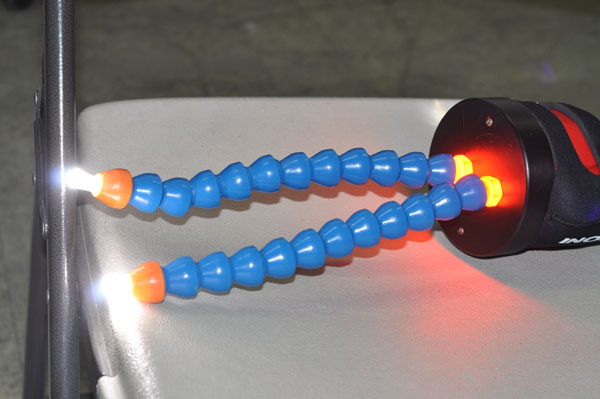
  2. How about one of these?

    post-595-1307538307.jpg

    Edited by CheungyDiver
  3. How about one of these?


    Looks like a nice fibre optic rig you have there.

    Not sure how I could modify that for the snoot I have. Also not sure I'd want to given how nice it looks.

    Is it a modular system? it looks like the front of the fibre optic rig detaches from the front of the mount? I suppose you could then attach different diameter snoot fittings.

    It seems to fit to the strobe really nice.

    Is the fibre optic rig commercially available?


    Thanks,

    Andy

  4. How about one of these?

    Sorry just noticed it does detach at the front. As you've shown it in the picture. lol :)

  5. Same idea. Using just 2 allen screw to hold to Inon D-180/Z-220/Z-240. DYI project.

    post-815-1307546359.jpg

    Edited by shchae
  6. Hi,


    Wondered if anybody was using a Seahorn snoot with an Inon Z240?. If so are you having the same problem as me?

    The problem is the method of attachment seems pretty poor. You stick 3 pieces of velcro to the strobe, butt the snoot up to the strobe. Then marry the velcro on the snoot to the strobe velcro and away you go! It took about two dives to fail. Either the velcro comes apart or looses adhesion to the strobe. Surely it would have been simple to make the snoot diameter a little wider than the strobe so that it fit more securely? As anybody had similar problems and come up with a solution? I'm happy with the snoot generally it just seems poorly thought out.

    I did notice on Youtube that Martin Edge was using what looked like the same snoot but with a nice modification. Looks like the snoot (link)

    If anyone has more info or idea's I'd be grateful.


    Thanks,

    Andy.


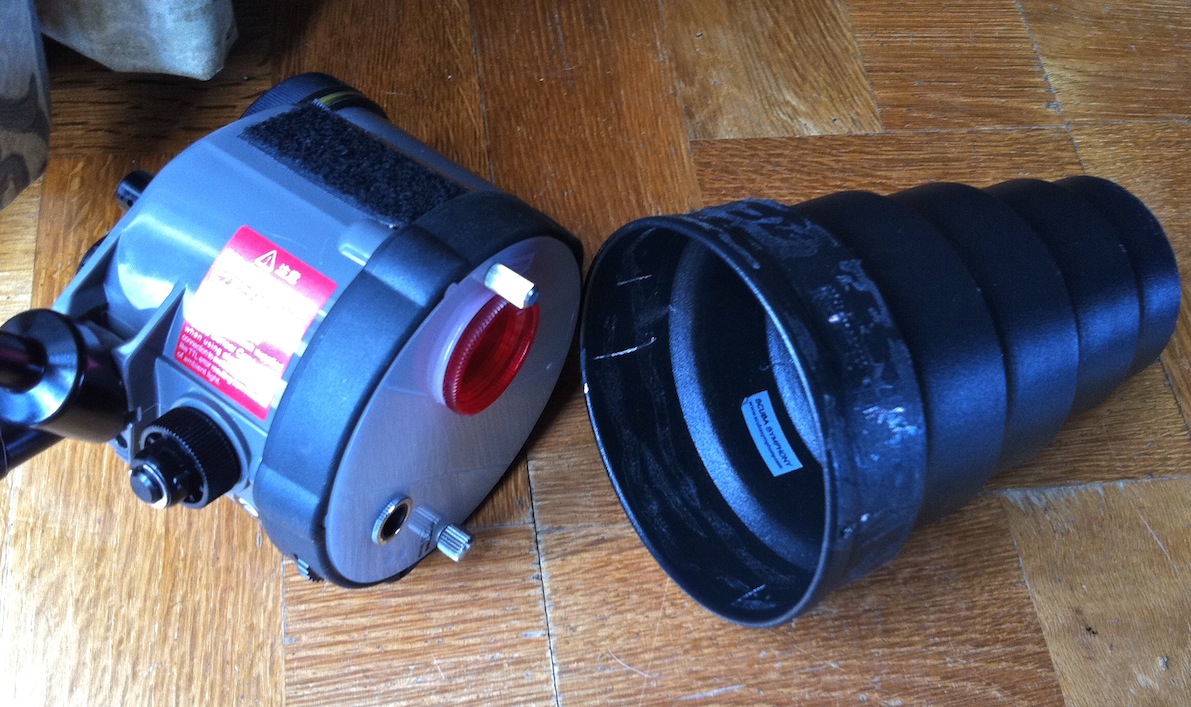
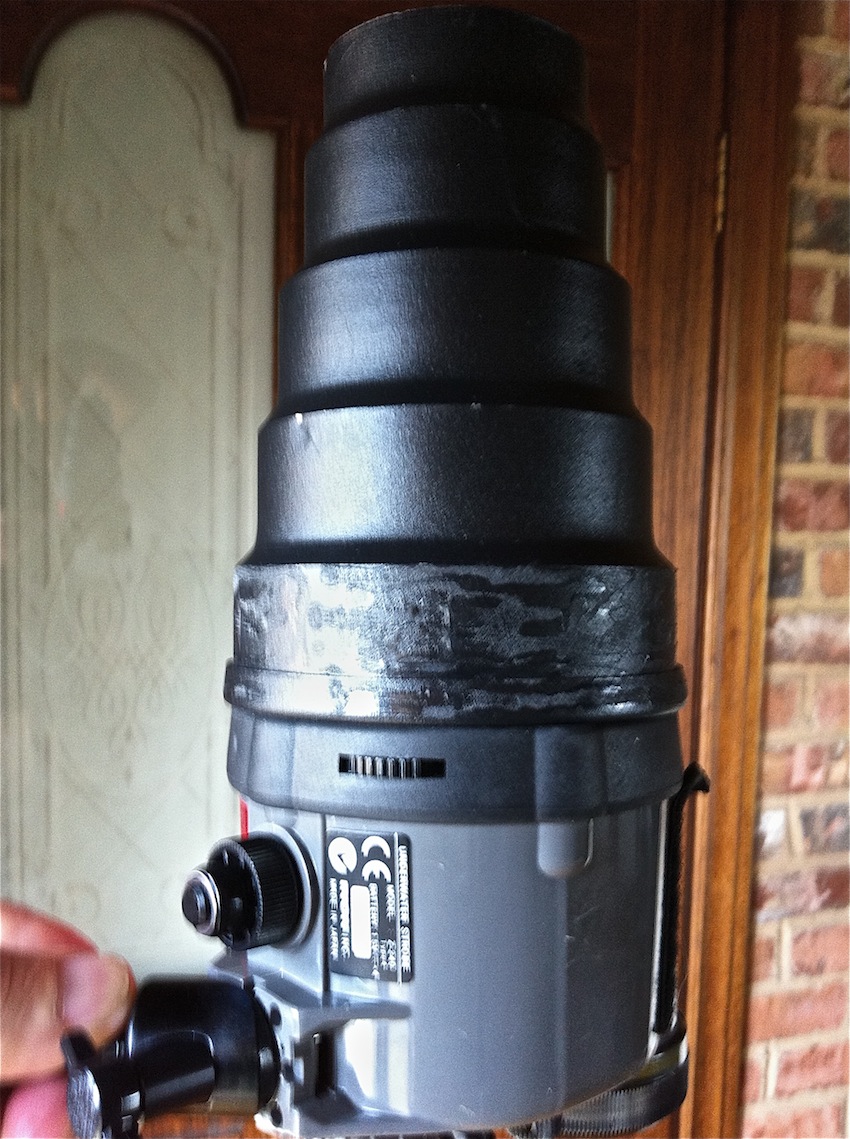
    Thought i'd show a couple pics. hopefully show my problem and what I want to achieve.

    I'taken off the velcro leaving just bare metal rim thats exactly the same diameter as the strobe. as can be seen in the second picture.

    I want some way to achieve a firm secure joint.


    post-25388-1307555258.jpg


    post-25388-1307555324.jpg

  7. Thought i'd show a couple pics. hopefully show my problem and what I want to achieve.

    I'taken off the velcro leaving just bare metal rim thats exactly the same diameter as the strobe. as can be seen in the second picture.

    I want some way to achieve a firm secure joint.


    post-25388-1307555258.jpg


    post-25388-1307555324.jpg

    But down and dirty, but, get hold of an old wetsuit that is not needed and cut a band off one of the arms. Use that to extend over the end of strobe and snoot.


    Cheap and cheerful!


    Duncan

  8. Andy,


    Sorry if this is stating the obvious, but you will need to remove the diffuser.


    I have one and it stays put!


    Adam

  9. Sorry if this is stating the obvious, but you will need to remove the diffuser.


    I agree that a diffuser theoretically makes no sense at all with a snoot, but without a diffuser you get two separate, but overlapping spotlights from it with a two flash tube Inon!

    post-713-1307570314.jpg


    The diffuser minimises this issue.


    That said, IMO, reductive snoots are like standard def video - work, but out-dated tech.


    Transmission snoots, like those shown above are a much more efficient solution. Both in terms of light efficiency and user friendliness. I have been using one on trips to Scotland, Iceland and Red Sea and hope to find time to write a review soon.


    Alex

  10. Looks like a nice fibre optic rig you have there.

    Not sure how I could modify that for the snoot I have. Also not sure I'd want to given how nice it looks.

    Is it a modular system? it looks like the front of the fibre optic rig detaches from the front of the mount? I suppose you could then attach different diameter snoot fittings.

    It seems to fit to the strobe really nice.

    Is the fibre optic rig commercially available?


    Thanks,

    Andy


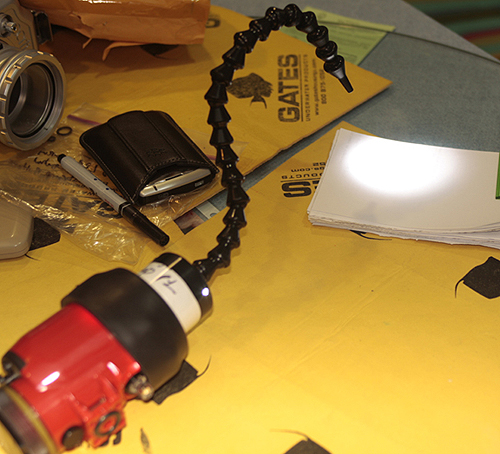
    Yes I handmade/ machine these on a lathe. I had similar ones made a few years ago for a couple of my photographer friends. Just the past few months everybody is making them. First one have eight fibre optic strands. I thought that would channel more light but clumsy. Now I have added optics to concentrate the light to the fiber optic tips and fewer is required - this means no need to crank up the strobe power thus longer battery life.


    Here is more info about it...just scroll down to the right Blog....cheers


    http://www.scubacam.com.sg/blog/

  11. I agree that a diffuser theoretically makes no sense at all with a snoot, but without a diffuser you get two separate, but overlapping spotlights from it with a two flash tube Inon!

    post-713-1307570314.jpg


    The diffuser minimises this issue.


    That said, IMO, reductive snoots are like standard def video - work, but out-dated tech.


    Transmission snoots, like those shown above are a much more efficient solution. Both in terms of light efficiency and user friendliness. I have been using one on trips to Scotland, Iceland and Red Sea and hope to find time to write a review soon.


    Alex


    Hi Alex


    Would you like to test the ones I've made? A mutual friend said you might be the best person to critique some of my gadget creations. I could PM you separately.


    regards


    David

  12. But down and dirty, but, get hold of an old wetsuit that is not needed and cut a band off one of the arms. Use that to extend over the end of strobe and snoot.


    Cheap and cheerful!


    Duncan


    Thanks Duncan,

    No more down and dirty than the manufacturers solution and would probably work better.

  13. Andy,


    Sorry if this is stating the obvious, but you will need to remove the diffuser.


    I have one and it stays put!


    Adam


    Hi Adam,


    To be honest. I hadn't thought about it. I have used it with and without the diffuser and apart from the 0.5 reduction in power I haven't noticed much difference if any. Though its obvious from Alex post that there is.

    Thanks again, will give you a call re diving.

    Andy.

  14. Are there any fibre optic snoots commercially available?


    /Bent C

  15. Are there any fibre optic snoots commercially available?


    /Bent C


    Yup. I am making a batch.


    Just PM me if you are interested. info@scubacam.com.sg


    Go to the site here if you need to know more: http://www.scubacam.com.sg/blog/


    Cheers


    David

  16. Yup. I am making a batch.


    Just PM me if you are interested. info@scubacam.com.sg


    Go to the site here if you need to know more: http://www.scubacam.com.sg/blog/


    Cheers


    David


    Hi David,


    Great project. I have a similar one, but for non-underwater flash. You mentioned in your blog, that you used some lens to focus the light into the fibers. I also considered this option, but never tried. Can you give us some more details about the lens you used and their availability.

    Thanks in advance


    Cheers


    Marcell

  17. Hi David,


    Great project. I have a similar one, but for non-underwater flash. You mentioned in your blog, that you used some lens to focus the light into the fibers. I also considered this option, but never tried. Can you give us some more details about the lens you used and their availability.

    Thanks in advance


    Cheers


    Marcell


    Hi Marcell


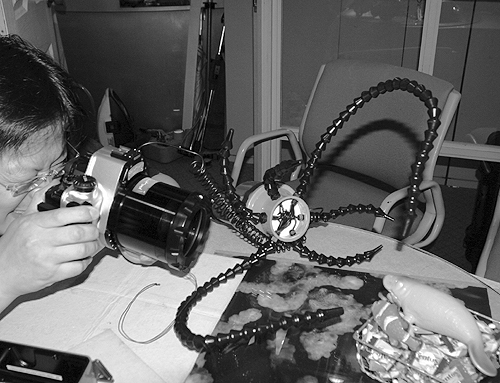
    I am sure someone must have thought of it before. I did many years ago. I made a couple of these "Octopus" lights for shooting macro at Lembeh Straits and the first version was with eight arms. It was too clumsy and my photographer friend broke a few off when he used it. I also tried it and found that I needed three dive guides to help me focus all the light tips to the subject. So it just left in a box in a workshop. Now suddenly this whole snoot craze started. I am using thicker optic fibre and better machining so now its time to start again.


    A convex lens really helps in focusing the strobe flash and the focus light. You could actually see where you are pointing. Add the red filter decal and you could point the tips without disturbing the fish at night. I am planning to make a batch so if you really would like to know how it works just get one from me :)


    It will be less fun than building one yourself but will save you the hassle as I already have all the tools and parts ready. To answer your question. The lens is just a magnifying glass that you use to focus a beam of light to a point. A short focal length lens work best and will make the whole thing more compact.


    Cheers


    David

  18. Hi Marcell


    I am sure someone must have thought of it before. I did many years ago. I made a couple of these "Octopus" lights for shooting macro at Lembeh Straits and the first version was with eight arms. It was too clumsy and my photographer friend broke a few off when he used it. I also tried it and found that I needed three dive guides to help me focus all the light tips to the subject. So it just left in a box in a workshop. Now suddenly this whole snoot craze started. I am using thicker optic fibre and better machining so now its time to start again.


    A convex lens really helps in focusing the strobe flash and the focus light. You could actually see where you are pointing. Add the red filter decal and you could point the tips without disturbing the fish at night. I am planning to make a batch so if you really would like to know how it works just get one from me :)


    It will be less fun than building one yourself but will save you the hassle as I already have all the tools and parts ready. To answer your question. The lens is just a magnifying glass that you use to focus a beam of light to a point. A short focal length lens work best and will make the whole thing more compact.


    Cheers


    David


    Hi David,

    Thanks for the fast reply! I use a similar set-up on land, where I have more flexibility. Mostly in home studio, relaxed conditions and I'm not really planning to try snoot photography underwater. Here is my set-up for above water photography:

    http://www.flickr.com/photos/fiberstrobe/s...57625456171059/

    http://www.flickr.com/photos/fiberstrobe/s...57625961713403/

    I use also snoots sometimes, but also other light modifiers. I was thinking recently that instead of snoot photography, the concept could be transferred to standard UW macro photography using 2 or 3 diffused light source out of one strobe. However you need a bit more sturdy attachment than my yoghurt cups ;-)

    Actually I have enough light with these 4 arms but a bit of boosting with some lens would improve my battery time.


    Cheers


    Marcell

  19. Hi David,

    Thanks for the fast reply! I use a similar set-up on land, where I have more flexibility. Mostly in home studio, relaxed conditions and I'm not really planning to try snoot photography underwater. Here is my set-up for above water photography:

    http://www.flickr.com/photos/fiberstrobe/s...57625456171059/

    http://www.flickr.com/photos/fiberstrobe/s...57625961713403/

    I use also snoots sometimes, but also other light modifiers. I was thinking recently that instead of snoot photography, the concept could be transferred to standard UW macro photography using 2 or 3 diffused light source out of one strobe. However you need a bit more sturdy attachment than my yoghurt cups ;-)

    Actually I have enough light with these 4 arms but a bit of boosting with some lens would improve my battery time.


    Cheers


    Marcell


    Hi Marcell


    I really like your gadget. Looks fantastic. I will also be making a land fibre optic snoot. I am planning to us that with my Canon MP-E 65mm 1-5X Macro Lens. Looking at your snoot if you want to add a lens I suggest a Fresnel lens. You could get these from Edmond optics here is a link - http://www.edmundoptics.com/onlinecatalog/...?productid=2040


    Just work out the best focal length you want. You will need to bunch up the fibre optic tips near the focal point. It does not have to be mm precise. You will need a longer box over the flash. The good thing about the Fresnel lens is that it is flat and could be made or cut to square or rectangular shapes.


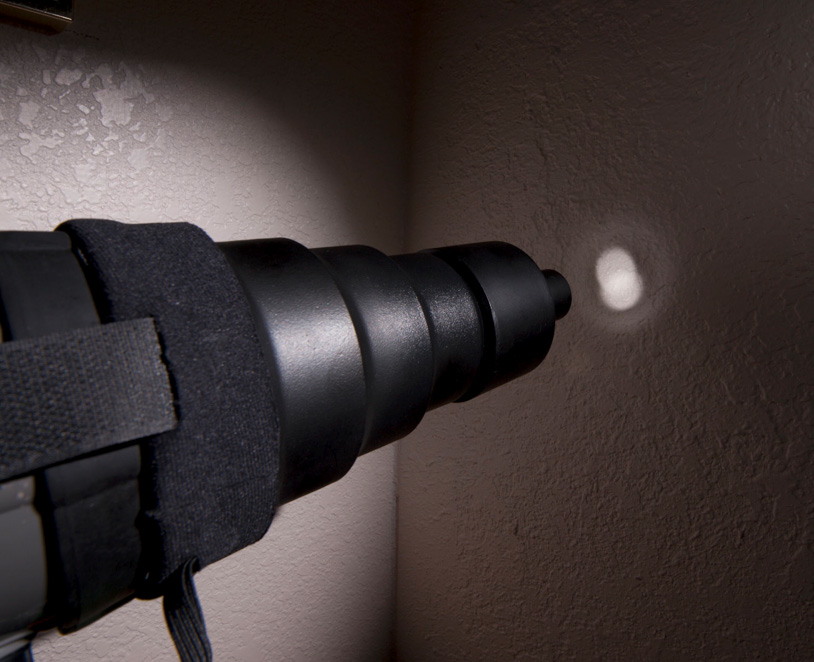
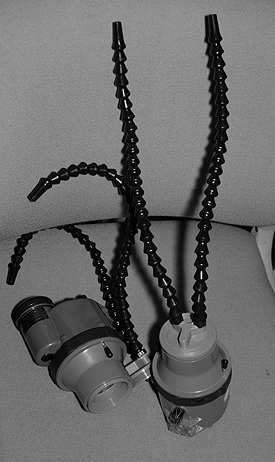
    I just use a regular convex lens with mine. Here is a picture of the first contraption made in 2007. Too many arms but after many attempts and adding a lens two or three is more than enough even one. See the "cyclop" light snoot I made for a friend.


    Cheers


    David

    post-595-1307799044.jpg

    post-595-1307799070.jpg

    Edited by CheungyDiver
WaterPixels Store

Account

Navigation

Search

Search

Configure browser push notifications

Chrome (Android)
  1. Tap the lock icon next to the address bar.
  2. Tap Permissions → Notifications.
  3. Adjust your preference.
Chrome (Desktop)
  1. Click the padlock icon in the address bar.
  2. Select Site settings.
  3. Find Notifications and adjust your preference.