Skip to content

Video Gear and Technique / Archived topic

Canon XF100 or XF105 camcorder

Started by peterbkk ·

  • 54Posts
  • 54Replies

Read-only discussion

Canon XF100 or XF105 camcorder

54 posts
  1. Hello Pascal,


    I just wanted to clarify the difference in the two models HD8 and HD8X.


    Both housings come with On/Off, Start/Stop, Zoom, White Balance, Auto Focus and Iris.


    In addition to the standard controls the HD8X also comes with a 2.5" rear mounted LCD, Manual focus gear and EO bulkhead for topside viewing.


    I am hopeful that this post is of assistance to you.


    Take Care,

  2. I am contemplating an XF100 and HD8X purchase. Keep us posted on the underwater workings of the camera.

  3. Has anyone looked at the Canon XF100 or XF105 camcorders? Seems like they'd increase my quality factor without decreasing the portability factor too much. Pricing is high but ballpark.


    Housing availability seems to be the challenge. Right now I can only find the tubular Equinox housing. Not exactly user friendly. Does anyone know of any other housings for these cameras? Or heard of any plans?


    You might know what the Canon XA10 features the same CMOS sensor and optical lens as the XF100-series. Sadly there is no escape from the AVCHD codec in the prosumer version, but at least the image quality should be comparative if you ignore the codec differences. For the XA10 there is several quality housings available from Gates and Light&Motion.


    (The hardware inside the XA10 is probably more or less identical to the XF100 so it probably could do MPEG-2 compression if Canon would release the firmware for it - which the will not of course to protect the pro gear sales.)

  4. You might know what the Canon XA10 features the same CMOS sensor and optical lens as the XF100-series. Sadly there is no escape from the AVCHD codec in the prosumer version, but at least the image quality should be comparative if you ignore the codec differences. For the XA10 there is several quality housings available from Gates and Light&Motion.


    (The hardware inside the XA10 is probably more or less identical to the XF100 so it probably could do MPEG-2 compression if Canon would release the firmware for it - which the will not of course to protect the pro gear sales.)


    Don't underestimate the value of that rich 422 color.

  5. You might know what the Canon XA10 features the same CMOS sensor and optical lens as the XF100-series. Sadly there is no escape from the AVCHD codec in the prosumer version, but at least the image quality should be comparative if you ignore the codec differences. For the XA10 there is several quality housings available from Gates and Light&Motion.


    (The hardware inside the XA10 is probably more or less identical to the XF100 so it probably could do MPEG-2 compression if Canon would release the firmware for it - which the will not of course to protect the pro gear sales.)


    Firmware? Not likely. I have both XA10 and XF105. The codex is different obviously and the user interface is different. Codex 422 is very different to AVCHD. There is also the variable bit rate. One is broadcast the other consumer/prosumer. The way the camera processes the incoming information from each lens system will be different. The camera hardware is not in anyway identical and only the sensors share closest similarity. After all my examination and tests the XF and XA are two very different camcorders.


    I have tried the XA10 and the footage is very impressive with good tonal range and depth but the colour space compared with the XF 105 or XF 100 is not in the same league. I would say the XF 105 shares more similarity to the XF 305 (and thats a 3 chip CMOS). Canon has made each category of products pretty distinct in levels of control, optical system, recording and function. Pro gears is never going to outsell consumer gear in terms of numbers so Canon marketing definitely would like the consumer to think that their camcorder share some of the feature of the upper end camcorders. They want to sell more cameras. I have no affiliation with Canon in anyway. Just my opinion and my generalization.


    Cheers

    David

  6. Firmware? Not likely. I have both XA10 and XF105. The codex is different obviously and the user interface is different. Codex 422 is very different to AVCHD. There is also the variable bit rate. One is broadcast the other consumer/prosumer. The way the camera processes the incoming information from each lens system will be different. The camera hardware is not in anyway identical and only the sensors share closest similarity. After all my examination and tests the XF and XA are two very different camcorders.


    The lens and sensor are identical in the XA10 and XF100/105. The hardware is probably mostly identical as well so the idea that the encoder in XA10 could be set to encode MPEG-2 instead of AVCHD is not far fetched. Its typical to employ integrated circuits which have different performance evels activated depending on the price/feature set of the product. In any case tests at slashCAM seem to confirm that these units behave very closely in the same league - codec diffrences ignored.


    There is a similar sheme going on at Panasonic i.e. the hardware in the GH-2 mirrorless is basically the same as the much more expensive AF-100 interchangeable lens camcorder at several times the price. The differences are mainly in the the back end firmware.


    (Some sources here; slashCAM, eosHD, etc).


    But I agree with the original poster that a high bit rate progressive encoded MPEG-2 4:2:2 codec is much more desirable, to bad the housing offers are not as good as for the XA10 at the moment.

  7. The lens and sensor are identical in the XA10 and XF100/105. The hardware is probably mostly identical as well so the idea that the encoder in XA10 could be set to encode MPEG-2 instead of AVCHD is not far fetched. Its typical to employ integrated circuits which have different performance evels activated depending on the price/feature set of the product. In any case tests at slashCAM seem to confirm that these units behave very closely in the same league - codec diffrences ignored.


    There is a similar sheme going on at Panasonic i.e. the hardware in the GH-2 mirrorless is basically the same as the much more expensive AF-100 interchangeable lens camcorder at several times the price. The differences are mainly in the the back end firmware.


    (Some sources here; slashCAM, eosHD, etc).


    But I agree with the original poster that a high bit rate progressive encoded MPEG-2 4:2:2 codec is much more desirable, to bad the housing offers are not as good as for the XA10 at the moment.


    Okay I stand corrected. Identical lens, sensor and processor. Still the fact is this camera's controls are in different locations and some simply not there. Hardly an identical twin. It could not be firmware updated to work like the XF. How do one switch from AVCHD to MP2/ 422 compression? XA10 is a dumb down version to fit between consumer and professional users and the difference is probably at circuit board level too. I would doubt using software alone would bring out the features embedded in the XF series. Then again if anyone knows how to, that would be very interesting. Putting the XF and XA side by side and using the camera's controls and menu they are very different cameras.


    Housing choice is definitely better for the XA10. Both Gates and Light and Motion has a housing and I will not to compare these two housings. It will be like comparing apples with oranges. I personally like the controls in the L&M. Your hands do not have to leave the two control grips. All the important functions including access to the menu and a built in back monitor that is as good as the one on the camcorder. Just a note on the L&M Bluefin housing it will fit the XA10,HF G10 and the HF S21. In my opinion if the XLR mic is not important then the HF G10 (cheaper camera) is also as good as the XA10 for underwater video.


    Cheers


    David

  8. Bit of a moot conversation really as there is no way anyone is ever going to get the XF firmware into XA10 body.

  9. A week ago I received the Equinox HD8X housing for the Canon XF100 and have been playing with it ever since.


    Good:


    - No leaks - big o-rings, tightly-clamped and visible through the perspex back make this a well-sealed unit.

    - Monitor clear and readable - can read all the settings and frame the video

    - Slightly negative buoyancy in sea water (a bit too negative in fresh water)

    - Very stable - combination of large mass and round sides makes it very stable

    - Main controls (start/stop, zoom, iris, auto/man focus) easy to use - with a bit of practice

    - Dial control is easy (I set it to control the iris as I use auto/man focus button underwater)

    - Well finished and strongly engineered


    Not so good:


    - A couple of controls are fiddly (on/off, WB) need to carefully align the control - will get better with practice

    - Very heavy out of the water

    - Slight barrel lens distortion (not serious but noticeable on shots of the pool tiles; not visible in UW shots)

    - Some softening of focus in the corners (not serious but noticeable on shots of the pool tiles; not obvious in UW shots)


    So, I can now go diving with the XF100. Looking forward to a weekend trip out to some wrecks in the South China at the end of this month. Will give you an update after the trip.


    Regards

    Peter

  10. Looking forward to seeing some underwater clips from this camera. Have played with it in a shop, and it seems pretty well thought out.

  11. Dear Peter


    Thanks alot for your comments. Looking foreward seeing some clips. Wish you a very nice trip and good shots with your xf100!! :) !


    All the best from freezing Switzerland


    Pascal

  12. I'd be curious to know whether the sensor on the G10 and XA10/XF100 are identical. From the specs, they seem to be. The reason I am asking is that I don't have the Bluefin Pro but only the Bluefin L&M housing (to be exact, the Stingray G2+ which is the same thing with a different color), so the manual function of the XA10 would be lost on me and the $500 difference, though not a killer, would be wasted in my case. Or am I missing something?

  13. Just back from a weekend diving with the Canon XF100.


    First of all, just to set expectations, I have to tell you that it was a lousy weekend dive trip. It was very windy out on the South China Sea, with a strong south-easterly blowing in from across the sea. Not many places to shelter and big swells. To add to our woes, a huge current was running, stirring up the sediments. First dive, we found a tiny vortex out of the current at the end of a small island. Viz was a couple of meters and the swell kept rolling us around. Next 2 dives we did a wreck and found some shelter inside but poor viz. Fourth dive was the only passible dive - a nice little night dive - but still low viz and a lot of surge. Sunday was so rough we cancelled the dives and came home. So, not the best trip to be trying out a new housing. Half the time I was worried about bashing into some coral or smashing it on the stern of the dive boat when climbing out with big waves crashing over the platform.


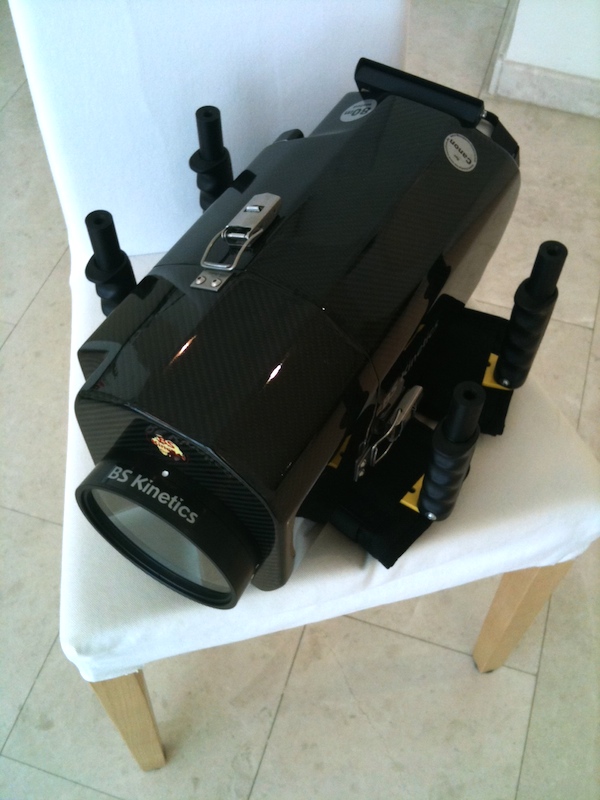
    The setup I was testing this weekend was the Canon XF100 in a BS Kinetics' Takla Makan housing, customised for the XF100.


    http://www.bskinetics.com/languages/en/vid...lamakan_en.html


    First task was to get the weight right. The Takla Makan, made from carbon-fibre weighs in at a very light 6 kg, even with camera inside. With the arms off, excellent for a plane carry-on. It needs about 4 kg of ballast to make it neutral. The system I worked out is to strap a small weight pouch on to the bottom of each arm, with 1 kg weight in each - tidy, out-of-the-way and gives a nice low stability. I mounted my L&M Sola 1200s locl-line arms on the top of 3 of the handles. When all setup, it is a bit heavy out of the water but nicely slightly negative and very stable underwater. You can see the setup in the attached photo.


    post-4537-1312204277.jpg


    No leaking problems. The housing comes with an alarm system. But, with just two large o-rings (housing middle and around the port), the housing seems to be quite a low leak risk.


    Controls: real strength of this housing. Every conceivable control: focus (auto, auto-lock, manual), zoom, iris, ND, shutter, gain, wb (auto, kelvin, sunlight, manual x 2), zoom speed, and all the menus. The primary controls are all on the right within distance of the right thumb. The secondary controls are in a row on the back and are controlled through switching though 6 modes then operating the controls in that mode. Bit of a memory test but within a few minutes I'd mastered the WB and Iris mode settings - enough to get going. The controls are all magnetic through the housing skin and have a nice positive push. Maybe slightly longer travel on each control button than my previous housing but something I'll quickly get used to.


    Monitor: I opted for the new 4.3 inch 16:9 monitor. It shows a large SD version of the HD video that the camera is capturing. And displays all the camera data.


    Battery: With the biggest battery that Canon sells (~ 8 hours) and the NiMH batteries inside the housing (~6 hours) and a couple of 64Gb memory cards, can shoot all day without opening the housing, a real plus on a wet dive boat. The on-off button on the housing puts the camera into "sleep" so it wakes up quite quickly. Using the housing's on-off switch seems to be enough to conserve both batteries between dives. It'll need more experimenting to find the limit but 4 dives over 12 hours didn't put much of a dent into either the camera or housing battery.


    Results: well, given the lousy conditions, I did not shoot enough great footage to edit a whole dive trip story but I did get a few nice shots, especially on the night dive. I can see how this is going to be a great set-up. If I get a chance later in the week, I'll put a couple of clips on vimeo for you to see (not that a vimeo version will do it justice).


    Improvements: Im working on a couple of things to improve the setup. Firstly, it needs a handle. Passing it up to the boat is a bit of a hassle, given that it goes from 0 kg to 10 kg as it leaves the water. I jury-rigged a rope for the weekend. A friend who happens to be an aircraft engineer is working on an aluminium handle that'll mount on top of the 4 handles. Secondly, with the standard lens behind a flat port, getting up close is not easy for larger stuff. So working on a WA adapter lens for the camera and a dome for the housing. Thirdly, the camera alignment on the tray needs a bit of adjustment and tightening. I must have had it slightly angled to one side so, on wide angle shots, the left edge of the port is just visible. Finally, I've ordered some more loc-line and will mount a WB card on top of the 4th arm. Not sure what color for the card, but from early experiments, I suspect a very light pink might be right.


    Prognosis: This is the one! For now, anyway... :dance:


    Comparison 1: Sony CX550 in L&M Bluefin Pro; the Sony/L&M, of course, is smaller and a little lighter (not much lighter - when the Takla Makan has its ballast off). And the controls on the L&M are great. But the rich colors, quality codec, light sensitivity and manual controls of the XF100 put it into a different league. I was concerned about the portability of the XF100 housing, but the Takla Makan just fits neatly into a carry-on bag. As the ballast is just 4 x 1kg dive weights, you can add that when you arrive at the dive boat.


    Comparison 2: Canon XF100 in Equinox HD8X; same camera so same quality results. Underwater the Equinox is the most stable housing I have ever used. The Takla Makan beats the Equinox on just two points; the Takla Makan is a whole lot easier for travel and the electronic controls are easier to operate. The Equinox is quite a bit cheaper. Both units are very well made. Both will shoot good video.


    Thanks to David (CheungyDiver) from ScubaCam for helping to make all this happen. David also spent the weekend rolling around on the South China Sea, testing a 3D camera - but I'll let him tell that story.


    Regards

    Peter

    Edited by peterbkk
  14. Great stuff Peter.

    How much is one of those housings.

    I like the idea that its super light so easy to transport.

  15. Great stuff Peter.

    How much is one of those housings.

    I like the idea that its super light so easy to transport.


    The price was surprisingly reasonable.


    But, because it was custom-made and a pioneering build, the price to me might not be typical.


    Can I suggest that you contact David or Sanah at ScubaCam ( http://www.scubacam.com.sg/ ) for a discussion on price.


    Regards

    Peter

  16. The price was surprisingly reasonable.


    But, because it was custom-made and a pioneering build, the price to me might not be typical.


    Can I suggest that you contact David or Sanah at ScubaCam ( http://www.scubacam.com.sg/ ) for a discussion on price.


    Regards

    Peter


    Hey Peter


    Great to be back on terra firma. Great weekend trip despite the choppy conditions. Glad to see the housing worked out so well. I took a few clips in 3D of you using the rig. Looks effortless. I will write about the prototype 3D housing for the TD10 in another slot in the next few days after I have cranked up a PC to load the Sony Vegas pro 10. It is amazing technology Sony has developed for this consumer 3D camcorder.


    Looking forward to more on the housing and vids.


    Cheers


    David

  17. Hey Peter


    Great to be back on terra firma. Great weekend trip despite the choppy conditions. Glad to see the housing worked out so well. I took a few clips in 3D of you using the rig. Looks effortless. I will write about the prototype 3D housing for the TD10 in another slot in the next few days after I have cranked up a PC to load the Sony Vegas pro 10. It is amazing technology Sony has developed for this consumer 3D camcorder.


    Looking forward to more on the housing and vids.


    Cheers


    David


    Ok guys this has been super valuable post!! wondering if you can give me some advice...Moved to USVI 6 months ago, i am addicted to diving, photography is not cutting it!! lol so started looking into video actually thinking about purchasing the Cannon XF100 and the Equinox HD8x Housing.... Peter love your review, the debate is between this camera/housing and a HD6 with a Panasonic TM900... As far as cost... i want something that is going to do a good job. Just spent the 4k on post edit machine, parts ordered yesterday so i can do something with video once shot. will be running Adobe Master Collection CS5. Is the XF100 worth around double the money? and my goal with this is A) Learn to shoot here, B) shoot dive videos as i travel the globe, C) shoot travel video on land as well. what do you recommend? do you think the XF100 is the right path?


    Thanks!

    LeRoy

  18. Leroy

    The first thing you gotta tell us is what you want to do with the video? Broadcast? Online? I know a few people shooting docos for online using DSLR/Evils as they can double for stills as well. And the housings are relatively compact with good noise performance.

    It's pretty simple, AVCHD 1080/60p is good enough for online stuff, and for slomo it's a nice little tool. The XF10x are great for color resolution, and the color resolution can translate well even with H.264 compression online. Then again, is it worth the money for you? A good motto is to buy what you can afford. DSLR video from the Canon 60D is very nice and with an assortment of lenses can be awesome topside and underwater. It's H.264 4.2.0 codec, but since film guys still use it on occasion as do broadcast, it's not without its fans. A lot of times, they use it for the shallow DOF, but one has access to a wonderful array of wide angle lenses that NO fixed lens camera will have.

    I sure a good shooter can use either. And it is easier to learn video from a video camera vs good old school with manual focus, blocking action for exposure (for best results) etc.But one learns so much more doing that, than just that point and shoot mentality of an automated video camera.

    Edited by Drew
  19. Ok guys this has been super valuable post!! wondering if you can give me some advice...Moved to USVI 6 months ago, i am addicted to diving, photography is not cutting it!! lol so started looking into video actually thinking about purchasing the Cannon XF100 and the Equinox HD8x Housing.... Peter love your review, the debate is between this camera/housing and a HD6 with a Panasonic TM900... As far as cost... i want something that is going to do a good job. Just spent the 4k on post edit machine, parts ordered yesterday so i can do something with video once shot. will be running Adobe Master Collection CS5. Is the XF100 worth around double the money? and my goal with this is A) Learn to shoot here, B) shoot dive videos as i travel the globe, C) shoot travel video on land as well. what do you recommend? do you think the XF100 is the right path?


    Thanks!

    LeRoy


    As Drew mentioned, it depends on what you want to do. There is no single answer. All options have their trade-offs.


    You have 3 main options with hundreds of variations within each option.


    Option 1. Pro video camera in larger video housing


    Plus:


    Good quality video footage with better color depth and motion capture

    Manual control over every aspect of video (with full auto too)

    Large stable housing for smooth shooting

    Tends to last longer (less turnover of models / housings)

    Looks Pro - tends to get more respect from other divers, easier to persuade people to model


    Minus:


    Price - expensive (greater fear of flooding)

    Weight - housings can be heavy

    Bulk - a big housing tends to dominate your dive

    Limited range of housings available


    Option 2. Prosumer video camera in smaller video housing


    Plus:


    Reasonable quality video footage with OK color depth and motion capture at full quality settings

    Easy to setup and operate with minimal technical knowledge required

    Manual control over some aspect of video (manual white balance is important)

    Housing easy to transport and convenient when underwater

    Larger range of housings available

    Small sensor gives excellent depth-of-field (easier to focus but less "filmy")


    Minus:


    Some quality trade-off over option 1 (color, smoothness)

    Lack of manual control frustrating when skills improve

    Poor quality audio (relevant for above-water footage)

    Smaller housing somewhat less stable

    Small sensor has poor low-light capabilities (in this case, less megapixels is usually better)

    Limited WB capabilities in low light

    Buyers often confused by a huge number of useless "bells and whistles"


    Option 3. DSLR with video capabilities


    Plus:


    Reasonable quality video footage with OK color depth and motion capture at full quality settings

    Easy to setup and operate with minimal technical knowledge required

    Manual control over most aspects of video - although not always convenient

    Housing easy to transport and reasonably convenient size when underwater

    Large range of housings available

    Lots of lens options

    Large sensor gives small depth-of-field (difficult to focus but nice "filmy" effect)


    Minus:


    Some quality trade-off over option 1 (color, smoothness)

    Lack of easy-access to video controls may be frustrating

    Poor quality audio (relevant for above-water footage)

    Smaller housing somewhat less stable

    Photo housings not designed for video shooting making them difficult to shoot stable footage (without lots of practice)

    Video shooting needs a different mindset - some people shooting video with DSLRs tend to use photo techniques rather than video (can be overcome)


    For me, I have used option 1 above for many years but, being a quality freak, have become increasing dissatisfied with the results. So I've just moved to option 2. But for many years, the prosumer option served me well. When still in early learning mode, better to have a video camera that you can quickly bring to bear on the subject rather be distracted by a bunch of options and settings.


    The most important part of shooting video is not the quality of the captured footage. The most important part is the story telling. You need to:

    a. have a story to tell (even if it is quite simple) and know what your audience is interested in (e.g. non-divers usually need above-water footage for context)

    b. know what footage you need to tell that story (before you start shooting (or, at least, before you finish shooting))

    c. capture both the primary footage and secondary (intro, context, background, positioning, visual interest, audio interest)

    d. edit the footage into a coherent story (knowing which story-telling constructs to use - and when to innovate)

    e. trim the story into what is needed to maintain audience interest (and dump the rest)

    f. add the accoutrements that people expect (e.g. sound, music, narration, titles, maps, etc)

    g. have enough technical knowledge to be able to output a quality finished delivery vehicle


    For your 3 goals: A) Learn to shoot in USVI, B) shoot dive videos as i travel the globe, C) shoot travel video on land as well:


    The XF100 in a Equinox HD8X will address A and C well but is a bit too heavy for B. The Takla Makan in my review would be better for B.

    I don't know much about the Panasonic TM900 but the specs look OK.

    But, if you want to go the prosumer route (option 2), I'd have to recommend the Canon HF G10 in a Light and Motion housing. Will cost more but you'll love the convenience of the L&M controls and the quality of the L&M glass.


    Hope that this helps.


    Regards

    Peter

    Edited by peterbkk
  20. You mean you went from option 2 to option 1, right? I know this was a test, but I thought I'd ask... :-)

    Since the G10 and the XF100 are identical sensor-wise (doesn't mean they are as far as their MWB is concerned, I know) and I am looking very closely at the G10, what would your opinion be on their MWB capabilities compared to those of the CX550?

Fotosub Shop

Account

Navigation

Search

Search

Configure browser push notifications

Chrome (Android)
  1. Tap the lock icon next to the address bar.
  2. Tap Permissions → Notifications.
  3. Adjust your preference.
Chrome (Desktop)
  1. Click the padlock icon in the address bar.
  2. Select Site settings.
  3. Find Notifications and adjust your preference.