My bread and butter photography work is architectural photography, most usually paving and building installations commissioned by the product manufacturer. Every 2 years in South Africa there is a massive industry wide competition called the "Awards For Excellence" where project teams submit their projects under various categories (Paving, Masonry, Roofing etc) for judging and the winners are awarded major prizes and much prestige within the industry. As the judges cannot be expected to travel the length and breadth of the country to visit every site, the judging is based on photos of the projects submitted. One of my clients spent a great deal of money on his entries and I spent many hours shooting and processing images for him. I was very chuffed when his company won the overall prize based on my photos, but my ego-stroking was short-lived.
One of his major competitors lodged an official complaint (through an attorney) that he cheated by having his images "photoshopped" and broke the rules of the competition. They demanded that the results be nullified and a new winner announced. This caused a stink in the press and looked to turn messy. The competition rules were very vague stating that the photos "should be submitted as a colour print (untouched)". The client asked me to respond in writing to the competition organisers and in doing so I gave some though as to what constitutes "untouched".
My reply touches strongly on the topic under discussion so I have included part of it here:
---start---
As I understand the complaint, the three issues at stake are that:
1. The images are not in the “original” format
2. The images have been modified using a computer program
3. The images do not fit the Oxford Dictionary definition of “untouched”
If indeed these are the official rules of the competition then it is patently obvious that neither the complainant nor the person that set the rules has even a basic understanding of photography, and especially not modern digital photography.
Please allow me a brief (and simplified) explanation of the modern photographic image making process, starting at the moment the digital camera’s shutter button is pressed. Millions of bits of information regarding colour and light levels are recorded digitally and stored in a RAW file on the camera’s memory card. Much more information than is needed for the final image is stored during this process. RAW files however cannot be used to produce a final image and this information now has to be converted to the final image format (JPEG or TIFF) and this can be done in camera or on a separate image editing computer, either automatically or manually. The recorded information has a number of criteria applied to it (assignment of a colour profile, levels adjustment, sharpening, contrast adjustment etc) and much of the original image information is discarded during this process. The final image is then used by the photographer. This is the process that happens with each and every digital photograph ever taken.
The digital camera itself fits the definition of a computer as it is a piece of hardware controlled by software, and in fact most of the digital cameras available as I write this (including my own) have the ability to conduct advanced image editing within the camera’s own software menus. In reality it makes no difference whether an image is edited in camera or on an external computer as it generally amounts to the same thing.
So before I continue, I can state the following as fact, without fear of contradiction:
Not one image submitted to the competition by any competitor is in the “original” format.
Every single image submitted to the competition has been modified using a computer program.
Not one image submitted to the competition by any competitor fits the Oxford Dictionary definition of “untouched”.
In the case of a professional photographer, the images are usually shot in RAW format and then downloaded to a separate computer for editing using advanced and purpose designed software (such as Adobe Photoshop). The editing process is carefully controlled and images are adjusted by the professional for maximum accuracy taking into account a myriad of factors (even to the extent of soft-proofing using the photo printing shop’s colour profiles for their printers).
In the case of the most basic amateur, the camera is set to Auto mode with the picture quality set to JPEG. The button is pressed and the picture appears, which is then taken to the printing shop and printed, supposedly “untouched”. But even in this case there is plenty of “touching”. The conversion of the RAW information to the JPEG file format is done automatically according to a pre-selected set of criteria. Editing operations such as sharpening, contrast control and assignment of a colour profile happen whether the user is aware of it or not. Again when the JPEG image is taken to a print shop it is loaded onto their print software which automatically edits the image using correction software before printing. This happens with all print shops unless you specifically ask them not to correct your photos (most photo pros will have already done the corrections themselves and are aware they need to do this).
If the existing rules of the competition are to be strictly applied then every single image submitted by every single entrant has to be discarded, including those taken by the complainant.
Ultimately the problem that is highlighted by this complaint is that in the past people were aware that paintings where fanciful creations but photographs were expected to portray reality. However modern day photographs can be altered beyond recognition. So where should the line be drawn?
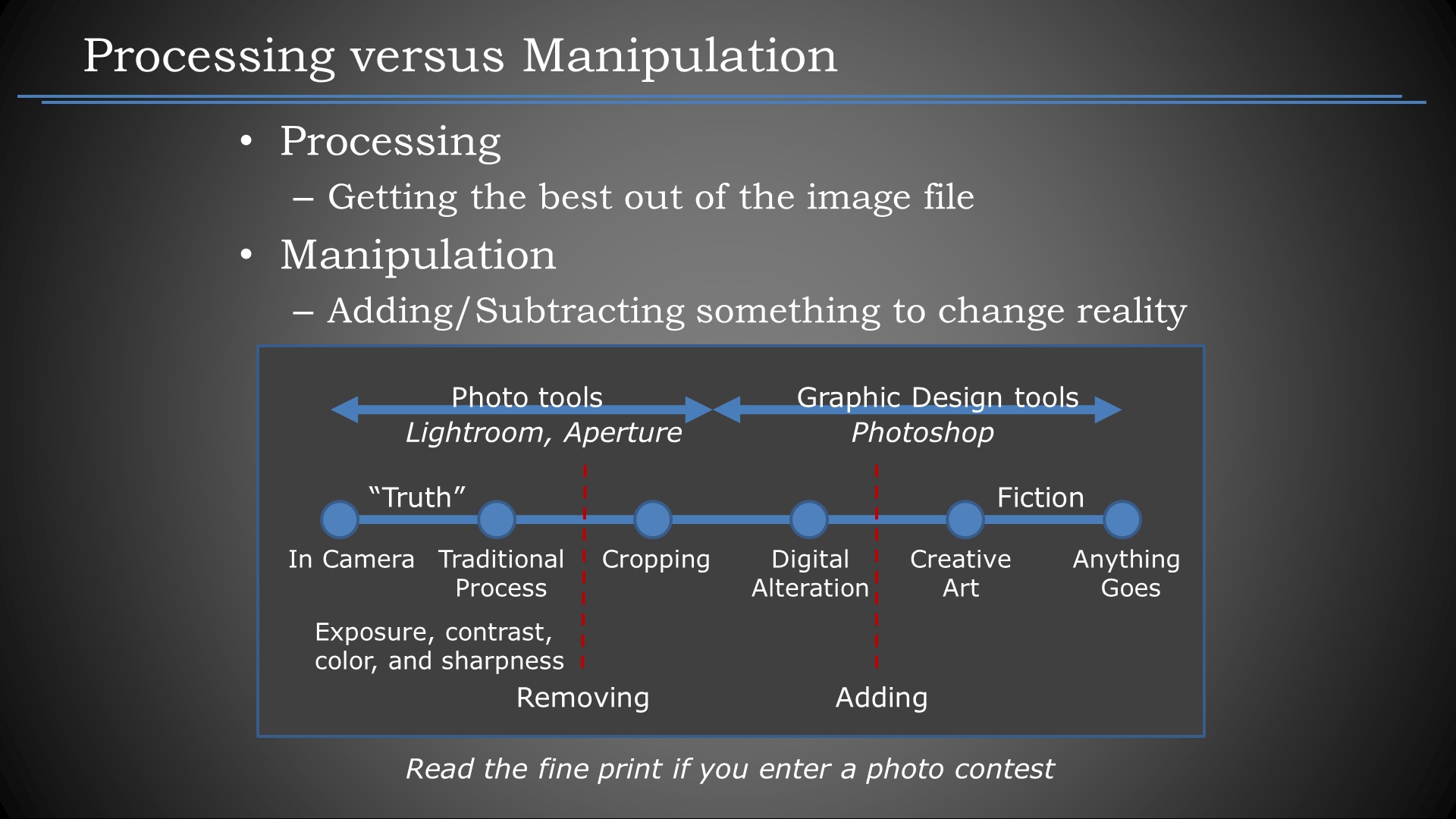
A distinction needs to be drawn between image editing on the one hand and image manipulation on the other. Both are as old as photography itself, in the past having taken place largely in the darkroom with difficult to perform techniques. Nowadays with modern photo editing software the techniques are much easier to perform and are much more commonly done by even skilled amateurs.
Image editing is usually taken to encompass aspects such as colour correction, exposure correction, contrast adjustment, sharpening etc, which in some instances take place automatically as has been mentioned.
Image manipulation (or photoshopping as it is often called) is a much more explicit alteration of an image (for instance putting a different head on some person’s body) and generally encompasses aspects such as the adding or removing of portions of the image with the intention to change the content of the image. The resulting image may have little or no resemblance to the RAW image from which it originated.
The ethics of photo manipulation are widely discussed and in some instances it is an acceptable art form. However it is frowned upon for most journalistic and documentary practices and I would consider that the Awards for Excellence Competition fall into this category. The National Press Photographers Association in the US has even gone so far as to set out a Code of Ethics promoting the accuracy of published images advising that photographers “do not manipulate images […] that can mislead viewers or misrepresent subjects.”
Most professional photographic competitions have a set of rules that are well documented and strictly applied, and although these differ from competition to competition, most share a common theme. Generally image editing is allowed and image manipulation is not (except in specific categories such as creative photoshopping). I would strongly suggest that the CMA follow a similar practice.
Lastly it must also be remembered that the portrayal of so called reality has already been skewed before the shutter button on the camera was even pressed. The scene has already been edited by the photographer’s own interpretation and resulting choice of angle, lens, lens filters, lighting and composition. Often what is done to an image comes down to intent. Was the intent to mislead the judges or was the intent to produce an image that represents as closely as possible to the actual reality of the site? Is sweeping the paving on site before taking the photograph an alteration of reality?
---end---
As it turns out the competitor had not wanted to "waste" money on a photographer when he already had a perfectly good camera. He went to his sites and took the photos himself thereby saving a lot of money. And then could not understand why he didn't win! (and the photos were properly crap!) The competition organisers agreed with my response, upheld the results and rewrote the rule book with comprehensive digital guidelines for future entries.
Regards
Jean.





.jpg.857dbbfbdc4d79d9c6ebf7b4ba96ed1b.jpg)
