



Skip to content

Shooting Technique, Workflow and Editing / Archived topic

Shooting sharks in Burst Mode with Video lights

Started by Interceptor121 ·

  • 16Posts
  • 16Replies

Read-only discussion

Shooting sharks in Burst Mode with Video lights

16 posts
  1. Am about to leave for the Galapagos and I am setting up my kit for the trip.

    I have a combination of video lights and lenses for my RX100 and I will be shooting primarily video in ambient light.


    I thought also of packing my strobes to take some stills but the results I have seen so far around look fairly poor when it comes to sharks.

    On the Galapagos sky site it says the sharks come between 3 and 5 feet from you. Based on this I would need incredibly long strobe arms and i would be looking at shooting around 18-20mm equivalent.

    My set of arms and trays is the same for video and stills but am now thinking that I may attempt taking some burst shots using the video lights.

    I have shot macro video at 1/125th of a second and it looks good I wonder if I can push it to 1/250th (would be sufficient for a slow cruising shark) of a second for stills and attempt something different instead of packing my two Z240 and end up with backscatter and poorly exposed pictures anyway?


    I wonder if anyone has tried anything similar


    Thank you
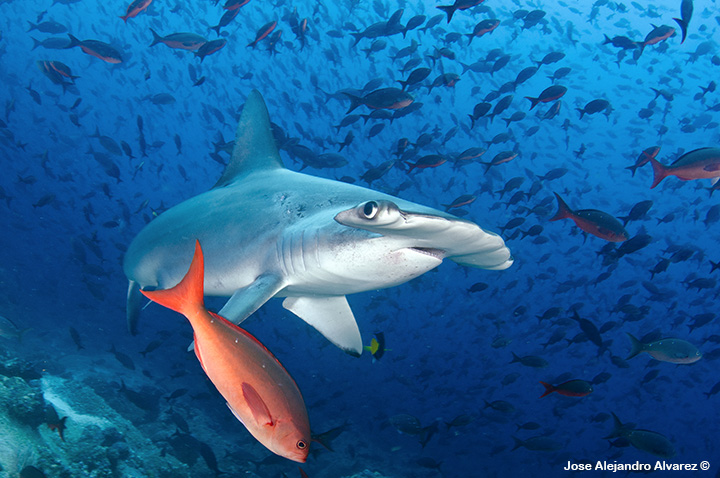
     

  2. Hi , i think you will need a extremely powerful lights if you want to light the sharks and have a fast enough shutter speed .


    Last time i went to Galapagos ( 7 months ago ) i use 2 Ikelite DS160 mounted in 2x8 inches TLC arms and had no problem .See the attached pic as an example . I used a Nikon D7000 with Tokina 10-17mm at about 15 mm.


    post-2893-0-14429800-1398638783_thumb.jpg

  3. That's a great shot except the red fish in front of the shark. What are the exposure settings f iso and shutter?

    How many shots like that did you get in total? I have also two strobes that I can take with me just in case

    Am thinking of shooting at 1/250 f/2.8 auto ISO. I have two sola 1200 that give 2000 lux each at 3 feet this will probably mean ISO 800 or maybe 1600

    An obvious issue is that the continuous light will scare the sharks but I have a shooting technique for that

    Edited by Interceptor121
  4. Video lights will also cause backscatter, and (the ones you are using) have a fraction of the light output of strobes. So you'll be compromising on exposure and foreground lighting, adding in gain, but still subjecting yourself to the problem you are trying to avoid.


    So I'd take the strobes along as well... If you get backscatter issues, use your video lights to practice arm and light positioning then apply the same to the strobes.


    WRT lights scaring the sharks, in my experience a constant light isn't an issue, they get used to it. (I spent a couple of months in the Tuamotus a few years back, on night dives the grey reef sharks would use your torch as a spotter for hunting fish. Exhilarating, if a bit nerve racking!). Strobe lights may scare them off or make then inquisitive and encourage them in, depends on the shark and temperament.

    Edited by Stuart Keasley
  5. Let me put it this way I have two Inon Z240 with approximately 100 degrees coverage and two Sola 1200 with 60 degrees coverage.

    The narrower beam of the sola means the cone of light meets further away so I can reach further before incurring backscatter compared to the strobes.

    Ideally I would like my strobe beams to meet around 3 feet but that would mean 36" plus arms if I had to have zero backscatter I only have 16" which means there will be 40 cm between the shark and the light of potential backscatter with the strobes. I will of course try that however I also have other issues such as shutter lag (shooting a Sony RX100)

    So my idea was pump the sola to the max on my current arms and that would give me 1000 lux at 4 feet which is not little combined with an aperture of f/2.8 (am shooting a 1" sensor so depth of field is not bad and the subject is quite far) and shutter of 1/250th I am hoping I get away with ISO 1600 or less


    Anyway the question is really has anybody tried it?

  6. Angle your strobes away further, you will get the same effect as the Solas ;)

    Edited by Stuart Keasley
  7. That is one option I will try that will have the same coverage but not improve the shutter lag (that by the way is not too bad at 0.326 seconds according to imaging resource)


    I really want to shoot burst continuous at high ISO which can only be done with continuous light


    Anyway if nobody has tried then I will give it a go and post results later on

  8. That is one option I will try that will have the same coverage but not improve the shutter lag (that by the way is not too bad at 0.326 seconds according to imaging resource)


    I really want to shoot burst continuous at high ISO which can only be done with continuous light


    Anyway if nobody has tried then I will give it a go and post results later on

    I'd be very interested to see how you get on, although gut feeling is that you're going to be disappointed with the exposure and quality, your lights just wont have the punch, even at the higher ISO.


    Now if you could get a more powerful video lamp, say about 15,000 lumens, that was still small enough to mount on your camera and be manageable.... (hopefully more on that later this week :))

  9. As I go there with the lights I see what exposure I get at 1/250 f2.8 if I see that am well over 1600 it will probably be crap. But at 800 the shots should come up pretty good. Let's see what happens

  10. Take your strobes. I was on Galapagos Sky in Dec 2013 used 18" arms with YS 110a strobes angled out. I also shot video with two iTorch Pro 6 (2400 lumen each), and they really didn't do much to light the sharks for video, so they really would be lacking for stills. Strobes were definitely a must. You can see some results here: http://wetpixel.com/forums/index.php?showtopic=52257&do=findComment&comment=342494

  11. Mcliffy2 when you say 18" you mean total length 18 or 18+18? I am taking the strobes

  12. That's a great shot except the red fish in front of the shark. What are the exposure settings f iso and shutter?

    How many shots like that did you get in total? I have also two strobes that I can take with me just in case

    Am thinking of shooting at 1/250 f/2.8 auto ISO. I have two sola 1200 that give 2000 lux each at 3 feet this will probably mean ISO 800 or maybe 1600

    An obvious issue is that the continuous light will scare the sharks but I have a shooting technique for that

    Yes ,agree with you , the problem is that in Darwin and Wolf those creole fish are everywhere, like a cloud .


    Settings were f/9 , 1/60 , iso 250


    During my trip , i don't have many close encounters with hammers , but besides the sharks you will find plenty of subjects both above and below water . Here you can see the gallery for that trip http://flickr.com/gp/jaalvarez/67831U .I made a special itinerary and spend half the time doing land photography, so no much diving as normal live aboard trips.


    If you want to make still photography using continuos light , you will need way more powerful ones that the solas 1200 . I have 2 of those and i don't think they will work for the sharks ( due to the distance they normally keep ) .


    I'm trying now a Orca light ( 20,000 lumens ) for a cave project, you can check some examples of my first try 2 days ago, in a separate post of today. Something like that can do the job for you at Galapagos.


    Good luck

  13. Yes ,agree with you , the problem is that in Darwin and Wolf those creole fish are everywhere, like a cloud .


    Settings were f/9 , 1/60 , iso 250


    During my trip , i don't have many close encounters with hammers , but besides the sharks you will find plenty of subjects both above and below water . Here you can see the gallery for that trip http://flickr.com/gp/jaalvarez/67831U .I made a special itinerary and spend half the time doing land photography, so no much diving as normal live aboard trips.


    If you want to make still photography using continuos light , you will need way more powerful ones that the solas 1200 . I have 2 of those and i don't think they will work for the sharks ( due to the distance they normally keep ) .


    I'm trying now a Orca light ( 20,000 lumens ) for a cave project, you can check some examples of my first try 2 days ago, in a separate post of today. Something like that can do the job for you at Galapagos.


    Good luck

    I think the orca light is out of my budget maybe I will just have to give it a miss


    I am also spending 5 days on land doing some other trips. I have a Nikon D7100 with a Sigma 7-200 f/2.8 + 2x teleconverter

    What lenses did you use on land?

  14.  

    On land i used mostly the Nikon 70-200 mm and the Sigma 17-70 mm , i used the Nikon 105 mm for some small lizards and i used a 1.4x TC a couple of times . Animals in Galapagos allows you to get closer than anywhere else that i have been .


    Enjoy Galapagos , it's a wonderful place indeed.

  15. Excellent I have also the sigma 17-70 is my main lens so that should work well. Your land pictures are excellent thank you for your help

  16. Having looked at the pictures I think I got my head around the issue.

    The hammerhead shark is at f/9 ISO250 1/60 lets make it f/8 ISO200 1/60

    At 1/60 the image will definitely be blurred with video lights so I need to freeze motion with the shutter speed which means 1/250th at least. This makes the background dark so I need to pump the gain up and am now at ISO800.

    For the foreground I do not need f/9 as my sensor is smaller I would achieve the same depth of field with f/4. Actually that is even too much so even f.2.8 would work as I am not interested in the sharpness of the background.

    So my sport program f/2.8 1/250 AUTOISO is a good start the question is will the two sola 1200 be enough to cover f/2.8 at 1 meter which is GN4.5 on land??

    Will find out soon!

Marelux

Account

Navigation

Search

Search

Configure browser push notifications

Chrome (Android)
  1. Tap the lock icon next to the address bar.
  2. Tap Permissions → Notifications.
  3. Adjust your preference.
Chrome (Desktop)
  1. Click the padlock icon in the address bar.
  2. Select Site settings.
  3. Find Notifications and adjust your preference.

