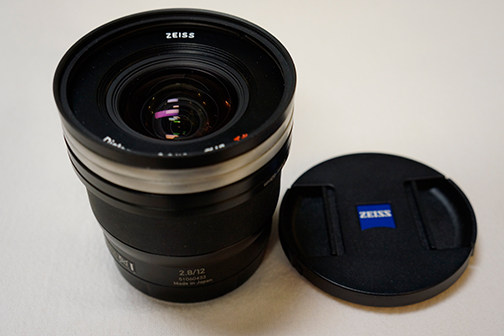
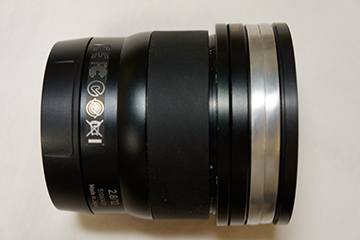
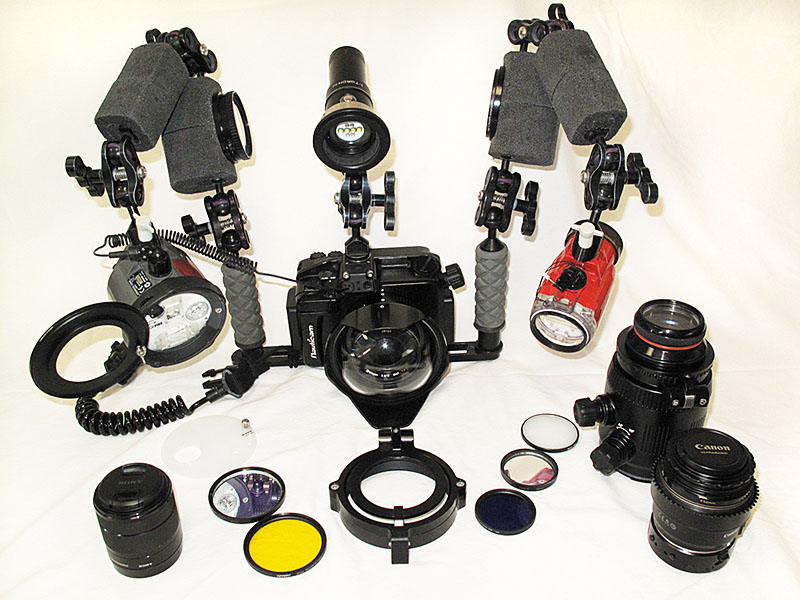
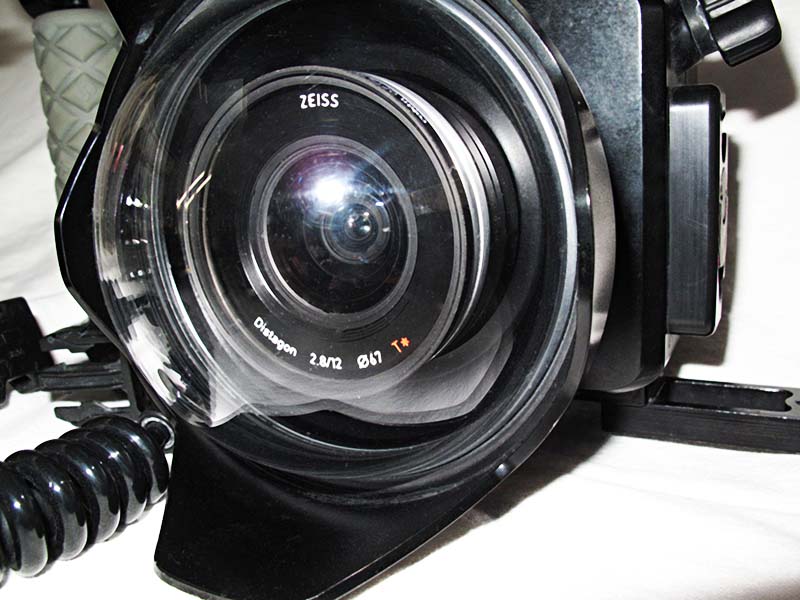
I shoot a NEX7 in a Nauticam housing and absolutely love the ergonomics and Sony 24MP APS-C sensor. The A6000 is even better at focus, etc at a lower price point. As you're seeing, many of us NEX users are still struggling with lens and ports for a high IQ compact underwater system, which is why we went with mirrorless to begin with. The Zeiss Touit 12mm has been rated as the sharpest lens available underwater, going beyond Canon and Nikon SLR's. Yet as Marc has pointed out, it normally needs an expensive 2 piece dome and adapter to work due to it's physical width. However, what many don't know, is the bell shaped shell on the lens is cosmetic or functions solely for the lens shade mounting. The lens is fully functional without this outer shell allowing it to fit in the Nauiticam NEX 4.33 and 7" domes. My Z12 is in Germany at the moment having the front cover (which hides the shell mounting screws) removed (it's glued on). Zeiss has been great and agreed to remove this cover for me at no charge other than shipping it to their NY service dept.
I will soon be able to experiment with the lens in the 4.33 compact dome. This is a FE (fisheye) dome and not ideally suited for wide rectilinear lens due to the dome's extreme curvature, so I may lose corner sharpness, but I don't believe anyone has tried it "real world" yet. I'll soon find out when the lens arrives. Should IQ suffer from the 4.33 dome curvature, the Nauticam 7" dome will work perfectly, but unfortunately, will add to the size of the compact system for travel. Yet, the good news is it's less than half the price of the Zen DP170 & adapter ($550 vs $1,200) and much lighter. It also will not require the 2 part dome/lens installation that Marc explains above.
I'm hoping it will perform in the small 4.33 for travel purposes and also because I have a 20mm extension which will allow me to use my S18-55 lens in the 4.33. I've figured out a way to adapt my Port 72 flip macro mount to the 4.33 port and like the idea of still having the kit lens for single dive versatility in WA and M. Again, because of the 4.33 curvature, I may have trouble with the corners at 18mm? The good news is, the N 7"dome finally has a zoom gear for the Z16-70 which will be a higher IQ replacement for the 18-55. Putting my flip macro mount on the 7" will be more of a challenge though….LOL.
For super-macro I'm using the exceptionally sharp Canon 60 EF-S macro and Aquatica +10 diopter with a Metabones adapter in Nauiticam's custom NEX port which offers some autofocus (slow, but works) and more important for macro, manual focus, which the shorter 50mm Touit set-up does not have. Sony's Focus Peaking is a fabulous tool underwater. Plus, the added 10mm over the Touit makes the lens longer in 35mm equivalency which is an added bonus, as the Sony "NEX" system doesn't have a long macro. Perhaps Nauticam will make a 2 part NEX port for the upcoming Sony 90mm FE e-mount macro, but that's a BIG maybe and certainly a long ways off. 90mm on a cropped APS-C body makes a great working distance macro, comparable to the more popular C100 and N105 macros, which are the most popular for SM. I'm sure many NEX macro shooters are keeping their fingers crossed…..
If I had to do it all over again, I would have considered the more mature 4/3 system with it's large and sharp lens selection. Yet, I print large and like the 24MP Sony sensor and can't afford to change systems in mid-stream. Fortunately, Sony's systems are slowly catching up.
Welcome to the expensive world of UW photography. It's kind of hard to cut corners with cheaper equipment. Purchasing a used NEX or 4/3 system rather than trying to get a cheap housing to work, is a better option in my opinion.
Cheers,
Marsh
Hi Marshall. Good to hear of your progress with the NEX system. My daughter and I have graduated from the NEX-5N to the A6000 and confirm that the latter's autofocus is very good. For wide angle and fish eye we are using the glass Zen 170 Mk II dome. For rectilinear the Sony 10-18 is a nice sharp fully automatic lens with this dome. We have come up with a more unusual but quality combination for fisheye. The popular Tokina 10-17 fits in this dome together with a Novoflex NEX/Nikon converter. This is a fully manual preset combination. Zoom preset usually at 10mm. so used like a prime. The aperture was preset to a relatively shutdown value and focus to an intermediate point providing a very wide depth of field and great images. Exposure controlled with shutter speed and ISO in camera. Without a port extension the lens is a bit far forward in the dome. Subsequent to our last trip, we have found that the 30mm port extension rectifies that and doesn't vignette, but this is yet to be tested in the field. The port extension has a slightly narrower internal diameter than the dome port itself and necessitates slipping off both zoom and focus rubber grips. I have now custom made a focus gear that works very well and will add focussing flexibility on the next trip and allow a wider aperture to be used.
For a mid-range scouting lens, the Sony Zeiss 16-70mm works well behind the same dome without extension. Nice and sharp - makes a great lens for larger stuff like sharks.
For macro we eventually bought the Zeiss 50mm macro and use it behind a macro port 45 and the 30mm extension. Again a very sharp lens, although so far only used for a couple of hours underwater. I agree with your assessment that a slightly longer focal length would be advantageous underwater by providing a longer working distance. However, the autofocus works well. With the camera set up for back button focus, in my opinion manual focus is unnecessary. I very rarely use manual focus with my DSLR system, but do sometimes release autofocus and gently rock the housing back and forth to optimise the focus point. We haven't so far used a wet diopter with the Zeiss lens so don't know how usable it will be at super-macro magnification.
For travel, the system isn't too bulky - one macro port 45, one 30mm extension and the 170 dome serves the 4 lenses. Although the Tokina Fisheye works adequately behind a compact dome when stopped down, my reading is that rectilinear lenses are very unlikely to provide adequate peripheral performance behind such small domes due to the extreme curvature of the virtual image.
Mark