Bit confused 
The WWL is 130 deg with a 28mm FF equivalent lens your GT14s being 90 each should easily cover that. What am I missing?
Stix floats are ok as long as you are shallow when you go deeper they compress and loose buoyancy.
Why not go up to ISO 400 ? Its GH5 native ISO so in theory you get the best image quality and dynamic range from the sensor.
If you are less the 0.3m aren't you blowing highlights with all these light? I understand you step down the lens to set the exposure (since you cant go much lower than ISO 200 and setting the shutter higher might create other issues if there is lots of motion in the scene) doesnt that create diffraction problems? Are you shooting against the sun and try to protect the highlights and get nice blues when filming? With the sun behind you, you got plenty of light between 10am and 3pm in tropical clear water, if deeper then you don't compete with the sun and your lights have a greater effect anyway. Just trying to understand why so much light is needed.
Thanks for taking the time 
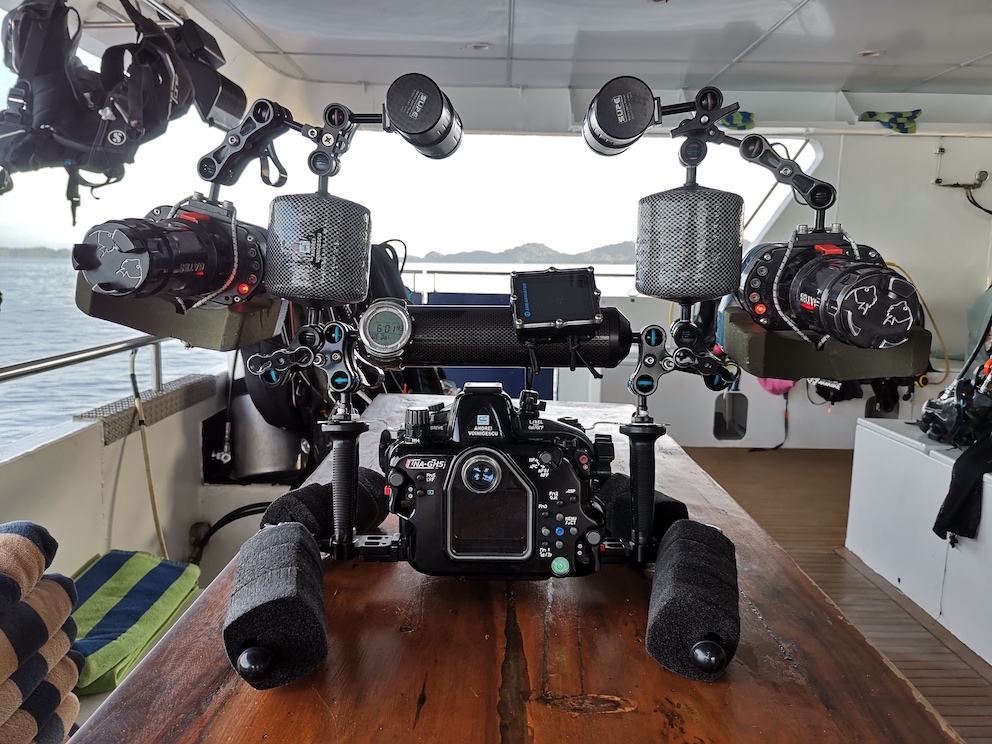
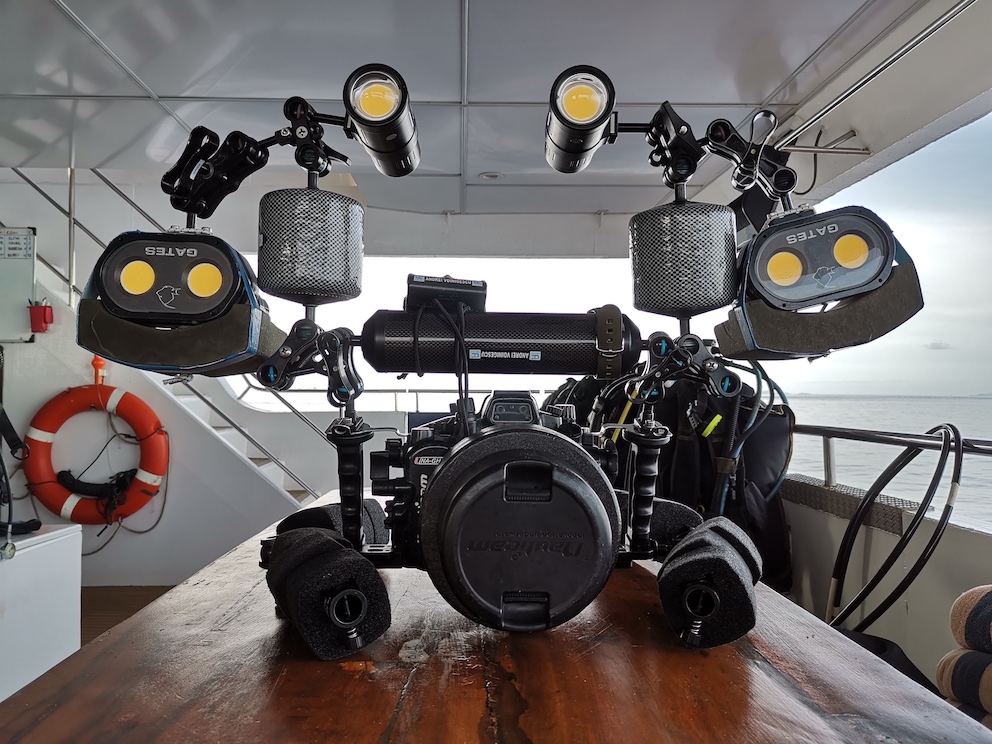
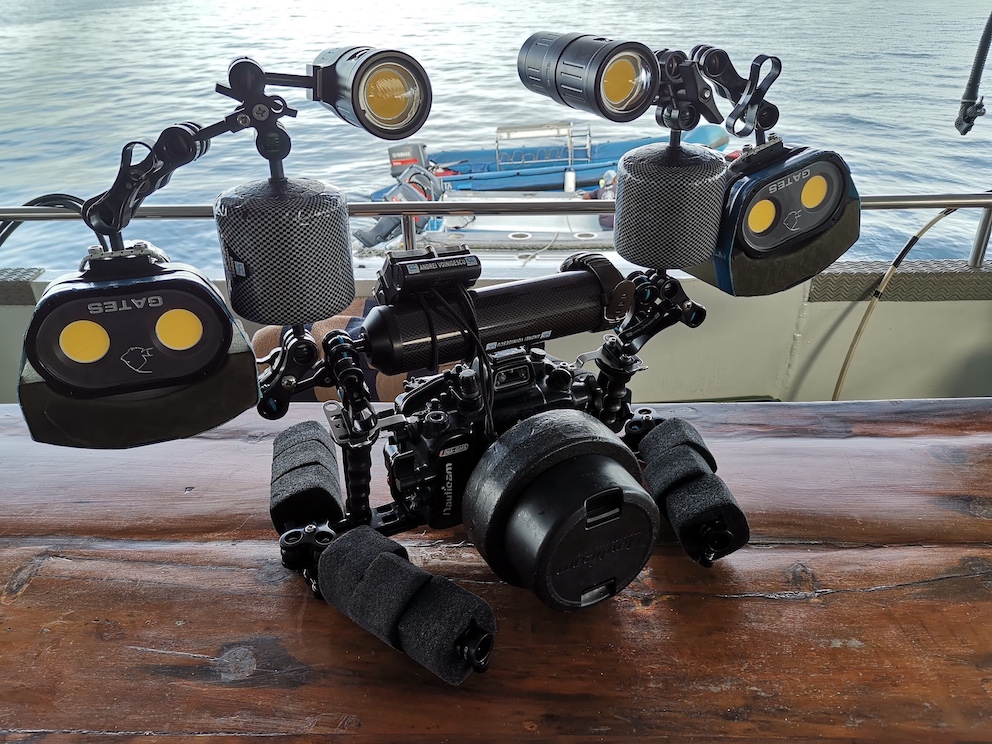
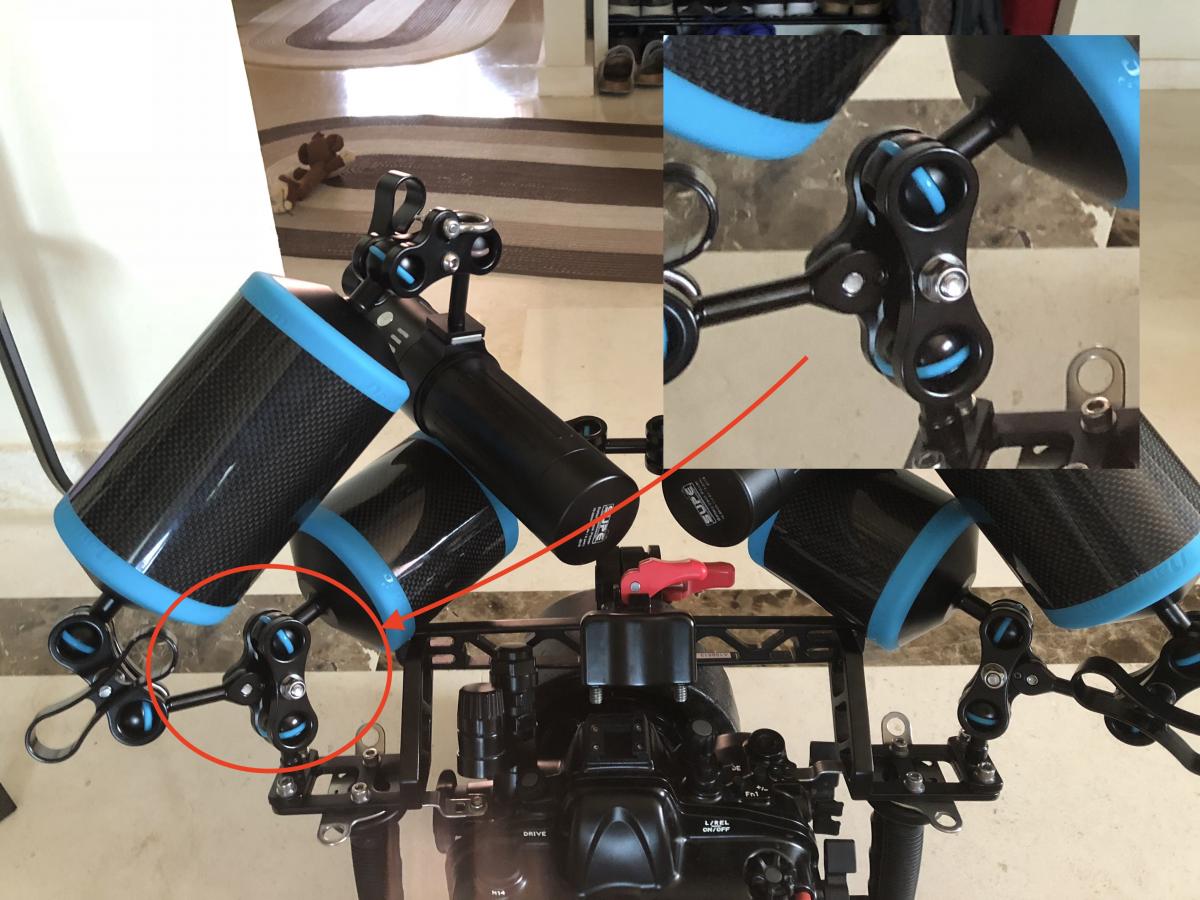
The GT14s are indeed 90 degrees each, which means the beams converge about an equal distance in front of the lights as the distance between the two. So, if the lights are 50cm apart, the beams would converge about 50cm in front of the lights. Because of the handles of the housing, it's basically impossible to move 2 side-mounted lights closer than around 20-30cm apart. Since I sometimes film subjects as close as 5-10cm from the front of the lens, this can create a dead spot in the center of the image where neither light illuminates. That's where a third top-mounted light would be helpful sometimes. Of course, I could also just turn the lights inward a bit for these sort of situations.
Stix floats do compress slightly starting around 20-30m, but the loss of bouyancy in recreational depths is minor. I estimate my rig is maybe 50-100g less bouyant at 40m than at the surface. Not enough to alter it's characteristics significantly. I wouldn't use them for 60+m dives though, for sure.
This 'native iso' business is a bit misleading. It's true that the Panasonic rates the base exposure for VLOG at ISO400, but this is to reflect the fact that when shooting VLOG you're basically lifting the shadows a bit to increase dynamic range, so by rating the camera at ISO400, you close down the aperture/shutter to compensate for the exposure, protecting the highlights in the process and maximizing dynamic range. The tradeoff is that you create more noise in the shadows.
I rarely shoot in vlog underwater, because it's not a high contrast environment. Particles in the water defract light, creating more even illumination. Add to that the fact that I'm usually using video lights to fill in the shadows and we're not dealing with scenes that contain a large dynamic range anymore.
Also, in terms of stills, the GH5 has the highest dynamic range at ISO200 (which is what the sensor is rated at without any additional analog or digital gain). Check DxOMark. ISO100 is an 'extended ISO' setting. Basically, the camera is still using the ISO200 (0db) signal, but actually pulling down the whole image one stop. You don't get any additional dynamic range (in fact, you lose some since you're crushing the shadows) but you are reducing noise somewhat. Nothing wrong with shooting at ISO100 when you need to reduce exposure, but keep in mind you're not actually increasing your dynamic range.
In practice, I keep my aperture between F3.5 and F8 to avoid diffraction, and rarely go to F11. Iso ranges between 200-800 most of the time. Shutter speed 1/125 most of the time since I'm filming 60p, but I will sometimes step down to 1/250 if the ambient exposure is really bright (or when filming sun rays because it helps separate the sun rays from each other a bit more). I never noticed 1/250 producing jagged motion, but I think that's to taste. I sometimes also shoot 1/100 shutter speed for 24p for drone shots and prefer the extra sharpness. I think weird motion blur from shooting something other than 1/2x frame rate is most noticeable when your main subject is a human in (fast) motion, which isn't the majority of my shots.
As I mentioned, with 52k lumens of video lights, I find that F5.6-1/125-ISO200 is the proper exposure for wide angle scenes (discounting ambient light levels - so for example, if shooting wide angle in a cave or at night). Nothing gets blown out. For macro, I might step down a couple of stops to F8 or F11 to avoid overexposure, which is exactly where you want to be for macro anyway for the increased depth of field. The problem arises when the ambient light is too bright for an F5.6-1/125-ISO200 exposure. In those circumstances, I have to shut down the aperture further or go to ISO100 to avoid the ambient light over-exposing the scene. But once you do that, the impact of your artificial lights is lessened, and you no longer get vibrant reds/oranges/yellows. You can partially compensate with a warmer white balance, but I'd prefer to have stronger lights and keep the white balance at 5000-5500k to get a pleasing blue color in the water column. Hence the desire to double my light power 






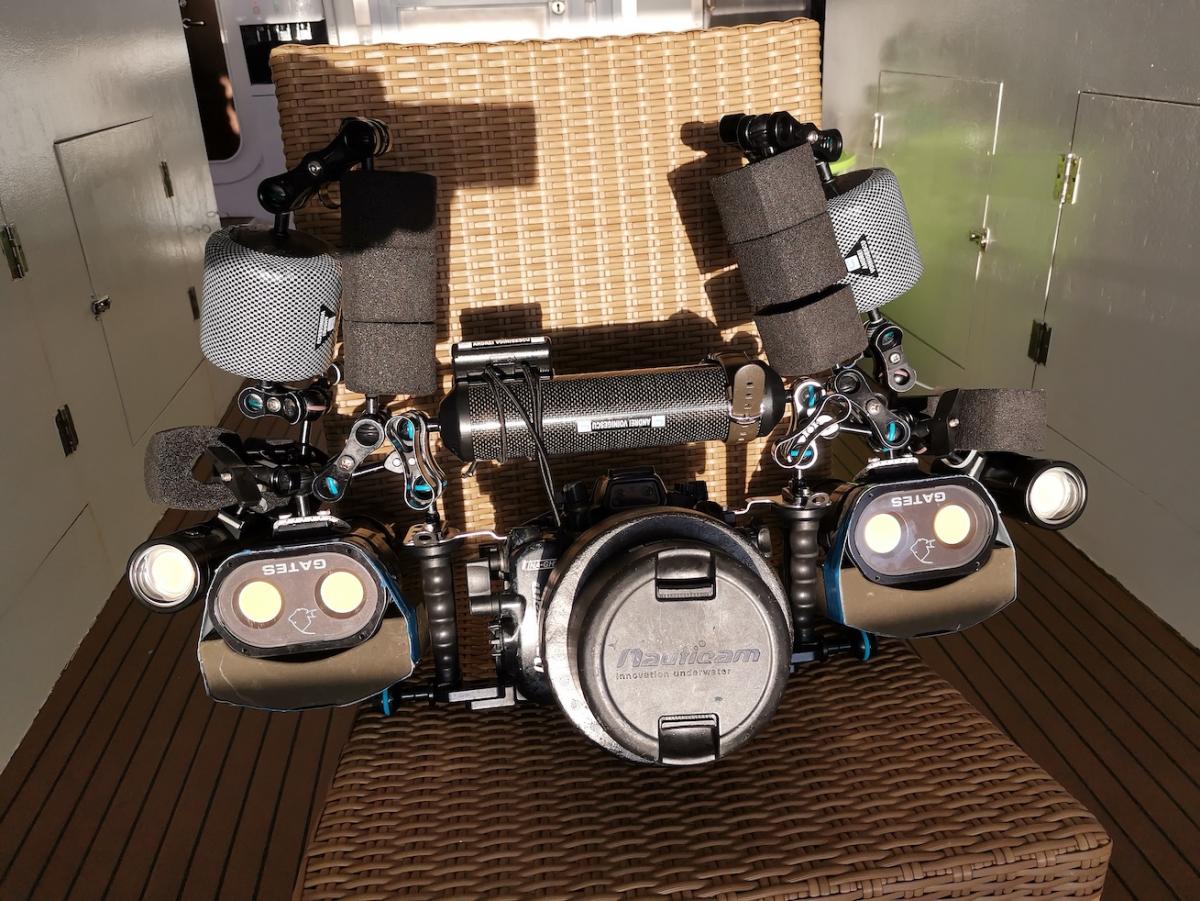
 )


