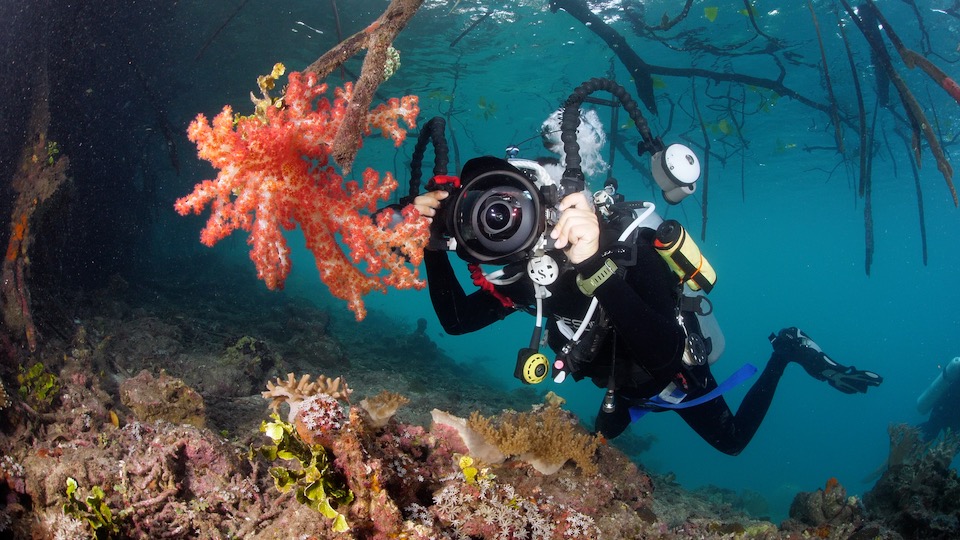
In short: do a custom white balance at the depth you're going to film with the light on at full power off a grey card the same distance away from your lens/light as the subject you're going to film.
That should produce the most accurate white balance on the subject itself, but there's some caveats:
* You are dealing with a mixed color temperature situation -- the temperature of the light falling on your subject is not going to be the same as the light falling on other parts of the scene, so you have to choose which parts of the image you want to have 'accurate' color. Often this will mean your subject ends up looking right, but the white balance required is such that the rest of the scene is still blue/green or, worse, the water column becomes a desaturated gray mush or even purple.
* Your camera may not be able to set a white balance sufficiently warm enough to account for the filtration of reds/oranges/yellows by the water column. Most cameras can only push white balance to 10000k for JPEGs/Video, where the actual white balance you need is closer to 20, 30, or 50000k. So even using the method described above, you may still end up with bluish-green images.
* You can't expect your light to be effective beyond about 1 meter (same as strobes really)
* You really need more light power to get vibrant warm colors on your foreground subject for wide angle in tropical conditions. But you'll get the best results from what you have by filming when the ambient light is not so strong -- that means, early in the morning/late in the afternoon, on overcast days, in murkier water, and deeper.
Think of it this way -- the light that falls on the subject is a combination of the ambient light and the artificial light you introduce. Both these sources start out as full spectrum white light, but they're filtered to varying degrees by the water they have to pass through. So the sunlight might have to travel through 20 meters of water from the surface to the subject and to your camera whereas the artificial light might have to travel through 2 meters of water from your light to the subject and back to the camera. The ambient light is obviously going to be cooler in temperature as a result, but the actual white balance you need will depend on the exact relative strength of your light and the ambient light. That's why you need to set a custom white balance as described above. And that's why you want to shoot in weak ambient light conditions, to maximize the effect of the warm light from your torch.