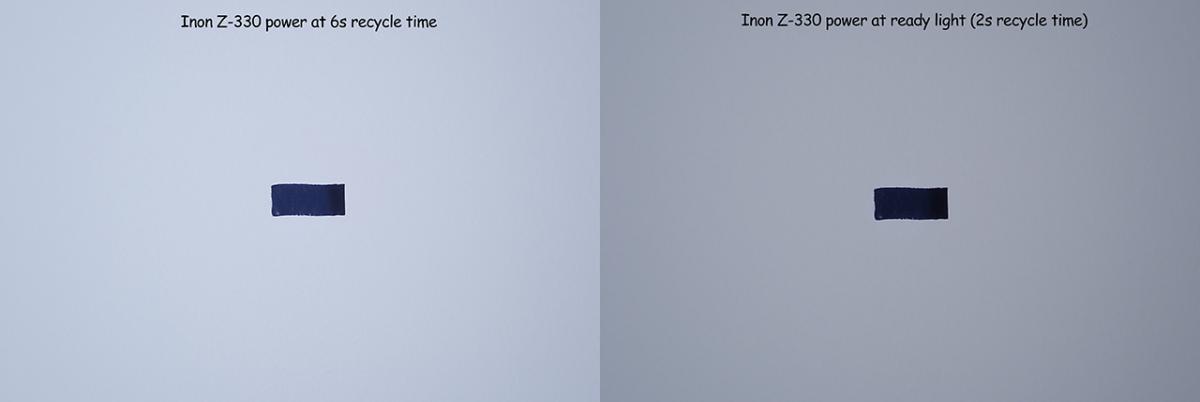
On the contrary, it is very clear what the connection between strobe power and F-stop number is:
100% = full
50% = -1 F-stop
25% = -2F-stop
12% = -3F-stop
etc.
It is also clear that the Inon will fire when the capacitors are at about 20% (before the ready light is turned on). Read the first two posts where the measurements are presented. After this I have confirmed on four different Z-330 the same result.
Now let me ask you: If you knew the Z-330 indicates the ready light (full charge) when it is charged to about 30-40% (-1.4 F-stop less power), would you buy it?
I know a lot of photographers who would think about it twice if they knew the actual recycle time was about 4-5 seconds.
My Z-330's aren't going away for this reason but I want to point out that it is very unfair to photographers who are making choices on their purchase based on completely false and misleading specifications.
I think you have some expectations of what certain specifications are that are not what manufacturers mean
When I read Inon Z330 specifications it says recycle time Approx. 1.8 seconds minimum ["eneloop" batteries]
Reading Sea and Sea specifications the language is different [Recycle time (full)*2] A: 2.5 sec. Ni-MH: 1.9 sec.
On Ikelite DS-160 it mentions 1.5 second recycle time at full power
My interpretation of those specifications is that once you output a full power flash this is the minimum amount of time you need to wait to fire again but there is no specifications anywhere to say that it will do so at full power.
So what is happening here is that you are expecting the strobe to give a ready signal when full charge is reached but this is not what is happening the ready lamp in all cases comes as soon as the strobe can fire and output whatever it can.
If you look at some example xenon tubes you see how much variation there is between tubes and you can also see that some will fire at over 50% some can fire at 18% of full power.
Example circular 100J tube trigger between 250-500 Volts min power 25% (-2 stops)
circular 200J tube trigger between 300-700 Volts min power 18% (more than -2)
linear 50J tube trigger between 280-360 Volts min power 60% (less than 1 stop)
linear 100J tube trigger between 300-450 Volts min power 44% (more than 1 stop)
linear 200J tune trigger between 330-450 Volts min power 53% (less than 1 stop)
So what I believe is happening here is that a combination of different design and different bulbs is producing more difference between the ready light and full power
Technically all strobes are 'ready' but the power they can produce varies maybe what would be useful would be not just to have a ready light but also an (almost) full light but frankly I won't be looking at the strobe to fire nor I want the strobe to only fire when it reaches 98% so what is key is to know how long does it take to cycle between full to full without this becoming the ready signal