Well done Bill, your brightness values seem to mimic the guide number values published by the manufactures, with Inon rating the Z-330 at GN33 and Sea & Sea rating the D2J at GN-32.
At the same time the brightness values are hardly apples to apples. The over 400 value for the S&S is for the strobe which has a beam angle of 80 X 80 degrees while the Z330 has a 110 X 110 beam angle. When the 110 degree diffuser is added to the S&S the brightness value drops to under 150. Using this logic it would stand to reason that if you reduced the beam angle of the Z330 strobes to 80 degrees the brightness value would jumpy 250 or close to 700.
Regarding diffusers the S&S 100 and 110 diffusers are designed to widen the beam angle. The Inon strobe dome filters are not designed to widen the beam they are designed for two reasons, to reduce the out put of light by up to four stops and too change the color temperature of the light output.
So again if you compare the S&S with the 110 diffuser for 110 beam angle and the Inon -0.3 dome filter with the same 110 beam angle the brightness value for the Inon Z330 is 100 points higher.
I am pointing these issues out not because I have an issue with the work Bill has put in I am very well aware of how time consuming doing these tests can be. I just think it needs to be pointed out because these two strobes are in the same price ranged but not comparable apples to apples.
I think that the test from Bill and also those done by the Retra guys and by backscatter confirm that actually the YS-D2 and the Z330 drop equally with angle without diffusers and that with diffuser the sea and sea is better distributed
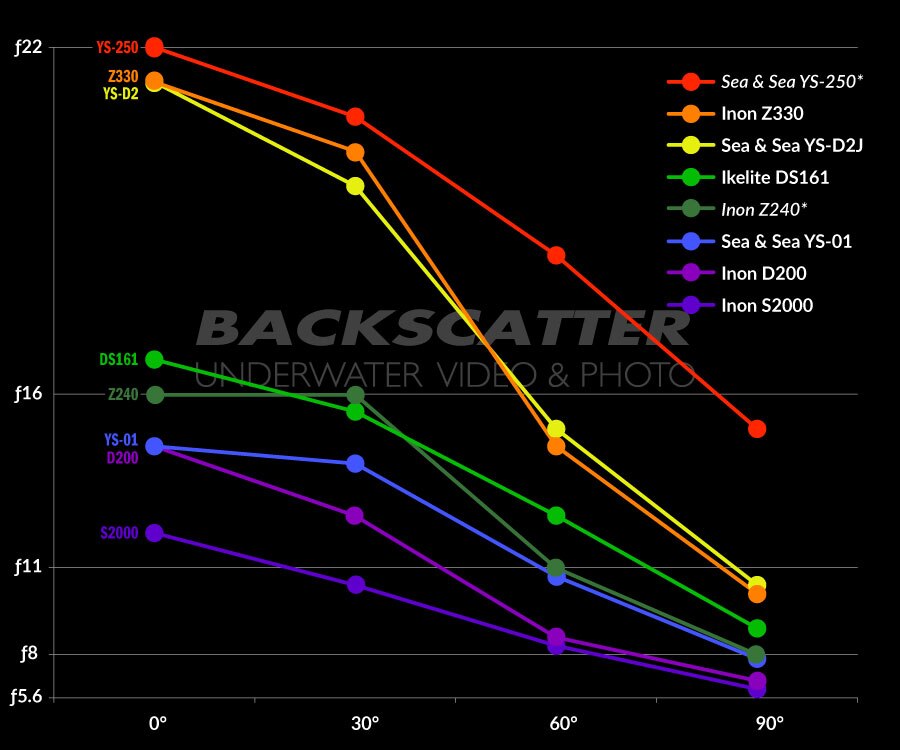
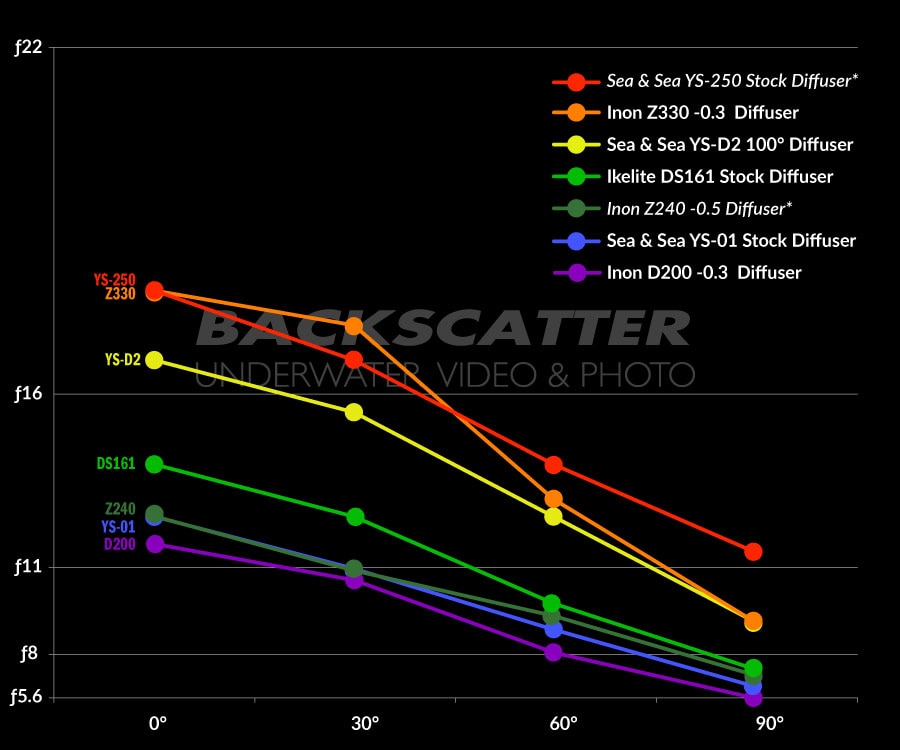

So I guess 80x80 is as incorrect as 110x110. Furthermore the Inon two bulbs clearly show a cross shape so a diffuser is essential as it is to the square of the sea and sea
From all the measurements I ca see that the loss of light of the Inon at centre is more like 0.5EV and not 0.3EV the diffuser is clearly required for any strobe with a linear tube even if you put two like the inon you see the cross with the shape of the two tubes
I would actually argue that the distribution of the Sea and Sea is actually better and that the strobe with the nominal 100 degree diffuser is wider than the Inon declared 110
In terms of power at the centre the YS-D2 appears around 1/3 of a stop weaker at centre with the diffuser on but the gap close at 60 degree off centre
If I had to purely look at Bill and backscatter tests without reading the specifications of the strobe I would conclude that the Sea and Sea has a more even light distribution at the edges and that the older Z240 and S2000 although less powerful have a nice distribution too
I think having this information with tests done in water just confirms that there is a lot more than land specifications to a strobe
It would be really interesting to understand how circular tubes behave in water







