Skip to content

Photography Gear and Technique / Archived topic

Inon 45 degree vs. Nauticam 45 degree viewfinder

Started by Larry C ·

  • 32Posts
  • 32Replies

Read-only discussion

Inon 45 degree vs. Nauticam 45 degree viewfinder

32 posts
  1. Live view also known as the stinky baby way to hold the camera (far in front of you).

    The 45 takes a bit of time to get used to but once you do it is hard to go back. On a recent trip, I borrowed a camera with no 45 and couldn't find the darned critters.

    Bill


  2. Bit the bullet. Backscatter has a sale this week and even though I can’t dive right now due to health issues and coronavirus closures, I ordered one. It’ll be shipped when they get the next batch in. Thousand dollars here, thousand dollars there, pretty soon this UW photography stuff will start costing real money.


    Sent from my iPhone using Tapatalk

  3. I have the 180 Nauticam.  One thing I particularly like about it is the ease of installation.  In order to pack my rig, I have to swap out the 180 for the standard viewfinder so it will fit in the bag.  (I've never used the standard viewfinder).

    I bought the 180 for a high eyepoint, so I could see to the corners more easily with a mask on.   It succeeds there, but an added benefit is the 3rd point of stability when I hold my rig and press the eyepiece to the mask.    I shoot both macro and wide angle this way, but I have to admit that a 45 degree could be very handy when down near the bottom.  I'm fortunate to do a lot of wall shooting and sometimes cna just hover straight up and down with a subject at eye level.


  4. Installation was about the easiest I've had on an accessory.  Pull the O-Ring, slide the old one out, clean a bit, put the new one in and replace the O-Ring.  Everyone who said "you'll hate  it for the first five dives", you ain't kidding.  Trying to use it with a snoot was all but impossible.  I turned on my other strobe to ttl and got about 3 pictures in an hour of diving.  I was often a foot above my subject, trying to find it in the viewer.  Once, I knocked a poor Nudi right off his rock.  Hopefully, I get the hang of this after a few more dives.


  5. No-one said life was easy, eh Larry? 

    A new 45-degree finder AND a snoot?? You're a brave man :P

    It will get easier though for sure!

  6. I think I must not be experienced enough to have really developed ingrained habits. I just got back from 4 days of diving down in NC with my new 45 degree Nauticam VF. I was shooting at WA and CFWA.


    I thought the VF was great, right from the first dive. Not to say that I had zero issues. Issues that I encountered were:


    Objects in viewfinder are closer than they appear! One time, I was tracking a shark in the VF and swimming slowly, to get it lined up how I wanted. I was looking at it over the gunwale of a wreck. I could see the gunwale in the VF, but I didn't realize how close I was to it until my dome actually ran into it. Fortunately, not hard and no damage. Another time, I was tracking a smaller shark that was inside the wreck, between me and a wall. I was snapping as it came closer, but when it finally started to go past and I looked up from the VF, I realized that I had trapped it between my camera and the wall. It's pectoral fins were hitting the wall and my dome to wriggle through.


    It is harder to see stuff. For example, I was composing a scene in a hold of a wreck where there was a shark and a bait ball in the far side of the hold. My composition was to take in almost the whole room, but the focus was to be the shark and I was waiting for that moment when the bait ball coalesced momentarily around the shark. Looking through the VF, I could not see the shark well enough to tell when the right moment was happening. I had to look up, not through the VF to really see what the shark was doing.


    Swimming and watching a subject in the VF was also more of a challenge to my buoyancy. I found myself watching stuff in the VF to use as a reference for whether I was starting to go up or down. But, when you're looking down at a 45 to see something that is straight in front of you, then sort of taking in the peripheral view (through the VF) to have an idea of up/down movement was a little disorienting.


    But, none of that outweighed the benefits that I enjoyed. The biggest one, for me, was that I was able to adjust the VF diopter so that I could easily read my camera "screen". I normally wear reading glasses, but I don't have prescription lenses in my masks. So, reading my camera settings on the back of the LCD has always been somewhat of a squinty affair and not 100% reliable. Previewing photos on the LCD was never sufficient for me to tell if things were in focus. Only that the color and basic composition was right. Looking through the VF, I could easily read the camera settings on the screen and see previews very well.


    Also, I am often trying to shoot at somewhat of an up angle and the VF was REALLY nice for that.


    And that was all only with 3 days of actual shooting. I am looking forward to getting even more comfortable and quick with it.




  7. Haven't tried WA or CFWA yet, as this was our first dive in 3 months and conditions were not appropriate for either.  Trying to line up the snoot and check the camera alignment with a macro subject was pretty much impossible.  I kept having my snooted  strobe hit things and finding myself a foot higher than I expected to be, probably because I'm used to looking level or  up at the subject, and now I'm looking down, but the position of the subject is not beneath me.  I think I'm instinctively going above the subject expecting that it will line up with my head position.  I'll have to start approaching it from lower and checking the distance before I put my eye on the viewer.

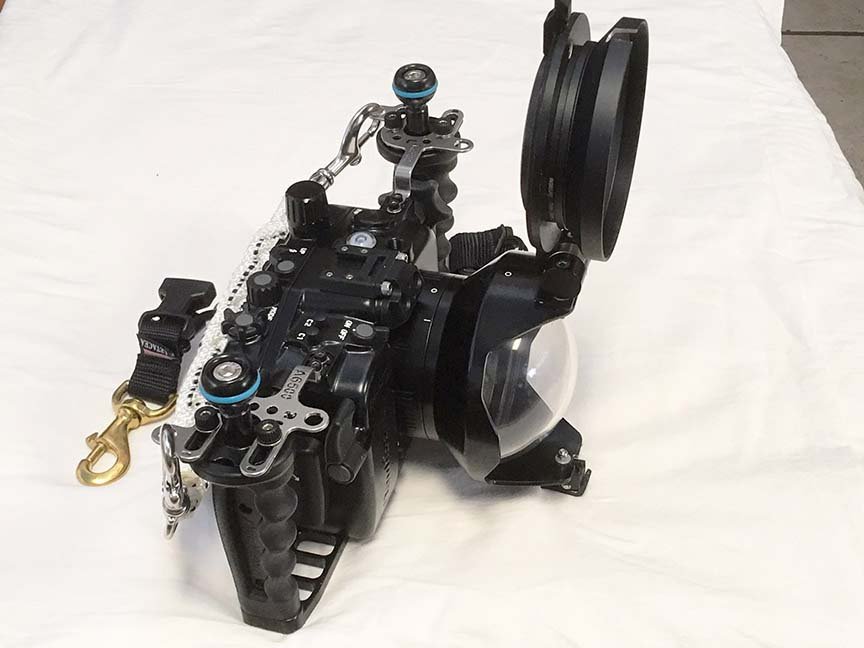
  8. My first rig was a Canon with Nauticam 45 degree viewfinder doing SM.  Man, did I come to hate that rig.  I didn't use it long enough to get the hang of the 45 VF.  I can't tell you how much time wasted in frustration looking for the little critters. LOL  Now I have a Nauticam-NA-a6500 Sony rig with a bright LiveView tilted screen using Sony's Peak Focus feature. I can keep my eye on the critter, watch the position of my port, maintain a decent angle to the reef with the rig slightly below and extended AND simultaneously see the subject enlarged on the screen. What a joy and ease of use compared to looking for it through a viewfinder. I'll never go back.  Hats off to those who develop the patience for 45 degree viewfinders. 

  9. 4 hours ago, Marsh said:

    My first rig was a Canon with Nauticam 45 degree viewfinder doing SM.  Man, did I come to hate that rig.  I didn't use it long enough to get the hang of the 45 VF.  I can't tell you how much time wasted in frustration looking for the little critters. LOL  Now I have a Nauticam-NA-a6500 Sony rig with a bright LiveView tilted screen using Sony's Peak Focus feature. I can keep my eye on the critter, watch the position of my port, maintain a decent angle to the reef with the rig slightly below and extended AND simultaneously see the subject enlarged on the screen. What a joy and ease of use compared to looking for it through a viewfinder. I'll never go back.  Hats off to those who develop the patience for 45 degree viewfinders. 

    Wow, 45o tilted back screen - THIS sounds ergonomically...

    How is it possible to tilt the screen within the camera housing? Is this a speciality of Nauticam housing or do you use an external screen?

    Wolfgang

  10. 34 minutes ago, Architeuthis said:

    Wow, 45o tilted back screen - THIS sounds ergonomically...

    How is it possible to tilt the screen within the camera housing? Is this a speciality of Nauticam housing or do you use an external screen?

    Wolfgang

    I don't think he means that the screen is 45 degrees.


    With my Sony a7r4 in a Nauticam housing, the tray that holds the camera inside the housing does hold the screen tilted up a little bit. But, it's more like 10 degrees - not 45. When you attach the tray to the camera, you flip the screen bottom out and the tray has a tab that sticks up. Once the tray is attached to the camera, you flip the screen back down and the tab holds it out from the bottom of the camera a bit.

  11. Back in the mists of time (which would be the early 2000s)  I had a Coolpix 5000 in a Subal housing. The Coolpix had a screen that could be tilted to 45 degrees and the Subal housing was built to allow that. So an early 45-degree viewfinder. Brilliant for macro!

  12. On the Sony APS-C systems, the screen is tilted some (I think more than the A7 series, but not sure), certainly less than 45, maybe 20 degrees or so.  Still,  the tilt helps and is better than having to be perpendicular to the housing body.  It definitely makes things easier for diver position to the reef, especially since the large live view screen permits one to hold the rig further from the body, slightly down in front of you to observe all factors simultaneously while you approach the subject. 

    Happy diving once we can all get back to it.  In the meantime, I'm keeping myself occupied by experimenting with lens options on my rig. Currently I can shoot with the Sony18-55 kit,  Zeiss Touit 12 (modified) ,  Zeiss 16-70,  Sigma 16 f1.4 (modified) and Sony 90 macro using the N85 4.33 port, some extensions (N85 20&30) and N100 macro port setup for the S90.

    If things continue to go well (looking good so far)  I'll soon be able to upgrade and shoot with the new Sony 16-55G, Canon 8-15 or Tokina 10-17 (prefer the C over T, but much more $$) ,  Zeiss 12,  and Sony 90 Macro. All using an N85 to N120 50mm adapter, two extensions (N120 20&30) and one N120 4.33 port for better IQ and a smaller system.

    I've modified my N85 4.33 port by adding a swing mount to it's shades for a CMC-1 CU lens.  I use it with the Sony 18-55 kit for a single dive lens for both WA and SM.  The new Sony 16-55G will replace the kit and the swing mount moved over to the N120 4.33.  The Sony 16-55G f2.8 will eliminate the need for the Sony kit, Zeiss 16-70 and Sigma 16 f1.4 (for video) for a smaller set-up.  

    If you're interested in any of these modifications, please send me a PM and I'd be glad to share my findings. 

    Enjoy your rig, whatever you have. 

    Cheers

    Marshall

    Sony a6500 Housing.jpg

    Edited by Marsh
WaterPixels Store

Account

Navigation

Search

Search

Configure browser push notifications

Chrome (Android)
  1. Tap the lock icon next to the address bar.
  2. Tap Permissions → Notifications.
  3. Adjust your preference.
Chrome (Desktop)
  1. Click the padlock icon in the address bar.
  2. Select Site settings.
  3. Find Notifications and adjust your preference.