



Skip to content

Lights, Strobes, and Lighting Technique / Archived topic

Life span of Eneloop Pro Batteries

Started by Interceptor121 ·

  • 31Posts
  • 31Replies

Read-only discussion

Life span of Eneloop Pro Batteries

31 posts
  1. 44 minutes ago, Interceptor121 said:

    I have been in correspondence with Panasonic energy and I have asked them about the production date

    The answer has been the batteries themselves last around 10 years so you should not worry too much about the production date. The life is influenced by the number of cycles which are 500 for the Pro and 2100 for the standard ones

    So as long as you do not drain them a standard eneloop has more than 4x the life of a Pro.

    Generally I doubt that someone doing 4 trips per year with two strobes say around 100 dives will do more than 100 cycles in the two battery sets it has. So each battery should have 50 cycles and last for a long period of time including the pro

    So any premature death is either extensive use or bad practices

    I fully agree, "So any premature death is either extensive use or bad practices", but want to add that the conditions, how we charge our accus when on a trip, are suboptimal and "bad practice" is unavoidable. Often the current is coming from a generator and not from the regular line, this causes problems. I think the 500 vs. 2000 cycles (pro vs. regular) do not apply for UW-photography conditions and in reality the lifetime is much shorter:

    I do not track the lifespan of the single cells, but the experience is that when my wife and me take 28 AA Eneloops (mostly regular white ones; we have 5 strobes together) with us for a 2-3 week diving trip, in average 1-3 of them are recognized as bad on the regular BQ-CC55 charger under these conditions during the trip. I sort them out and regenerate them at home with the "good" Ansmann charger (I cannot remember that the regeneration program ever failed with a single cell, this must be very seldom the case). These cells are not recycled for UW-photography, instead they go to e.g. remote controls at home. Over the last six years, we have sorted out most of our Pro cells this way, while there have been only few regular (white) cells that had to be excluded. I doubt that recycled Pro cells will have a charging advantage over fully intact regular cells...

    => The reason why I renew our stock now exclusively with white Eneloops, is not that I want to save (very little) money on the cost of (a little) charging time, but I intend to get more reliability during the diving trips...


    Wolfgang
    Edited by Architeuthis
  2. 42 minutes ago, Architeuthis said:

    I fully agree, "So any premature death is either extensive use or bad practices", but want to add that the conditions, how we charge our accus when on a trip, are suboptimal and "bad practice" is unavoidable. Often the current is coming from a generator and not from the regular line, this causes problems. I think the 500 vs. 2000 cycles (pro vs. regular) do not apply for UW-photography conditions and in reality the lifetime is much shorter:

    I do not track the lifespan of the single cells, but the experience is that when my wife and me take 28 AA Eneloops (mostly regular white ones; we have 5 strobes together) with us for a 2-3 week diving trip, in average 1-3 of them are recognized as bad on the regular BQ-CC55 charger under these conditions during the trip. I sort them out and regenerate them at home with the "good" Ansmann charger (I cannot remember that the regeneration program ever failed with a single cell, this must be very seldom the case). These cells are not recycled for UW-photography, instead they go to e.g. remote controls at home. Over the last six years, we have sorted out most of our Pro cells this way, while there have been only few regular (white) cells that had to be excluded. I doubt that recycled Pro cells will have a charging advantage over fully intact regular cells...

    => The reason why I renew our stock now exclusively with white Eneloops, is not that I want to save (very little) money on the cost of (a little) charging time, but I intend to get more reliability during the diving trips...


    Wolfgang
    This is a valid point however the power supply should be able to manage a good DC output to the charger even if the input is fluctuating as it is an AC DC converter

    I use USB chargers so I can actually power them with a power supply that is regulated or a powerbank

    For what concerns batteries that are recognised as bad during the trip there are several possibilities

    1. You mixed batteries in the strobe from different ageing and batches

    2. The batteries got too hot

    3. The batteries were drained and could not revive using the charger

    4. other things I cannot think about....

    For me the single most dangerous thing for a battery is heat this can happen in the strobe but also in the charger if the charging current is too high. The eneloop chargers have a fairly low charging current but some fast chargers can delivery 1A to a small AA and that in due course may fry the battery if there is insufficient ventilation, the enviroment is hot etc etc

    I will continue with some experiments this week processing some 2017 batteries with the eneloop pro charger to see what it says. I have disposed of those batteries for regular use underwater but they still work technically

    With regards to white vs black eneloop the initial capacity of 1900 mAh vs 2500 mAh means that you can get less flashes out of regular eneloop which in turn means more likely they will drain out

    I am surprised you get fauly whites I use those for keyboards and mouses since many years. The reason why Panasonic recommends eneloop pro for flashes is that they tolerate higher discharge current at the cost of shoter life. The white ones will recycle slower and potentially also die sooner than 2000 cycles

    Edited by Interceptor121
  3. 5 hours ago, Architeuthis said:

    I fully agree, "So any premature death is either extensive use or bad practices", but want to add that the conditions, how we charge our accus when on a trip, are suboptimal and "bad practice" is unavoidable. Often the current is coming from a generator and not from the regular line, this causes problems. I think the 500 vs. 2000 cycles (pro vs. regular) do not apply for UW-photography conditions and in reality the lifetime is much shorter:

    I agree with Massimo, most chargers should be able to cope with current variations as they have a multi voltage electronic inverter to produce a stable DC output.  Maybe I'm a light user but I've not encountered difficulties with Eneloop or Eneloop style strobe batteries and Like I said for land use I run them empty and they'll generally do 3 dives on my Z-240s so I can generally soft charge them at 0.5A on my Maha charger which is what I travel with.

  4. I agree with Massimo, most chargers should be able to cope with current variations as they have a multi voltage electronic inverter to produce a stable DC output.  Maybe I'm a light user but I've not encountered difficulties with Eneloop or Eneloop style strobe batteries and Like I said for land use I run them empty and they'll generally do 3 dives on my Z-240s so I can generally soft charge them at 0.5A on my Maha charger which is what I travel with.

    Interestingly Panasonic recommends charging the battery between 0.5 and 1C which means 1250 to 2500 mA a fairly high current. However their own charger works at 600 mA
    The trickle charge mechanism is actually good as it avoids overcharging the batteries when they are left in the charger and also avoids heating them up more than required
    In terms of storage eneloop recommendation is actually to store the batteries fully charged if you are not going to use them for a while. This is different from lithium batteries that are stored at 20-25%


    Sent from my iPhone using Tapatalk
  5. 8 hours ago, Interceptor121 said:


    The trickle charge mechanism is actually good as it avoids overcharging the batteries when they are left in the charger and also avoids heating them up more than required
     

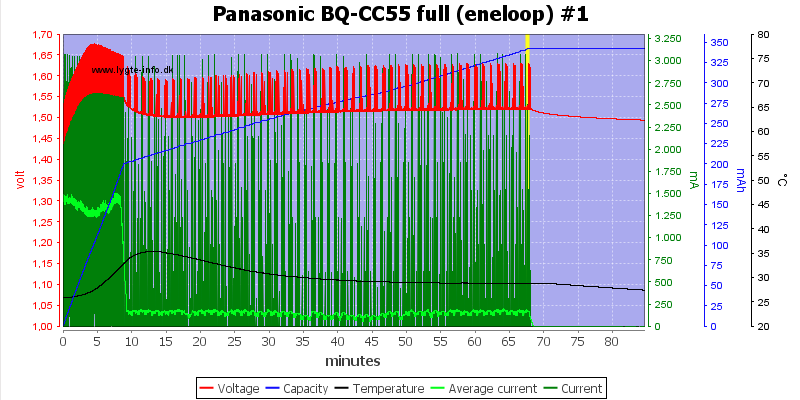
    Everything I have read and heard on the battery nerd forums and test sites suggests that using a top-off or trickle charge method is not ideal for charging LSD batteries.  I am not a battery geek, so I may have the terminology wrong, but with LSD batteries, chargers cannot easily determine when a full charge has occurred if the charge rate is too low (Below 500 - 1000 mA).  When chargers rely on a top-off or trickle charge for the last 20%, there is a likelihood of overcharging, so many of these chargers have to rely on a timing mechanism instead of assessing a 100% charge. I believe the BQ-CC55 shuts off after 1 hour.  LSD batteries are sensitive to overcharging and doing so will shorten their lifespan and can cause other problems.  So the ideal way to charge LSD batteries is to supply a sufficient charge  until the battery is at 100% and then terminate the charging.   This assures a full, but not overcharged battery.  That is not how all the Panasonic chargers work.

    image.png.5e708646d5a79ff24af351ac9112c02c.png

    The BQ-CC55 "uses a -dv/dt termination and has a 1 hour top-off charge at around 140mA.... as can be seen on the temperature the cell is full and get stuffed a bit extra with the top-off charge. "


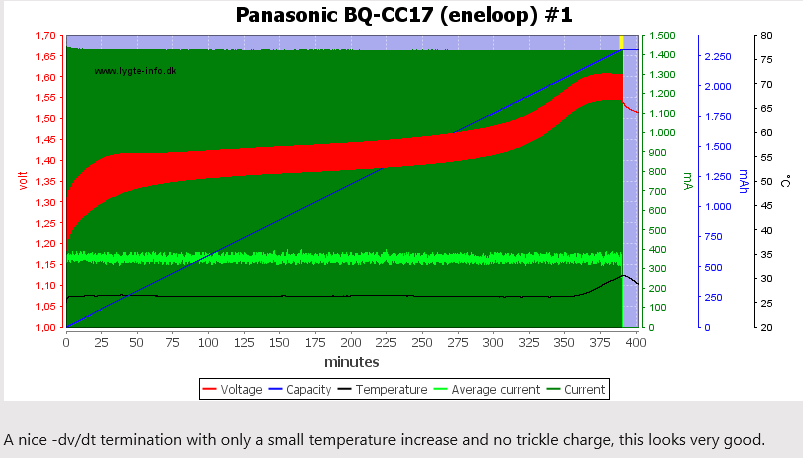
    The BQ-CC17, in contrast to the B-CC55, charges to 100% and then stops.  But is a much slower charger:

    image.png.71d73729827046117def79d98591cdf7.png

    Again, I am relying on what others have told me, including testing and opinions (and the attached graphics) found at https://lygte-info.dk/

    On this page (https://lygte-info.dk/info/batteryChargingNiMH UK.html )  is one of the clearer explanations of what I am saying: 

    "AA/AAA NiMH batteries are usual rated for charging up to 1C, i.e. same current as their capacity. This means that a charge current of 2000mA (or 2A) for a 2000mAh battery, most chargers will charge with a lower current, but there is also some chargers that uses higher current.  A high charge current will usual reduce the number of charge cycles a battery can last, i.e. using a lower charge current will mean longer battery life.  But using a low charge current has its own problems, detecting when a NiMH battery is full can be problematic and overcharging will also reduce the life of the battery, especially LSD (Low Self Discharge) types.

    One way around this problem is using the battery voltage for termination, it works, but has a few problems because it varies with temperature and actual chemical composition of the battery, i.e. not all brands needs exactly the same termination voltage. If the termination voltage in the charger is a too high the charger may never terminate and will overcharge the battery in a serious way. If the termination voltage is too low, the charger will stop premature and you will get a battery with a bit less than full capacity. This can be fixed with a top-off charge, i.e. a lower current charge for a fixed time (like 1-2 hours), this will probably overcharge the battery, but with a low current and for a limited time, i.e. damage will be minor."


    His concluding statement includes "To get a good charger look for one with individual cell termination, i.e. it must be able to charger one cell at a time. It must terminate when the battery is full and preferable not use trickle charge. For chargers with voltage termination a top-off charge is acceptable and secures that the cell is full, for chargers with -dv/dt termination it is not needed."

    So, I prefer a charger that charges to 100% at a reasonable rate of charge, and then terminates, but a charger like the BQ-CC55 is a good alternative due to its speed, and for most of us, a possible slight reduction in battery life is an acceptable trade-off.  I would not hesitate to use them on a dive trip.  However, the thread topic is lifespan of eneloops, so the point of increased lifespan is germane. 

    Note:  I also obtained some information from a very close family member who, as it happens, is an engineer for Panasonic Energy.

    Oh, and one last point.  NIMH LSD batteries should not be "left in the charger."  This may explain some of your lifespan issues.  Take them out when they are done and store them out of the charger.


    Edited by Draq
  6. 3 minutes ago, Draq said:

    Everything I have read and heard on the battery nerd forums and test sites suggests that using a top-off or trickle charge method is not ideal for charging LSD batteries.  I am not a battery geek, so I may have the terminology wrong, but with LSD batteries, chargers cannot easily determine when a full charge has occurred if the charge rate is too low (Below 500 - 1000 mA).  When chargers rely on a top-off or trickle charge for the last 20%, there is a likelihood of overcharging, so many of these chargers have to rely on a timing mechanism instead of assessing a 100% charge. I believe the BQ-CC55 shuts off after 1 hour.  LSD batteries are sensitive to overcharging and doing so will shorten their lifespan and can cause other problems.  So the ideal way to charge LSD batteries is to supply a sufficient charge  until the battery is at 100% and then terminate the charging.   This assures a full, but not overcharged battery.  That is not how all the Panasonic chargers work.

    image.png.5e708646d5a79ff24af351ac9112c02c.png

    The BQ-CC55 "uses a -dv/dt termination and has a 1 hour top-off charge at around 140mA.... as can be seen on the temperature the cell is full and get stuffed a bit extra with the top-off charge. "


    The BQ-CC17, in contrast to the B-CC55, charges to 100% and then stops.  But is a much slower charger:

    image.png.71d73729827046117def79d98591cdf7.png

    Again, I am relying on what others have told me, including testing and opinions (and the attached graphics) found at https://lygte-info.dk/

    On this page (https://lygte-info.dk/info/batteryChargingNiMH UK.html )  is one of the clearer explanations of what I am saying: 

    "AA/AAA NiMH batteries are usual rated for charging up to 1C, i.e. same current as their capacity. This means that a charge current of 2000mA (or 2A) for a 2000mAh battery, most chargers will charge with a lower current, but there is also some chargers that uses higher current.  A high charge current will usual reduce the number of charge cycles a battery can last, i.e. using a lower charge current will mean longer battery life.  But using a low charge current has its own problems, detecting when a NiMH battery is full can be problematic and overcharging will also reduce the life of the battery, especially LSD (Low Self Discharge) types.

    One way around this problem is using the battery voltage for termination, it works, but has a few problems because it varies with temperature and actual chemical composition of the battery, i.e. not all brands needs exactly the same termination voltage. If the termination voltage in the charger is a too high the charger may never terminate and will overcharge the battery in a serious way. If the termination voltage is too low, the charger will stop premature and you will get a battery with a bit less than full capacity. This can be fixed with a top-off charge, i.e. a lower current charge for a fixed time (like 1-2 hours), this will probably overcharge the battery, but with a low current and for a limited time, i.e. damage will be minor."


    His concluding statement includes "To get a good charger look for one with individual cell termination, i.e. it must be able to charger one cell at a time. It must terminate when the battery is full and preferable not use trickle charge. For chargers with voltage termination a top-off charge is acceptable and secures that the cell is full, for chargers with -dv/dt termination it is not needed."

    So, I prefer a charger that charges to 100% at a reasonable rate of charge, and then terminates, but a charger like the BQ-CC55 is a good alternative due to its speed, and for most of us, a possible slight reduction in battery life is an acceptable trade-off.  I would not hesitate to use them on a dive trip.  However, the thread topic is lifespan of eneloops, so the point of increased lifespan is germane. 

    Note:  I also obtained some information from a very close family member who, as it happens, is an engineer for Panasonic Energy.

    Oh, and one last point.  NIMH LSD batteries should not be "left in the charger."  This may explain some of your lifespan issues.  Take them out when they are done and store them out of the charger.


    The panasonic charger BQ-CC55 uses a combination of methods. It charges at higher current to start with and when the battery is almost full switches to a lower current this means that it achieves a good combination of speed and battery life. 

    Charging a 2500 mAh battery at 300 mA means 8 hours to full charge which is not practical for our use

    I also believe that those graphs are for a single battery. When you look at 4 batteries in the charger you are not going to be able to deliver 1.25 A for all batteries in the charger. 

    When I said leave the batteries in the charger I am talking a real life situation. You put the batteries in there and don't wait until they are charging to remove them immediately. You go away do other things and come back some hours later. At that point they may have been sitting there for a while.

    All current smart chargers including those I have (not panasonic I use Chinese EBL on USB average cost £9) have both -dv/dt and switch current to a lower value. The charging eventually stops and the charger tells you the batteries are ready. If you remove them when the ready signal flashes they are hot. If you wait long enough they are colder which means the charger stopped very much like the Panasonic BQ-CC55. Likewise even those relatively cheap devices charge each battery individually. The ones I just got even have an LED display per battery.

    I prefer to take USB chargers on a trip to reduce the need for power strips but then at home I have the professional Panasonic charger to analyse and recondition the batteries if required.

    I have used this approach since beginning of 2019. Generally I have seen maximum current dropping. My chargers bought in 2019 had peak current of 3.6 A for 1 AA and 0.9 for 4 AA. Now this is 0.5 A 


  7. The graphic I provided chart shows only one cell.  I did not want to take up the space to show the graphs for each slot and there were no significant differences for each slot.  Links to the relevant sites and tests were provided.  Please feel free to review them.

    If you are using the EBL iquick charger, here are notes from testing that charger by HKJ  (LYGTE site): 

    "This charger is fast, especially when only charging 1 battery, this fast charging will be hard on the batteries. It is good at terminating at the correct time, but I do not like the high trickle charge.  It is a fairly good charge, if a shorter battery life can be accepted."

    The thread was on battery life.  Some chargers shorten battery life more than other chargers.  In that context, each person needs to make choices between the cost and size of a charger, the speed of charging, and the lifespan of the batteries.  It is just a question of choice, assuming one has accurate information.  Based on the stated price of your EBL charger, I assume you are using the iquick, and if so, I believe you have chosen a charger that shortens the life of the batteries.  That is a reasonable choice to make, in return for the speed of the charger and your willingness to buy new batteries every few years, but others may wish to understand how charger choice may influence battery life.  I feel there are other chargers that offer speed combined with less damage to the battery, but they do cost a few dollars more.

    I have neither the time nor inclination to test battery chargers.  As I said, I am relying on information from others, who seem to know what they are talking about, but of course, each of us is free to rely upon and/or believe what we want. 


  8. 56 minutes ago, Draq said:

    The graphic I provided chart shows only one cell.  I did not want to take up the space to show the graphs for each slot and there were no significant differences for each slot.  Links to the relevant sites and tests were provided.  Please feel free to review them.

    If you are using the EBL iquick charger, here are notes from testing that charger by HKJ  (LYGTE site): 

    "This charger is fast, especially when only charging 1 battery, this fast charging will be hard on the batteries. It is good at terminating at the correct time, but I do not like the high trickle charge.  It is a fairly good charge, if a shorter battery life can be accepted."

    The thread was on battery life.  Some chargers shorten battery life more than other chargers.  In that context, each person needs to make choices between the cost and size of a charger, the speed of charging, and the lifespan of the batteries.  It is just a question of choice, assuming one has accurate information.  Based on the stated price of your EBL charger, I assume you are using the iquick, and if so, I believe you have chosen a charger that shortens the life of the batteries.  That is a reasonable choice to make, in return for the speed of the charger and your willingness to buy new batteries every few years, but others may wish to understand how charger choice may influence battery life.  I feel there are other chargers that offer speed combined with less damage to the battery, but they do cost a few dollars more.

    I have neither the time nor inclination to test battery chargers.  As I said, I am relying on information from others, who seem to know what they are talking about, but of course, each of us is free to rely upon and/or believe what we want. 


    Those were the previous generation I got in 2019. My view was I need the batteries to charge in two hours but frankly this mattered less

    For me it was more important to remove power supplies and go on USB and at that time there were not many and they were all similar

    From that site I see that no USB 4 slots charger scores higher than 2 faces ravpower and nitecore seem a bit better, I would not carry a 250 grams chargers like the nitecore and the ravpower can't be found here

    The new generation EBL  have lower charging current 0.5A it takes now four hours more or less to charge a set I am not convinced this will be fast enough when on boats.

    Personally the only reason why I am concerned about the batteries is because it seems like they can kill the YS-D2 otherwise yes I am ok throwing them away every 3 years


    Edited by Interceptor121
  9. Yesterday my panasonic BQ-CC65 arrived and I decided to run through some Eneloop Pro produced in January 2017 that I have set aside for disposal

    I did a refresh cycle as it tells you the mAh of the battery and I had the following results

    Battery 1 2430 mAh

    Battery 2 2281 mAh

    Battery 3 2494 mAh

    Battery 4 2444 mAh

    Even the lowest capacity one was within 10% from nominal power after 5 1/2 years production and 4 1/2 years use.

    Conclusion: eneloop pro batteries actually still work pretty well and the USB chargers I use at 900 mA, so that I can get the batteries ready between dives, do not seem to have an effect in my typical use.

    I did not pay attention not mixing battery sets as I was not aware that would have been suboptimal but I will do going forward

    It also confirms for me that unless you do hundreds of dives per year, and sadly I do not, you can keep going for a while with two sets of eneloop pro per strobe.

    No battery reported failure which can happens when the voltage drops to low values as I understand

    So for me really no point to go for standard eneloop instead of pro if after 5 years the worst cell is still much higher than 1900 mAh. In fact having lower capacity may mean a higher probability of draining the battery during the dive and damaging it.

    Edited by Interceptor121
  10. I managed to complete the refresh cycle with all 16 batteries and the findings are surprising. I want to first admit that I have mixed battery from different batches in my strobes 

    What comes out is that regardless of production date some batteries are in better shape than others. I measured not only mAh but also Wh provided by the panasonic professional eneloop charger. The results are below

    ID Production Date Capacity mAh Capacity Wh
    1 01/2017 2430 2.51
    2 01/2017 2281 2.37
    3 01/2017 2494 2.58
    4 01/2017 2444 2.54
    5 01/2017 2441 2.48
    6 01/2017 2408 2.37
    7 01/2017 2482 2.55
    8 01/2017 2301 2.41
    9 01/2017 2433 2.5
    10 02/2019 2336 2.44
    11 02/2019 2467 2.56
    12 02/2019 2399 2.53
    13 07/2019 2470 2.54
    14 07/2019 2365 2.48
    15 07/2019 2523 2.64
    16 07/2019 2450 2.57


    In essence some batteries from 2017 did better than batteries from 2019 and I think this has to do with mixing them.

    While 3 of the less powerful ones were from 2017 one was from 02/2019. 

    It also shows that all eneloop pro would deliver better than standard eneloop even when five years old as long as they had not done many cycles.

    I have not done many dives between June 2017 and September 2022 due to the pandemic. However I had bought 2 packs as I managed to fry the battery in the chargers due to lack of ventilation (something fell on the chargers and the batteries melted down).

    I mixed the batteries from the pack so I have influenced the results and I have done several video dives with no strobes.

    In conclusion there is no need to worry too much about when you bought the battery but it is important not to mix the batches and follow all guidelines and recommendations

    it also does not matter to use quite fast chargers mine can deliver 900 mA I see no reason to use a 500 mA chargers and having to wait near double the time or have to take more batteries. I have done many trips with 1t6 batteries in total and had no issues at all.

    I now have 32 batteries of which 16 brand new and 16 old and I need to decide if I throw any away I am considering a cut off at 2.5 Wh but generally I could use the batteries for other purposes and just wear them out

    Edited by Interceptor121
  11. Just a quick update as I have also refreshed some standard eneloop and broadly all have stayed at 1800 mAh or more with one exception

    Yes the Wh delivered by the eneloop was 1.95 while the eneloop pro bought the same year stayed at 2.48

    So althought the ratio drops from the initial 2.5/1.9=1.3 to 1.27 there is essentially no reason whatsover to buy eneloop vs eneloop pro other than lifetime duration

    If you change batteries each dive and have two sets you need to go through at least 500-600 dives before the batteries are trash assuming you followed all usage guidelines. If you did not you would kill eneloop as well as eneloop pro

WaterPixels Store

Account

Navigation

Search

Search

Configure browser push notifications

Chrome (Android)
  1. Tap the lock icon next to the address bar.
  2. Tap Permissions → Notifications.
  3. Adjust your preference.
Chrome (Desktop)
  1. Click the padlock icon in the address bar.
  2. Select Site settings.
  3. Find Notifications and adjust your preference.

