Skip to content

Photography Gear and Technique / Archived topic

SMC-1, fitting and difficulty

Started by horvendile ·

  • 36Posts
  • 36Replies

Read-only discussion

SMC-1, fitting and difficulty

36 posts
  1. Hi! I dive with Nikon Z6/Z7 in a Sea&Sea housing. I have a 105 macro (AF-S on FTZ currently, may swap for Z version of 105 macro) in a port with, I believe, 67 mm threading. My general diving skill is decent. UW photography skills: wouldn't say beginner, but far from professional.

    This autumn I may be heading to Dauin in the Philippines to photographs nudies and other small critters. I've already found that the 1:1 magnification of my current macro setup doesn't always cut it. I'm given to understand that quality-wise a Nauticam SMC-1 on a flip adapter would be a good idea.

    Questions:

    1 - This should work on my Sea&Sea port, right? What worries me most is that the lens may not be at exactly the same distance from the SMC-1 as in a Nauticam port and I don't know how much this matters.

    2 - Vague question, but how difficult is this setup to use? More difficult than with just the macro lens, sure. But is it an insane learning curve?
    Edited by horvendile
  2. I've done quite a bit of high magnification macro on land - what ends up being the biggest single difficulty is not pointing at the subject it's maintaining stability so you are not moving back and forth...Depth of field is minimal and you need to be hold on target and not rock otherwise you drift in and out of focus. 

    I'm not saying don't get the lens but there are so many nudis and very cool critters to shoot that don't need a super macro lens in those waters you could be shooting an amazing variety new stuff for a week without even thinking about going super macro.  By all means buy it but be sure to dedicate time to the huge variety and not spend the whole time trying to get the high magnification thing right.  I assume you have also seen the wetpixel live episode on close-up lenses?

  3. 2 hours ago, ChrisRoss said:

    I'm not saying don't get the lens but there are so many nudis and very cool critters to shoot that don't need a super macro lens in those waters you could be shooting an amazing variety new stuff for a week without even thinking about going super macro. 

    I'm with Chris on this. 

    I do lots of macro especially with a snoot. The idea of super-macro sounds is so appealing but in practice, I found, is an utter pain resulting in very few images that are worthwhile.

    As Chris explains the depth of field is minimal (millimetres) and keeping the subject in the area is so hard given the inevitable water motion and maybe the creature's own movement.

    As he says, there is so much stuff to macro photo without going super. Especially if you try a snoot too! That brings a whole level of complexity and creativity of its own. 

    The pic below was shot on DX sensor camera (D300) with a 105mm lens and is pretty much 1:1


    TG22989.jpg

  4. I am going slightly off-topic with some questions about macro. I'll preface this by saying that I'm talking about video.

    Does a wet lens only make sense in addition to a true macro lens?

    LONG STORY:
    I had the Panaleica 45mm MFT with its nauticam port and was quite satisfied except for the slow focus.
    When I bought the WWL1-B I bought the flip adapter and a CMC-2 wet lens (*) to use with the flat port and the 14-42mm zoom. Initially I was very pleased especially that I could shoot macro but also fish portrait in the same dive by simply removing the CMC-2. Which was not possible using the 45mm macro.
    After several uses I am no longer sure about my choice because unlike the macro lens that focused in a much wider range of distances, with the wet lens the focusing distance is much more limited. That is, with the 45mm I was not forced to work in a predetermined range of distances. I would get very close just to get a higher magnification but if the conditions did not allow it I would settle for a smaller distance/ magnification. for video you are forced to use a tripod of some kind and not always the conformation of the backdrop or the environment allow you to work at the optimal distance required by the wet lens. 
    I should add that I had a chance to try the CMC-1 which was really extreme for my use. The distance to the lens combined with a focusing range of very few centimeters made it really difficult to use and really extreme. So I bought the CMC-2.
    TL;DR
    I'm thinking of going back to the 45mm 

    What am I doing wrong?

    P.S.
    Out of curiosity, question for the great trigonometric scientists ;)
    Adding the CMC-2 on the 45mm Panaleica what magnification and focus distance do I get? (Assuming it is possible)

  5. 30 minutes ago, Davide DB said:

    Adding the CMC-2 on the 45mm Panaleica what magnification and focus distance do I get? (Assuming it is possible)

    This is answered in Nauticam’s port chart. No need to do any complicated maths. 

  6. 10 minutes ago, hyp said:

    This is answered in Nauticam’s port chart. No need to do any complicated maths. 

    You are right, I missed that page:

    Pana 45mm + CMC - 2 Max. Magnification 1.4X
    CMC - 2 Working Distance 23-124mm

    CMC -2 alone 0.6X
    CMC - 2 Working Distance 80-120mm


    Edited by Davide DB
  7. CMC-1 with my 14-42mm is nearly unusable for me. 2 cm of working distance.

    Max. Magnification 0.7X
    Working Distance 50-70mm

  8. @ChrisRoss and @TimG - thanks. I'll think it over. Indeed, skipping on the super macro would save me a large chunk of money.

    Tell you what - this is a trip with Klas Malmberg, don't know if you know about him but he's world famous in Sweden, well, in nudibranch Sweden. I'll try and ask him, see what he says.

    I have been thinking about snoots too. Never used one but... how hard could it be? :) Thing is, I use YS-D1 and I can't seem to find many snoots for those. I may be looking in the wrong places.

    Edited by horvendile
  9. 2 hours ago, Davide DB said:

    What am I doing wrong?

    I don't think you do anything wrong.  I own both the Panaleica 45mm and the Oly 60mm and mostly find myself using the 45mm because it's much easier with larger subjects. In addition to the 45mm I attach a CMC-1 for cases where I want to photograph small macro.  With this combination I usually make several photos of the same subject because of the low succes rate.  Often I am still unsatisfied because only part of what I shoot is in focus. I also would have bought the CMC2 instead of a CMC1 if I knew.

    I have a 14-42mm and WWL-1 as well but never swap. The main reason I don't like the hassle underwater but also I also never had succes with the 12-42mm with the CMC1.  So I fully agree, use the 45mm and when you need flip the CMC2 on OR dive with the WWL1.

  10. 1 hour ago, horvendile said:

    I have been thinking about snoots too. Never used one but... how hard could it be?

    :lol2: Let's just say, not easy! It takes practice for sure.
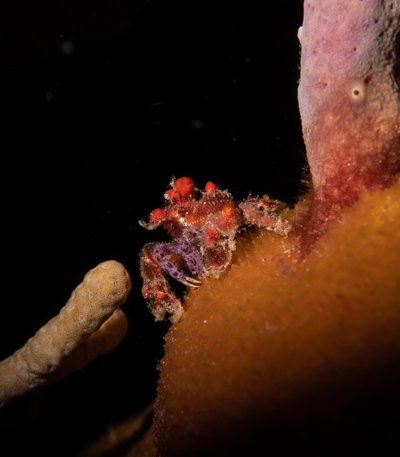
    And, what I found really important was having a strobe focussing light that was accurate, ie where it light was where the snoot would light. This is not always a given depending on the strobe/snoot arrangement.

    I was getting pretty frustrated with an Inon Z240/Retra LSD combination and, after much agonising. sold my Inons and bought Retras. Praise the Lord, it was a miracle!

    Here's couple of examples of showing macro with snoot.

    I don't know which snoot might work best with YS-D1 but a circular flash tube with a central focussing light really helps.


    TG51833.jpg

    TG51862.jpg

    TG52036.jpg

    TG52041.jpg

  11. 2 hours ago, horvendile said:

    @ChrisRoss and @TimG - thanks. I'll think it over. Indeed, skipping on the super macro would save me a large chunk of money.

    Tell you what - this is a trip with Klas Malmberg, don't know if you know about him but he's world famous in Sweden, well, in nudibranch Sweden. I'll try and ask him, see what he says.

    I have been thinking about snoots too. Never used one but... how hard could it be? :) Thing is, I use YS-D1 and I can't seem to find many snoots for those. I may be looking in the wrong places.

    An alternative might be a lower power lens, Alex mustard was full of praise for a +3/+5 diopter which gave just a little more magnification.

    I never shot cold water nudis, I've heard they are quite small, talking with different people they said many Indo-Pacific nudis are giants in comparison, I certainly wasn't near 1:1 when shooting many of them in Lembeh.   There are of course many tiny subjects in the indo pacific dive sites and if they find stuff that is too small for you then  you just have to ask your guide to find stuff in the right size range for your equipment.

    But if it was me I would buy it before I went on the trip and practice at home where a dive costs me an air-fill and some time, compared flying halfway round the world and the expenses of diving and staying.

    Snooting with the YS-D1 might be a challenge unless you get one of the modern snoots with built in aiming light, that co-incides with where the flash goes.

  12. I would probably just get a Backscatter MF-1 Snoot set. I don't think they are much more expensive than the alternative which is the marelux SOFT snoot. I don't think there are that many other high quality options with built in aiming lights.

  13. I have a note on the original question of Horvendile about the use of SMC-1 with the Nikon 105 macrolens and FF camera:

    The situation between MFT with Pana 45mm and Zuiko 60mm plus CMC-1 (or 2) differs from FF. While 1x magnification on the small MFT sensor is already a lot of magnification, 1x magnification on FF means only half of this (a 17mm subject will not fill the entire frame, as it does on MFT, but only half of it). Up to now I was using MFT with both lenses and only seldom was using the CMC-1 (occasionally for eggs of nudies and clownfish).

    I start just now with a Sony FF system and cannot say yet from own experience, but I suspect that a diopter lens is much more useful on FF, in order to get 2x magnification (what, in the end, gives roughly the same magnification, relative to the frame, as 1x on mFT sensor).

    => the advice that with MFT 60mm or 45mm macros, the diopter lens can easily be left at home applies for MFT (I agree, but still like to have CMC-1 with me) but not necessarily for FF, in case similarily small subjects are to be photographed...


    Wolfgang


    Edited by Architeuthis
  14. 12 hours ago, Floris Bennema said:

    I have a 14-42mm and WWL-1 as well but never swap. The main reason I don't like the hassle underwater but also I also never had succes with the 12-42mm with the CMC1.  So I fully agree, use the 45mm and when you need flip the CMC2 on OR dive with the WWL1.

    Me too. Never swap WWL-1. I dive with WWL-1 or flat port with CMC-2 flip.

  15. 2 hours ago, Architeuthis said:

    I have a note on the original question of Horvendile about the use of SMC-1 with the Nikon 105 macrolens and FF camera:

    The situation between MFT with Pana 45mm and Zuiko 60mm plus CMC-1 (or 2) differs from FF. While 1x magnification on the small MFT sensor is already a lot of magnification, 1x magnification on FF means only half of this (a 17mm subject will not fill the entire frame, as it does on MFT, but only half of it). Up to now I was using MFT with both lenses and only seldom was using the CMC-1 (occasionally for eggs of nudies and clownfish).

    I start just now with a Sony FF system and cannot say yet from own experience, but I suspect that a diopter lens is much more useful on FF, in order to get 2x magnification (what, in the end, gives roughly the same magnification, relative to the frame, as 1x on mFT sensor).

    => the advice that with MFT 60mm or 45mm macros, the diopter lens can easily be left at home applies for MFT (I agree, but still like to have CMC-1 with me) but not necessarily for FF, in case similarily small subjects are to be photographed...


    Wolfgang


    Useful perhaps but the depth of field issue bites you harder and you still have to hold incredibly still and you need to be able to find the subjects of course.  My main point against it for a trip to a macro rich destination is there is more than enough bigger stuff in normal macro range to keep you busy.

  16. Hello again! Hijacking my own topic I continue about snoots. @hyp above suggested the Backscatter MF-. I'm not sure which one that is. But I did find this device at Backscatter (which appears to ship to Sweden): 

    https://www.backscatter.com/10Bar-Snoot-for-YS-D1YS-D2

    10Bar Macro Snoot Set for Sea & Sea YS-D1, YS-D2 & YS-D2J Strobes

    It has a light guide for the LED in the strobe. And it's not super expensive. Do we know anything about it? For example, whether it works in practice.

    I mean if it doesn't, I could almost as well take the top of a plastic bottle, paint it white and duct tape it to the strobe.

  17. The 'top of plastic bottle' snoot is something that many people try, and almost universally abandon as unworkable. This device looks little better - the problem is, YS-D1/YS-D2 have an off-center modeling light, and thus your aiming spot is not aligned with what the strobe is actually going to light. Sea & Sea has a snoot for YS-D3 which uses a prism to fix this, but it won't fit the earlier strobes. 10Bar has a laser attachment which will fit this snoot and simplify aiming, but it has its own issues - some critters will actively chase the laser spot when they see it, and while it gives you an idea where the strobe is aimed, you won't know how big the spot is going to be until you take a shot and review it.

    Backscatter MF is this: https://www.backscatter.com/Backscatter-Mini-Flash-2-Optical-Snoot-Combo-Package

    It has two modeling LEDs bracketing the flash bulb from both sides, so the resulting beams are aligned. It's a bit expensive, but having the snoot on a separate strobe allows you to quickly switch between snoot and regular shots, much faster than attaching/detaching a snoot to a regular strobe.

    I personally use a Retra LSD, but I use it with a Retra flash, which has a circular flash bulb and modeling LED in the middle, which prevents alignment issues.

  18. Thanks @Barmaglot! Good intel. So, I understand the Backscatter MF you linked to is a standalone kit, not needing any separate strobe. Maybe a stupid question - do you usually use one or two snoots? I would have guessed two, as that's standard for strobes, but I've never used a snoot before. But with two snoots mounting on the camera housing requires some thinking, at least if I want to bring strobes also. 

    (Also requires a respectable amount of money but one thing at a time.)

    Edited by horvendile
  19. Backscatter MF-1/MF-2 is a small strobe, yes. I believe it uses the same light head as AOI Q1 strobe, but in a different housing. The now-discontinued MF-1 is manual only, MF-2 offers RC TTL with Olympus cameras and remote triggering.

    I can't imagine using two snoots except with a tripod; managing one is difficult enough - you're looking through the viewfinder, holding the camera in your right hand to frame and focus, while manipulating the snoot-equipped strobe with your left hand to aim the narrow light beam. A second snoot would basically require a third hand, and there isn't much point, unless you're getting creative with wide-angle shots rather than macro, which is the typical use case for snoots. I've never seen a dual-snoot setup in the wild.

    The typical setup for MF-1+snoot is on top of the camera, where the focus light usually is, while regular strobes are on the handle-mounted arms.

  20. I'm a big snoot fan and, like Barmaglot, use the Retra strobe and Retra LSD combination which works very well. The circular flash tube surrounding the centralised aiming light is the ideal setup for snooting. 

    As Barmaglot says, I think many of us start with a painted set of plumbing piping or plastic bottles. And, yep, it doesn't work! Sadly. Very satisfying to build, but hopeless in creating snoot-lit pictures as it's almost impossible to aim correctly.

    Agreed too, that two snoots are definitely one too many - although I did try with two sets of painted plumbing piping.

    I set up with the snoot on my left hand strobe; hold the camera with my right hand and make (hopefully) small adjustments to the strobe/snoot position with my left hand.

    Like so many things connected to u/w photography, it's practice, practice, practice - but it does require the right gear otherwise high levels of frustration are likely.

    Have a go with a painted plastic bottle by all means, but don't expect much and relish it if you do get a well-light pic - or perhaps I should say a pic that is snoot-light as you intended.  I think I managed it once........

    Edited by TimG
Reef Photo & Video

Account

Navigation

Search

Search

Configure browser push notifications

Chrome (Android)
  1. Tap the lock icon next to the address bar.
  2. Tap Permissions → Notifications.
  3. Adjust your preference.
Chrome (Desktop)
  1. Click the padlock icon in the address bar.
  2. Select Site settings.
  3. Find Notifications and adjust your preference.