1 hour ago, Architeuthis said:
Massimo,
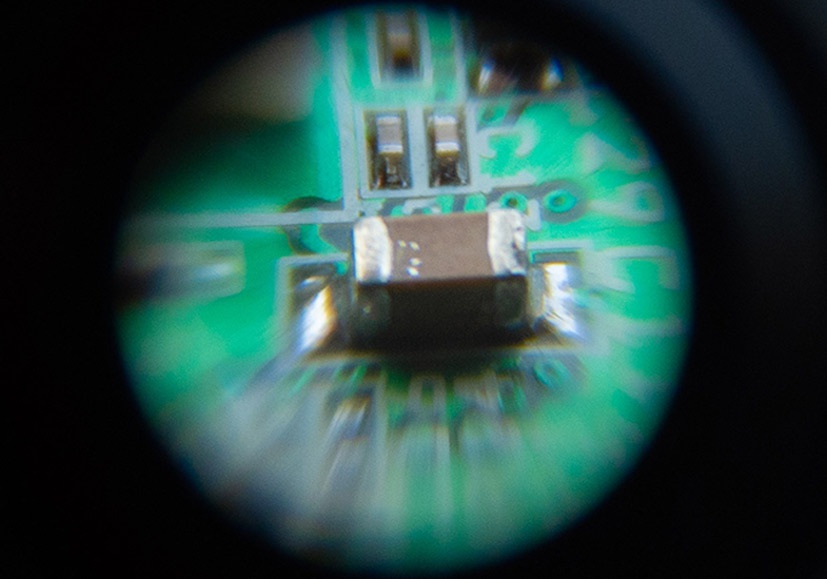
I see a blurred image (presumably an out of focus image through a domeport (in air?)?). Can you please explain how this would be related to spherical aberration?
Nevertheless I must correct part of my statement: spherical aberration leads to less resolution in the corner of an image compared to in the center, not the same throughout the image (but also other lens imperfections contribute). The loss in resolution is, however, also seen in the center and towards the edges the resolution decays by 40%-70%, depending on lens quality. I do not see how this effect could be responsible for the loss in corner sharpness, produced by a domeport...
When browsing through the internet, I could find some articels about how domeports work in principle, but I could not find one, how exactly, they produce optical imperfections, as e.g. unsharp corners (the working hypothesis for blurry corners is usually the curved virtual image). If you are aware of some article, please post the link, this would be highly interesting ...
Wolfgang
Wolfgang
Hi Wolfgang
The example is simply what comes from a cheap spherical lens that exhibits blurring at the edges similar to what you see in some dome port shots.
You will not find literature on dome port nor any quantification of how the edge improve due to the size of the dome
This research paper https://www.mdpi.com/1424-8220/16/1/48
Show that there are 3 effects of a dome port
1. Increase of depth of field as infinity is closer
2. Field of curvature
3. Spherical aberrations
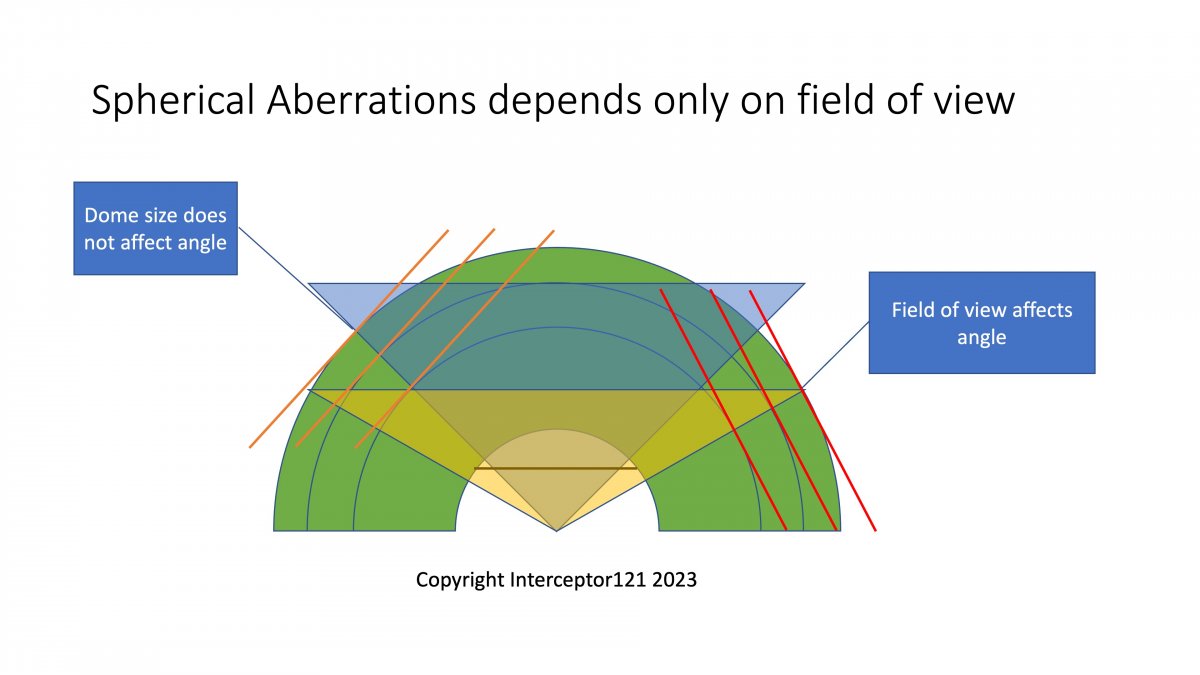
For the purpose of understanding the performance of a dome port I think about the optical system as a combination of the master lens and the dome with the assumption of a correct position and not considering the dome thickness
If you think that way a dome is a positive meniscus lens

But the reality is that the thickness does not change that much as you move to the edges so the rays do not converge all in a single point
See diagram 2 here

When the rays are not collimated you get spherical aberration and to minimise it you close the lens aperture.
As wider lenses have more diverging rays they are more subject to spherical aberrations. The statement from wikipedia seems to indicate that the area free of aberrations is delimited by the arcsin of the ratio fo the refraction index and therefore 67% of the diameter is free of defect
A spherical lens has an aplanatic point (i.e., no spherical aberration) only at a radius that equals the radius of the sphere divided by the index of refraction of the lens material. A typical value of refractive index for crown glass is 1.5 (see list), which indicates that only about 43% of the area (67% of diameter) of a spherical lens is useful.[citation needed]
This would mean that a lens wider than 24mm will exhibit this issue topside
When you put water index which is higher than air this angle would become 124.9 andthe surface would be 88% so although there are spherical aberration it would seem that water would reduce them not increase them
Now the issue with field of curvature is also there but at the same time the dome increases depth of field which is how you fix field of curvature.
Having taken shots topside and underwater of the same test target what I can say is that overall the situation does not change that much at all. In my tests at close range f/16 was needed both topside and underwater to get everything more or less in focus with both a fisheye lens and rectilinear lens
I would say that in majority of cases the reason why photos taken with rectilinear lenses look ugly is because close up photos of rectilinear lenses that are very wide look ugly also topside and underwater is no different
In conclusion the dome when correctly positioned and the right size (different discussion) does not appear to alter the topside performance of the lens. However as most underwater shooters are unaware of the topside performance of the lens they complain about edges that in most cases were either identically or blurred even topside





 ?) or even WWL/WACP optics...


