Skip to content

Photography Gear and Technique / Archived topic

Nauticam for Canon EOS-R50

Started by ColdDarkDiver ·

  • 21Posts
  • 21Replies

Read-only discussion

Nauticam for Canon EOS-R50

21 posts
  1. As on the front page:

    https://wetpixel.com/articles/nauticam-introduces-housing-for-canon-eos-50

    Nauticam released a housing for the R50 which takes essentially a P&S approach and adds it to the mirrorless market (no interchangeable port and tied to the kit lens).  AND not at a crazy (ish) price tag.  The R50 in this setup seems like a new version of what used to be the G7 ii/iii housings and the equivalent from other manufacturers.  No real macro port but the housing is clearly setup for wet lenses.  And the camera body is pretty cheap.

    I see a couple downsides... small battery, only 30p in 4k.  I am torn on the use of the internal flash to fire the strobes.  I love not having to buy a second device to fire my strobes but this can stress an already small battery - but then again it does TTL for not 400-500 USD - which is what all the TTL adaptors are.

    I'm looking forward to peoples thoughts and how this is in the wild.  The entire cost - with camera and lens - is cheaper than some dome ports alone.  Which is pretty compelling.  As a backup system for remote trips, doesn't seem like a bad plan or a "just getting into it" option = also seems good.

    I do wonder whether this will be the new route that Nauticam goes for multiple cameras.  The Sony ZV-E1 is another one that seems like being put in a housing that is dedicated to wet mount lenses could really make it accessible to a swath of people who don't want to drop 3-6k on a housing.  Not to mention the Canon R8, R10... whatever the A7c ii will be...

    Personally, I see this as a really interesting step considering the very unexciting options in the P&S range right now and the exciting entry level mirrorless.  

  2. I find this a really interesting innovation too. Like you say this is a price sensitive areas of the market. Where the typical user isn’t going to want to have a buy a fisheye, macro lens and flash trigger just to become an underwater photographer.

    If it proves popular I can see Nauticam using their optical expertise to enable users to do all sorts of different shots with this one lens.

  3. I too was surprised by this Nauticam announcement plus smiled a bit :)

    Back in the film days many Japanese photographers would buy the least expensive SLR and spend $$$$ on lenses and travel. You could buy 2-3 spare bodies too......

    Today Nauticam's wet lenses provide incredible capability including zoom through with modest priced "kit" lenses. This could be an all in one solution for those who don't want to haul multiple ports, lenses, etc. I see the same with recent testing going on by Phil Rudin with the Sony 20-70mm lens and a 180mm dome port. 

    The built in flash on many Canon cameras can be set for a manual modest power dump to trigger an accessory flash in manual mode. That would extend battery life somewhat and shooting all ambient images many batteries deliver way more than the CIPA rating.

    I know this from personal experience using my small Canon G7X II 1" sensor compact. On one whale shark snorkel I shot over 1100 frames and still had power left from the tiny NB-13L battery. 

    I certainly don't think high end mirrorless camera, lenses, housing, etc. will go away. But for many people solutions like this new Nauticam offering will certainly be a great choice.

    David Haas


    Edited by dhaas
  4. I think this will be an excellent entry level, one lens kit. I have tried and reviewed kits like the Ikelite with the Canon Rebel/SL3, AOI kit with the Olympus EPL-10/9 and others for years and they are great entry level moves up from compacts. 

  5. This team will be a good alternative, if in the future is developed a wet lens that covers the range of 180º to 130º.

  6. Did someone already figure out the difference in weight/size between this housing (with handles) against the R7 housing with the appropriate flat port for the RF S 18-45mm lens and if yes, is the difference really worth sacrificing the modular system?

    I think the R7 is a much better camera and the flexible modular system with exchangeable ports (e.g. for macro) is more appealing...


    Wolfgang

    Edited by Architeuthis
  7. 19 minutes ago, Architeuthis said:

    Did someone already figure out the difference in weight/size between this housing (with handles) against the R7 housing with the appropriate flat port for the RF S 18-45mm lens and if yes, is the difference really worth sacrificing the modular system?

    I doubt the size/weight difference is significant, maybe about half a kilo, but the cost difference is very noticeable - the R7 housing alone is over $3k, add a flat port for wet lenses, and the price premium over R50 goes to over $2k; more than $3k if you include the cost difference in camera bodies. Yes, R7 is a better camera than R50, but is it three thousand dollars better? For some people - yes, but not for others.

  8. One thing I hadn't noticed on the original announcement but now see is that it doesn't come with handles and a tray system.  If you go with the Nauticam one (which are the most seamless for their housings) that is another $309.  I hadn't realized this and this does start to slightly lessen the cost difference between the R7 and the R50 housings.  An unfortunate choice by Nauticam not to include it (even if I am still excited about the housing).

    However, as Bermaglot points out - there is still a very large price difference between the two housings + Cameras.

  9. A few other observations on going small and less $$$$$ regarding this housing.......

    One, I note no viewfinder with only LCD window for framing. I applaud this approach as large 100% LCDs have continually improved.

    No, the lowly Canon R50 isn't a 3 million pixel one but considering underwater you look through your face mask and however close you shoot it works fine.  Towards my last days shooting my Canon SL1 in an Ikelite DLM Dry Lock Mirrorless small housing I used the LCD  practically 100%. I could extend the length of my arm into holes, under ledges, etc.and see the frame.

    As to tray and handles I'll have to check for mount holes on the Nauticam housing. Many friends and I have begun to ditch anything that adds bulk mounting a strobe or aiming light right on the housing mostly for one strobe shooting.

     Solid attachment points is necessary but can streamline a set up. No, you likely won't be able to mount dual strobes and tons of accessories but it sure is light and easy to dive with.

    There are mounts available allowing quick disconnect of a strobe to hand hold aiming and Inon has a slick little YS one I've seen........For decades we shot holding your camera (Nikonos) and  a single strobe ensuring your light was on why you wanted to illuminate.

    Just some ideas and your mileage may vary!!!

    Please don't take any of my comments negatively. I'm just an observer of technology change and long time enthusiast who questions and tries different methods :)

    David Haas

  10. 43 minutes ago, ColdDarkDiver said:

    One thing I hadn't noticed on the original announcement but now see is that it doesn't come with handles and a tray system.  If you go with the Nauticam one (which are the most seamless for their housings) that is another $309. 

    It's a standard tray with two 1/4" screws; you can get those for less than a hundred if you shop around. On the other hand, the R50 housing comes with a zoom gear bundled - a $220 value otherwise.

    Basically, looking at list prices, an R50 setup (sans strobes) will cost $799 for body + 18-45mm lens, $1494 for housing, $220 for vacuum valve + pump, $150 for tray (assuming Kraken, for US availability), $1494 for WWL-1B,  $387 for CMC-2 and $58 for bayonet mount adapter for CMC, total $4602.

    An equivalent setup based on an R7 will cost $1499 for a body, $299 for a lens, $3163 for housing with handles, $220 for vacuum valve, $220 for zoom gear, $457 for port, $1494 for WWL-1B, $387 for CMC-2 and $58 for an adapter, total $7797.

    If you want to shoot the R7 with fisheye + macro lenses, then you pay $1499 for body, $99 for adapter, $519 for a Tokina 10-17mm, ~$300 for a Canon 60mm macro (not available new anymore), $3163 for housing, $220 for vacuum valve, $597 for an N100 to N120 adapter, $202 for zoom gear, $668 for a dome, and $483 for a macro port. I think the dome will also need a 10mm extension (as SKU 18804 designated for Tokina 10-17mm is no longer available, and other domes take a 10mm extension, so I'm guessing the generic 18803 needs it too), which is another $158, so total $7908. A 100mm RF macro instead of 60mm EF-S plus the appropriate port will push the price up by another thousand or so.

  11. 4 minutes ago, dhaas said:

    One, I note no viewfinder with only LCD window for framing. I applaud this approach as large 100% LCDs have continually improved.

    Good point - and it takes the LCD magnifier hood. $271 for the hood + attachment rails gives you a viewfinder-like experience.

  12. 29 minutes ago, Barmaglot said:

    $150 for tray (assuming Kraken, for US availability)

    The Nauticam tray works with their fancy vertical trigger that comes with the housing.  If people are seeing this thread when shopping, I think the extra money for nauticam (in this instance) is worth it.  I really like that vertical trigger with thick gloves.  Or can the Kraken tray work with that Nauticam attachment?

    One other quick note - the setup will work with the WWL-C which is another spot to potentially save some money.  You lose 14 degrees of coverage on the wide end but it gets even smaller and $500 less.  Lots of modularity with this housing even though it has a fixed port!

    Agree with the sentiment that there is nothing wrong with a small housing with one strobe. (actually a lot right with it).

  13. 24 minutes ago, ColdDarkDiver said:

    The Nauticam tray works with their fancy vertical trigger that comes with the housing.  If people are seeing this thread when shopping, I think the extra money for nauticam (in this instance) is worth it.  I really like that vertical trigger with thick gloves.  Or can the Kraken tray work with that Nauticam attachment? 

    I have a trigger like that on a totally generic tray with a SeaFrogs housing. Costs twenty bucks.

    https://www.aliexpress.com/item/32918340010.html


  14. 34 minutes ago, ColdDarkDiver said:

    One other quick note - the setup will work with the WWL-C which is another spot to potentially save some money.  You lose 14 degrees of coverage on the wide end but it gets even smaller and $500 less.  Lots of modularity with this housing even though it has a fixed port!

    Or an AOI UWL-09F via M67 adapter, which will save you another $400 over WWL-C and keep 130 degree coverage.

  15. Question about the R50 Nauticam kit: what is the expected macro capability for the kit without any add-ons?

    Thanks in advance,

    Tom

  16. 35 minutes ago, wydeangle said:

    Question about the R50 Nauticam kit: what is the expected macro capability for the kit without any add-ons? 

    RF-S 18-45mm specs say max magnification 0.16x, so none to speak of. If you want to shoot macro, you will need a diopter.

    image.png.ab8130e81849cd55ebd2c1c1bc31a2bf.png

  17. Well, you can call me a pioneer (you know, the guy with all the arrows in his back...) since I've just ordered the R50 + Nauticam setup.

    Reef Photo says they'll have it any day now but no longer than 2 weeks. I hope that's correct because my next dive trip is at the beginning of June 2023.

    If I get any experience with it I'll report back here. It'll be used for 4K video including macro.

    Fingers crossed,

    Tom

  18. Sounds also (on top of the constructive comments above) like a nice backup system (i have R7+Nauticam and a Canon 80D housed in Aquatica) as in missions and science projects, back up can save the dissemination work.

  19. Happy to report the NA-R50 housing arrived today. Installed accessories and the camera and have it ready to go into a pool in the next week I hope.

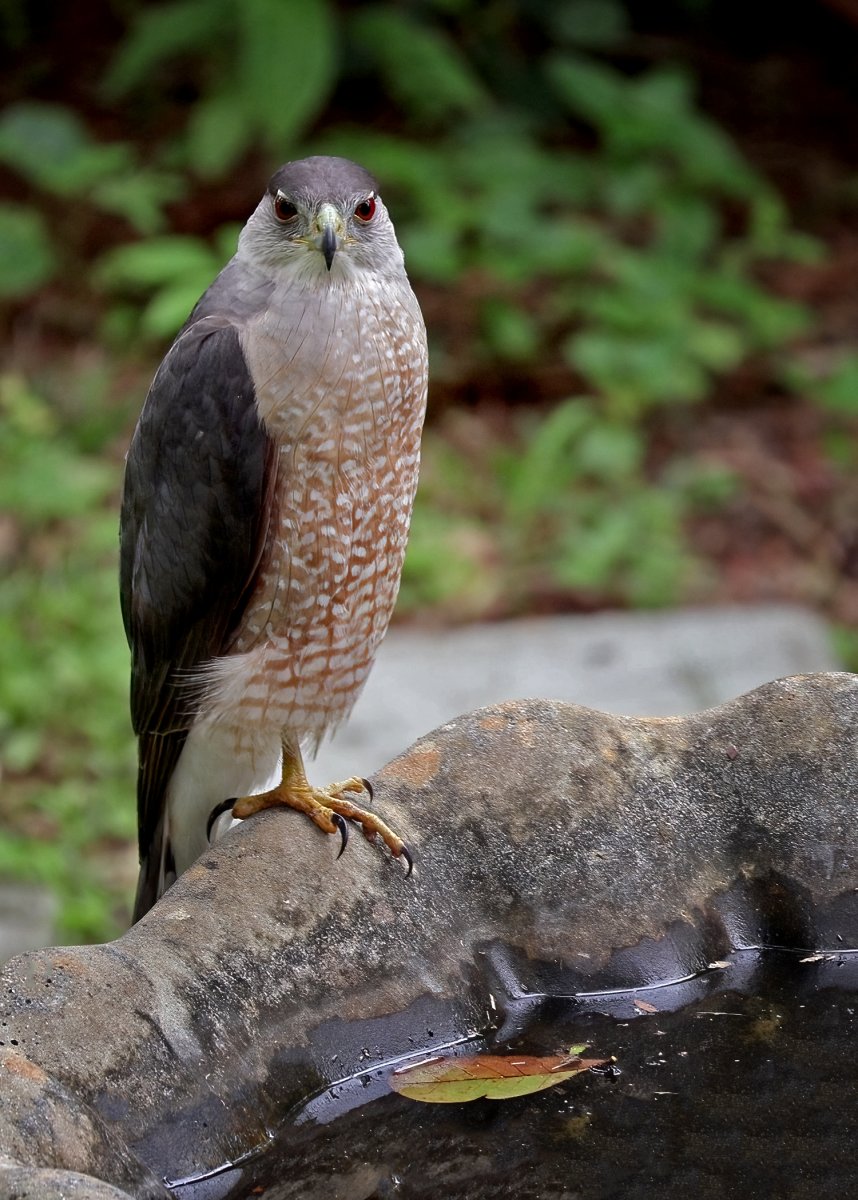
    As to the R50's image quality, here's a shot of Sheldon (our Cooper's Hawk) at the back yard bird bath. He's a regular visitor. This was taken with the R50 with the 100-400mm lens from about 50 feet away. And it's a freeze frame from a 4K video. Click on the photo to get a better version. Quite satisfied - I hope the underwater clips turn out that good ;-)

    The only R50 negatives so far are trying to see how much battery remains when the symbol is quite small and only has 3 sections, so it's not a very precise measure, and the remaining space on the single SD card seems only available if you select the FORMAT directive, and then you need to be really careful not to tell the camera to actually complete the format. Seems kinda risky to me but I haven't found an alternate way of finding that information...

    I did find an incorrect instruction in the Nauticam manual concerning the viewfinder/LCD (screen) selection. The manual advised AUTO1 which didn't work - the SCREEN selection did fine. I've passed this comment to Nauticam so it's probably fixed by now I hope.

    I also tried a Reefnet SubSee 10x diopter (in air) which didn't provide much enlargement there; when it goes underwater I expect a better result. I used the Nauticam bayonet adapter to install the lens.

    I didn't buy a tray; just a right hand strap to keep the size and weight down. Again, above water it seems fine.

    I also installed the LCD magnifier from Nauticam so glare or reflections shouldn't be problematic.

    The whole setup is probably 15-20 pounds lighter and half the volume or less compared with my Gates AX700 rig. I'm really looking forward to using this setup in Bonaire in a few weeks!

    I'll post more impressions/experiences as they become available,

    Tom

    Sheldon 4-2023 back yard.jpg

    Edited by wydeangle
  20. Since I'm using the Nauticam/R50 combination for video almost entirely, I'll start a new thread in the Video Gear and Technique Forum.

Sea & Sea

Account

Navigation

Search

Search

Configure browser push notifications

Chrome (Android)
  1. Tap the lock icon next to the address bar.
  2. Tap Permissions → Notifications.
  3. Adjust your preference.
Chrome (Desktop)
  1. Click the padlock icon in the address bar.
  2. Select Site settings.
  3. Find Notifications and adjust your preference.