



Skip to content

Photography Gear and Technique / Archived topic

dSLR viewfinders

Started by Trevor Rees ·

  • 23Posts
  • 23Replies

Read-only discussion

dSLR viewfinders

23 posts
  1. A decent viewfinder must surely add to the ease of use of a dSLR underwater.


    I'm sure this topic must have come up at times on WetPixel before but a further discussion might be worthwhile. Here goes:


    From the current crop of popular dSLR cameras that are going in to housings has anyone a clear idea of which model has the largest viewfinder? The models I'm referring to are the Nikon D100, D70, D2X as well as Canon 300D and 20D.


    Following on, is there much to choose between the standard viewfinders that you get on the popular housings such as Ikelite, Subal, Nexus, Seacam, Sea&Sea, Aquatica etc. Can any particular housing claim to be better than any other?


    As a seperate question - I'm aware of the additional viewfinder magnifiers that only Subal and Seacam appear to offer. For those that have them just how much of an improvement are they?

  2. I can only speak for Subal GS Viewfinder, with D70, it makes a huge difference.

    D2X has the biggest viewfinder of all Nikon dSLR, don't know how it compares to 20D but definitely bigger than 300D/350D.

    With GS Viewfinder and my D2X, my mask does not have to press against the viewfinder on the housing all the time to be able to see the whole frame and all the readings like my D70 and Sea and Sea housing.

    However I have not try it underwater yet but on land with my glasses on, I can see the entire viewfinder of D2X with the GS viewfinder 2-3 inches in front of me but the view get very mushy and soft if I move it further away.

    Edited by ssra30
  3. I believe that the order is this (Specs from Dpreview reviews)


    From largest to smallest.


    1DsII, D2X, 1DII, 20D, 300D, D100, (350D D70 tie)

    Edited by acroporas
  4. As a seperate question - I'm aware of the additional viewfinder magnifiers that only Subal and Seacam appear to offer. For those that have them just how much of an improvement are they?
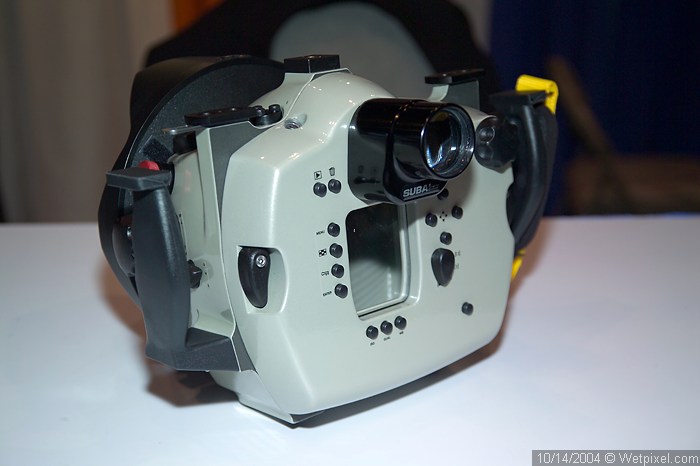


    Trevor,


    I've used the Seacam S45 (the angled viewfinder) extensively.


    The first thing I noticed was that I really needed to ensure my eye was correctly lined up with it - if you're not looking straight through, then the corners of the viewfinder go black (The same problem you can find when using binoculars)- I got used to this after a few dives, so it's not a problem.


    Secondly, whilst it's great for macro (it really does make a difference being able to view the camera at an angle, especially when it comes to not damaging the environment), it is a bit of a pain when tracking large animals. This is the very reason why they also make the S180, which has the same magnifying qualities, but not the angled view - browse www.seacam.com for more views. If money was no option, I'd buy both.


    My initial view was that these were not worth the huge cost, however, my other housings use the standard G-Pro magnifiers, and I only had to use these once to see what a marked improvement the S-series magnifiers were.


    So personally, I recommend them highly, providing you're aware of their limitations and quirks.


    Cheers


    Steve

  5. In my very personal opinion the magnified housing optics (like Seacam & Sealux offer) are a great luxury for full frame and film cameras. I always would go for them. Composing and judging images is so much easier. But the smaller the camera viewfinder gets with cropped DSLRs - the more this option really becomes necessary in my opinion. That’s why I finally have chosen Sealux (Only 10D housing with this kind of viewfinder).


    I use the Sealux GD finder and love it. I got used to it right away. Even fast action stuff is absolutely no problem with the required straight forward sight. I have looked thru the Seacam finder (the 180 straight one) as well in the past, but I have not compared the Seacam and Sealux enhanced viewfinders side by side. From data Seacam does 1:1,0 and Sealux 1:1,1. That would mean the Seacam viewfinder image is 10% larger and translates your camera’s viewfinder image without shrinking. Subal is identical to Sealux as they get the viewfinder from Sealux.


    But the housing viewfinders magnify only the size of the camera’s viewfinder. So the combination of housing viewfinder and camera viewfinder is what counts in terms of size.


    I would also be interested how the normal housing optics compare as there are differences as well. But there are virtually no data available and I haven’t used too many housings in order to have an idea.


    If I understand this stuff correctly you have to take the sensor size, apply coverage (%) and multiply the value with the viewfinder magnification from camera’s specs:


    viewf.gif


    I find it remarkable that every millimetre makes a visible difference if you look into the cameras side by side.


    Regards,


    Julian

    Edited by Jolly
  6. Don’t forget Konica Minolta 7D. It has the biggest viewfinder in its class. (And the biggest LCD screen and the best control system)

    Unfortunately it’s an ignored camera in the underwater world.


    Marcell

  7. right, quiet big for its class (24,2mm diagonal). did not expect so.


    As far as I know only UK-Germany does a metal housing for this camera. Featuring a different (more modern?) design than the other UK hosuings:

    http://www.uwpix.net/phpbb/viewtopic.php?t=62


    Julian

    Edited by Jolly
  8. Camera manufacturers also have something called "eyepoint" what does that mean?


    Cheers

    James

  9. eyepoint describes the maximum distance from where you still can see the entire viewfinder image. I think it's usually given in millimeters referenced to the eyepiece, but I'm not sure.


    That's where the term 'high eyepoint finder' comes from in concjunction with some amphibic cameras. You still can view the entire viewfinder image with your eye being further away.


    Maybe this point has to be taken into consideration when it comes to enhanced housing sportsfinders? I still don't know if it's as simple as I have worked out quickly for some camera models above. However, housing sportsfinder are great :blink:


    Julian

    Edited by Jolly
  10. A few useful thoughts are coming out.


    From my initial posting I had not thought that the early discusion would be biased towards add on viewfinder magnifiers. Perhaps it is evident to those that have them how worthwhile they are as an extra worth paying for.


    It seams that Subal owners like their GS viewfinder and the Seacam owners their S45 and S180 viewfinders. I had not heard of the Sealux brand before but they also have a decent looking add on viewfinder magnifier.


    The Seacam magnifier looks less than ideal on a camera like the Nikon D70 if a chunk of the LCD is going to be covered up by its large size.


    I can find no similar optional extra for the likes of Nexus, Ikelite, Aquatica and Sea&Sea. This seems a shame. I wonder if this renders these housings somewhat less desirable especially for the smaller viewfinders in cropped sensor camera such as the Nikon D70 which might really benefit from extra magnification.


    I still have little idea when comparing the standard eyepice viewfinder built in to a housing as to whether one brand is significantly better than another?

  11. I have the Subal G180 Viewfinder on my D2X hosuing (or whatever it is called).


    It is hard for me to make a judgement as the D2X has a much bigger viewfinder than my Fuji S2 so I am unsure whether it is the camera viewfinder that is making it much better or the viewfinder itself - I suspect it is both.


    You do have to line up your eye properly to use the viewfinder, but once you have a dive or two with it, that isn't an issue anymore (very natural) and then you have full view of the viewfinder and just as importantly some of the info in the viewfinder as well.


    Must say that I will always go for this option in the future but that is basically because I want to make sure I have every advantage possible in getting a shot. it is one of those options that wont make me a better photographer, but it certainly wont make a worse one.


    As for hosuings without them - I have had plenty before and the lack of a viewfinder doesn't make them any less attractive - especially with the premium charge these viewfinders run. I mean you can buy a whole housing for the cost of a SeaCam viewfinder.


    M

  12. It seams that Subal owners like their GS viewfinder and the Seacam owners their S45 and S180 viewfinders. I had not heard of the Sealux brand before but they also have a decent looking add on viewfinder magnifier.


    You don't have to think about how they compare, as stated above Subal doesn't make one on its own. Subal GS180 is the Sealux finder.


    041014_142430_1.jpg


    cc10cgr.jpg


    Seacam offers the best finder (slightly bigger image, 45° model, interchangeable by user, ....). As marriard has pointed out, you can get a housing for the money you pay for the Seacam finder. Therefore I find the Sealux finder very attractive and it's a bargain compared to the Seacam finder (I've paid 500 € - later upgrade costs a bit more). I don't know what Subal wants to have for the finder, someone here mentioned it's a bit more.


    To me the finder provides an image which is roughly quiet equal in terms of size to that on land when looking into the camera without housing/diving mask. You simply have no shrinked small viewfinder image underwater anymore. I highly reccomend these finders for a D70 housing if you have the choice.


    regards,


    Julian

  13. Interesting point on the above images of the Subal/Sealux viewfinder...


    Both are NOT shown as you use them underwater. They have a screw on hood/cover which allows you to block ambient light and actually see the viewfinder correctly.


    If you do not add this screw on, it is almost impossible to use the viewfinder underwater as I found out the first dive I tried to use it on....


    I think I paid $785 or $800 USD for the viewfinder on the Subal. I'll look it up later.


    M

  14. The Nexus D100 housing (and others) come with a so-called pickup finder, a magnifier which clips over the viewfinder on the camera body and remains inside the housing. It provides magnification of the viewfinder image. I've never had an issue with it, although I haven't used the external add-on eyepieces. I'm sure they're great, but again, the viewfinder has never been a problem in my UW photography.

  15. SSRA: It is not clear to me that an add on magnifying viewfinder can actually make what you see better coverage than the camera's own viewfinder. For example, the 20D has a 95% coverage without being in a housing, I am pretty sure that you can not get full coverage by adding a magnifier. Am I missing something?

  16. SSRA: It is not clear to me that an add on magnifying viewfinder can actually make what you see better coverage than the camera's own viewfinder. For example, the 20D has a 95% coverage without being in a housing, I am pretty sure that you can not get full coverage by adding a magnifier. Am I missing something?


    I don't think the magnifying viewfinder will give you more coverage so if your viewfinder has 95% coverage, the magnifying viewfinder will still only give you 95% coverage but at a larger view. AT least this is my impression anyhow.

    I never tried the D2X without a magnifying viewfinder but had a D70 Sea and Sea housing before and looking at a D70 through Sea and Sea vs Subal with GS Viewfinder, the difference is very noticeable.

  17. it is one of those options that wont make me a better photographer, but it certainly wont make a worse one.


    Shooting with a magnifying viewfinder has definitely enhanced my photography. I KNOW when I click the shutter whether or not I got the shot. I think that allowing you to see your subject in detail is one of the most important functions of any housing.

  18. I'm currently using the Seacam S45 viewfinder. This viewfinder is very good for macro and allows very low shots. Since I fitted it I cannot think of going back to a 'standard' viewfinder. I initially used it with an S2Pro where it gave a far better and more viable view for composing, and now use it with an EOS1DS which really works very effectively with it. Oh yes, and it rotates for vertical shots too!


    Although I don't actually use one myself, the S180 also rotates and if required can give a view effectively through the lens axis, allowing for great ease of tracking moving subjects.


    Neither of these viewfinders are cheap, but both make camera operation easier by increasing the ease of composition which is, in my view, the most important aspect of photography.


    I haven't looked through the Sealux/Seacam finder but assume that it operates in a similar way to the 180 (but doesn't rotate?). I expect that all these finders enhance the small digital format viewfinders significantly.

  19. Just wondering if the Subal / Sealux viewfinders are actually interchangable ?


    It is clear that they look the same but is it the same mount ?

  20. The Subal GS Viewfinder is fixed to the housing and has to be fitted either by the factory or only certain dealer. It is not removable by the user like the Seacam so unless you know what you are doing, I probably would not try to get a Sealux viewfinder and try to mount it yourself on a Subal and vice versa.

Backscatter

Account

Navigation

Search

Search

Configure browser push notifications

Chrome (Android)
  1. Tap the lock icon next to the address bar.
  2. Tap Permissions → Notifications.
  3. Adjust your preference.
Chrome (Desktop)
  1. Click the padlock icon in the address bar.
  2. Select Site settings.
  3. Find Notifications and adjust your preference.

