Everything posted by Chris Ross
-
I do the same, my Maha I always use on soft charge mode.
-
Many cameras have the option to use 1/2 or 1/3 EV steps buried deep within the menus. But realistically it's probably not making a huge difference.
-
On the subject of using a curved port for macro, clearly the port shown in the video is nowhere near correctly positioned at the centre of curvature and this is discussed in the video. The narrow angle of view of the Macro lens means the aberration from incorrect positioning as light towards the edge of the field is refracted is much smaller. Clearly the mentioned port is going to be the easiest to use if you can get it special order. You would get similar results using something like the 4.33"dome port and appropriate extensions, but maybe not so easy to use? You would however need to buy one of the expensive N100-N120 converters as the dome is not available in N100. On the Nauticam #36471 n100-n85, the Nauticam website shows it in stock, though Backscatter says its discontinued.
-
Marelux just announced their monitor: https://www.instagram.com/mareluxunderwater_housing/p/DJ3GgRLzFcz/?img_index=1 Doesn't seem to be much data on it as yet.
-
Particularly with m43, there's minimal image quality advantage for using a large dome with a fisheye lens, though an 8"dome certainly will with over-unders. It looks like the only Pen housing to OM-D port adapter sold adds 37mm of extension which is too long to use with your 4"dome. The thing to be aware of if you went with the 8-25 is to resist the temptation to zoom in too much as opposed to getting closer. You do of course lose the fisheye effect if going that way. I think it's probably best to practice more with your strobe placement, particularly getting them well back behind the dome.
-
I think the risk with the longer adapters is vignetting due to the smaller diameter dome shade, compared to the 140mm dome. . Easily checked out on land of course, though the N85-N120 adapters are quite expensive these days. If you don't want to go with the 10-17 or 8-15 it may end up being cheaper to buy an N85 100mm dome, particularly if you could source one second hand.
-
Depends on which port, Nauticam N120 are easily adapted to Isotta and S&S, just by changing the lug ring. But there is very little I've seen to use N120 ports on smaller system ports like n85, or Isotta B102 which go with the m43 cameras. I think it probably unlikely to find anything you can use on AOI or Seafrogs. A lot of adapters have been discontinued recently, Backscatter still has a few of them: Backscatter.comBackscatter Underwater type: Port Adaptors - BackscatterBackscatter Underwater type: Port Adaptors
-
I suspect you would need to use a custom made adapter. The 10.5mm is not on the Nauticam port charts any longer, but I seem to recall it used no extension and looking at the N120N dome it appears it uses no extension either. The Port charts specify a 17mm extension for the Olympus fisheye , so it seems like there is enough room to make an adapter. This means you would need a 17mm N85-N120 adapter which is not made. As for buying the metal only part of the n85 DP100 dome I would suggest messaging Reef photo to see if they have that as an option. This is what you would need to buy because as far as I can see the aluminium part of the N85-DP100 dome is machined from a single piece of aluminium. It might work out cheaper to pickup a second hand dome is you could find one? An alternative might be to use a Tokina 10-17mm, you can buy a N85-N120 adapter for that to use on m43 with the Metabones speed booster. You would need the lens plus N120 zoom gear the appropriate N85-N120 adapter and possibly an extension ring to use with your dome. There are probably various options to allow you to use your dome in that setup. There are people on here using that combo including Wolfgang( @Architeuthis ). You could put up another post seeking experience with that combination and the part list if it was of interest to you.
-
In theory only the contacts need penetrate the casing. The little magnets don't need to go all the way through to work. Only way to tell for sure would be to cut one apart. From the picture the contacts seem to be stainless steel so should not rust. If you get a new casing should be minimal risk to file the old one flat to see if it fixes the attachment issue..
-
If you google a replacement battery it seems to show the back end of the torch complete with outer skin and battery contacts. It's not entirely clear though that you would get the whole back end of the torch. Agree that the magnetic contact seems to be a weak point. You could try scraping the rust off and then soaking in citric acid.
-
Just to clarify, are the contacts shown are outside of the torch? I would expect that the rust is from the magnets used to hold the charger in contact with the terminals. I would think that just scraping back the rust and also considering sitting the contacts in a citric acid solution it would cleanup nicely. Iron oxide aka rust is soluble in citric acid but it won't dissolve the iron that has not yet rusted. Also to clarify, is the new battery a complete unit with outer casing and contacts? It seems like a spare battery is a better deal than a new torch.
-
As far as I know for infinity focus you need to be quite precise in air, The UW situation is probably similar for the Nikonos as you probably want something close to infinity focus on that lens while a land lens inside a dome is probably more forgiving as it is focusing quite close when used UW behind a dome. I expect and depending on what type of tip your depth gauge has that it wouldn't hurt the sensor to touch it gently when doing the measurement. The main thing would be to de-grease it I would think - but of course at your own risk. But if I'm not mistaken where you want your precision is the difference between the lens flange distance of a Canon RF versus a Nikonos. Assuming the figures are correct with 28mm for Nikonos and 20mm for Canon RF. You want the flange on the Adapter 8mm in front of the camera's lens flange.
-
It seems to me its aimed at the Pro cinema market, they show it on what looks like a Canon C400 which is a $US12K housing and from what I understand these big video housings are quite the brick to start with, the C400 weighs 6.6kg on land and 1kg -ve with camera in water. Whether it's right for that or not I can't say but they seem to work on using the bulk to stabilise things and have rails to trim etc.??
-
Google reveals multiple sources stating it is 20mm including a Canon website. I recall reading somewhere that a straight measurement to the surface of the sensor stack is not what you use, rather you want the sensor surface. The sensor on cameras with in body stabilization is also mobile and some of them apparently have a parked position to allow cleaning without damaging the IS mechanism which could change the sensor position?? Though if you have measured using something like a depth gauge (not a ruler and straight edge) it should work for physically placing the camera body correctly. It sounds like quite the project! with some precision machining required. The ID of the adapter recess you can use will be set by the ID of the port o-ring minus 2x the wall thickness you need to use, which you could judge from the wall thickness marelux uses. I'm thinking it might something like 110mm ID you have available (4mm O-ring plus 3mm wall thickness and rounded down). Some type of flexible drive shaft might be the way to control the focus and aperture. Not that I'm trying to discourage you but it seems to me switching to Sony or at least researching a housing that places the sensor closer to the port flange might be a lot less work.
-
The issue you up against is that many housing manufacturers opted set the camera back in the housing such that the lens mount of the adapter (EF -RF or ZTF) was in the same position relative to the port flange as the DSLR camera flange. Doing this means that the port charts and zoom/focus gears for DSLR lenses will be the same when adapted to mirrorless cameras. Sony never had this limitation as it was for the most part and was using short mirrorless flange distances from their first full frame mirrorless. Looking up the flange distance for Nikonos it's 28mm, your Canon RF has a 20mm flange distance - in theory adaptable if there's no obstructions but I guess you've worked that one out! I think your fundamental problem is that the aperture knobs will stop you getting the nikonos deep enough into the adapter to reach focus. Have a look at the pic in this arrticle, scroll down to the pic of the mounted 15mm in hand and you will see the knobs extend beyond the outer diameter of the N100 mount shown here: Interceptor121 Photography & Vid...Nikkor UW15 on Sony Mirrorless for photography – Worth it?Nauticam makes some really interesting adapters and ports for Sony cameras, one of them allows you to use vintage Nikkor lenses on full frame mirrorless cameras. I decided to source the UW15 as I a…You've got a 125mm mount on the Marelux but the knobs would need to be inside the port flange to get close enough to the sensor it seems, it looks like the knobs extend past the 100mm port diameter by at least 10mm or more not leaving enough meat to allow you to recess them even with the 125mm port mount of the Marelux. The link also reviews using the 15mm lens on his Sony. The adapter looks odd with those plates bolted to it, that's because there's not enough room to build it with a flange, so they bolt on two pieces so there is no flange under the knobs. The plates are what stop the adapter ring being pushed through the port. I'm guessing you need to remove them, mount the lens then replace them. There's only just enough room to mount this lens in the Nauticam setup and have it in the right position to reach focus. The only way I can see to use it with a Canon mirrorless would be to find a housing with a shorter camera flange to port flange distance if one exists. Either that or convert to Sony, You might be able to engineer something but it may work out cheaper to change brands 😂 I see that Aquatica utilise an external RF-EF extension to EF lenses on RF mount mirrorless cameras. Indicates their camera is closer to the front of the housing but is it close enough?
-
I would also suggest you confirm the port arrangement with Nauticam. They used to have a line item on their Sony N85 port charts for the correct N85-N120 adapter and then refer you to the Canon EF port chart, but that's not on the current port chart. I can't remember for sure but I thought it was a bit shorter than 60mm to use the Canon port system.
-
If you are looking for minimal maintenance, the INON torches are good, they include an additional sand seal that the torch head contacts when you screw it down, it seems to be good enough to exclude any water and grit, so that if the torch is dried off externally you just unscrew the head, give a quick visual and screw it back on after changing batteries. I have never seen any water or grit on the o-rings and and have greased and cleaned them once in about 5 years. Operation is quite simple just a knob you turn to switch on, it's comes on in low power and you screw it in further and it goes to high power. Quite bright enough for a focus light. I'm a fan of low power focus lights, you really don't need a super bright light and even their 350 lumen model with the 30° beam is enough to grab focus for macro work. I generally add the 60° diffuser that is included. They also have a tight 5° deg model which has good range for use as a dive light, believe it is popular as a spotting light for black water dives. You don't need to remember button sequences to turn them on, just a simple twist knob.
-
I think unless you have experience in electronics, probably best to buy something. Any trigger that only has the large centre contact should work for you. You didn't say which flash you wanted to trigger, manual triggering is usually problem free, but if you are triggering a known difficult strobe like a YS-D2 you would want to be sure the trigger put out enough light. An additional possibility would be to use electrical sync cords if that is an option with your strobes, though you would then be maintaining the additional o-rings and dealing with the usual sync cord issues.
-
Sorry, the Iphone does - if your interested in the numbers it's 24.6 mm2 for the GoPro and 71.5 mm2 for the Iphone 15 Pro. This means it gathers 3x the light for the image compared to the go-pro, means the signal to noise is better on the iphone.
-
The issue is two fold - a wider field than WACP/WWL and maintain reach while not getting too heavy. A fisheye like the 8-15 gives you the first one, but no ability to zoom beyond 180° nominal diagonal fisheye. You could add a fisheye and exchange the WACP for a WWL, but you can't do them both on the same dive. and it's more weight. The 8-15 with 2x effectively combines the diagonal fisheye with a WWL/WACP. If you don't use the long end of the WACP much you could probably use the 1.4x.
-
I would have thought the same. The sensor has nearly 3x the surface area and you can pick between a 24mm and a 13mm equivalent lens.
-
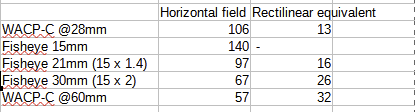
It does get pretty heavy, the Canon 8-15 is a bit of a brick, though the 140mm dome doesn't weigh 1.5 kg, that I think is the shipping weight. I have most of this stuff so I can weigh it, the adapter/extension weight is of the n85-N120 34.7 with 35mm extension that I have, so will be close: 140mm dome 740 gr adapter plus extension tube 550 gr Canon 8-15 with metabones: 740 gr Total : 2030 gr While the 28-60/WACP-C/30mm ext weighs 2657 gr... You would need to add either the 1.4x or 2x TC if you want to get the reach you had with the WACP: the fields of view are best visualized by looking at the diagonal field of view and also working out the equivalent 35mm rectilinear lens focal length, with just the 8-15 you get a circular fisheye or a full about 175° diagonal fisheye, no additional reach, if you want some reach as well you need to look at using it with 1.4x or 2x TC, the Sony TC produce better results than the kenko and can be used with the Metabones mounted in the order camera-TC-Metabone-Canon 8-15: You can see that the 8-15 with 2x is close to covering the Full 180° diagonal fisheye all the way through to almost the full reach of the WACP-C by these calculations, while the 1.4x TC gets you out to about the field of a 16mm rectilinear lens. It will probably end up about the same weight once you add a 2x/1.4x and the required extension tube but, it does get you wonderful flexibility to shoot a school of Barracuda then drop down to shoot an anemone fish CFWA on the reef below. You could save around 200 gr with the 4.33"acrylic dome perhaps.
-
If it's mostly macro , the TG7 is the only game in town really, it's wide enough for a weedy sea dragon, but probably want a wide angle lenses for big schools of fish etc. I hear the weefine housing allow you to use an 18650 battery to charge the camera up and get much more dive time before needing to change out.
-
Go-Pro and DGI are basically video machines they can take photos but they aren't fantastic. More importantly they don't focus close as they are setup for wide angle work. The TG-7 on the other hand is a macro camera- it's not that wide at its widest but can focus very close and is great at capturing smaller critters and filling the frame with them. As I understand things the TG-7 does video but it's not its forte. To some extent it depends on what you are shooting. The GoPro/DJI require an accessory closeup lens to shoot anything small, while the TG-7 requires an accessory wide lens to shoot larger things like reefs etc. The lens on the GoPro/DJI is fixed focus no zoom, while you have full focus range from a few mm to infinity with the TG7 and it zoom from a 25mm equivalent lens to a 100mm lens. To some extent it depends on what you are shooting and where, if you are mostly in Tassie, I would guess a lot of macro work?
-
Also I moved this into Photo Gear and Technique.