-
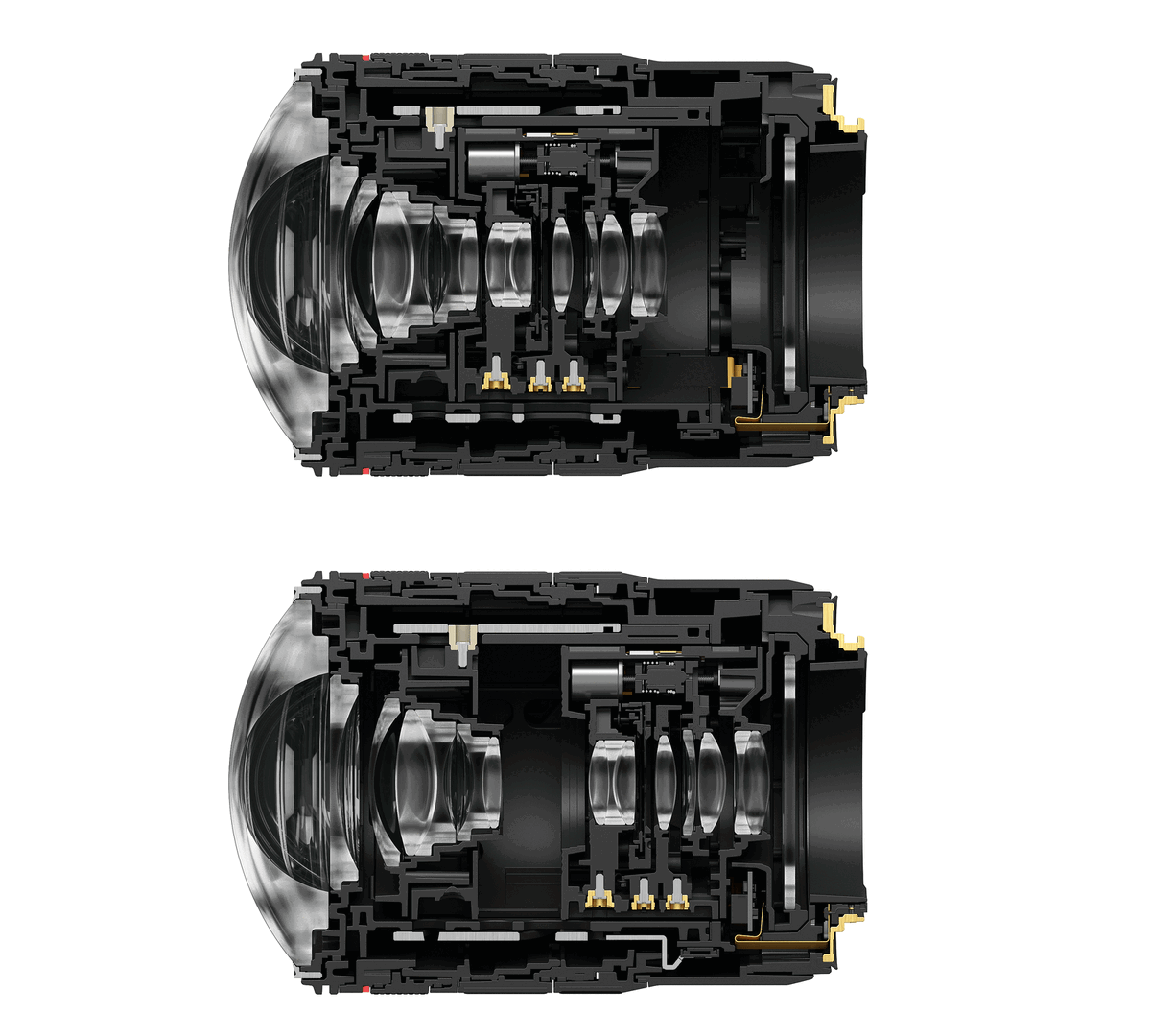
 I have read that. Therefore, I wrote “also”. I have added a visual to confirm what has been written.
 -
There’s clearly enough space inside the lens—anyone want to try adapting an extender in exchange for some focusing capability? 🙂 Jokes aside, this view also pretty much confirms that adapting an extender isn’t realistically possible. At this point, I honestly don’t see much reason to choose this lens over the EF 8–15mm f/4L. The 8–15mm is sharp enough for me with sufficient field of view.
-
The price has been revised to $1899 as well. Happy to see that it is a proper L lens with a drop in filter. As @atus mentions, the possibility of fitting the RF 1.4x TC is also very exciting. Hope it works out.
-
The EF version originally launched at $1,399 back in July 2011. Adjusted for inflation, that works out to roughly $2,000 in today’s money. Given Canon’s usual lens pricing (generally on the higher side) and compared to its predecessor, it’s honestly surprising that the new one is cheaper. With that in mind, I really hope it turns out to be a true L-series lens in both build and optics, rather than something closer to the non-L RF 28-70mm f/2.8 IS STM which is a lens that was clearly designed as an “almost-L”. It is very sharp but heavily relies on software correction, which Canon seems to be leaning on more and more these days as part of cost reduction.
-
Very good news for underwater Canon shooters! According to CanonRumors, Canon may announce the RF 7–14mm f/2.8–3.5 fisheye zoom this week—alongside the RF 14mm f/1.4L VCM, which could be another great option for underwater shooters. If true, this would be the first native mirrorless fisheye zoom from Canon/Sony/Nikon, and hopefully a nudge for more dedicated mirrorless fisheye options across the board. Curious to see whether it lands as an L lens (likely) and how it stacks up against the EF 8–15mm f/4L Fisheye USM. You can find the rumour link here.
-
I am curious about this as well. Especially, if there is a comparison with Marelux Apollo III 2.0. As circular flash tubes are measured in watts and rectangular flash tubes are measured in guide numbers, it is very hard to compare them solely on the spec sheet. Real world usage input would be great.
-
Many thanks @DreiFish. Beat me to it :) Still no one in my community has bought one yet and I might be the first one to purchase it as well. What I suppose is that if you order only the tray from Nauticam there will not even be a dremel work which is really interesting as they completely designed a new housing for the R6 III. I also saw that the joystick is a bit more sticking out. How was the joystick usage? Was there any movement not being registered by the camera or was it firmer? As this also occasionally happens underwater, maybe, it being firmer, will be an accidental benefit.
-
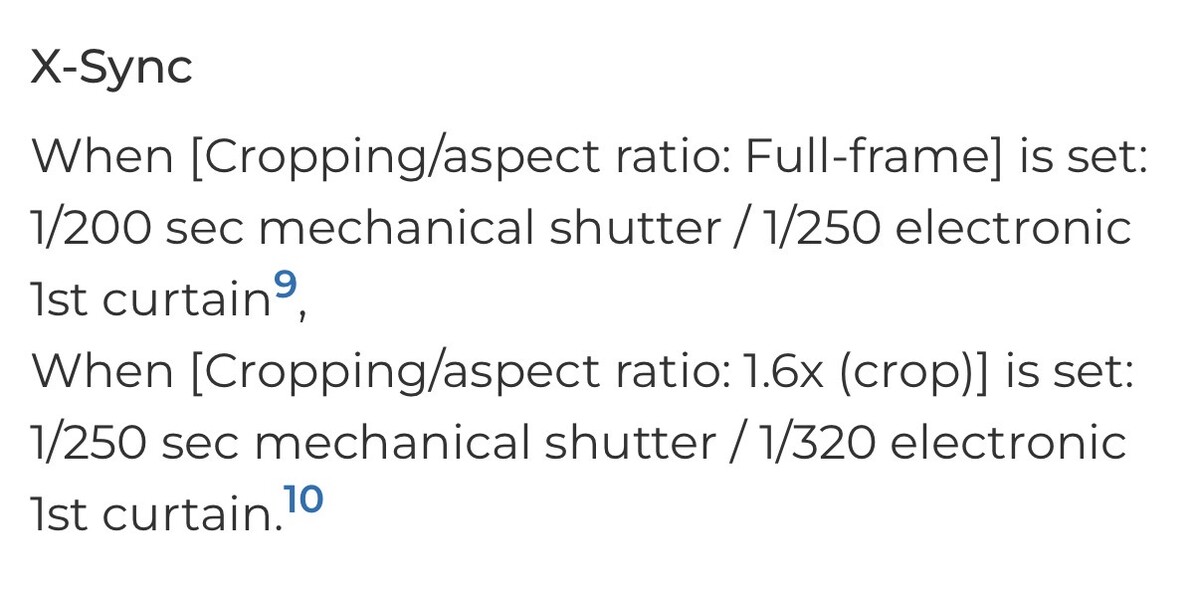
Yes, electronic shutter is not supported. It is the same as the R6 II. Above screenshot is directly from Canon. If you want to use HSS, you should use UW Technics trigger or similar and Marelux’s or Retra’s HSS capable strobes and explore that route.
-
For photography, it is basically the same camera except for the 32.5 MP sensor upgrade where you can get more sharpness and more cropping ability. I think there is a misunderstanding with the sync speed of the camera and I had a look at the detailed specs. The x-sync speed of 1/320 applies for cropped resolution which is not very useful: This is the same for R6 II for full frame resolution. There is a slight banding issue visible when EFCS is used at 1/250 with my YS-D3s. So, I would be careful when relying on maximum specs given. The number 9 and 10 footnotes in the screenshot also mention that these speeds are only compatible with Canon’s own flashes. I usually shoot at 1/200 and use 1 or 2 stop ND filters internally depending on the scenario if I really want to block ambient light. This results in the equivalent exposure of 1/400 and 1/800 of light stopping speed and would also recommend this.
-
I made the same comparison with cameradecision visuals and apart for the on/off switch also saw that the joystick is a bit more sticking out. I am going to check whether this prevents any movement and will keep you updated. I might be an early adopter as these were the specs I was expecting from my next camera when I was in the market. However, I settled with the R6 II as there was no such offering. Additionally, I still believe that the R6 II is an excellent camera even though the R6 III is out.
-
Hello All, I am planning to shoot video on top of photography this summer and looking for a good light to cover both wide angle shoots, including big wrecks, and macro shoots. The video light is below: DIVEPRO Divelights VideolightDIVEPRO VisionPro+ 15000Lumens 160° Wide Beam CRI 98 Unde...Model Vision Pro+ LED 1*CMA2550 CREE LED Color Temp 5000K Beam Angle 160° Output 15000LM /7500LM / Low 1500LM Runtime 55mins / 110mins / 5500mins Battery 14.4V 6800mah Battery Pack... Specifications are are as follows: 15.000 Lumens 160° Wide Beam CRI 98 This looks like a good light for me at this stage to cover both wide angle and macro scenarios and also has a diffusion filter option. What is lacking is the cyan/blue filters for the lights to compensate for red gel lens filters but I think that can be solved via placing them in the diffusion filter. I am planning to buy two of them. Has anyone used this light and is it recommended to cover both shooting types?
-
You stated except Nauticam, so I won't be able to help you with your general query but I can give the following tips as a Canon shooter: 1) Positions are irrelevant as you should set the most ergonomic button on your housing (*, AF-on, or any other customisable button) to eye autofocus and the lesser ergonomic button to the usual back button autofocus. Therefore, if * is easier to press on the housing, that will be the eye autofocus, which is what you will be using mostly. I usually use AF-on to adjust the focal plane then continue with eye autofocus for the eye autofocus to work faster and more efficiently. 2) This combination might be a burden if you are mostly using your fisheye lens as 140 mm is optically great (speaking for Nauticam) to be used with the fisheye lens and is super small and lightweight. Therefore, a 2 dome solution would be better prioritising the most used lens in this case (small glass dome for the fisheye and big acrylic dome for the rectilinear if you also want to cut costs). The single dome solution will be the 230mm glass dome unfortunately as the smaller domes will affect corner sharpness. Additionally, you will need two separate port extensions for both lenses to ensure correct positioning of the lenses. 3) I just purchased a spare adapter just to try this. I'll update this post after I reach a conclusion. 4) Very easy if you can find a good fit design template to be printed.
-
I have an R6 II with the Nauticam housing and I really enjoy using it. The sensor has 24 megapixels but you can always use super resolution to upscale the images. The difference with a 45 megapixel sensor won't be noticeable at 45 megapixels when upscaled and you will have the benefit of using a smaller and lighter setup. I would also recommend going with the 8-15mm fisheye lens rather than the WWL-1B which will give you a 180 degree FOV and the lens together with the Nauticam 140mm port has excellent image quality.
-
Yes @Dave_Hicks, that will yield the exact same result. Forgot to mention that. For my case, I do not like spending time post-processing and therefore, I try to sort out almost everything while shooting. This also applies for me shooting on land. I also have been participating in the yearly national underwater shootouts here in Turkey where you have to submit straight out of the camera JPEGs to be judged in the original resolution of the camera without any crop. Therefore, I can also say that I have more of a shootout mentality underwater when it comes to the techniques I use.
-
As I am the original poster of this post, I wanted to come back and give an update. As you pointed out @Chris Ross, my main aim was to capture shy fish portraits with ease from a distance and use it for super macro. However, I haven't even bothered borrowing or buying an extension ring for this lens the whole summer as the RF 100mm Macro is a joy to use with its 1.4x magnification together with the R6 II. I have found out that the R6 II digital teleconverter options of 2x and 4x upscales back the shots to original resolution with no loss in quality and no artefacts (Canon has a great algorithm in camera). This, essentially, makes this lens a 200mm and 400mm lens, respectively. The only drawback is that you must shoot JPEG only. However, if you get your settings right in camera along with correct strobe settings and positioning, the requirement for post-processing is minimal and any JPEG can handle it. This applies both for shy fish and its super macro application. So, I will not be using this lens underwater and only for shooting on land.