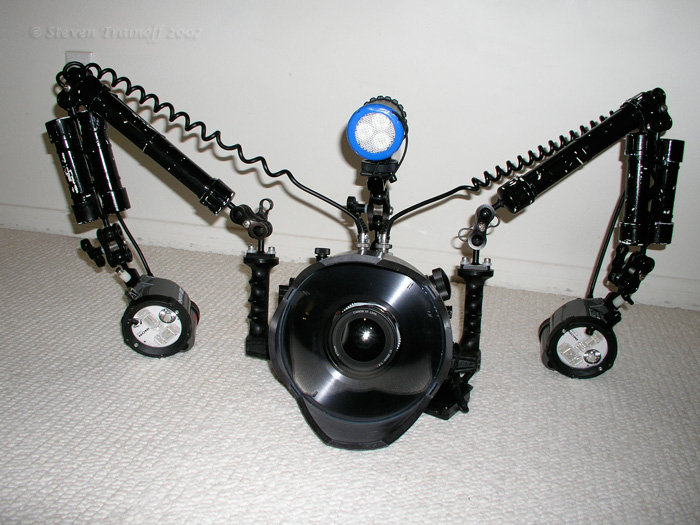
I would begin any buoyancy compensation project by first deciding on the goal. IOW, do you want your rig to be positive, neutral, or slightly negative underwater.
I would next determine how negative the rig is underwater before any modifications. This could be approximated with the aid of a hand held "fish" scale (spring or digital style). Attach a fishing line from the hook of the scale to the camera rig. Immerse only the rig into water (keep scale out of the water) and hold it as motionless as possible (if the camera is "bobbing" up and down, so is the answer  ). If fresh water is used, keep in mind that salt water will make the rig more buoyant (3%?).
An alternative (preferred?) method for finding the underwater weight of an object is to determine its actual displacement (volume) (*see below*) .
If the weight of the water that is displaced weighs more than the dry weight of the rig itself, then the rig will be positively buoyant ( why boats float).
Once you have determined the rig's underwater weight, then determine the buoyancy of the material you choose to add to your rig. If you are purchasing a brand new strobe arm system, StiX offers a guide to the buoyancy of each component they offer.
If you wish not to purchase a new arm system and are adding to strobe arms already owned, then buoyancy of the chosen material can be determined in the following manner:
choose a known size of buoyant material (volume in cubic inches)
weigh the known volume dry
Salt water weighs 0.037 pounds per cubic inch. Multiply the volume of the buoyant material (in cubic inches) by the weight of water (in cubic inches) it will displace. Subtract the dry weight of the material from that subtotal and the result will be how much lift is created.
For best results, choose materials that will not compress when exposed to recreational dive depths. As materials compress, they lose volume and subsequently the ability to displace water.
Example of a material that does not compress at recreational dive depths:
A 4' by 8' sheet of 1/2" Core Cell A weighs 5 lbs per cubic foot (12x12x12= 1728 cu in.)
Core Cell A weighs @ 0.0028 pounds per cubic inch
Since water weighs 0.037 pounds per cubic inch and Core Cell A weighs @ 0.003 pounds per cubic inch, then 0.034 pounds of lift can be created with every cubic inch of Core Cell A added to the underwater rig.
Lets assume you wish to add 1 pound (16 ounces) of buoyancy to your rig using Core Cell A. Divide the target of 1 pound by the benefit lift of 1/2" thick Core Cell at 0.034 pounds per cubic inch. According to the math, @ 29.4 cubic inches of Core Cell A would increase buoyancy by 1 pound.
If you had a single 12" long strobe arm, you'd probably only wish for 10" of linear material placed on it so that free movement was not impeded upon by the strobe arm clamps found at either end of the arm. If you were to cut and install 4 pieces of Core Cell A measuring 10" by 1.25" by 0.5 inches around the arm (encapsulate the arm), 25 cubic inches would be added to each strobe arm. 25 cubic inches of Core Cell A would yield a net benefit of (25 times .034) 0.850 pounds or 13.6 ounces, about 2.5 ounces shy of the target.
If you had a pair of 8" long strobe arms:
a 6" by 1.25" by 1/2" section of Core Cell A would yield 3.75 cubic inches of displacement per section
4 sections per strobe arm would yield 15 cu in per strobe arm
15 cu in realizes a lift benefit of (15 times .034) 0.51 pounds or 8.1 ounces per arm
therefore two 8" long arms with the above modification would yield a benefit of @ 1 pound of lift. If your dual strobe arm system consisted of 4 x 8" arms including the above modification, then 2 pounds of lift could be created.
Paint and fastening system used to attach material to strobe arm (glue, cable ties, plastic nuts and bolts, wire, o-rings, etc) should be chosen carefully as they will affect the end result.
* To determine Volume:
Choose a container of known size. A common household pot for boiling large quantities of water would be sufficient as long as the sides of the pot were straight and not angled outward. For example, my wife has a straight sided pot that measured (diameter) 13" across. Its radius therefore is 6.5". In order to determine the displacement of my rig, I filled the pot with 7" of water. I next placed a ruler along the interior side of the pot, vertically into the water. As mentioned, the water depth read 7". I then placed each component of my rig separately into the water and noted the increase in height of the water on the ruler.
Say once the component was immersed, the height of water as noted on the ruler increased one inch, from 7" depth to 8" depth .
To determine volume of a cylinder, the following formula is used:
V=L*Pi*r²
The increase in height of the water inside the pot will now be noted now as the Length of the cylinder
Volume equals Length times Pi (3.14) times the radius of the pot squared
V=1 (height increase of water) times 3.14 times 6.5²
V=1*3.14*42.25
V=132 cubic inches
The object that I placed into the pot of water that increased the level of water by 1" therefore displaces 132 cubic inches of water.




 ....)
....)




