



Lights, Strobes, and Lighting Technique / Archived topic
INON Z240/D2000 Type 3 -- Only compatible with Eneloops
Started by MikeO ·
- 33Posts
- 33Replies
Read-only discussion
INON Z240/D2000 Type 3 -- Only compatible with Eneloops
33 posts
-
-
that's kind of a drawback. I just ordered my 2nd one...I hope it comes as a type II.
-
I wonder what Inon could have changed to cause this sensitivity to normal NiMH batteries and, more importantly, what advantage do we get in exchange. Hopefully there's a good answer for that. Wonder if the limitation still exists if you don't use the modeling light.
-
Wonder if the limitation still exists if you don't use the modeling light.
That's a good question.
As far as the Eneloop batteries go, here's a tip for where to purchase them cheaply. I just recently found out about this quite accidentally while shopping at COSTCO.
They have a set consisting of 1 eneloop Battery Charger, 8 AA eneloop Batteries, 4 AAA eneloop batteries and 2 each C and D adapters. All of this comes in a convenient carrying case and it cost just a little more than $25.
Also, it did say "worldwide voltage" on the package leading me to think I could use them while traveling outside the U.S.
-
Interesting stuff...
I'm not that familiar with the Eneloop batteries but do notice them more and more at various camera and electronic shops. I also notice that the AA Eneloops are only 2000mAh. Does the main benefits of the Eneloops - low/no discharge over life outweight the low mah rating vs say a standard 2700mAh AA nimh battery?
-
Does the main benefits of the Eneloops - low/no discharge over life outweight the low mah rating vs say a standard 2700mAh AA nimh battery?
Don't know if this will specifically address your question, but here's an interesting fact sheet on the eneloop batteries and may be helpful:
Ellen
-
thanks, Ellen. I looked around the net for some more info on the Eneloop batteries. Might make sense for things like topside strobes where they can be sitting in your bag for weeks or months (at least in my case) and when you pull it out for that once in a lifetime shot... the batteries are drained...
For u/w strobe use, not sure how much it would benefit unless you were traveling to distant areas without electricity... I figure most of us religiously charge up our main/ backup u/w strobe batteries every night during a trip...

-
Hi Guys,
Is it possible that the eneloop batteries are a 'low drain' battery and take longer to lose a charge,
whereas the 2700, although holding the same volts, is a 'high drain' battery and discharges quicker?
I would imagine that there must be some trade off for increasing all the grunt in these batteries, and
it would seem that higher temps and quicker discharge rates are the result?
Are the Inon electronics susceptible to higher battery temps and is it possible that due to the higher
discharge rates of the 2700mamp batteries, that Inon can no longer quote such high shot per charge rates??
Obviously the 3watt LED lamp will lower 'burn' temps in the strobe and should also be less of a drain
on the power supply?
Lots of questions, I know...
Bruce...
-
I don't quite remember but the engineer in me says that mah or milliampere hours is a rating of how long a battery can maintain its delivery of the 1.5 Volts at a 1ma. So theoretically a 2700mah battery should last longer than a 2000mah device.
BTW..just checked with the folks I purchased it from and they're still shipping the type II. Since the one I own is a type II this is better. I'd hate to think I stuck the wrong batteries in the strobe and accidentally damaaged it. From what I can see about my type II it doesn't really say what type it is on the strobe so if you did have a mixture you'd have to use a sharpe or other marker to distinguish the type III from the type II. In any case I'm not sure what a brighter spotting light is going to achieve. In many cases you're not going to want to point the strobe directly at the subject anyway. Most people I know are using a separate focus light.
-
I've switched entirely to Eneloops (purchased dozens of both AA and AAA and gave away all of my other NiMh rechargeables), and have been very happy with them. My reason was as much non-dive-related as for my uw strobes (Inons - Z220 and Z240). I always keep a bunch of rechargeable batteries at home to use for various things, and so my wife knows where she can grab fresh rechargeable batteries (for remote controls, clocks, flashlights, etc.)...and I got sick and tired of her replacing batteries and having the "new" ones already be largely discharged. The Eneloops hold their charge so well that they virtually eliminate that issue (thereby enhancing the state of marital bliss around my house).
As for use in cameras/strobes, I think most of us tend to recharge batteries well before they are dead, and I don't find that I recharge the Eneloops any more often than I did when I was using 2700mA AA's. If I'm taking 100 shots on a dive, I'll recharge batteries every dive or two. If I'm only taking 20-30 shots/dive, I use the same set for 3-4 dives and just replace/recharge them once a day.
IOW, I find that Eneloops are just as good as higher mA NiMh batteries for uw photography...and FAR better than standard NiMh batteries for use around the house. Therefore, I'm a big fan!
BTW, someone over on Digital Diver found this link about Eneloops at epinions:
I found the following from that discussion particularly interesting:
> ...Now, what about the fact that AA eneloops are rated at 2000mAh and most regular NiMH AA batteries are rated at 2500mAh and above? . . despite the higher mAh rating, the Energizer batteries didn’t run as long as the eneloops because their voltage dropped to the camera cutoff point sooner. Only if your device has a cutoff voltage of around 0.9 volts per cell would you benefit from higher capacity regular NiMH batteries, but then you wouldn’t get the long shelf life... <
IOW, it's not just about mAh, especially with equipment that has a voltage cutoff point...I'm not sure if that's the issue with Inon Z240 strobes, but it could be related...
-
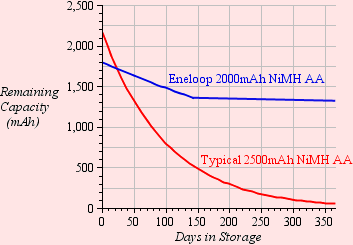
This review of the eneloops was interesting. I think the graph at the bottom pretty much tells the story.
Now the original question of why the type III Inon Z-240's are restricted to eneloops is still unanswered...
http://www.stefanv.com/electronics/sanyo_eneloop.html
-
Yes there's no question about storage charge. However it would be interesting to see how long they last in a device. For example right now my batteries last through 4 dives in the current Inon strobe. So I really don't have to open the strobe before I get back to the hotel. They're the 2650mah duracell. Yes they have to be freshly charged but this isn't a problem as they're usually charged the day before the dive.
I've also used the Energizer Lithium non-rechargeables which actually create more heat than the NMih batteries. I'm certain this would be a problem with the Inon type III's if they can't handle the nmih batteries.
-
All Inon offered as an explanation is discharging and recharging temperatures. Obviously, you don't recharge the batteries in the strobe, but it can certainly happen that you put batteries in the strobe that are still hot from recharging.
Heat causes the internal resistance of a cell to increase. Higher internal resistance causes the cell to generate more heat when discharged. Heat is the enemy of batteries.
I believe that Eneloop batteries have lower internal resistance than normal NiMH. That means that they generate less internal heat AND they hold their rated voltage better at higher loads. I doubt the Inon strobes have suddenly become sensitive to cell temperature but they may now draw more surge current than they did before. I believe that's likely.
Batteries are capacity-rated assuming a low current draw. In addition, they are rated for a maximum current draw and that rating is typically specified in terms of total battery capacity. A "1C" rating means that the battery should not be drawn at rate faster than the rated cell capacity. 2C means double the rated cell capacity and so on. NiMH should ideally be used at far less than 1C and their capacity ratings are generally at a 1/10C rate.
A battery with very low internal resistance will generally offer high drain rates. It's probable that Eneloops are better than normal NiMH batteries for this reason. You do have to be careful though. Current Eneloops offer only 70-75% of the rated capacity of conventional NiMH so they have to overcome that disadvantage with at least a 1.4x improvement in draw rate just to break even. This why NiMH has killed NiCad. NiCad offers higher discharge rates but NiMH overran them with capacity. It doesn't matter when one battery is 3C and the other is only 1C when the 1C battery has 4 times the capacity.
I agree that Eneloops have a lot of appeal for situations when you don't know when you need the battery. That's what they are designed for. Underwater strobes aren't that situation, though. It appears that Inon is saying that they are better strictly from a performance perspective as well.
Inons can get a lot of cycles off of 2000mA when you aren't using full power dumps so the lower rating is probably not a big handicap for most shooters. It wasn't that long ago that 2000mA was state of the art, and today you can buy Eneloop-style batteries at 2100mA, too. I suspect this isn't as big an issue as it seems.
-
One of the concerns with the Z-240 from the beginning was internal heat buildup. When it was first released at BTS a few years ago, I talked with the INON America guys and they said that one of the things that delayed the release of the 240 was that the designers had to find materials that could allow adding more power to the strobe and accommodate the increased heat generated. When you start having to restrict the type of battery and the number of flashes in succession so the strobe doesn't fry itself, you might drive the perception that the design has "hit a wall". Perhaps the reality is that it isn't all that limiting but I wonder if they are thinking of finally making one a bit larger?
Mike
-
The question is what has changed in this version of the Z-240 that might have caused it to hit such a wall. The visible change is the LED light which I personally wouldn't use.
It should be noted that many strobes restrict the number of burst fires so that they don't melt.
-
The question is what has changed in this version of the Z-240 that might have caused it to hit such a wall. The visible change is the LED light which I personally wouldn't use.
Hi power leds get hot. In fact, one of the critical design aspects of hi power led torches is heat disipation. Perhaps Inon is considering that the led could be turned on for a whole dive, which would make heat disipation in the strobe even more critical.
-
I checked with Mr. Miyashita at Inon Japan on this.
Only difference between Type 2 and Type 3 is LED focus light, which emits more heat the previous Xenon bulb. The main issue is heat.
The 3W LED increases total heat load on circuit unit. Considering the total heat load when using conventional NiMH batteries, Inon decided to limit recommended NiMH batteries to less heat emitting eneloop type, and keep the existing focus light continuous burn time and strobe repetitive flash limitations, rather than making them more strict.
As noted by others, eneloops offer various conveniences over conventional NiMH, and the current lower mAh specs are still completely adequate for most u/w situations.
Addressing the other thread, here is background on Type 2 / Type 3 etc.
Z-240 model history
1) Z-240 (original model)
2) Z-240 Type 2 (also D-2000 & D-2000S were upgraded to Type 2)
Circuitry upgrade for compatibility with Nikon D200/D80 when used with fiber optic cable.
Before D200/D80 models, Nikon only used one preflash and one main flash. But from D200/D80 Nikon changed to where preflash can be one or two times, depending on shooting conditions, followed by main flash.
This upgrade is only relevant for fiber optic configurations, and specifically for S-TTL and External Auto Modes.
Besides this circuitry modification there were no other changes.
3) Z-240 Type 3 (also D-2000 upgraded to Type 3)
Change from Xenon filled bulb focus light to LED focus light.
No other changes to strobe.
However, due to increased heat from LED, only compatible NiMH batteries are eneloop (HR-3UTG). Operational limitations on using focus light in continuous mode, and limitation on repeated flashes are same as previous models. (see two .pdf attachments)
Mark Rupert
Inon America, Inc.
D_2000Type3_CompatibleBatteryLimitations_1_2_0___En.pdf
Z_240Type3_CompatibleBatteryLimitations_1_2_0___En.pdf
-
... Inon decided to limit recommended NiMH batteries to less heat emitting eneloop type...
So any of the newer low discharge nimh's are appropriate/recommended and won't void the warranty?? My D2000's are type 2 but one day I might upgrade to Z240's. Eneloop is a brand and if they are required I would need to keep this in mind when buying new batteries.
Jeff
-
Yay, that makes complete sense. Thanks, Mark.
Technically, if you don't use the modeling light then nothing has changed regarding conventional NiMH, but Inon's guideline suggests that Eneloop batteries are likely the right choice in any case. Honestly, 2000mA is usually plenty except when you are shooting rapidly at full power. When you do that, Eneloops are the best thing for the strobes anyway. I'll be switching.
-
First of all hi to everyone here. I am a new member and look forward to interacting and learning from all of you. I have been diving for nearly 30 years and recently started underwater photograhy. I recently bought the Inon z-240 strobe and asked Inon if I can use any other battery than the Eneloop. Here is the email exchange:
1. To Whom It May Concern:
I just bought the new Z-240 Type 3 strobe. I understand that I must use the Eneloop battery. Is it possible to use and other similar type of battery, for example the Rayovac Hybrid? I look forward to your reply soonest as I am going on a dive trip in three weeks to Indonesia.
Thank you,
2. Thank you for your inquiry.
We have asked INON, Inc (they are the manufacturer – we are an American distribution company) this question and they have stated the only NiMH battery they have tested and confirm at this time is the Sanyo Eneloops.
Kind Regards,
____________
Jolene Philbrook
INON America, Inc.
The funny thing is that on the Inon AMerica web site under specifications of the stobe, they give specs for other batteries...funny. In any case I bought the Eneloop batteries (on sale to boot).
Cheers.
Yay, that makes complete sense. Thanks, Mark.Technically, if you don't use the modeling light then nothing has changed regarding conventional NiMH, but Inon's guideline suggests that Eneloop batteries are likely the right choice in any case. Honestly, 2000mA is usually plenty except when you are shooting rapidly at full power. When you do that, Eneloops are the best thing for the strobes anyway. I'll be switching.


