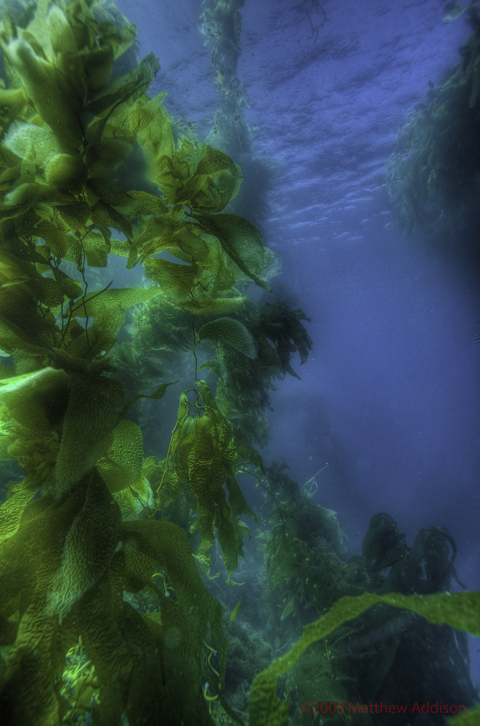
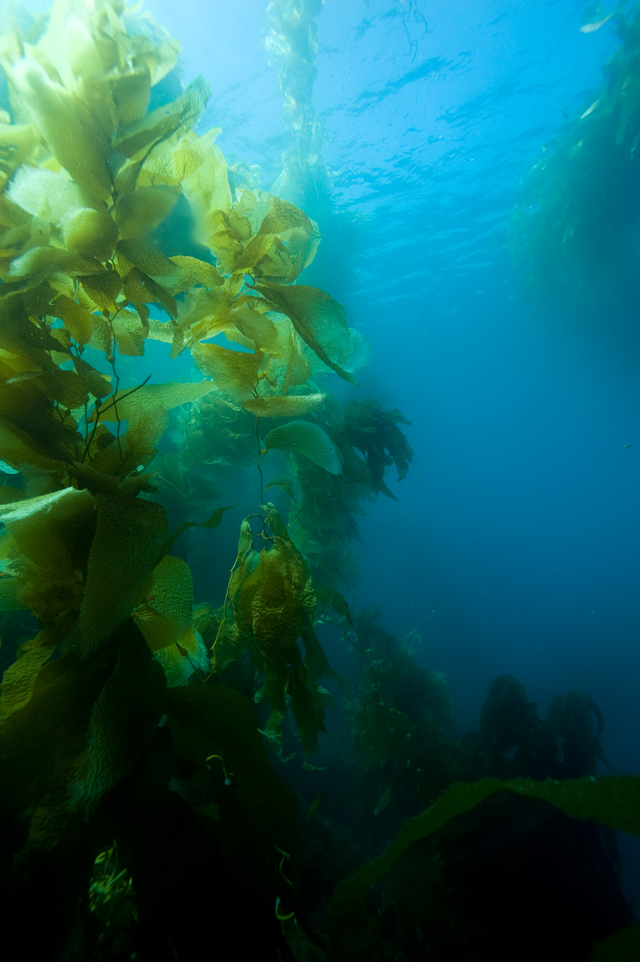
That was my impression after looking at the shot compared with the 0 EV exposure.
I've dusted off my $40 aluminum tripod and will be bringing that with me to Turks in two weeks to try some more shots of this nature. I have my trusty machinist working on a mounting bracket for my housing as I type.
One thing of interest to me is that some HDR shooters here on Wetpixel advocate less shots with greater EV spreads. I have found that shooting smaller series takes some of the finesse away from the tonemapped images, making for more "startling" lighting.
However, it would make such shots potentially suffer less ghosting. As Jeremy pointed out, the Nikon only goes up to 1 EV steps, and depending on the scene, 3 - 1 EV shots may not cover the dynamic range required (certainly not the shot I took in the kelp).
I think there are a huge number of variables with HDR, starting with 'What you are trying to achieve?' Is one trying to create more realism, or trying to create an effect.
As you know all the HDR software options have different tone mapping options etc, so there's an infinite number of results one can achieve.
At the present time I personally am simply trying to extend the realism of my photographs, trying to take them as far as possible to being there, yet still being believable.
I don't think there is any right or wrong on the number of images, but I think one simply has to keep in mind that more images may generate more artifacts in underwater images. The two topside images I have posted on this forum both contained surface water in the images, and on close inspection of both of my images, it is in the water surface that one can see artifacts generated in the software interpretation even with the appropriate alignment settings checked. Motion is the killer of HDR, and underwater nothing is ever static, including light shimmering down through the water, subtle current related movement of plants etc. One of the reasons I wanted to see the original of your image is to see this, and I think you can see some softening of the kelp for example in terms of sharpness and detail, although in this case the dreamy effect of the image is actually very nice. So I think it's a matter of trying to get the highest dynamic range while trying to generate the least amount of artifact. With topside HDR, the most common starting recommendations I have seen are 3 images, with +2,0 and -2EV, keeping aperture constant so there are no DOF / Focus changes. Underwater we may want to keep a constant higher shutter speed to keep the time of the exposure sequence to a minimum. (With the Nikon at present this means at least 5 frames.) Unfortunately this is at least 1 second say with the D700 and a little quicker with your D3. Underwater 1 second is a long time in terms of keeping ambient light static. This is one of the reasons I think future RAW video capture possibilities will really take underwater HDR to the next level.
One suggestion I would make for all of us as we post these HDR images for learning purposes, is to provide as much specifics about how we generate the image - which software, what type of tone mapping algorithm, exposure values etc.
Cool stuff!