Skip to content

Shooting Technique, Workflow and Editing / Archived topic

strobe positioning W/A

Started by nortoda1 ·

  • 27Posts
  • 27Replies

Read-only discussion

strobe positioning W/A

27 posts
  1. I was asked about strobe positioning on my last trip.


    My first comment was, "There is one rule for strobe positioning. That is that is no one rule on how to position your strobes."


    "Tobbe's" picture of his rig with the strobes pulled even further back is quite pointless. Regardless of the spread of light from the strobes, his rig is clearly going to block the path of light.


    It's ridiculous to even provide some notion of where strobes should be. It depends on how and what you are photographing and where relative to the light source, your foreground subject lies. E.g., it's silly to think that your strobes should be positioned in the same place when shooting portrait versus landscape. My strobes are rarely symmetrically positioned. Nor are they often set on the same power setting.


    There is no problem lighting a fisheye wide angle shot with a single strobe, if you know what you are doing.


    Yes, but it's a kind of backward way of explaining it. If your need your strobe(s) to cover 100-180 degrees, you are either 1) not composing your shot very well or 2) diving in a cave.


    The biggest error I usually see is that the shooter has no idea where his/her strobes are actually aimed relative to the subject.


    24" arms are a macho myth, once promulgated by the great and the good, including Martin Edge, then debunked by experiment.


    Sure, but it depends on how you create the protocol of the experiment.
  2. ...the same set up that Cathy Church uses and has taught to me...


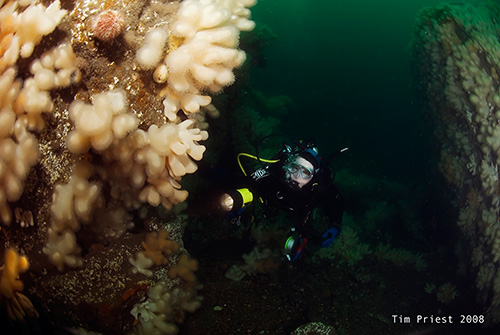
    That's a nicely lit shot, and three years ago I would have agreed with everything that you say, but after using shorter arms diving the wrecks of Bikini atoll in pretty poor visibility I thought about avoiding some of the difficulties of handling 24" arms around coral, and used 12" or 18" arms with no problems. I was ready to be convinced when reading Martin Edge's latest edition of "The Underwater Photographer" where he describes good results with short arms.


    Single 8" segment with two ball joints, 10.5mm Nikkor:


    post-4522-1227646967.jpg


    Single 12" segment with two ball joints, 10.5mm Nikkor:


    post-4522-1227647027.jpg


    It's so much more comfortable with shorter arms...

    ... but long arms look so much more impressive.


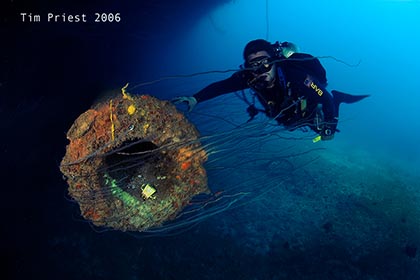
    I move my strobes around all the time, and often have one vertically above the lens, with the other out to the side. One is often powered right down, or even off. I'll try different positions and powers if the subject permits, and definitely bracket my strobes far more than exposure or composition. That was all much more difficult with 24" arms. I know that it's difficult to justify changing a technique that works for you, but it's pretty clear to me that there's more than one way to handle backscatter (not to mention using filters and side-stepping the problem completely by using ambient light) and that, as Alex says, it starts with getting close. Angling the strobe outwards is difficult, as you are trying to preserve illumination in the centre without having "hot-spots" at the edges, and I've often got it wrong, but it does allow you to get in close without long arms obstructing access and risking damage to both camera and subject:


    Single 12" segment with two ball joints, 10.5mm Nikkor:


    post-4522-1227648491.jpg


    Tim


    :)

  3. It's so much more comfortable with shorter arms...

    ... but long arms look so much more impressive.


    Tim


    :)


    Very nice shots Tim.


    I am not sure why people keep saying 24" arms. I said I have two 12" segments to give me up to the max of 24" away from the camera. It gives me options is what it does. I can go right next to the camera to above, below, and to the side. I can go as close to the camera as touching the camera (not something I would do normally) to the 24" of extension and anywhere in between.


    Flexibility to provide me options is what I am after. As far as ability to get into tight areas, well, I don't do wrecks really so I couldn't speak to that.. but I have never had a problem getting my camera/strobes where I want to. The arms also make a very good carry method when crossed over so it can be handed down and take back up for entry/exit.


    Anyhow.. I just wanted to clarify, I am in NO WAY saying all my wide angles are always at 24" out from the camera. I position them where they are needed and with the arms I use, I have a LOT of options that I would otherwise not have with a different set up.. After all, shooting underwater is all about options in order to get the best shot.

  4. For me strobe position depends on what you want in the photo. I always wonder what people are doing when their strobes never change positions. The answer is you keep getting the same shot. I use a double arm on each side because it gives me more flexability, to up light, backlight or whatever. As a wide angle guy I try to visualize what type of light I want the subject, or situation, to have. For example I may downlight to try and enhance a sunlight effect on the subject , or spotlight something to make it stand out, backlight to add textue. The point is move them around

    Edited by vazuw
  5. Just saw this thread, though it seems like it's been abandoned, I'll post anyways. I am taking in every word here - I also shoot almost exclusively in dark/murky water and I have also had difficulties with CFWA shot lighting and backscatter. I use 2x 5 & 8-inch arms (I have 12 inch arms, but they are huge and annoying...). I have been shooting with either both strobes close to and slightly behind the port (I'll tend to get backscatter when there isn't an object right in front of a strobe) OR one strobe as far away from the post as possible (facing open water) and one close and slightly behind the port to light an object. In all cases, both are pointed about 30% out.


    The other issue I get on occasion is a "hot spot" , though I've heard that this can be lessened by angling the strobes slightly up (any comments on that?). Sill, balancing the foreground and background in dark water can drive me to the brink of insanity.


    I recall, Alex, when you were out here, that you told me you almost always keep your strobes close to your port when shooting WA - did I remember that correctly? Tim - I never thought of putting a strobe above and pointed out - I am really excited to give that a try - I have been "cheating" by putting my close subject of to the side a bit, since this is the only way I've been able to accomplish anything reasonable.


    I have seen beautiful dark water shots from all kinds of crap conditions, and I really feel stongly that this is an area in which it is possible to do well with perseverence and hard work - someday, I'd like to be able to have a WA lens on for particular sites without worrying about conditions, knowing I might still be able to get salvageable shots even with 20 ft or less of visibility.


    Allison

    Edited by vetdiver
  6. Lighting a photograph is part of the art and skill, that comes with time and experience and is dependent on the subject, the distance, the water clarity and all them factors.

    Given that, I believe there is no one solution to mounting strobes. It all depends on the individual photo.

    I believe there is no one size fits all solution. THus, my arms are all adjustable, so that I can move them in or way out and also removable underawater. Very often, I will hand hold one of my strobes and try various and different angles and distances when shooting a subject.

    In general, I try to have a top light, and a side light.. in most cases.

    Having dove for many years in dirty water, I have found that there is great value in getting the strobes "way out" on long arms, and with the light coming in from a large angle (in respect to the lens axis.) to reduce backscatter. Howerver, the lighting becomes harsher, and thus multiple strobes helps to soften shadows. The length of the arms, varies with the distance from the lens to the subject.

    This angled strobe technique works for macro shooting to a diver at wide angle. You just need to vary the strobe distance to fit the lens to subject distance. Its got nothing to do with the lens angle, but the lens to subject distance instead.

    Look at some of my images on the weblink below... especially some of the Puget sound or Canada divesite photos. You will notice very little backscatter in the photos. Thats not from using photoshop to touch up any backscatter, but is instead from the techniques discussed above.

    If your shooting in clearer water you can "get away" with using shorter arms and a shallower strobe to lens axis angle as there is less particulate in the water to create backscatter. In dirtier water, I find that I have to increase this angle to reduce the backscatter, thus, the arms get longer if shooting wide angle.

    But I have found that long arms in clearer water means less backscatter occurs in my images, so, I like using long arms in the tropics. Why not? But you are right, it does become a "chore" to lug a more unwieldy rig during a dive.

    Edited by wolfeeldiver
  7. Lighting requires, above all else, an understanding of what you are trying to achieve. Only then can the technical aspects be considered and appropriate set-ups sorted out. There are NO rules, and NO 'standard' systems. To achieve the desired lighting you need to be able to predetermine the way your subject will look in the final image. Fortunately with digital the learning curve is much easier as its a matter of shooting and reviewing. Its also well worth examining photos taken by others and trying to figure out how they are lit and apply this to the images that you want to take yourself. Whether you want to use long or short strobe arms, wide beam or narrow beam strobes, or single or multiple strobes and wher they should be positioned will all depend on what you are trying to achieve and until you understand this, then figuring out positioning is unfortunately irrelevant.

Reef Photo & Video

Account

Navigation

Search

Search

Configure browser push notifications

Chrome (Android)
  1. Tap the lock icon next to the address bar.
  2. Tap Permissions → Notifications.
  3. Adjust your preference.
Chrome (Desktop)
  1. Click the padlock icon in the address bar.
  2. Select Site settings.
  3. Find Notifications and adjust your preference.