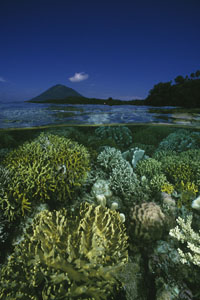
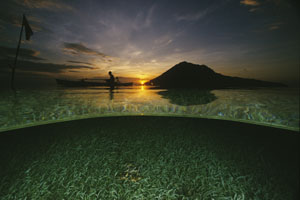
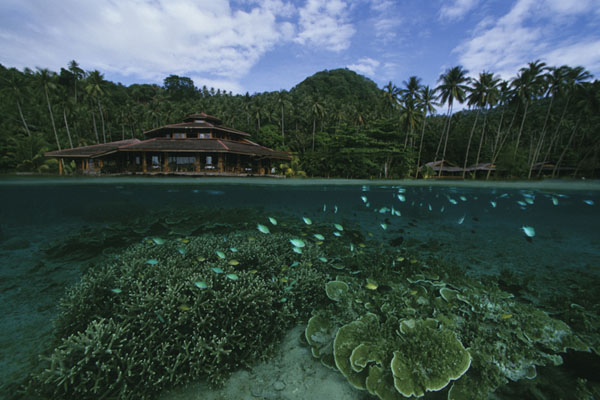
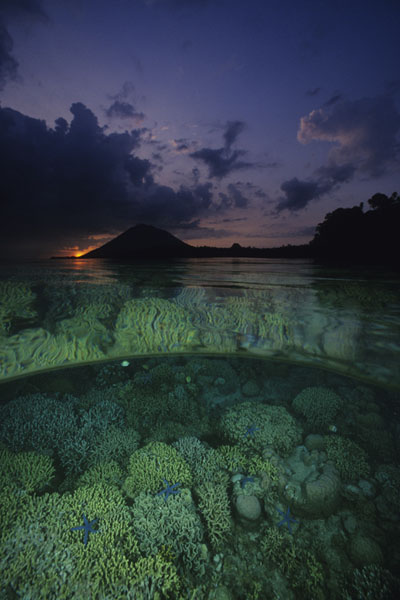
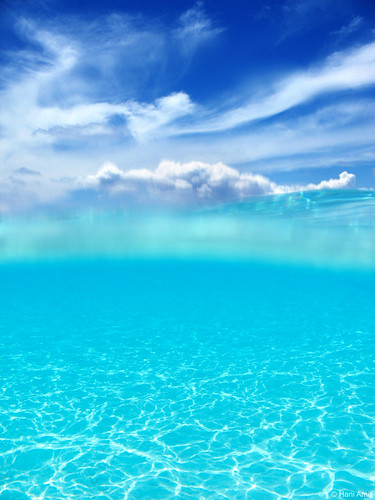
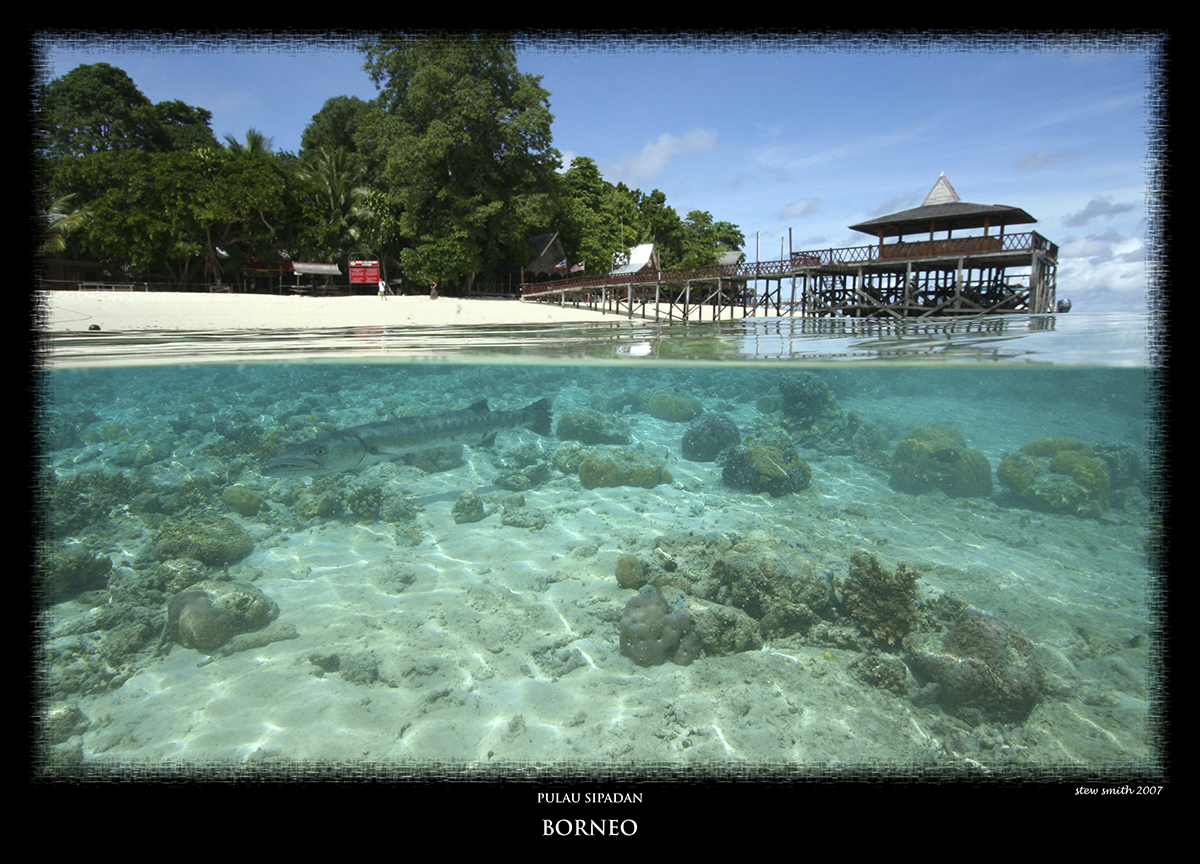
For my over/under landscapes where I consider the topside part of the picture important, I focus at a point midway between the underwater subject focus point and the topside subject. The underwater focus point is not the actual distance because of the virtual image formed by the dome. Its closer than the actual distance. You go in a swimming pool and focus on something about a meter or a bit less away with the lens and dome you want to use for over/under shots. Then get out of the water being careful not to change the focused distance on the lens. Take off the dome port and look at the distance the lens focus is actually focused on. With an 8" dome this might be about 12~14 inches. This is the "near" focus point in the final lens setting calculation. IF you have a distant topside subject you want sharp, infinity on the lens focus scale is the "far" focus point. Set the lens focus about midway between these. If your lens has depth-of-filed markings on it, you can immediately see the aperture needed. If not, go back into the pool and shoot pictures at different apertures to see which aperture is needed to get enough depth-of-field to make both halves of the image acceptably sharp. Then, when you later want to shoot real over/under shot with these same "near/far" distance parameters, simply preset the focus point on the lens to this same mid-point distance on the lens focusing scale and leave the camera set to manual focus so this focus point isn't changed when you meter and shoot. Then just point and shoot at the required aperture.
For the four shots I posted, the focus point was about half a meter. And the depth-of-field scales on the lens told me that it would require an aperture of about f14 or f16 to make both halves sharp. I recently bought Nikon's 14-24mm lens as a possible replacement for my older 14mm fixed focal length lens feeling that the zoom versatility might make it a good back-up for my 17-35mm IF something went wrong with the 17-35 on a trip. The 14-24mm zoom has no depth-of-field indications on it, but at 14mm, the depth of field was about the same as with the fixed focal length lens and the starting focus distance was the same. This was easily confirmed with a dip in a pool in Bali. My modified F5 (film) housing now has a control that allows me to depress the depth-of-field preview button on the F5 and I was able to visually confirm what I wanted to know without having to shoot any film. A digital camera makes checking out this kind of thing even easier.
But I'm still waiting for a Seacam housing for the D700 which is my digital camera of choice to house.
Fred