Skip to content

The Galley: General Chat / Archived topic

Turn your flash off please

Started by Scubysnaps ·

  • 97Posts
  • 97Replies

Read-only discussion

Turn your flash off please

97 posts
  1. Most of their divers on the boat were the average touristy type photgrapher and were taking shots from any distance and any angle, it was only me getting real close, so I stood out, I think that would be the norm on these type of boats, I'd definately check every time now. Scenarios change tho, usually one would go in with just their buddy and go their own way.

    I appreciate that the situation was unpleasant and unfair. But then again, self-policing doesn't always work either for many other tourists. So unfortunately you ran into the overzealous DM who thinks everyone is an idiot.


    [Drew,

    I won't bore you with endless pictures of cats but one thing any cat handler will tell you is that a cat cannot be trained, you just have to select one that is inclined to do what you want. I chose that one picture because they certainly looked relaxed. If you really want to help the planet, stop wearing non-biodegradable clothes, dig a big hole, climb in and contribute to the biomass. :) Going diving including getting there is not helping...

    Sure Roy found that out the hard way.

    As for reducing my carbon emissions, my power bills are positive credit monthly. Just so you know there are many carbon neutral/positive cotton/merino clothing around so you don't have to walk around starkers, although you may like to.

    As for my joining the biomass, that'll happen soon enough but who else will challenge your assertions here? :B): Plus I have to try save reefs and other boring stuff and not pout about the world's environmental situation. Nor am I ready to advocate mass geno/suicide for the sake of being carbon neutral. :D

  2. Getting flashed is very bad for you - I have positive proof of that. A few years ago I was driving on a high speed forest car rally when two female spectators flashed their breasts at us and I crashed out on the next corner - so see getting flashed is very bad for you!


    On a more serious note many thanks for the heads up about checking with operators before booking. I can potentially see constant flashing being a problem for something like a pygmy seahorse where photographers cue up for the chance to get their shot, but for other things I don't think that it is such a big issue.

  3. The afternoon dive was sold as a 45 minute dive. It was perfectly clear - big letters on the board. My objection is not about people who want long dive times it's with people who sign up for a short dive and then think they have some kind of right to insist the dive's over when they declare it's over. You wouldn't pay for a forty five minute massage and then insist you get an hour would you?


    Fortunately, every operator I've ever gone out with has measured and "sold" dives by the tank, not the minute.


    Thanks for the heads-up; I'll make sure to stick to the "by-the-tank" school and avoid the "by-the-minute" school. I wouldn't want to inconvenience anyone at work while I was just laying about on vacation ...

  4. Egypt's Mediterranean fishing fleet is pushing for access to trawl in the Red Sea so I guess we'd better not blind the little buggers or they won't see the trawl net coming. On the other hand, all those restaurants in the Far East (trying not to look racist!) will need attractive pictures for their menus!

  5. Fortunately, every operator I've ever gone out with has measured and "sold" dives by the tank, not the minute.


    Fortunately that is pretty much where I shake out on the dives most of the time - mostly due to the fact that there are dive ops that know me pretty well, know how to handle my cameras, how I like them handed to me and the rest.


    Thanks for the heads-up; I'll make sure to stick to the "by-the-tank" school and avoid the "by-the-minute" school. I wouldn't want to inconvenience anyone at work while I was just laying about on vacation ...


    While I agree with that generally, often it is not just work that goes into making the decision. There are scheduling issues, which is work related to some degree, but for instance I was in the Keys diving about 6 years ago, something where friends asked us to go along, and we said what the heck, might as well. Boat was one of those that did two two tanks in the morning and two two tanks in the afternoon on a tight schedule. The dives were generally planned with timings that were pretty much in line for them to get back, let people have lunch, load/unload things and turn around. If people blew past the times, then the break would get cut, no time for food, etc. And it happened a couple of times. It was not that the permitted times were that short (though I would have liked to stay down longer on some of them.)


    There are a various range of divers on boats (depending on where you are diving, the operation etc.) There are also many cowboys and cowgirls out there who will not pay attention to computers or others rules, and sometimes these time limits are in place for things like that. Have been on boats with many "great wonderful experienced divers who can do anything, including brewing coffee at 130 feet down", just ask them or listen and they would let you know, until they actually hit the water of course :B): They say they know multi level diving, they say they know how to monitor air, they say they know how to use a computer, but they don't. I can only imagine what DMs see day in and day out. On a smaller boat after a couple of days and the DMs know you, things can get relaxed a bit. There are place I go where there are other divers on the boat the DMs will keep some time limits in effect, but otherwise I can do what I want.


    The best thing (obviously) is to check out dive operators ahead of time. Unless you (meaning any of us) will be willing to pay for a more private boat with divers of approximate equal level and wants, we may not get what you want.


    I can fully see why people would get PO'd, especially if told one thing and then have things switched on them. I had this happen to me once. Had a couple of days of diving, and the second day, when I was the only diver, they called the dive after 25 minutes when I had a ton of air left and we were already back up from 90 feet and just tooling around in 30-40 feet area. (Before heading out I knew I would be the only one due to cancellations and specifically said if they did not want to run the boat, I was fine with that.) If I had a camera that day and there were things to shoot, I may have hurt someone :D

  6. I agree in principle about finishing up the dive before you empty the tank (maybe 300psi etc). However, on a skiff with no cover, such as on a liveaboard, it's unkind to have 5 people wait 30 minutes in the hot sun with wetsuits. A time limit is a good thing sometimes. If you want longer, then talk to the ops. If it doesn't mess with their schedule/life, I'm sure they won't mind. Unless they are in Australia. For eg. the HMS Swan, where they sold us EAN36 so we could dive an air profile like everyone else and finish the dive in 40 mins with 120bar left.


    Egypt's Mediterranean fishing fleet is pushing for access to trawl in the Red Sea so I guess we'd better not blind the little buggers or they won't see the trawl net coming. On the other hand, all those restaurants in the Far East (trying not to look racist!) will need attractive pictures for their menus!


    Nothing racist about overfishing. Fishing fleets from many different countries are trying to rake the sea of fish. The seafood restaurants in Asia tend to want live seafood, so unfortunately there's no new market to exploit for photogs. :B):

  7. While I agree with that generally, often it is not just work that goes into making the decision.


    I hear you. It is all about clear communication and properly managed expectations ... easy stuff if all involved are grownups.


    I was just annoyed that American divers were painted with such a broad and prejudiced brush ... as were others I imagine ...

  8. Jeremy

    Didn't you read the polls by Expedia? We americans are the loudest, biggest complainers, messiest and worst dressed (what compared to the brits and ozzies? I object!).


    http://press.expedia.co.uk/press-releases/...-in-europe.aspx


    So now all Americans have to go to Bruno for fashion tips. The other ratings are cultural :B):

  9. Jeremy

    Didn't you read the polls by Expedia? We americans are the loudest, biggest complainers, messiest and worst dressed (what compared to the brits and ozzies? I object!).


    http://press.expedia.co.uk/press-releases/...-in-europe.aspx


    So now all Americans have to go to Bruno for fashion tips. The other ratings are cultural :D

    Now if they could only figure out how to do that "double blind" ...


    As it isn't seemingly winning us that many friends, maybe we should stop tipping so well? :B):

  10. I was just annoyed that American divers were painted with such a broad and prejudiced brush ... as were others I imagine ...


    I'm sorry I've annoyed people here. It think there are two separate points:


    Firstly some people seem to be getting very annoyed that I worked for an operator who ran 45 minute afternoon dives. I have no idea why and quite frankly they need to get over themselves. The afternoon dive was marketed as a 45 minute dive and attracted a very different client to the 2 tank morning dives. Generally we'd be taking down people who dived once every couple of years or weren't very confident, and a load of people on Discover Scuba courses. It wasn't everybody's cup of tea but it's not like we drove round the island rounding up all divers and forcing them to come with us.


    Secondly I'm sorry I've upset so many Americans here. I didn't mean at any point to suggest that all Americans were a demanding PITA - my point was that there's a certain attitude some people have when on holiday that whatever they thought was the correct way to run a service was right way, and if they disagreed they'd just do what they wanted a b****cks to everyone else. The nationality I've noticed that most in is the Americans. However I did not mean to imply that most Americans (or even many Americans) are like that - but at least ten of them are - and I've had those guys on my boat.


    Further I should just point out that whilst it may have annoyed me you know what I did? I smiled about it and got on with the job. The others on the boat weren't so happy though. They were on holiday too and we'd promised to get them back by a certain time and because of one individual we didn't. Hard to keep everybody happy.


    Finally - to those who say you shouldn't get a job like that and clock watch just ask yourself if you're really being fair. I missed the first pre-natal scan of my son because I had to wait for somebody to complete a 20 minute deco stop on a no deco dive. We were on a small island with one clinic that had restricted hours. I couldn't afford to pay for the missed appointment and reschedule so I missed the scan smiled and got on with the job. Nobody's fault and shit happens - but do you think I cared about the size of the tip when the guy left? I'm just using this to illustrate the point that dive guides have lives outside their work that people didn't seem to consider when they complained about my 'clock watching'.


    However I've learnt my lesson - I apologise for my stereotyping and I'll keep my observations about the Brits, Italians and Japanese to myself. (except to say that the deco guy - he was a Brit).

  11. Jeremy

    Didn't you read the polls by Expedia? We americans are the loudest, biggest complainers, messiest and worst dressed (what compared to the brits and ozzies? I object!).


    http://press.expedia.co.uk/press-releases/...-in-europe.aspx


    So now all Americans have to go to Bruno for fashion tips. The other ratings are cultural :B):


    From the release: "The 3 loudest nations are the Americans, Italians and Spanish” .

    That must be why I love the Iberians. I am planning two more trips. OBTW, I was observing a very rude family in Seville. I jokingly thought that they were French. When they began to speak, I discovered that they were French! But, the wife was ooh la la! Now how's that for beeing non PC?

    Bob

  12. How interesting, as I only have dived with Exotic. No regulation regarding strobes... I guess they changed their rules to no strobes


    Was diving with Exotic, Dec 2008. They do not allow strobes & dive torches (not even mini UKQ40) at Monad Shoal. If I am not wrong, all the dive shops at Malapascua adhere to the "rule". If the thresher sharks are scared off from the site, all the dive shops will go out of business...

  13. Interesting about "Bad Easter" island. I guess those of us who went before these rules came into existence were lucky. I guess still shooters will be out of luck as the light level on those early morning dives is pretty dismal. Then a significant portion of their clientele will not go back and they may still lose money.

    Generally for deep water species like Threshers, I agree to the no strobe rule but seeing that many shooters have used strobes.

    The sharks will have to get cleaned. I remembered they stayed deeper (off the edge of the seamount in 30+m depth) with fewer cleaner fish when the top was crowded with divers. If they really wanted to keep the sharks on the cleaning stations, they'd band together and limit the number of divers on the shoal at any one time. Maybe even alternate between operators on time slots etc. I remember the first time I was there, there were like 3 ops doing the dive. When I was last there, there were like 5 ops, 2 liveboards dumping their 15 divers etc. I only saw threshers off the ledge that trip.

    Here is a new thread that I started to build a list of operators which have these restrictions:

    http://wetpixel.com/forums/index.php?showtopic=31405

    Hopefully it will help readers avoid surprises.

    Edited by Drew
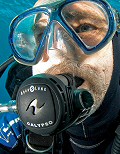
  14. Just to add a little bit or real research to this subject, over the last seventeen years I have photographed myself with every single regulator that has been available on the UK market. This has meant holding the camera a distance of about ten inches from my face and making repeat exposures with flash. You can imagine that since I am not looking through the viewfinder I have to have lots of attempts before I get the shot I want. This means 30 or so exposures in a short time interval. I use the lowest ISO (or ISO100 in the days of film) and the smallest lens aperture. This means discharging the twin strobes at full power (Nikon SB104, Subtronic Mega Colour, Subtronic Alpha and Inon 240Z close to my face. I always have my eyes open despite owning functioning eyelids.

    I now need to wear spectacles for reading. (My wife has suggested that my failing eyesight is more to do with another filthy habit.) I passed my HSE medical exam, which includes examination of the retina, with flying colours.

    I hope this sets everyone's mind at rest. Incidentally, though some would argue, I am a more complex animal than a pygmy seahorse.

    post-4197-1248245212.jpg

    Edited by John Bantin
  15. :D Not more complex, just different John.

    I'll agree that phototoxic retinopathy is hard to produce on mammals, but nobody has done much studies on fish. What study has been done shows that fish avoid strobe lights and such lights are used to control fish movement on fish farms etc.

    Fish eyes are NOT designed for bright lights (like the sun) and have evolved to deal with a different light environment. Using yourself as an example is frankly invalid research unless you are a marine (desire to be one doesn't count ;) ) and have eyes like marine animal (and the various different kinds of eye designs that exist).

    Putting the science aside and perhaps broaching on the ethics of nature photography (btw this discussion of flash effects for topside animals was as controverisal). The fact that the Beeb used IR instead of normal lights to get behavior means artificial light affects the behavior of the animals topside. Some benefit (like the trevally which scooped up a fish and temporarily blinded by my lights) but some don't.

    I'm much more tolerant of affecting behavior in remote areas where the marine is thick and not too many divers with 250W strobes come round. With regular dive traffic, I agree some controls are warranted, but done within reason.

    John you were in Bali and dived the liberty. Due to the incessant parade of divers, the fish are VERY accustomed to divers and tend not to scatter, especially that big 'cuda. Still somehow some divers manage to scare the trevally school to swim deep and fast. If you looked for pygmies on the fans, you'd see very few. Because of the high traffic including photogs, they have either moved or worse died off. I'm sure if there were rules to keep the harassment of critters to a minimum, they'd stay and everyone can enjoy.

  16. :D Not more complex, just different John.

    I'll agree that phototoxic retinopathy is hard to produce on mammals, but nobody has done much studies on fish. What study has been done shows that fish avoid strobe lights and such lights are used to control fish movement on fish farms etc.

    Fish eyes are NOT designed for bright lights (like the sun) and have evolved to deal with a different light environment. Using yourself as an example is frankly invalid research unless you are a marine (desire to be one doesn't count ;) ) and have eyes like marine animal (and the various different kinds of eye designs that exist).

    Putting the science aside and perhaps broaching on the ethics of nature photography (btw this discussion of flash effects for topside animals was as controverisal). The fact that the Beeb used IR instead of normal lights to get behavior means artificial light affects the behavior of the animals topside. Some benefit (like the trevally which scooped up a fish and temporarily blinded by my lights) but some don't.

    I'm much more tolerant of affecting behavior in remote areas where the marine is thick and not too many divers with 250W strobes come round. With regular dive traffic, I agree some controls are warranted, but done within reason.

    John you were in Bali and dived the liberty. Due to the incessant parade of divers, the fish are VERY accustomed to divers and tend not to scatter, especially that big 'cuda. Still somehow some divers manage to scare the trevally school to swim deep and fast. If you looked for pygmies on the fans, you'd see very few. Because of the high traffic including photogs, they have either moved or worse died off. I'm sure if there were rules to keep the harassment of critters to a minimum, they'd stay and everyone can enjoy.

    There is a big difference between using a strobe and a very bright lamp. See Alex' new thread about using continuous lighting.


    Drew, you do seem to be advocating the banning of underwater image-gathering in its present form.

    Edited by John Bantin
  17. Not at all,John. I think I've said in every one of my posts in this thread that those ops were overreacting. However I do believe in moderation and an ethical approach to photography in general is needed for the future of good dive sites to stay good.

    The days where one could tear up coral heads and destroy stuff is over, except perhaps on the most remote reefs. High traffic sites are getting hit so hard that the reefs may not grow back. Furthermore, the 36 frame limitation has also been removed. Also the strobes are becoming more powerful.

    The present form is always changing. The growth of this website proves there are more people with big strobes taking photos and as such, new discipline has to be instilled. Every Tom, Dick and Mary is now able to take 3-400 shots on one dive. The ethics of nature photography hasn't been touched nearly enough sometimes, and that's why you have ops like emperor divers making silly decisions like that out of ignorance.

    I am just trying to balance your statements that marine life are not affected at all by strobes. There is only anecdotal evidence for either side of the argument. There's also the aquarium owners who will attest that some fish usually disappear under cover when lights are turned on because they can't adjust as fast to a sudden burst of light. A strobe will has the same effect, a series of strobe flashes will put the animal at a disadvantage. Obviously it's not a universal truth that all fish are affected equally. But that doesn't mean people should go crazy with their strobes too.

  18. Probably a bit late with this but...just to row in with Drew and John.....


    I totally agree with not taking one flash too many-and making the right call to flash or not to flash..and we as photographers should have enough experience to know when and when not to shoot.….Yes we should all have our own code of ‘best practice’ for taking pics underwater-and pass it on to those who are taking underwater pics for the first time. I think Martin Edge sums it up very well in his book. ‘Over flashing’ the same subjects is something we are all guilty of- it just happens- that’s the nature of what we try to do in underwater land- given all the time, effort, and lets not forget… money, that we put in to get our precious beautiful images.


    My two cents…….


    1. Doesn't light from strobes travel and get absorbed by water anyway? So the amount of light an animal underwater receives underwater from a strobe is distance dependant and strobe output dependant ....right?? Light travels differently when photographing a cat in a room, or a pygmy seahorse on a sea fan???


    2. Its fair to assume that there is an effect of strobe light…on any animal….. is species dependant………including homo sapiens…(right Drew?? )


    3. If someone tells me- 'dont use strobes on an underwater animal ‘cause it effects them'- my first response is - 'How do you know??' In my limited experience as a scientist - if you can’t back up statements with proven facts- then don't make statements. We are perfectly well within our rights to hypothesise. However, to ram a hypothesis down someone else’s throat (particularly when that ‘someone’ happens to provide you with a living) as fact,when its not proven, - is deeply flawed logic IMHO.


    4. Whatever happened to the old saying …'Leave footprints- take only pictures'? So some dive tour operators/guides are now saying you can’t do this-after you/the customer paying a lot of money-and going through a lot of effort to travel, lug camea gear etc etc While they are at it- why don’t we extend the same courtesy to insects, birds, and every other animal species on the planet??? Also –let’s all stop computer use for manipulation of images, posting images/rants on wetpixel forums, stop manufacture of underwater camera housings, stop travel to photograph sharks etc etc. After all these posts- I think itys safe to say that strobe flashes on a shark’s eyeball from a photographer -is the least of our problems-and we should all- as a species-never forget the home truths behind our current existence on this planet and how we are shaping it. (right John?? )


    5. At least by taking pics we heighten awareness as to what we have left in our oceans- and will be nice memories for future generations-and just maybe- that’s all they will have left. 


    Thank you all so much for making me think of ‘flashing’ a subject underwater-its been an education.!!!

  19. Probably a bit late with this but...just to row in with Drew and John.....


    I totally agree with not taking one flash too many-and making the right call to flash or not to flash..and we as photographers should have enough experience to know when and when not to shoot.….Yes we should all have our own code of ‘best practice’ for taking pics underwater-and pass it on to those who are taking underwater pics for the first time. I think Martin Edge sums it up very well in his book. ‘Over flashing’ the same subjects is something we are all guilty of- it just happens- that’s the nature of what we try to do in underwater land- given all the time, effort, and lets not forget… money, that we put in to get our precious beautiful images.


    My two cents…….


    1. Doesn't light from strobes travel and get absorbed by water anyway? So the amount of light an animal underwater receives underwater from a strobe is distance dependant and strobe output dependant ....right?? Light travels differently when photographing a cat in a room, or a pygmy seahorse on a sea fan???


    2. Its fair to assume that there is an effect of strobe light…on any animal….. is species dependant………including homo sapiens…(right Drew?? )


    3. If someone tells me- 'dont use strobes on an underwater animal ‘cause it effects them'- my first response is - 'How do you know??' In my limited experience as a scientist - if you can’t back up statements with proven facts- then don't make statements. We are perfectly well within our rights to hypothesise. However, to ram a hypothesis down someone else’s throat (particularly when that ‘someone’ happens to provide you with a living) as fact,when its not proven, - is deeply flawed logic IMHO.


    4. Whatever happened to the old saying …'Leave footprints- take only pictures'? So some dive tour operators/guides are now saying you can’t do this-after you/the customer paying a lot of money-and going through a lot of effort to travel, lug camea gear etc etc While they are at it- why don’t we extend the same courtesy to insects, birds, and every other animal species on the planet??? Also –let’s all stop computer use for manipulation of images, posting images/rants on wetpixel forums, stop manufacture of underwater camera housings, stop travel to photograph sharks etc etc. After all these posts- I think itys safe to say that strobe flashes on a shark’s eyeball from a photographer -is the least of our problems-and we should all- as a species-never forget the home truths behind our current existence on this planet and how we are shaping it. (right John?? )


    5. At least by taking pics we heighten awareness as to what we have left in our oceans- and will be nice memories for future generations-and just maybe- that’s all they will have left. 


    Thank you all so much for making me think of ‘flashing’ a subject underwater-its been an education.!!!


    I agree!

  20. Probably a bit late with this but...just to row in with Drew and John.....


    I totally agree with not taking one flash too many-and making the right call to flash or not to flash..and we as photographers should have enough experience to know when and when not to shoot.….Yes we should all have our own code of 'best practice' for taking pics underwater-and pass it on to those who are taking underwater pics for the first time.


    Sure but the problem is certain individuals think nothing of 400 shots at the same subject is fine in 50 minutes. Self-restraint and contro aren't traits "homo-sapiens" are well known for.

    I think Martin Edge sums it up very well in his book. 'Over flashing' the same subjects is something we are all guilty of- it just happens- that's the nature of what we try to do in underwater land- given all the time, effort, and lets not forget… money, that we put in to get our precious beautiful images.

    Well then because I spent $10k to get a destination and more flights, fought with my SO/family to get the holiday, I get to shoot more than someone who lives next to the site? Let's not assume that we are entitled to things. It always creates trouble when we do.


    3. If someone tells me- 'dont use strobes on an underwater animal 'cause it effects them'- my first response is - 'How do you know??' In my limited experience as a scientist - if you can't back up statements with proven facts- then don't make statements. We are perfectly well within our rights to hypothesise. However, to ram a hypothesis down someone else's throat (particularly when that 'someone' happens to provide you with a living) as fact,when its not proven, - is deeply flawed logic IMHO.

    Actually they are protecting their living by ensuring it stays around. If I go to the Azores once a year for 10 days and get to harass the sperm/fin whales as I like, spending €500 a day for a boat and permit, and the whales leave. What happens to the rest of the season and others who want to come do the same? You are absolutely right that the hypothesis is flawed. It's the same logic as saying since nicotine inhalation doesn't cause real health problems for 100% of users, does that mean it's safe for some and not others? ;)


    5. At least by taking pics we heighten awareness as to what we have left in our oceans- and will be nice memories for future generations-and just maybe- that's all they will have left. 

    That reason went out the door with Getty, Alamy and MS going nuts on stock images. If every picture taken was of a new species or at least a new stage of development of an established species, I'd buy that. Otherwise, it's just another justification to get what we want. Calling a spade a shovel doesn't change what it is. :D


    Thank you all so much for making me think of 'flashing' a subject underwater-its been an education!!!

    That's the point of discussions like these. Getting polar viewpoints out and letting people decide.


    I agree!

    Consensus at last! ...well sorta. ;)

    Edited by Drew
Marelux

Account

Navigation

Search

Search

Configure browser push notifications

Chrome (Android)
  1. Tap the lock icon next to the address bar.
  2. Tap Permissions → Notifications.
  3. Adjust your preference.
Chrome (Desktop)
  1. Click the padlock icon in the address bar.
  2. Select Site settings.
  3. Find Notifications and adjust your preference.