Skip to content

Lights, Strobes, and Lighting Technique / Archived topic

Selective lighting

Started by danielstassen ·

  • 57Posts
  • 57Replies

Read-only discussion

Selective lighting

57 posts
  1. Daniel - Great froggy shots! The shot with eggs is a stunner to me - that's been on my wishlist for YEARS now. Great find, and excellently captured.


    I am afraid I disagree with Keri here. What a wasted opportunity the green frogfish is. Such great subject matter and the chance was missed by playing around with a snoot and half cutting off the mouth. I am only so honest (because since you knew when the eggs hatched) I am sure you have lots of photos of this fish and its eggs.


    The key to good lighting is not just to learn a fancy technique and apply it to the next subject you find. But is to choose the technique to match the what you as a photographer want to "say" about the subject - the concept of your image. Subject, camera angle, composition, depth of field, lighting, all working in synergy with the important message of that image. To quote mister adams "there is nothing worse than a sharp image of a fuzzy concept" or something like that.


    Your two images are a great example of this. The concept behind the lower image is a portrait. Directional light is well suited to a portrait, particularly with a frogfish, accentuating their texture and creating mood. This image the lighting works in synergy with the concept. The other shot is about a behaviour and here the most important part of the concept is what is going on. And here I want to see all that in the frame, not squeezed in at either end. And with lighting that shows it off best. I would expect that your non-snoot images of this frogfish with eggs are much stronger images.


    Alex

  2. I am afraid I disagree with Keri here.


    Don't be afraid................. :beer: (j/k)


    I was commenting more on the rare subject matter, than the technical perfection of the image. Although, I do still think it's a good shot (well-exposed, interesting subject, crisp focus on the eye and eggs), but I would've framed and lit it differently, and I agree that a snoot was not necessary.


    The key to good lighting is not just to learn a fancy technique and apply it to the next subject you find. But is to choose the technique to match the what you as a photographer want to "say" about the subject - the concept of your image. Subject, camera angle, composition, depth of field, lighting, all working in synergy with the important message of that image. To quote mister adams "there is nothing worse than a sharp image of a fuzzy concept" or something like that.


    Well said!


    Keri

  3. The key to good lighting is not just to learn a fancy technique and apply it to the next subject you find.


    I think it is a trap we can easily fall into whilst learning a new technique. We spend the whole dive so focused on the nuances of the particular technique that we can easily miss the bigger picture.

    Your two images are a great example of this. The concept behind the lower image is a portrait. Directional light is well suited to a portrait, particularly with a frogfish, accentuating their texture and creating mood. This image the lighting works in synergy with the concept. The other shot is about a behaviour and here the most important part of the concept is what is going on. And here I want to see all that in the frame, not squeezed in at either end. And with lighting that shows it off best. I would expect that your non-snoot images of this frogfish with eggs are much stronger images.

    And part of learning a new technique is when to use it.


    It is nice to have discusion on the creative side of capturing photo's rather than just the technical bits.

  4. Nice shot Keri!


    I tried to stick sheets of aluminum foil inside, but without success. I thought that aluminum would be reflective, but it doesn't seem to increase the power of the strobe. What do you use inside you snoot?


    Cheers


    Daniel


    PS: Do you sometimes go to Raja Ampat? If yes, then you probably stopped at the pearl farm in Waigeo, in Alyui Bay, and dived on the jetty. I have been working in this farm since January 10, and all the liveboards passing by told us that they find quite often spotfin froggies w/ eggs under the jetty. Well I only found one in 4 months.

  5. I am afraid I disagree with Keri here. What a wasted opportunity the green frogfish is. Such great subject matter and the chance was missed by playing around with a snoot and half cutting off the mouth. I am only so honest (because since you knew when the eggs hatched) I am sure you have lots of photos of this fish and its eggs.


    Alex,


    It might have been a wasted opportunity, but I believe that one must experience to understand. One does not excel without practice. I only took shot of the frogfish w/ a snoot, and I would not have tried without because I wanted to practice the snoot to understand how it works and what kind of results one can get.


    Your two images are a great example of this. The concept behind the lower image is a portrait. Directional light is well suited to a portrait, particularly with a frogfish, accentuating their texture and creating mood. This image the lighting works in synergy with the concept. The other shot is about a behaviour and here the most important part of the concept is what is going on. And here I want to see all that in the frame, not squeezed in at either end. And with lighting that shows it off best. I would expect that your non-snoot images of this frogfish with eggs are much stronger images.


    Next time when the frogfish has eggs again, I will try to follow your advice and post the photo.


    Cheers


    Daniel

  6. Excellent pics all. Edward, I really like the Mandarin fish. Those little buggers are a pain to catch sometimes. Keep up the excellent work on the housings, Im loving my 7d!!

  7. Nice shot Keri!


    I tried to stick sheets of aluminum foil inside, but without success. I thought that aluminum would be reflective, but it doesn't seem to increase the power of the strobe. What do you use inside you snoot?


    Cheers


    Daniel


    PS: Do you sometimes go to Raja Ampat? If yes, then you probably stopped at the pearl farm in Waigeo, in Alyui Bay, and dived on the jetty. I have been working in this farm since January 10, and all the liveboards passing by told us that they find quite often spotfin froggies w/ eggs under the jetty. Well I only found one in 4 months.


    I have been by there myself. A few years back with Larry SMith. The guys came over to the boat with a bag full of pearls and I have shots of them on the table. Truly special to see. Dove the jetty too but did not find frogfish but a great dive none the less. Fire urchin across the bay. Nice place for some dives.


    Cheers


    Todd

  8. Alex, Keri


    Great comments and i agree with how a technique can be so ingrained in the mind during a dive that you forget what your really looking at and how a different technique may be better suited, but having said that, you have to try these things to get it right!


    Alex, i remember a shot of yours of a mimic octopus or wonderpus with a disctinct lighting from above? was this a snoot shot? I ask because we have recently discovered a dive site here (s. leyte, Phils) where mimics are common and my shots just have no impact and your image is in my head. The little guys move so fast and erratically i cant believe this was with a well aimed snoot?


    Olly

  9. Alex, Keri


    Great comments and i agree with how a technique can be so ingrained in the mind during a dive that you forget what your really looking at and how a different technique may be better suited, but having said that, you have to try these things to get it right!


    Alex, i remember a shot of yours of a mimic octopus or wonderpus with a disctinct lighting from above? was this a snoot shot? I ask because we have recently discovered a dive site here (s. leyte, Phils) where mimics are common and my shots just have no impact and your image is in my head. The little guys move so fast and erratically i cant believe this was with a well aimed snoot?


    Olly

    Olly,


    I seem to recall that it was shot using a torch and high iso...


    Duncan

  10. Excellent pics all. Edward, I really like the Mandarin fish. Those little buggers are a pain to catch sometimes. Keep up the excellent work on the housings, Im loving my 7d!!


    Hi Mike,


    Our pleasure that you like our housing. Thank every one of you wetpixel members for the support. Still working hard.....


    Best regards,


    Edward

  11. I decided to jump on the band wagon and give snoot photography a go. I've got a few bits and pieces to play around with, but I jumped in the water for a dive over the weekend with a slightly wider one (a large, white pice of restrictor pipe), that was more for directional light than lighting up a small spot.


    This guy is normally around the same area on a site we regularly dive. Only a juvinile, and hides in finger coral (so the snoot meant I could get the black background without too much behind it). I was only able to shoot a bunch of shots before he started looking a little aggitated, so I backed off.


    I haven't calibrated my monitor (something to do this week), please let me know if the colours are out.


    4510035833_739dfb9d1e.jpg


    Comments welcome!


    Ryan.

  12. ... they will crusify you (rightfully) for changing the truth and meaning of the image...


    How can it be wrong to manipulate the image to create the subjective truth of the experience, or to recreate what you saw? Cameras do not see what the eye sees, and do not interpret the image at all. I contend that the "truth and meaning" of any image are more likely to be created in post-processing (once called development and printing) than in the camera.


    National Geographic has a house style that often influences the meaning of its images. In competition the restrictions prevent the assembly of synthetic images and promote photographic skill, but this shouldn't be confused with the "truth" of an image. That is a measure of the success in communication between the photographer and the viewer, the transmission of an idea or an emotion through the medium of the image.


    Tim


    :beer:

  13. Couple of quick points.


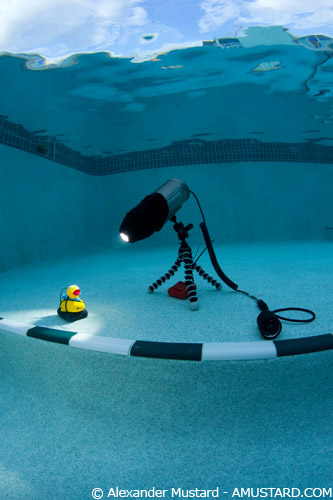
    Be aware that underwater plastic gorillapods are buoyant and are not stable underwater with a heavy strobe on top. I hang dive weights under mine to give them stability:


    post-713-1270021904.jpg


    Alex


    How do you get the camera mount off of the ball head of the Gorrilapod, such that you can put on the clamp onto the strobe?


    I would like to replicate your mount.


    Thanks,

    Robin

  14. Anyone seen or heard of anyone using the new snoots for inon? Look a very versatile setup but maybe not as fun as making your own from plumbing and duct tape


    Olly

  15. Much enjoyed the topics on snoots.


    Have played around (only on land, so far) with them, and there are many techniques to modifying the entrance/exit aperature. I am working on various custom tip ends to get different effects (trying them out in a couple of weeks, then in Anilao in April). I've been using some higher-end fiber optic stuff (that I machined/constructed), as well as playing with attachments, light sources, off-camera optical triggers (be prepared to drop some serious cash for triggers, cabling, joby-pods and heads), and the type of fiber optic cable (sadly, I have become a frequent customer of the wholesale supplier....all in the interest of science and engineering!).


    I am using both on and off camera snoots (at the same time, no less), on the "bead" arms. The real fun begins when you start adding a diopter. I have found while shooting (in full manual mode), the "aim" of the snoot is critical. Depending on what the "purpose" of your photo is, will depend on light placement, angle, etc. (good point, Doc). What I have found to be the most challenging is to balance what I want (or think I want), as well as getting an exposure that utilizes the camera's full dynamic range (check your histogram often). Anyone having problems nailing the full spectrum with snoots? Any advice?


    I see this has been kind of a specialized forum, with few posts. Hope people aren't giving up on this technique, as it's beyond cool. Really lends itself to shallow shore dives, as you can spend some time on setup and composition (my wife really doesn't like to dive with me while I'm shooting. Says I ingore her. We all know she's right).

  16. I have my wife dive with an off camera strobe with a Retra LSD attached that is triggered by a Triggerfish sensor. She aims the Retra at my subject. That way I can concentrate on camera settings and composition, while she maintains proper aim of the snoot light. It gives her a way to participate.

    Edited by diverdoug1
  17. I have my wife dive with an off camera strobe with a Retra LSD attached that is triggered by a Triggerfish sensor. She aims the Retra at my subject. That way I can concentrate on camera settings and composition, while she maintains proper aim of the snoot light. It gives her a way to participate.

    My wife carries a video camera and my participation is to take photos of the cool things she finds after she is done and to make sure that I don't allow any strobe flashes to show up in her video clips. But because she has all the talent in the family it works OK.


    Bill

Ultralight Control Systems

Account

Navigation

Search

Search

Configure browser push notifications

Chrome (Android)
  1. Tap the lock icon next to the address bar.
  2. Tap Permissions → Notifications.
  3. Adjust your preference.
Chrome (Desktop)
  1. Click the padlock icon in the address bar.
  2. Select Site settings.
  3. Find Notifications and adjust your preference.