Skip to content

Video Gear and Technique / Archived topic

Cost efective LED light recommendation

Started by Andy Davies ·

  • 30Posts
  • 30Replies

Read-only discussion

Cost efective LED light recommendation

30 posts
  1. Hi


    A friend wants to buy some lights to work with a Sony FX1 in a Gates housing with the standard dome port to be used in the UK for wildlife shooting in relatively shallow water (<20m).


    Cost is an issue. What do people think of the Darkbuster LED - 12 and the Intova Super Novas. Both have been mentioned in previous threads. Are either (or both) a worthwhile option?


    Thanks


    Andy Davies

  2. Andy,

    i have no experience with the Intova Videolight, but the Intova ISS 2000 strobe

    is surprisingly well made for the very low price.

    For this reason i would expect that the Super Nova videolight is of a similar quality.

    BUT, i had some email contact with them and they told me that the Super Nova will be redesigned

    and should be available in May (now).

    This means to me that there was a flaw or they try to gain more light output, who knows.

    Your friend should may wait and investigate further about the Super Nova.


    Chris

  3. Out of curiosity, what kind of budget do they have to work with?

  4. Hi


    A friend wants to buy some lights to work with a Sony FX1 in a Gates housing with the standard dome port to be used in the UK for wildlife shooting in relatively shallow water (<20m).


    Cost is an issue. What do people think of the Darkbuster LED - 12 and the Intova Super Novas. Both have been mentioned in previous threads. Are either (or both) a worthwhile option?


    Thanks


    Andy Davies


    Neither of the lights you mention are really underwater video lights. The Darkbuster led-12 has a beam angle of 25 degrees...even with a diffuser it would only be marginally useful for macro work. Lumens is only 700 @ 25 degrees...the more you try to spread it, the more brightness you lose. There's no mention of their color temperature on the manufacturer's data sheet.


    The Intova Super Nova is a more promising option. I use two of them for macro/very close video. But...this only works well with a good "prismed" diffuser (the original beam angle is not that wide) and the color temperature is very hight (I gesstimate about 8000 K)...too high to balance with daylight, but OK if you only use it as the main source of illumination and WB accordingly.


    I've seen the new version. No idea why they changed the switch...maybe some users had problems with the original design located at the rear (it's now near the head). Light output seems to be the same...but I didn't have a chance to do a side-by-side.


    It never ceases to amaze me that so many people allocate most of their budget to the camera and housing...and end up getting inadequate (or no!)video lights. There are so many good, dedicated, underwater video lights available today from so many manufacturers...compared to just a few years ago. And the prices are becoming more realistic for some of them.


    Good lighting can make or break a video. It restores colors in deeper water in a way filters never can. Using powerful (eg 2000 Lumens +) daylight balanced lights can greatly reduce the need for regular WB since the ambient light is balanced with the correct video lighting. With dedicated, wide beamed (80 - 100 degrees UW) video lights you also avoid the amatuerish "spotlight" effect when shooting at night or in wrecks, caves, etc.

    Edited by HDVdiver
  5. Many thanks for the feedback. What would people recommend as the best option lights when the budget is tight? Could be either HID or LED.


    Andy

  6. HID lights are normally quite expensive so i guess that the LED lights are less expensive.

    But consider hat a LED light should have a - sometimes much- longer burn time and that

    HID bulbs are very expensive and delicate too.


    I think that the INTOVA is the best bang for the buck.


    Chris

  7. The problem with the Intova is, as HDVdiver pointed out, the colour temp is very high making them only good for macro where they are the only light source ie. no ambient.


    Andy

    Edited by Andy Davies
  8. HID lights are normally quite expensive so i guess that the LED lights are less expensive.

    But consider hat a LED light should have a - sometimes much- longer burn time and that

    HID bulbs are very expensive and delicate too.


    I think that the INTOVA is the best bang for the buck.


    Chris


    HID is now a stable mature technology...LED technology is changing rapidly. At the moment the best leds are not that much more efficient than the best HID bulbs: CREE XPG 130 Lumens/watt...best HID 110 Lumens/watt. This will change by next year since CREE has just demonstrated a white LED of 200 L/watt.


    Good HID underwater video lights are now/should be MUCH cheaper than LED...for the EQUIVALENT lumen/beam angle performance.


    Contrary to urban myth, good HID bulbs are very tough. They are used on jet fighters, military vehicles and in the aerospace industry. They can be switched on/off as many times as necessary...as long as the time interval is sufficiently long enough (approx one minute) to allow the ballast electronics to ramp up the voltage (to ignite the Xenon gas) and then stabilize. Rapid, continuous switching will even blow a halogen lamp filament.


    Good HID bulbs (35w & 50w) are now cheap. They should be available from the video light's manufacturer as a spare for around $100. They should last for 2000 hours.


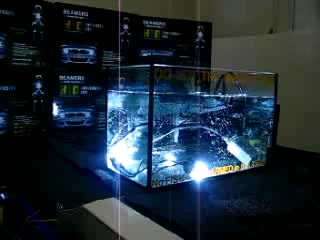
    Another consideration. Flood a well designed HID (with potted/sealed electronics), the chances are good it'll still work after a wash & dry (the batteries might need replacing). I and a couple of dive buddies have flooded several HIDs over the years (always due to rubber toggle switch damage...be very careful with toggles!). In every case the HIDs were washed out in fresh water, dried for a day...and worked OK until they could be serviced. I've got a great video of a bare HID bulb burning in a fish tank (...no fish)! Don't try that at home...:)


    Flood an LED light and the chances are it will stop working...and be a lot more expensive to repair.

    post-16448-1275015388.jpg

    Edited by HDVdiver
  9. ....

    Contrary to urban myth, good HID bulbs are very tough. They are used on jet fighters, military vehicles and in the aerospace industry. They can be switched on/off as many times as necessary...as long as the time interval is sufficiently long enough (approx one minute) to allow the ballast electronics to ramp up the voltage (to ignite the Xenon gas) and then stabilize. Rapid, continuous switching will even blow a halogen lamp filament......


    The on/off limitations and warm up interval has always been what kept me from getting HID lights.

  10. The Inon LE550-W looks like a possibility (550 lumens, 75 degree, 6000K color temp, as low as $209 each). I am thinking about these, but am still trying to find some more info. Anyone have these or used them?

  11. The Inon LE550-W looks like a possibility (550 lumens, 75 degree, 6000K color temp, as low as $209 each). I am thinking about these, but am still trying to find some more info. Anyone have these or used them?


    As I've said in another post, the actual lumen output of these is closer to 400/450 if you do the calculations using CREE MCE data sheets. I've used them side-by-side with the Intova (with a diffuser on the Intova)...and the Super Nova is much, much brighter. If you're willing to tape on a diffuser and warming filter onto the Intova, it would be the more usable than the Inons in terms of brightness. For macro, just a simple plastic diffuser would be fine.


    "The on/off limitations and warm up interval has always been what kept me from getting HID lights."


    Sure...it's a minor inconvenience. But it's easy to live with in reality.


    It takes 10 seconds for a current generation HID to reach peak luminousity. I simply turn the HIDs on as soon as I know I'm about to video something. They warm up as I'm getting into position and composing the shot. I leave the lights on until it's obvious that I'm done shooting that subject. With about an hour of burn time for a 50w and more for a 35w HID I can do a full dive without even being particularly careful with conserving burn time. At night, they usually stay on for the full duration of the dive...a fantastic experience...10,000 Lumens really lights up the landscape.


    If not HID then what...LED's still can't compete in terms of maximum Lumen output...or robustness for that matter. As I've said...and based on real world experience...a well designed HID should survive a total flood, an LED will not. Sure, the marketing palaver always stresses LEDs have a life of 20k hours. But there's a lot more to it than that. Both technologies have their strengths and weaknesses.


    Price wise, lumen for lumen, HID is also a lot cheaper than LED at the moment...and today's LED technology will be seriously outclassed when the new 200L/w LEDs are available next year.


    Edited by HDVdiver
  12. Hi

    Yes HID's now days boot up in no time.

    I just leave it on for all the dive with my G3 35/50watt HID as its got heaps of battery power.

  13. Jeez !!! I love it when someone asks for a low cost video light and all the technical specs start getting thrown about :):)


    In the UK I Personally, If it's averagely clearwater and shallow (say down to 10M), just use a 'greenwater' filter and W/B. Obviously the more available light the better. Although i have been told Greenforce have some nice lights, whether they are cheap or not I do not know as I have never used lights (well unless I'm shooting at night, in a cave or inside a wreck. Did I tell you i once shot the outside of a wreck at 65M with no lights looked a bit grainy but still pretty cool.


    Dive safe


    Dean(promoting natural light for 2010)B

  14. Yes DeanB,

    the question was lost in the woods of lumens, watts and start-up times... :)


    My friend and a well known videographer in Italy is recording almost everything only with ambient light,

    using different color filters and the results have impressed me.


    If there would be a "cheap" HID Videolight it may be interesting to test them, but still, 100$ for a bulb is

    much lesser than 2 years ago but i still find it "hefty".


    As HDVdiver wrote, if the higher colourtemp of LED is a issue there is still the solution to adapt a colour correcting

    filter and/or a diffuser.


    Chris

  15. Jeez !!! I love it when someone asks for a low cost video light and all the technical specs start getting thrown about :):P


    Dean(promoting natural light for 2010)B


    Ha ha...don't you see the irony of this statement.


    How can a buyer possibly make an informed decision without looking at the technical specs of alternative products!


    Even 2000 years ago the Romans had a term for it...Caveat Emptor...let the buyer be aware! It's worth the (little) effort involved. It could mean the difference between spending money on something you'll be happy with...or something you'll put on Ebay the next day at half the cost price. :)


    Cheers

  16. Ha ha...don't you see the irony of this statement.


    How can a buyer possibly make an informed decision without looking at the technical specs of alternative products!


    Even 2000 years ago the Romans had a term for it...Caveat Emptor...let the buyer be aware! It's worth the (little) effort involved. It could mean the difference between spending money on something you'll be happy with...or something you'll put on Ebay the next day at half the cost price. :)


    Cheers


    Or just baffle them with way too much info ... I prefer the "I had a pair of Fa-Mi LED's (insert manufacturer number) and they were awesome go and try them at you local shop" technique ... Or "two of my friends have the latest L&M HID's and they can be dimmed to your taste with a long battery life" Although I suppose if your techno minded finding out what particles of matter? the bleeding paint is made of might help :P:) at least it sounds great. Bring back Drew he was the 'king of swing' on Info :P


    Dive safe


    DeanB

  17. I've had a reply from Kevin Lackey at Intova saying that the Super Novas are 6000-7000K.


    Regards


    Andy

    Edited by Andy Davies
  18. ...and they are awesome (really heaps bright) go and try them at your local shop...:)

    Edited by HDVdiver
  19. ...and they are awesome (really heaps bright) go and try them at your local shop...:)


    Best piece of advice so far :)


    Dive safe


    DeanB

  20. Unfortunately, there is no dive shop for a couple of hundred miles from where she is based. The question I posed on her behalf was not "a low cost" solution. It was a "cost effective" solution. So this is where a forum like Wetpixel is invaluable. A place where we can discuss the pros and cons of different options. Colour temperature, beam quality, coverage, lumen output etc are all important factors that need to be understoood before a purchase. I have tried a pair of very warm lights and it was a nightmare trying to colour balance them with ambient.


    Andy

    Edited by Andy Davies
Kraken Sports

Account

Navigation

Search

Search

Configure browser push notifications

Chrome (Android)
  1. Tap the lock icon next to the address bar.
  2. Tap Permissions → Notifications.
  3. Adjust your preference.
Chrome (Desktop)
  1. Click the padlock icon in the address bar.
  2. Select Site settings.
  3. Find Notifications and adjust your preference.