Skip to content

Video Gear and Technique / Archived topic

Red Filter Too Red

Started by peterbkk ·

  • 24Posts
  • 24Replies

Read-only discussion

Red Filter Too Red

24 posts
  1. I find that, in nearly all tropical water, the UR Pro red filter provided with the L&M housing is too red, blowing out the reds in the corals, even when doing a MWB.


    One nice feature of the new L&M housings is that the filter, in its frame sits in a magnetic holder and can be replaced in a couple of seconds. I'm thinking of getting another frame and trying a much lighter red filter for shallow reef shots (without lights).


    Has anyone done anything like this?


    Any suggestions on what to use for the very light red filter? What about those photo gels like "Lee Filters"? Any idea what colour I should buy? Light pink?


    Regards

    Peter

  2. Generally at shallow depths I don't use the Red filter, just MWB which solves the prob, deeper using the filter works well until you are 25m+ then it just stops too much light.


    I reckon with WB get it in the ball park then correct it in post.

  3. Generally at shallow depths I don't use the Red filter, just MWB which solves the prob, deeper using the filter works well until you are 25m+ then it just stops too much light.


    I reckon with WB get it in the ball park then correct it in post.


    I have stopped using the red filter for all shots because it is way too red for clear tropical waters. I just MWB off some coral, then fix the rest in post. But, seems a shame not use that flip device if it can add value in some circumstances.


    What about using a "magic filter" instead of the deep-red UR Pro filter? http://www.magic-filters.com/magicindex.html Has anyone tried that?


    Regards

    Peter

  4. Try manually white balancing off the palm of your hand, which is what I do to knock back the redness slightly, or perhaps get some pale pink fins or scrawl some red marker on some white duck tape on one of your fins to get the right shade of pink (which is what I used to do). I've never had a satisfactory MWB off coral ever.


    In the top few metres of water I'll use any combination of no-filter+autoWB or red-filter+autoWB or no-filter+MWB or red-filter+MWB. It all depends on the ambient light (e.g. midday, sunset etc.) and behaviour of your particular rig, and it's extremely dependent on the depth. A couple of metres can make all the difference in which method I would choose.


    The Lee, Rosco etc gel filters are designed to just change the colour of electric lights and are allegedly not "optical" quality (whatever that means), although I have seen point-and-shoot users get away with them. You can get a swatch book from them with loads of samples. Apparently the Magic Filters are somehow different in a way that makes them "optical" quality, but exactly what that is, I have no idea.

  5. The Lee, Rosco etc gel filters are designed to just change the colour of electric lights and are allegedly not "optical" quality (whatever that means), although I have seen point-and-shoot users get away with them. You can get a swatch book from them with loads of samples. Apparently the Magic Filters are somehow different in a way that makes them "optical" quality, but exactly what that is, I have no idea.


    David at ScubaCam is now fitting a "magic filter" into my L&M flip filter holder. Not sure how it'll work but I'll give it a try. I'm hopeful because the magic filter is less red (more orange) than the UR Pro and much less thick. Should be a milder filter than the UR Pro filter. Let's see. I'll update you after I test it in a couple of weeks.


    Regards

    Peter

  6. An 18% grey card is probably the better MWB because it reflects less light and thus will give a more "neutral" look. Problem is finding an accurate 18% grey card for uw use.


    I'd worked on a Magic Filter vs URPro for video comparison. But didn't have the time to finish it.

  7. I found the Magic Filter very disappointing for video. Even in crystal clear water with good sunlight I couldn't normally one touch MWB with it on much past 10m, compared to 25-30m with the URPRO in similar conditions.


    Be interesting to see your thoughts on it Peter after you've given it a whirl, especially as you are finding the URPRO too red.

  8. I found the Magic Filter very disappointing for video. Even in crystal clear water with good sunlight I couldn't normally one touch MWB with it on much past 10m, compared to 25-30m with the URPRO in similar conditions.


    Be interesting to see your thoughts on it Peter after you've given it a whirl, especially as you are finding the URPRO too red.


    Interesting that it would not MWB at the same depth as the UR Pro. Holding the 2 up to a light, the UR Pro looks redder and darker.


    In any case, I only use a filter in water down to about 15 meters for natural light video. Deeper than that and I flip out the filter and switch on the lights. Lights and filter definitely don't mix well.


    Later this month I'll take the flip Magic Filter on a 6-dive weekend coral reef trip and see how it works out. I'll report back.


    Regards

    Peter

  9. If you are not going to MWB below 15m then it will be fine. Even if you only get to MWB at 10-12m you should be able to easily correct that in post! In the 3-8m range the Magic Filter was very good with great colour reproduction. It was just a shame it wouldn't work deeper than 10m :D


    Cheers, Simon

  10. I have struggled (and still am struggling) with the CX550V MWB and since I am diving in rather green water at time (should I add cold too?), I thought that using a Green Water filter would help. After having tried unsuccessfully to haggle with L & M, I went ahead and purchased their $100 green water filter and tried it. Fat luck...

    A bit disgruntled, I took my filters to my lab and measured their transmittance to better understand what they are really doing. Here is the result:


    post-29705-1287795331.png


    In other words, the Blue Water filter basically cuts the Blue and Green part of the spectrum quite drastically, leaving only Yellow to Red untouched. A very costly process in terms of light reaching the sensor, especially at depth.

    The Green filter on the other hand does very little (especially considering its price). It kind of tries to reduce the Green while not killing the Blue in the process, but the result is at most a 35% decrease of the Green light (compared to the more than 90% decrease for the Blue Water Filter in this region of the spectrum). So unsurprisingly, when I use that filter, I pretty much see no difference on my LCD screen (before or after trying to MWB).

    If I had seen these specs before I bought the filter, I certainly would NOT have purchased it, because its inefficiency (for my Green SoCal waters) would have been totally predictable. In fact I was expecting some kind of LARGE dip in the transmittance around 520 nm and a recovery to almost normal on both sides.

    To me these two filters are far from ideally designed and I want to inform the manufacturers, just in case they do not that, that filter design has made giant strides nowadays. One can pretty much obtain ANY desired specs...

    Maybe we should require manufacturers to publish the specs of the filters they sell. At least, now you have those of L&M (which most likely are very similar to Blue and Green Water filters from other vendors).

    My 2 cts.

    Edited by uwxplorer
  11. A bit disgruntled, I took my filters to my lab and measured their transmittance to better understand what they are really doing. Here is the result:


    Maybe we should require manufacturers to publish the specs of the filters they sell. At least, now you have those of L&M (which most likely are very similar to Blue and Green Water filters from other vendors).


    Interesting analysis. No wonder that the red UR Pro "blue water" filter really confuses the camera's MWB algorithm. In water below a few meters, with most of the red gone and the filter removing all the blue and green, there'd be very little light left for the sensor to work with - hence the drastic "gain" causing the red fuzzies.


    My "in field" experiments have come to a similar conclusion. I've taken the red-fliter out of the housing and will just use the macro diopter lens in the flip mechanism.


    Of course, one thing to remember about all the housing manufacturers is that they are not giant multi-department companies. They make the housing but buy-in many of the components. The UR-Pro red filter is made by someone else. L&M simply install it in their housing. But even UR Pro don't seem to publish any specs: http://www.urprofilters.com/content.do?region=TechTalk Just like the "magic" filters people, they appear to want to keep their specs secret: http://www.magic-filters.com/magicindex.html


    My technique these days is to use no filter. If shallow, I MWB off something with a lot of red in it (brown coral is good). If deep, I either switch to AWB or leave the MWB setting from a shallower depth. I use the lights when deeper or darker. Then, I fix the colour in FCP.


    Regards

    Peter

  12. uwxplorer, that's a really valuable analysis. Thanks very much. Would love to see how the Magic Filters and others compare to those graphs.


    A few years ago I tried to find out exactly what it is about URpro filters that had been "patented", as claimed on their website. I was genuinely intrigued. But I couldn't find a patent or get a patent number from them. Still curious now.

  13. It's a snap to do when you have a spectrophotometer available...

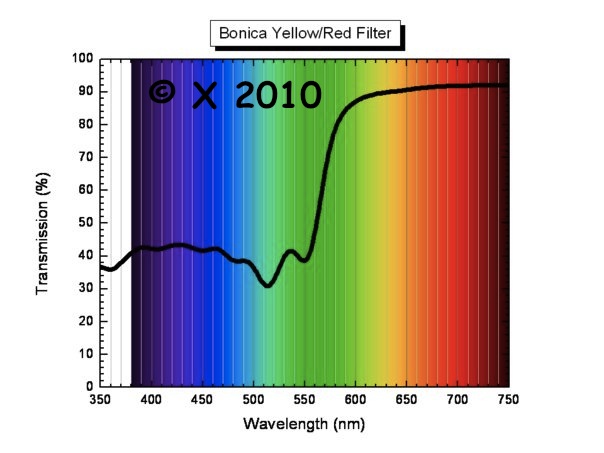
    What I found interesting is that the "red filter" of L&M is in fact different from the one sold by Bonica for their Action system (that's what I was using before):


    post-29705-1287843500.jpg


    That filter has a much flatter absorption in the blue-green region than the L&M one and also a much less drastic reduction.

    But as said, if we could agree on what specs we wanted, we could order a filter to those exact specs from one of the filter manufacturers (such as Semrock, Omega Optical, Chroma Technologies, etc) who dominate this market in the scientific arena. It would not come cheap by the unit, but if the market was large enough, prices may become more reasonable

    Edited by uwxplorer
  14. What's needed as a starting point is an accurate graph of the light absorbtion/transmittance of sunlight with water depth. Clean salt water in the case of a blue water filter. Then just match/mirror the graph. Had a quick search and couldn't find one though.

  15. The two graphs in http://en.wikipedia.org/wiki/Electromagnet...rption_by_water provide the two most important pieces of information. But that's for pure water and for an abstract sunny day... Then particles etc will affect sea water absorbance, cloudy sky will modify the sun irradiance, etc...

    I would go experimental on this one: go down with a set of test filters with different specs and keep the one I like most. But then since we are talking MWB, each camera will have a different reaction to having this or that part of the spectrum cut-off from the incident light...

    Pretty complex problem indeed.

  16. Not to mention different sensors deal with light differently and filters may make it worse. I've noticed a change in WB with filter techniques as CMOS takes over from CCD in video cameras. Seeing how URPro filters were designed for film and CCD cameras, I think the newer CMOS cameras have difficulty because of sensor characteristics and the WB programming has changed to optimize CMOS sensors. It'd be interesting to test for this.

    Edited by Drew
  17. Hi everybody,

    I just starting my adventure with underwater videography, i have panasonic SD700 + gralmarine.com housing + 6LED video light.

    i just back from kenya where i was make first movies [ i will upload sample later ] unfortunatly even with light a lot of scenes are green.

    is there any postprocessing method to color correction, please provide link to some tutorial how to do that

    Please also advice how to avoid it in future, use red/green filter or better do always postprocessing in some program and which program is the best on PC.


    Best Regards

    Palkers

  18. Hi everybody,

    I just starting my adventure with underwater videography, i have panasonic SD700 + gralmarine.com housing + 6LED video light.

    i just back from kenya where i was make first movies [ i will upload sample later ] unfortunatly even with light a lot of scenes are green.

    is there any postprocessing method to color correction, please provide link to some tutorial how to do that

    Please also advice how to avoid it in future, use red/green filter or better do always postprocessing in some program and which program is the best on PC.


    Best Regards

    Palkers


    I haven't bothered with filters or "White Balancing" for the last few years. I preset the WB for "daylight" and if necessary correct for water colour cast in post.


    Any of the new NLEs will allow very comprehensive (and easy) colour grading and correction. I use EDIUS, but most NLE's work the same way. There are many tutorials online (see Vimeo etc) which talk about colour grading/correction in post for topside work...same principles apply.


    The problem I found with filters is 1) trying to decide when the filter would crap-out the colour in shallow water; and 2) removing the filter for macro/close-ups so as not to interfere with the daylight balanced lights. White balancing I found to be time consuming...and the variability of the results actually made colour grading in post a nightmare.


    This works for me in the blue water tropics or in the greener home waters of southern Australia ...with or without lights. But I personally never dive without lights. :D

    Edited by HDVdiver
  19. I haven't bothered with filters or "White Balancing" for the last few years. I preset the WB for "daylight" and if necessary correct for water colour cast in post.


    Any of the new NLEs will allow very comprehensive (and easy) colour grading and correction. I use EDIUS, but most NLE's work the same way. There are many tutorials online (see Vimeo etc) which talk about colour grading/correction in post for topside work...same principles apply.


    The problem I found with filters is 1) trying to decide when the filter would crap-out the colour in shallow water; and 2) removing the filter for macro/close-ups so as not to interfere with the daylight balanced lights. White balancing I found to be time consuming...and the variability of the results actually made colour grading in post a nightmare.


    This works for me in the blue water tropics or in the greener home waters of southern Australia ...with or without lights. But I personally never dive without lights. :D


    As you'll see from the older part of this thread, I played around with different red and orange filters. None worked well. So now the flip device in my Bluefin only ever holds the flip macro, which works great for CU of macro subjects. Recently shot some great Pygmy seahorse footage with it.


    I do use the MWB but only down to about 15 to 18 meters. Below that, lights and AWB are better, IMHO.


    With the Sony CX550, the MWB must be done off something brown, red or pink, otherwise it blows out the red channel and you get ugly red fuzzies in the dark blue areas.


    Regards

    Peter

Nauticam

Account

Navigation

Search

Search

Configure browser push notifications

Chrome (Android)
  1. Tap the lock icon next to the address bar.
  2. Tap Permissions → Notifications.
  3. Adjust your preference.
Chrome (Desktop)
  1. Click the padlock icon in the address bar.
  2. Select Site settings.
  3. Find Notifications and adjust your preference.