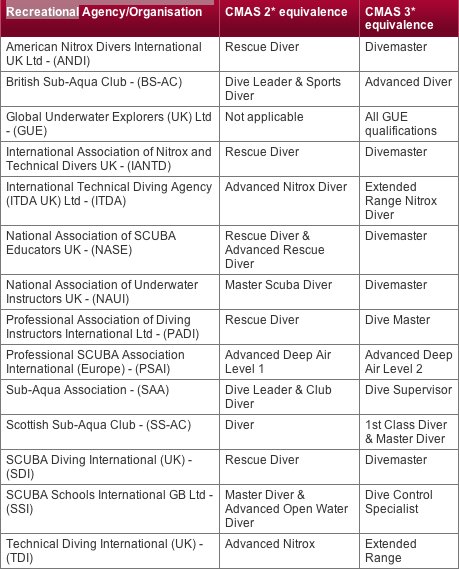
This post merely serves to show how misunderstood our HSE regulations for diving actually are - even those involved in professional diving (ie. not sports diver training) have varied 'opinions' on how they operate. Add to this some operators who overlay more of their own 'rules' (usually to serve as restrictive practices' - I can give instances) and the whole thing is a mess, with a lot of concern thrown in about actually talking to the HSE about any of it, and of course innumerable stories about ludicrous HSE requirements (some possibly true, many probably not) and inspector's apparently awkward requirements too (again some possibly true, many probably not).
Lets get a couple of things clear - if you are being PAID for underwater activity using compressed gas in the UK (or I believe from a UK registered vessel) then you fall under the Diving at Work Act. If you are taking photos or shooting video for fun and then happen to sell the images/footage afterwards, you may not - unless that is, you are actually trying to get around the HSE requirements - however proving this might be extremely difficult (if you were approached by someone to film something, did it and then sold the footage to them and this could be proved then you could just be in trouble) and its a very grey area which could also be difficult to prosecute as in many cases as it would involve proving intent which is I am told, far from easy. Shooting stock is something else too - another very grey area indeed (I've talked to the HSE about this and the inspector said this himself). However the HSE can take the view that if the work being carried out can be construed as part of self-employment.....
Whilst working for a UK based company abroad may involve adhering to HSE regs because the company believes this to be good practice (I think R Bull said that the BBC operate this way), I can't see that HSE regs are enforceable on a UK company outside the UK for various reasons - they might even contravene the countries' own regulations - and in any case the HSE have no jurisdiction for any sort of investigation - its a none starter as far as I can see, this one. Perhaps J Bantin will confirm whether he dives to HSE regs all the time outside the UK???!
If working under the HSE regs both diving contractor and diver also need to carry appropriate third party liability insurance and I'm far from convinced that anything other than specialist commercial scuba insurers or negotiated insurance (like my own) cover underwater work - last year clauses actually came in which specifically excluded underwater work which I had to negotiate out. I strongly doubt that the insurances intended primarily for diver training will cover HSE work - I've never been able to get a definitive answer about this when I've queried it! And specialist insurance is expensive!
As I said, its a complicated mess as far as I am concerned and I believe that it needs thorough revision - or primarily simplification - it might be worth writing MPs about it as we have a government who has gone on record as saying that it wants to reduce regulation and red tape!
Its interesting that whilst the HSE regulations are all about improving safety, adherence to 'rules' is all too often still seen as more important than a common sense approach to risk assessment and appropriate action (this is a real hobbyhorse of mine - has anyone ever tried signaling with a safety buoy in anything other than perfect conditions for example!). In another thread regulator maintenance is clearly perceived by some as something which is not absolutely necessary on a regular scheduled basis. As life-support, gear it is necessary and accepting this fact and dealing with it and paying out is simply a professional approach and on this note its worth commenting to the OP that all the equipment being used will need to be in test and maintained appropriately too.
In case anyone thinks that I have a vested interest in ensuring that HSE regs remain strict and reduce the number of divers in the phot/video/science 'industry', I do not. There are many highly competent divers out there who I believe could happily work if they only had the appropriate HSE qualification/insurance/medical/etc. However with the opportunity of working comes the responsibility of a professional attitude and the need to understand the risks and minimise them - serviced equipment, appropriate insurance and so on. I'd personally like to see a simpler system in place where everything is far more transparent and much easier to understand.
Lastly, I would also add that there needs to be an emphasis on experience - having all the bits of paper and gear are not enough on their own and I think that the ACOPs do require appropriate experience to carry out a job (which does beg the question of how such experience is obtained).
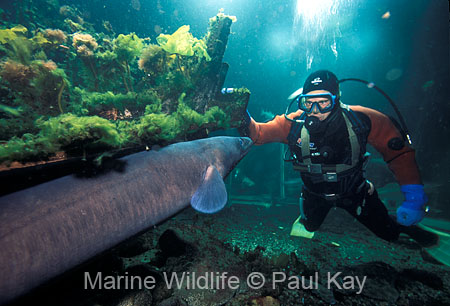
Oh yes, and whether an aquarium is considered a benign environment will partly depend on ease of entry/exit - some are not that simple to get in and out of. Also it depends whats in them (see pic!).