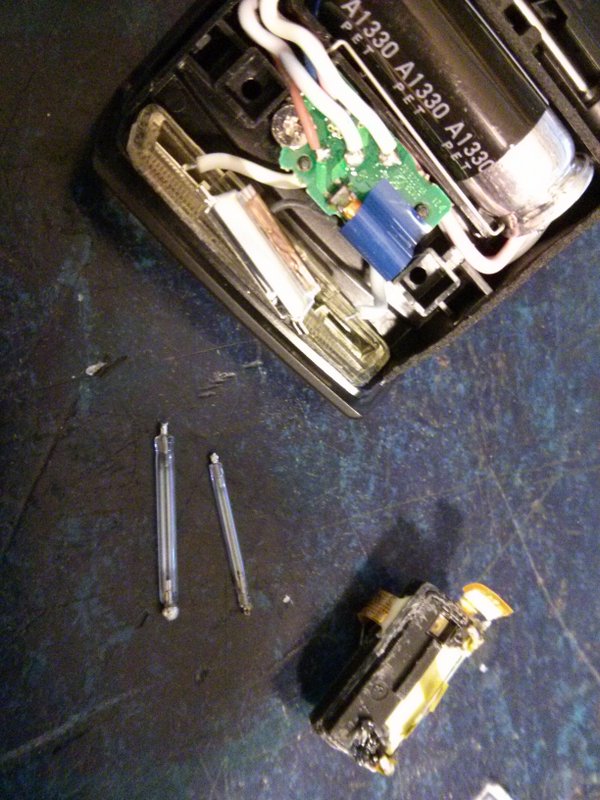
I just discovered this thread and it is a nice brain-teaser forcing you to think about how flashes and TTL operate. It reminded me of the flash trigger recently released by Nauticam but that one does not support TTL. However, after some thought I either don't understand how flashes work or there is a problem with this approach.
On my EM-5/Nauticam housing 100% of the strobe light comes from the external strobe as the camera strobe is blocked by the housing. My understanding is that flash light output under TTL is determined by controlling flash pulse duration. So if we need a given amount of light for our scene then we need a certain pulse duration. In turn that means that the pop-up flash on the camera needs to fire for that same duration. The way I see it, the only manner to reduce the energy consumed by the camera flash is to reduce its light intensity. I don't think using a smaller capacitor does that very effectively beyond perhaps lowering the average voltage over the pulse duration.
The oscilloscope images shown above seem to work but are misleading because they are "full flashes" that dump all the energy in the capacitor. This is not a fair comparison because the larger capacitors actually produce a proportionally stronger flash. In a real shooting situation where you need a fixed, non-maximal, flash output all capacitors are drained by the same absolute amount but different relative amounts. In other words if the shot requires a "25uF drain", the 100uF capacitor will have 75% of its juice left, while the 33uF capacitor is almost empty and the 10uF capacitor ran out of steam prematurely giving an underexposed image. This can explain the report where the smaller capacitor gave reasonable exposure in some situations but not others if shooting conditions affect the required strobe output (ISO, aperture, subject distance/color, ambient light, etc). Reality may be a bit more complicated because the smaller capacitor will lose voltage faster as it drains but if I am correct then I don't think this approach will work satisfactorily. What is needed is a different light source that can handle the voltage coming off the capacitor but has a light output just enough to trigger the external flash. I read on wikipedia that "A photoflash capacitor is an electrolytic capacitor used in flash cameras, professional flashes, and also in solid-statelaser power supplies." A tiny laser that directs its light right into the fiber optics would need a tiny amount of energy but I have no clue if cost, size or other limitations prevent that from working.
Bart
PS: looking at the Nauticam flash trigger it seem they use either a laser or more likely a LED, which is somewhat related to a laser.
 ).
).