Skip to content

Photography Gear and Technique / Archived topic

More super macro questions

Started by nortoda1 ·

  • 28Posts
  • 28Replies

Read-only discussion

More super macro questions

28 posts
  1. I have just taken the FX plunge (D800) after a decade of DX (D70, D300). I've invested in a 105VR and can use my old sea and sea NX stanard flat port with the SX extension after a small modification to the inside of the port. Now to the questions;

    What are my best options for super macro


    I have a 6T diopter, but will need to purchase the 40mm extension to use this. Adding the 40mm exntension will mean there is about 2.5cm gap between the diopter and the port glass, will this have any negative effects? Will it have any negative effects if I add a wet lense (e.g. subsee)? If people think the 6T is a good option I will most likely also purchase the subsee +10 to use with and without the 6T


    Am I better off purchasing subsee +5 and +10 and forgetting about the 6T? Or should I be considering one of the other wet diopter options???

  2. I'd suggest the Subsee route. Although there is no harm in starting with the 6T - which is great optically - just probably not good in conjunction with the Subsees if you have that gap. Generally you want to minimise the gap between the dioptre and lens - although I have never done the tests to see how much of a difference it makes.


    Alex

  3. Cheers Alex, subsee it is then.

  4. I am going to mess with the same issue on a Sigma 150 (An extension port won't work for my 105). I have a 5T and 6T plus subsee +5 and +10. On my D-300/105 I have difficulty locating the subject when i have the +10 mounted and difficulty getting a focus lock when I do. Possibly your later generation camera will do better

  5. On DX cameras definitely start with Subsee +5. Subsee +10 is very extreme.


    Alex

  6. Alex-


    Right. I am hoping that the 150 with the +5 will take comparible pictures to the 105/+10 with less difficulty.


    Tom

  7. I am hoping that the 150 with the +5 will take comparible pictures to the 105/+10 with less difficulty.


    If the "stand-off" distance is greater, then lighting and backscatter may be more difficult. I certainly found that switching from a D300 to a D800 made my macrophotography more difficult as I swapped from using a 60mm most of the time to a 105mm.

  8.  

    If the "stand-off" distance is greater, then lighting and backscatter may be more difficult. I certainly found that switching from a D300 to a D800 made my macrophotography more difficult as I swapped from using a 60mm most of the time to a 105mm.

    Tim, If you kept shooting with the 60mm and then cropped the image to get the same 1.5 DX magnification, you would still have a higer resolution image than you would have had with your D300.

  9. The standoff distance is greater on the sigma 150 but not as much as one might think. The working distance difference is just a couple of inches and the +5 cuts it in about half. I will report my experiences. I have dove wakatobi the last 4 years with the 105 mounted. I plan to start with the 150. We shall see.


    Tom

  10. Tom, just remember your DOF will be VERY limited using the Subsee (even the 5+), so think about increasing you ISO so that you can use a bit tighter aperture.

    Doug

  11. Tim, If you kept shooting with the 60mm and then cropped the image to get the same 1.5 DX magnification, you would still have a higer resolution image than you would have had with your D300.


    That's cheating!


    The standoff distance is greater on the sigma 150 but not as much as one might think. The working distance difference is just a couple of inches and the +5 cuts it in about half. I will report my experiences. I have dove wakatobi the last 4 years with the 105 mounted. I plan to start with the 150. We shall see.


    Tom


    The lens is longer, so it amounts to about 5-6" more on the strobe arms, which was my particular frustration, with back-lighting in particular.

  12. T.D.


    I am using a pair of 9" Stix so I think I can get the strobes forward enough and still have enought spread for normal side-to-side parallel to the lens. Backlighting may indeed be a problem. Maybe I should pack a couple more arms. I have a couple of extra 4" Stix. I also have an INON s-2000 with an ultra-long fibreoptic cord that I purchased for snoot work. That could be interesting. Thanks for reminding me.


    I actually think I may need more working distance using a Subsee. I have successfully taken minimum focus distance shots with the +10 using a 105. However, the working distance is very tight and it limits creative strobe placement. I am hoping the 150 and +5 will give me another inch of working distance and slightly less magnification. One problem is the 150 only goes to F/22 and I am usually at F/32 with the 105/+5 combination.


    Internet at Wakatobi is very slow so i won't be able to post much or in high res.


    Tom

  13.  

    I am using a pair of 9" Stix so I think I can get the strobes forward enough and still have enought spread for normal side-to-side parallel to the lens.


    I am using a pair of 9" Stix so I think I can get the strobes forward enough and still have enought spread for normal side-to-side parallel to the lens. Backlighting may indeed be a problem.


    Two 8" arms were only just long enough to backlight my 105mm in Lembeh, and my favourite subjects were moving, so a remote strobe and a helpful buddy would have been better.

  14. Tom, just remember your DOF will be VERY limited using the Subsee (even the 5+), so think about increasing you ISO so that you can use a bit tighter aperture.

    Doug


    That defeats the purpose. Any resolution you gained by getting closer is lost to diffraction and increased noise. It just ups the masochism factor, loses useful field of view, and does not show extra detail you couldn't have seen by cropping an image shot without diopter from a bit greater distance (the only exception being if you are in low viz conditions where just getting closer is a big benefit, but you could do that be selecting a shorter focal length lens).


    There is nothing wrong in general with trading increased depth-of-field for lower spatial resolution by closing the aperture, except when your primary objective is to maximize the level of detail, then you want the image resolution to be at least close to the max sensor resolution.


    Bart

  15. That defeats the purpose. Any resolution you gained by getting closer is lost to diffraction and increased noise. It just ups the masochism factor, loses useful field of view, and does not show extra detail you couldn't have seen by cropping an image shot without diopter from a bit greater distance (the only exception being if you are in low viz conditions where just getting closer is a big benefit, but you could do that be selecting a shorter focal length lens).


    There is nothing wrong in general with trading increased depth-of-field for lower spatial resolution by closing the aperture, except when your primary objective is to maximize the level of detail, then you want the image resolution to be at least close to the max sensor resolution.


    Bart

    Uh Bart, what purpose is being defeated?? If you try to shoot a Pygmy Seahorse with a Subsee on a long lens, the DOF will be so narrow, his snout will be blurry if his eyes are in focus! Of couse the angular and spatial resolution are inversely proportional to the diameter of the aperture, but that only holds water in the infinitesimally small optimum focal plane. We are not benchmarking sensor resolution here, we are taking pictures in the real world!


    My comment you quoted was a suggestion for making the use of the Subsee easier, it does not address the virtues of the use of the Subsee. Had you taken the time to read all of the posts in this thread, you would have seen my post to Tim, extoling the virtue of using a shorter lens and cropping when using the higher resolution cameras. It seems that you have missed the point entirely!

    Edited by diverdoug1
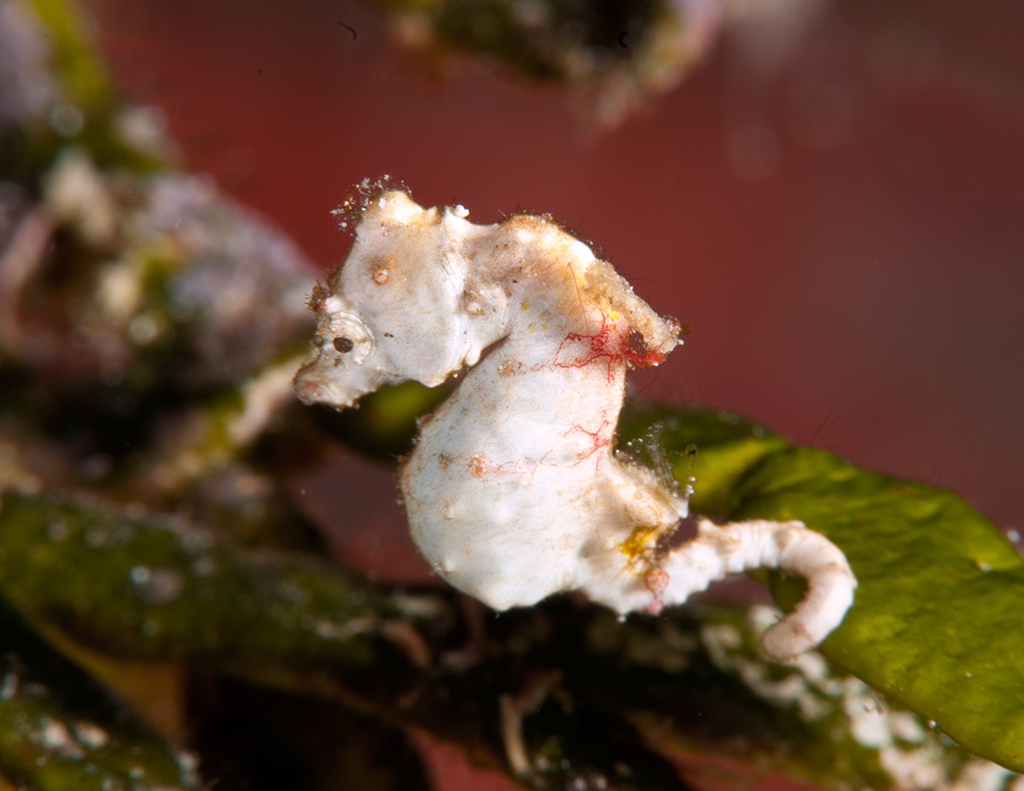
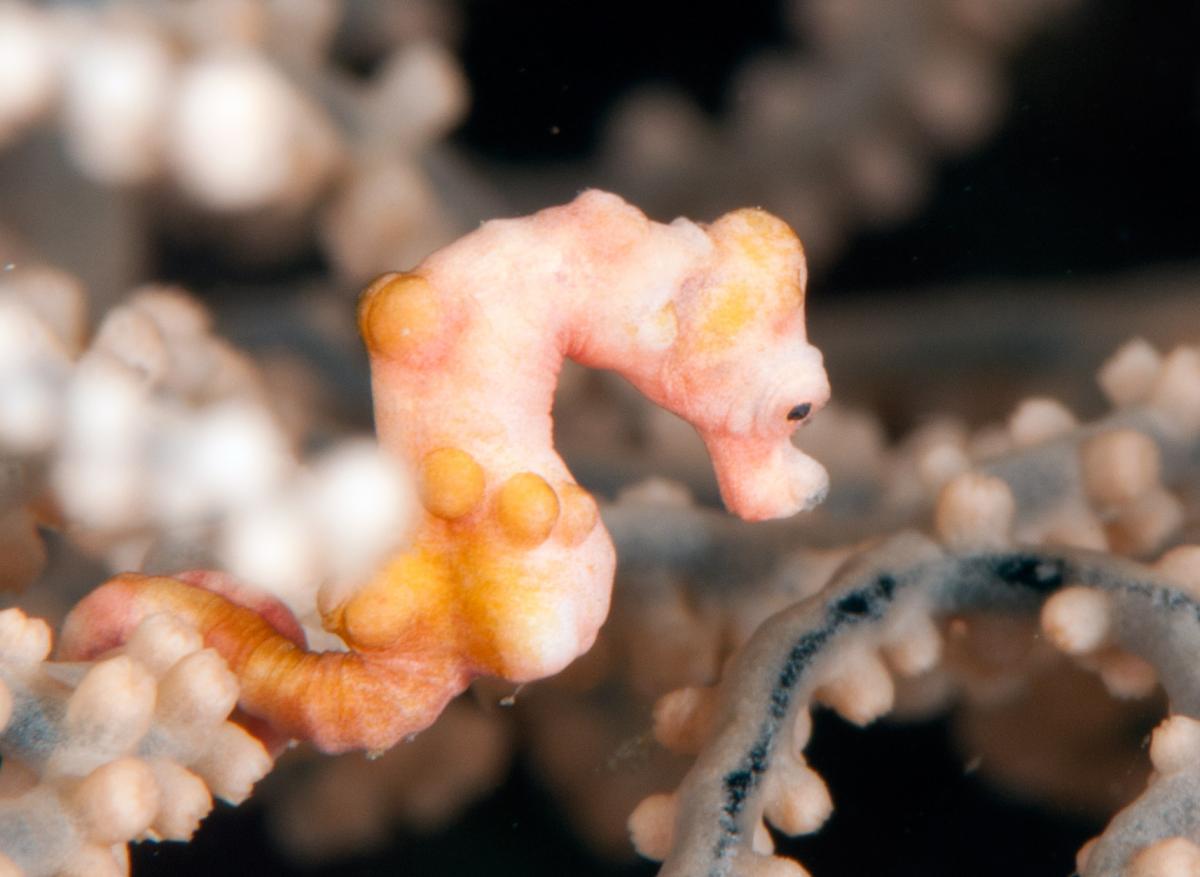
  16. Here is a Pigmy at minimum focus distance AF-105-Vr, +10 Subsee on a D-300. F/32, 1/200. It is a very difficult shot. The only way i could take it was but getting closer than MFD then slowly rocking backward until the camera achieved focus lock. That limited my strobe placement big-time. I am looking for different ways to get this kind of shot easier


    Here is a Pigmy at minimum focus distance AF-105-Vr, +10 Subsee on a D-300. F/32, 1/200. It is a very difficult shot. The only way i could take it was but getting closer than MFD then slowly rocking backward until the camera achieved focus lock. That limited my strobe placement big-time. I am looking for different ways to get this kind of shot easier.


    The second is a crop of the first.post-1589-0-88183400-1387652108_thumb.jpgpost-1589-0-13607200-1387652215_thumb.jpg

  17. sorry wrong shot

  18. Beautiful shots that are a great example of the point I was making. The DOF is too shallow to get the complete seahorse in sharp focus even with the aperture stopped down to f/32. Had the aperture been more open, the amount of the Seahorse in focus would be even less.

    Edited by diverdoug1
  19. ... This is a continuation from message #14 ...

    Uh Bart, what purpose is being defeated?? If you try to shoot a Pygmy Seahorse with a Subsee on a long lens, the DOF will be so narrow, his snout will be blurry if his eyes are in focus! Of couse the angular and spatial resolution are inversely proportional to the diameter of the aperture, but that only holds water in the infinitesimally small optimum focal plane. We are not benchmarking sensor resolution here, we are taking pictures in the real world!

    My comment you quoted was a suggestion for making the use of the Subsee easier, it does not address the virtues of the use of the Subsee. Had you taken the time to read all of the posts in this thread, you would have seen my post to Tim, extoling the virtue of using a shorter lens and cropping when using the higher resolution cameras. It seems that you have missed the point entirely!


    Hi Doug, I did read your comment on using the 60mm macro and fully agreed with it (even though Tim considers it cheating). I did not realise that that comment and the one on easing the use of the SubSee were both from you, but it doesn't really matter. The reason for my reply was that in discussions of supermacro the focus, stated or not, often centres on magnification instead of resolution. In practise the two are related, but they are not the same and in my opinion this becomes especially important for supermacro and current high-resolution sensors with very small pixels. The same issue was recently raised by Alex in his review of the Nikon D7100 and I've copied a revealing section below.


    "The only time we may want to consider diffraction on the D7100 is when we are shooting super macro. If you never shoot super macro, no problem! If you do, you have two options. First, just ignore it and use the aperture you want for depth of field you desire. This approach is fine and ignoring diffraction will leave you with images, even at the smallest apertures that are as good as you could have got with a D7000. The alternative is to worry about diffraction and shoot super macro at more open apertures. While this will allow you to realize the full potential of your 24MP, it will mean you are deleting lots of images because of lack of depth of field.

    I think the best solution is to generally pick the aperture you need, but only go above f/32 in extreme cases. Ultimately it is the image that matters and it won’t in any way be ruined by a bit of diffraction, you simply loose the extra resolution advantage and end up with an image you could have taken with the 16MP D7000 – hardly the end of the world."


    Alex is clearly aware of the interplay between DOF and resolution, as are you and most others, but I come to a somewhat different conclusion. The difference is subtle and not so important until you get into supermacro. One way to think about it relates to how you define supermacro. It is often stated as "a magnification larger than 1:1" but in my opinion it is better to think of it as "resolving details smaller than the resolution limit of the sensor". To do the latter you need a magnification larger than 1:1 but a magnification larger than 1:1 does not necessarily give you higher resolution. Another way to think about it, and more closely related to how we shoot, is as follows.


    Start with your subject of interest. In this case let's stick with the pygmy seahorse. Given the shape and dimensions of its head you need a certain amount of DOF to get both eye and snout in focus. That amount of DOF directly sets the maximum resolution you can obtain. If this resolution is already less than what the sensor can resolve then you are not doing supermacro. Adding diopters, extension tubes, or teleconverters does not change that and in general will just make taking the image more challenging. As you and Alex said; getting the desired DOF takes precedence, you care about "the shot" not "benchmark the sensor". But the point I was hoping to make is that it is worthwhile to consider whether the DOF requirements for your subject qualify it for supermacro photography. If not, taking the diopter off is likely preferable to closing the aperture and boosting ISO.


    Bart

    Edited by Glasseye Snapper
  20. One of the reasons that super macro has become very popular recently is because the shallow depth of field serendipitously gives us great backgrounds.


    Backgrounds make or break macro shots.


    And the narrow depth of field of super macro tends to make it easy to get a diffuse, non distracting background.


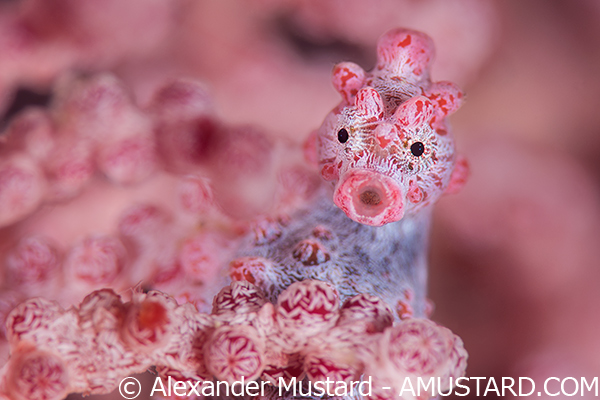
    This pypmy was not posing in a good position, although helpfully he was staying still and watching me (as I don't use a torch/focus light - which always makes them turn away). If I had shot this with less magnification the background would have been in focus (or more in focus) and therefore much more distracting in the final image. As I was setup for super macro I got this nice diffuse background - that made the shot worth keeping.


    post-713-0-57188000-1387705070_thumb.jpg


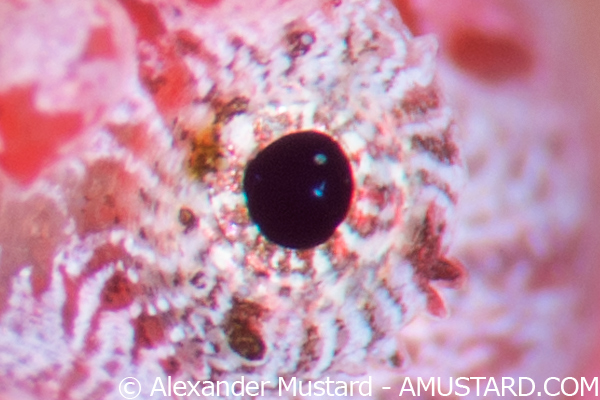
    Taken with Nikon D4 and 105mm VR and 1.7x Nikon AF-S TC and SubSee +5. Subal housing, Inon strobes. 1/250th @ f/40, ISO 200.


    I know I can shoot on f/40 on my D4, but if I was using a different Nikon I might not have stopped down that far. Here is a crop from the same file to show that there is plenty of sharpness:


    post-713-0-39148000-1387705370_thumb.jpg


    Alex


    Edited by Alex_Mustard
Turtle

Account

Navigation

Search

Search

Configure browser push notifications

Chrome (Android)
  1. Tap the lock icon next to the address bar.
  2. Tap Permissions → Notifications.
  3. Adjust your preference.
Chrome (Desktop)
  1. Click the padlock icon in the address bar.
  2. Select Site settings.
  3. Find Notifications and adjust your preference.