



Skip to content

Photography Gear and Technique / Archived topic

More super macro questions

Started by nortoda1 ·

  • 28Posts
  • 28Replies

Read-only discussion

More super macro questions

28 posts
  1. Hi Alex,


    That is a great example to demonstrate and discuss the properties of equipment, imaging goals and choice of camera settings. But your motivation was to actively limit DOF to get the smooth background whereas this discussion started on how to get supermacro while retaining enough DOF for the subject of interest. But it raises an interesting point.


    You mention: "If I had shot this with less magnification the background would have been in focus (or more in focus) and therefore much more distracting in the final image."

    Do you mean the background of supermacro is qualitatively different from a normal macro shot taken at the same shallow DOF? In other words, could you have achieved the same shallow depth of field and background quality without the SubSee by opening the aperture as needed? I am surprised if you couldn't get the same DOF that way, but perhaps there is a different quality to the background due to TC or diopter?


    The camera you used also plays a role and since it is on the extreme-end of the scale concerning pixel size it is a nice contrast with the D7100 in the review (54Mpix in FF equivalent). As a result the D4's resolution becomes sensor-limited much earlier than the D7100. That means it relies more on image magnification to achieve high-resolution. One interesting result is that in "my definition" of supermacro you would be well into supermacro on a D4 to achieve what is "just" 1:1 macro on the D7100.


    I'm also interested in your combination of 1.7x teleconverter plus diopter. My guess is that the discrepancy between targeted image resolution and sensor resolution is so great that a diopter strong enough to achieve the desired magnification would give unpractical short focus distances. Because there is excess optical resolution the TC effectively converts the D4 to the equivalent of a 1.7x crop sensor with a pixel density equivalent to a 20Mpixel APS-C sensor. In your review you mention "I took my Nikon 1.7x teleconverter with me to Bali (as I use it a lot on my D4 with the 105mm) and didn’t use it once on the D7100". Chances are that if you had tried, and it would be fun to do the experiment, you wouldn't have gotten the same improvement as on the D4 unless shooting really extreme shallow DOF shots, because more often the sensor is not limiting.


    Having pondered on this some more I wonder if the focus on magnification is not driven by the desire to compose the shot in camera. To fill the frame with a small creature you have no choice but to boost magnification, even if DOF-limitations don't allow you to increase resolution. My attitude is not to bother and achieve the same effect by cropping the image later. But if you are in a photo competition (of if you consider it cheating) then that is not an option.


    Bart
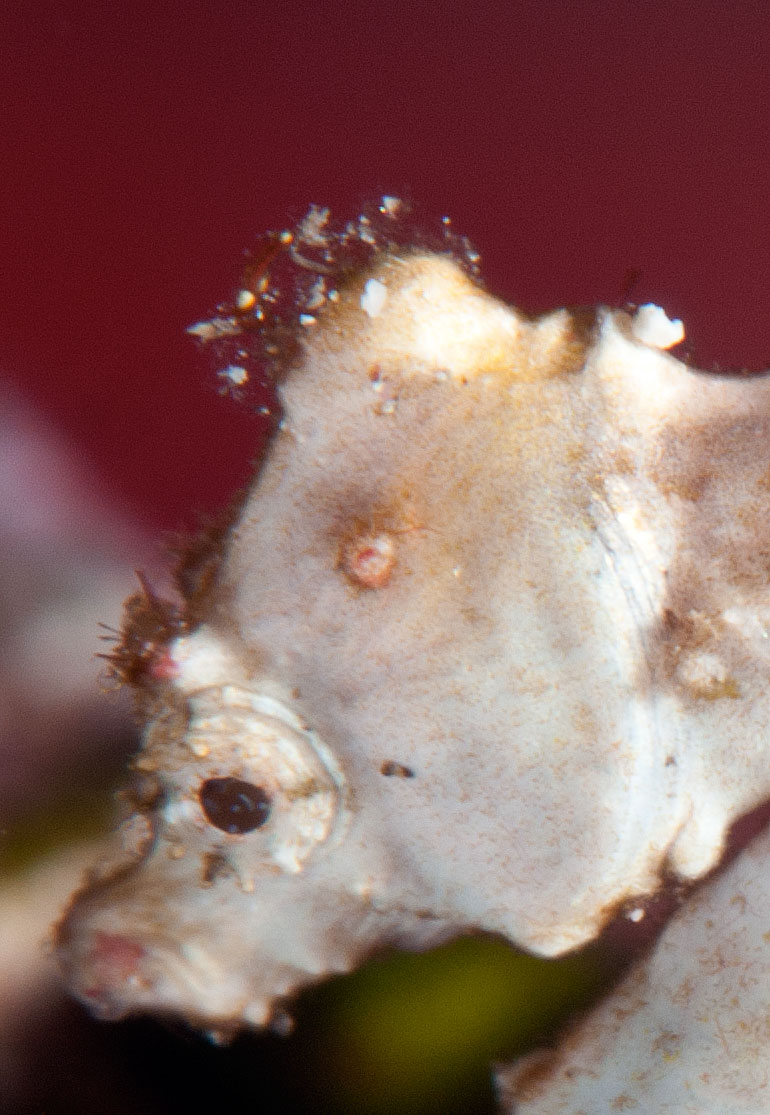
  2. Here is the crop of the White Pigmy I posted earlier. These critters are d@mn small. The entire Pigmy seemed to fit in my focus rectangle using the 105/+10/D-300. I did not use a focus light either for the reasons Alex states. One shot was all I felt acceptable to take as thes critters hate strobes.


    I am not against cropping but this is about a maximum crop for a printable picture. It was the first time I had seen the crown on the Pigmy's head.


    Regards


    post-1589-0-71704100-1387760182_thumb.jpgTom

  3. Hi Alex,


    That is a great example to demonstrate and discuss the properties of equipment, imaging goals and choice of camera settings. But your motivation was to actively limit DOF to get the smooth background whereas this discussion started on how to get supermacro while retaining enough DOF for the subject of interest. But it raises an interesting point.


    You mention: "If I had shot this with less magnification the background would have been in focus (or more in focus) and therefore much more distracting in the final image."

    Do you mean the background of supermacro is qualitatively different from a normal macro shot taken at the same shallow DOF? In other words, could you have achieved the same shallow depth of field and background quality without the SubSee by opening the aperture as needed? I am surprised if you couldn't get the same DOF that way, but perhaps there is a different quality to the background due to TC or diopter?


    The camera you used also plays a role and since it is on the extreme-end of the scale concerning pixel size it is a nice contrast with the D7100 in the review (54Mpix in FF equivalent). As a result the D4's resolution becomes sensor-limited much earlier than the D7100. That means it relies more on image magnification to achieve high-resolution. One interesting result is that in "my definition" of supermacro you would be well into supermacro on a D4 to achieve what is "just" 1:1 macro on the D7100.


    I'm also interested in your combination of 1.7x teleconverter plus diopter. My guess is that the discrepancy between targeted image resolution and sensor resolution is so great that a diopter strong enough to achieve the desired magnification would give unpractical short focus distances. Because there is excess optical resolution the TC effectively converts the D4 to the equivalent of a 1.7x crop sensor with a pixel density equivalent to a 20Mpixel APS-C sensor. In your review you mention "I took my Nikon 1.7x teleconverter with me to Bali (as I use it a lot on my D4 with the 105mm) and didn’t use it once on the D7100". Chances are that if you had tried, and it would be fun to do the experiment, you wouldn't have gotten the same improvement as on the D4 unless shooting really extreme shallow DOF shots, because more often the sensor is not limiting.


    Having pondered on this some more I wonder if the focus on magnification is not driven by the desire to compose the shot in camera. To fill the frame with a small creature you have no choice but to boost magnification, even if DOF-limitations don't allow you to increase resolution. My attitude is not to bother and achieve the same effect by cropping the image later. But if you are in a photo competition (of if you consider it cheating) then that is not an option.


    Bart

    I think that for me, it would be difficult to see if my sublect was in focus if it was very small in my viewfinder (I am talking about the VERY small subjects. So if I go too low on magnification, it is a crap shoot as far as getting spot on focus. I think you could get some good super-macro images shooting 60mm on a D800 with subsequent croppping,but it unless you have eagle eyes, it sure would be hard to focus. I truly feel that the concern about decreased resolution with with smaller apertures is a non-issue in the real world with the images we are talking about here. Alex's photo is a great example when shot at f/40 the resolution is still great.

    Edited by diverdoug1
  4. I think that for me, it would be difficult to see if my sublect was in focus if it was very small in my viewfinder (I am talking about the VERY small subjects. So if I go too low on magnification, it is a crap shoot as far as getting spot on focus. I think you could get some good super-macro images shooting 60mm on a D800 with subsequent croppping,but it unless you have eagle eyes, it sure would be hard to focus. I truly feel that the concern about decreased resolution with with smaller apertures is a non-issue in the real world with the images we are talking about here. Alex's photo is a great example when shot at f/40 the resolution is still great.


    Excellent point! My subjects are pretty much limited to fish and with them that problem rarely comes up. But I can see that with tiny invertebrates just seeing them becomes a challenge. Just goes to show that practice beats theory.


    Bart

  5. Dear Nortoda 1

    You can see the formula is quite simple

    A macro lens stopping down to the smallest possible aperture, highest flash sync speed, a close up filter in front of your macro plus/minus extension tube.

  6. I am not certain. My plan is to use the Sigma 150mm on my D-300 with the Subsee +5 or +10 as needed. I am hoping for a better working distance to allow more flash choices. Up to now I have been simply positioning my strobes next to the port, getting even light on the subject, and relying on a blurred background to make the subject stand out.


    However, as pointed out here, sometimes a good part of the subject winds up not in focus and that is NOT pleasing to me. Maybe I can use a shadow from the key strobe to make the subject stand out. I have no problem blurring the background in post although it has never come up with super macro.


    Tom

  7. The distances and the interspersing water column are so small when shooting super-macro, putting the strobes right next to the port usually works well with minimal exacerbation of backscatter in all but the most turbid of dive conditions.

  8. Doug,


    We talked about getting together previously since I also live in Sarasota. I'll be home for a while and it seems you are also. Why don't we do it.


    My phone number is 941 953-7623.


    Fred

Ultralight Control Systems

Account

Navigation

Search

Search

Configure browser push notifications

Chrome (Android)
  1. Tap the lock icon next to the address bar.
  2. Tap Permissions → Notifications.
  3. Adjust your preference.
Chrome (Desktop)
  1. Click the padlock icon in the address bar.
  2. Select Site settings.
  3. Find Notifications and adjust your preference.
