



Skip to content

Shooting Technique, Workflow and Editing / Archived topic

Can you use Nauticam silicone on Sea&Sea blue o-ring?

Started by Marjo ·

  • 26Posts
  • 26Replies

Read-only discussion

Can you use Nauticam silicone on Sea&Sea blue o-ring?

26 posts
  1. I recently purchased a Zen dp-100-NT port second hand to use on my Nauticam housing. It came with a Sea&Sea blue o-ring, but no silicone. Is it safe to use Nauticam silicone on the o-ring or does it need to be Sea&Sea silicone?


    As my housing is coming in from maintenance today, I'd really love to take the Zen for a dive tomorrow, but I am scared of using he wrong grease and possibly causing a flood.


    Anyone with experience on this?


  2. Yes you can use the Nauticam lube (either tribo or christolube, I am too lazy to run it through the lab). What I do is for trips is buy a contact lens case (the screw lid ones) and put Tribolube 77 in one side and Tribolube 66 in the other side and am covered for both sliding and stationary orings of any kind.

    Bill

  3. Thank you, Bill for your super fast and informative reply!

    Edited by Marjo
  4. Marjo,

    The o-ring on the Zen port is blue (light), but it is not the same blue (dark) as the o-rings from Sea & Sea.


    Before you put Sea & Sea silicone on it I would check to make sure it is compatible. If someone replaced the Zen o-ring with a Sea & sea o-ring...then I suppose you would have no problem. Just wanted to point out that Zen and Sea & Sea o-rings appear to be different.

  5. I think she was going to use the Nauticam grease which would be no issue.
    Bill

  6. Grease is grease: Use it!

  7. Not so much. There are silicone greases and fluorosilicone greases and each has specific uses. For example Silicone grease (the stuff in the big trident tub) can swell silicone o-rings and lead to troubles. That is why we keep recommending either the Tribolube or Christolube (or Krytox if you can find the right one) since they are good for all types of o-rings.


    Bill

  8. To complement: some zen domes had been sold with sea & sea dark blue orings which are not good with nauti grease. In fact i've asked after buying a used zen dome, and been told by i think zen themselves to buy their newly produced light blue orings which are for sure compatible with nauticam gear. I did son 1 year ago and didn't have any issue.


    Envoyé de mon iPhone en utilisant Tapatalk

  9. that is surprising, I am quite sure that S&S o-rings will be fine with the Nauticam grease, of course Zen might be trying to hedge against a flood (but not from the wrong grease)

    Bill

  10. that is surprising, I am quite sure that S&S o-rings will be fine with the Nauticam grease, of course Zen might be trying to hedge against a flood (but not from the wrong grease)

    Bill

    Sorry memory confusion: i didn't get this reply from Zen but from Reef Photo, and it didn't seem like a black&white answer but more a word of caution:


    Quoting Reef:

    Nauticam grease is safe on the new Zen lighter blue o-rings, but I would recommend using the true Sea & Sea grease on the dark blue o-rings.

  11. i always use Nauticam lube on my sea&sea flash o-ring since 3 or 4 years now and never had any issue

  12. Just to understand it right:

    - years ago there was the problem with Nikonos o-rings (made out of silicone, right?) swelling when using grease made out of silicone, right?

    - I never heard about a similar problem today, why? Are we all aware just to take the supplier's grease?

    - Is it in general the fact not to use silicone based grease for silicone o-rings?


    I have now Nauticam, Seacam, Inon and S&S stuff and grease.....is the only way to take with me only ONE tube, to use tribolube 71? But never grease than contains Silicone tself?


    If Tribolube 71: very hard to buy it in Germany.....any sources or alternatives? Just got the recommendation Vaseline.....


    I have now the maximum confusion.....Any help welcome....

  13. is the only way to take with me only ONE tube, to use tribolube 71? But never grease than contains Silicone tself?

    ...

    I have now the maximum confusion.....Any help welcome....


    I wouldn't mind if someone (Bill?) could lay this out a bit more succinctly please. Even reading the previous linked thread is confusing when I've never used S&S, Nauticam or Inon grease.


    Personally I've really only seen 3: old Nikonos grease (the clear thick 'gel'-like stuff), Ikelite which I believe was similar, and Aquatica which is white, less dense, silky smooth and much more expensive. Personally the Aquatica stuff seemed far superior so years ago I tossed out the rest. I've used it for years on the yellow Inon strobe orings which are markedly different from my aquatica orings. But never saw the Inon grease.


    If there's a single grease that is safe for everything, I'd like to get that! Tribolube 66, 71, 77??? Though I only see 66 & 71 at this site linked from the other thread:


    https://www.piranhadivemfg.com/category/Lubricants-156


    I have a feeling the Aquatica grease is one of these.


    What I do is for trips is buy a contact lens case (the screw lid ones) and put Tribolube 77 in one side and Tribolube 66 in the other side and am covered for both sliding and stationary orings of any kind.

    Bill


    So what's the difference???


    Cheers,


    Chris

    Edited by Undertow
  14. From the Piranha website:

    TRIBOLUBE 66 is only for static applications. This grease is also a PFPE oil that is thickened with PFPE, but has a thicker viscosity. The grease will thicken and in cold conditions can cause a sluggish response, due to the fact that it's operating range is not as wide.


    Whereas, Tribolube 71 and Christolube 111 are all-purpose.


    A lot of folks seem to be using 71 for all their o-rings, scuba and photography.

  15. There is an old saying in organic chemistry that like dissolves like. For example salt is an inorganic compound that dissolves well in water while not so much in things like olive oil. Similarly, olive oil floats on water but will dissolve very nicely in heptane or gasoline.

    For o-rings you don't have to worry about dissolving them (mostly) but you need to control swelling. For example many silicone rubber o-rings use fluorosilicone grease since silicone grease will dissolve into the o-ring and swell it perhaps leading to a leak. Similarly some folks talk about using petroleum jelly (Vaseline). According to the o-ring kings (https://www.physics.harvard.edu/uploads/files/machineshop/epm_oring_handbook.pdf) which comes from Harvard so it has to be right :lightbulb: petroleum jelly is probably not so good for EPDM or Silicone but OK for nitrile and Viton.
    The reason to use Tribolube 71 (for sliding o-rings) is that it will not swell any type of rubber that I know about. Similarly, Christolube is just as good as is Krytox (there are 745,000 types of Krytox, I think the scuba one is GPL 205 but others might work as well. Krytox is ungodly expensive while Tribolube and Christolube are only ridiculously expensive but you don't really need much. I store mine in contact lens cases that look like a dive mask (https://www.amazon.com/gp/product/B01BU6E15M/ref=oh_aui_search_detailpage?ie=UTF8&th=1) and one side has lasted for at least two years.

    There are lots and lots of urban legends about o-rings and o-ring material compatibilities. Look at the table in the Harvard link and you will see that many o-rings are not so good in contact with common stuff.


    Cheers

    Bill

  16. The simple answer for most people I think is is Nauticam grease which is perfluoro ether based grease like christolube. The Nauticam tube says it is suitable for silicone and nitrile o-rings and should be quite widely available from UW photo retailers worldwide. Don't know about Christolube at least outside the USA.


    The reason most places revert to use the manufacturer's product is lack of knowledge, so that is the safe recommendation. It seems most o-rings are silicone these days apart from Ikelite which uses Nitrile, so the Nauticam product is OK for both.

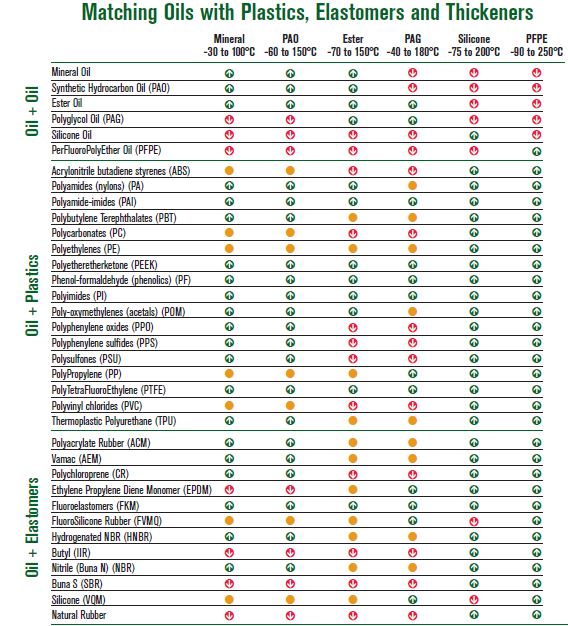
  17. This is an extract from a table for matching various oils and grease with materials. The Elastomer section shows that the PFPE grease is the only one that is compatible (indicated by green arrow pointing up) with all elastomers listed. If you want to use only one grease for your O rings PFPE greases such as Christolube, Tribolube, Krytox, etc is the way to go.

    post-5262-0-78041700-1519875536_thumb.jpg

  18. Intrigued by this discussion, I looked at the olympus supplied grease PSOLG-3 (for the PT-EP13 housing, but maybe for others too). It says "Silicone grease". It says "Silicone Grease, only for Silicone O-Ring". I assume there's some subtlty I'm missing, since it seems to contradict the above chart. Probably the name doesn't really tell much about the chemical composition.

  19. I suspect that the grease is indeed a fluorosilcone which in general terms could be thought of as silicone.

    Bill

Account

Navigation

Search

Search

Configure browser push notifications

Chrome (Android)
  1. Tap the lock icon next to the address bar.
  2. Tap Permissions → Notifications.
  3. Adjust your preference.
Chrome (Desktop)
  1. Click the padlock icon in the address bar.
  2. Select Site settings.
  3. Find Notifications and adjust your preference.

