Skip to content

Photography Gear and Technique / Archived topic

Smaller alternative to Nikon FX (m4/3)

Started by horvendile ·

  • 33Posts
  • 33Replies

Read-only discussion

Smaller alternative to Nikon FX (m4/3)

33 posts
  1. Hi,
    i was using a Nikon D300 and when switched to a Olympus OMD5 in a Nauticam housing.
    Specially the 60mm macro lens is great. Pretty small setup, good pics.
    Met Phil in Anilao who used an Olympus OMD1 at that time ;-))
    But 2 trips later, i found the limit of that camera:
    Malapascua philippines, treasure sharks early morning 30m deep with no light.
    The m43 systems have small sensors, that gives you a small camera. But for low light, the are not good.
    Had to push the camera to 800 and that looks ........ And was still to slow to freeze a shark.
    So i changed to a Nikon D500 and all the big and heavy parts......

    If i would start complete new, i would select a Sony a6300 setup. Naerly the same as my D500, but you get a Nauticam housing with less than 1kg....
    All the FF housing, or mostly start with more than 2,5 kg! That makes a difference in traveling.

    Regards,
    Wolfgang

  2. The issue here is not DR or resolution, but AF.


    No other camera comes close to the AF performance of the D500, D5 or D850.


    For what it is worth, I shoot a D850 at f/8 with a fisheye and a 7" dome and it is fine. The issue is with a rectilinear wide angle, and this is where the WACP is the best solution. Of course, a D500 with a 10-24mm with a big dome port will give similar performance too.


    There is a misconception about how WWL and WACP work:


    As to what that means with a WWL & 14-42 vs a WACP and 28-70 for Nikon I'm not sure. You still have the same DOF advantage, but the WWL allows you to shoot more wide open and you could certainly use f4??- f5.6 with the 14-42 if needed and it gave enough DOF.


    Conversion lenses offer a virtual image that is parallel to the sensor, so remove the DOF issue that is a problem with dome/lens combinations. The WACP can be used with high-resolution cameras at very open apertures (f/4) and still give excellent corner results.


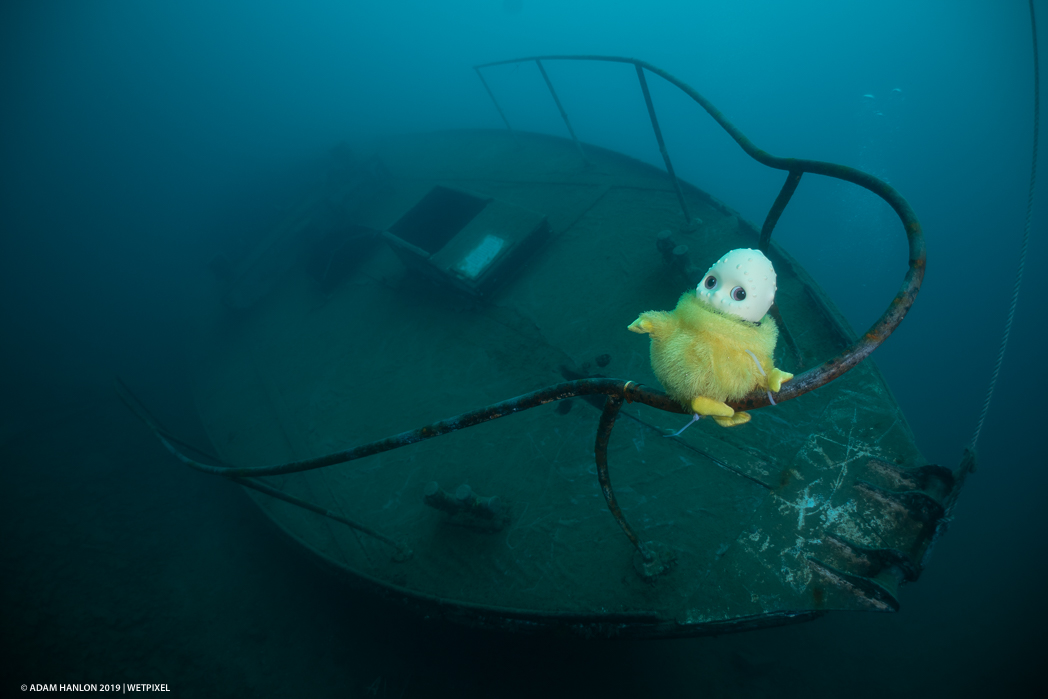
    190322-ahanlon-0679.jpg

    (Nikon D850, Nikon 28-70mm f/3.5-4.5, Inon Z330 strobes, Nauticam WACP. 1/100 at f/4, ISO200)


    Not the best subject! But I think it shows the corner performance advantage.


    In terms of portability, it all hinges on your needs and priorities. If you need to give yourself the best chance of capturing images, a modern SLR will be the tool of choice and, while heavy and bulky, this is an acceptable compromise. Pros tend to still use SLRs underwater, as they find that they are the best tool for the job. When a mirrorless camera system arrives that can match the SLRs performance, I will be the first to "jump ship." Until it does though, I will put up with the weight and bulk as it gives me the best chance of delivering the results that I need.


    Adam

  3.  

    There is a misconception about how WWL and WACP work:


    Conversion lenses offer a virtual image that is parallel to the sensor, so remove the DOF issue that is a problem with dome/lens combinations. The WACP can be used with high-resolution cameras at very open apertures (f/4) and still give excellent corner results.


    There's not really any misconception, I'm fully aware of how the WACP functions - it's basically a field flattener, bringing the corners of the curved virtual image into focus at the same time expanding the field of view, probably not so good with choice of words. I recalled reading the reviews of the WACP and WWL and was not sure exactly how low you could go with aperture and seemed to recall f8 being touted as a limit. Since posting that I went and reviewed the article in UWP 99 to confirm my recollections. The UWP 99 can be found here: http://www.uwpmag.com/?download=99


    On p42 you can see peak image quality in the corners occurs at f16 for the chosen rectilinear (nikon 14-28) as does the WACP albeit at higher resolution and the WACP resolution drops with aperture and is equal to the 14-28 at f16 when the WACP is at f8, basically a 2 stop advantage. f 5.6 is certainly usable. So aperture does impact corner quality still, whether this is a limitation of the WACP/WWL or the kit lens being used is less certain.


    The main purpose of the post was to explore any aperture advantage that might be obtained in m43 over full frame. On p42 you'll also see data for the WWL vs the Oly 7-14mm, The 7-14 peaks at f11 and the WWL is equal or better than the 7-14 down to f5.6 and again there's a 2-stop advantage.


    The whole idea behind the sort of comparison is that when people see the dynamic range, noise and other numbers in isolation the numbers quoted are the numbers for base ISO, but the Noise, DR and colour depth all reduce as ISO goes up. If you can operate 2 stops wider open you can use two stops better ISO on m43 and claw back part of the full frame advantage. However is you can get to f5.6 to f4 of full frame that advantage is very much reduced to non-existent as the lenses being used will be wide open. It's still not as good as full frame but if you are aware and adjust your aperture and ISO appropriately it closes the gap. Of course is you shoot your full frame at base ISO it leaps ahead.


    It will be interesting to follow developments in water contact optics, the WACP certainly provides excellent performance at a price in both purchase $$ and weight. Maybe a hybrid between the Sea and Sea internal corrector and a water contact optic?

  4. The D850 dynamic range is 14.8 Ev compared to 12.8Ev at base ISO, but you probably rarely use base ISO and on the D850 that's ISO64 while it's 200 for the EM-1. If you come up around 200 ISO it reduces to a 1 Ev advantage. I've don't find I'm dynamic range limited that often with UW work, if anything the DR recorded is narrow and requires stretching quite often. Here's a comparison of the D850 to EM-1 MkII DR: https://www.dxomark.com/Cameras/Compare/Side-by-side/Nikon-D850-versus-Olympus-OM-D-E-M1-Mark-II___1177_1136


    The other thing to remember is that m43 can shoot wider open and still get the same depth of field so it claws back the noise and DR advantage somewhat as you can often use lower ISO if your aperture is wider. The full frame retains an advantage in more pixels and more total light gathered (even if light per unit area remains the same) as long as you don't crop. Typically you need to stop down two stops to achieve the same results on FF as you do on m43 for DOF and from that sharp corners. I shoot the EM-1 MkII and I typically shoot my fisheye and WA shots at f8.


    As to what that means with a WWL & 14-42 vs a WACP and 28-70 for Nikon I'm not sure. You still have the same DOF advantage, but the WWL allows you to shoot more wide open and you could certainly use f4??- f5.6 with the 14-42 if needed and it gave enough DOF.


    On macro lenses it's a trade off. I have both the 60 and the 30. The 60 is good for small stuff, but problematic particularly in temperate water with plenty of particles if you are shooting things bigger than say 30-40mm long. One concern with particles is the camera can lock onto them with distant objects, it you are shooting in close, it's normally not an issue. The 30mm (I have the Panasonic 30mm) is good for larger stuff up a Weedy sea dragon at 300mm long but really is only practical down to about half life size as the subject needs to be too close to the lens beyond that to allow easy lighting. The 45mm Pany Leica is sharp but reputed to slow to focus, though I've not tried it out. You could get both and buy the N45 port for the 30mm and add the 20mm extension tube to use the 60mm


    This is with the 60mm, it's about 30mm long:

    Ceratosoma_amonenum14.jpg


    And this is with the 30mm, about 200mm long:

    SenatorWrasse3.jpg


    Both images are temperate waters around Sydney.

    This is pretty off topic but I love those images. Super detailed and amazing to see from someone who is just getting into this type of work.

  5. attachicon.gif190322-ahanlon-0679.jpg

    (Nikon D850, Nikon 28-70mm f/3.5-4.5, Inon Z330 strobes, Nauticam WACP. 1/100 at f/4, ISO200)

    I think that's a great picture!

    Furthermore, I have just acquired a Nikon 28-70, so I guess I have now no choice but to buy the rest of the Nauticam WACP system also.

    Poor me.

  6. I think that's a great picture!

    Furthermore, I have just acquired a Nikon 28-70, so I guess I have now no choice but to buy the rest of the Nauticam WACP system also.

    Poor me.


    Doh!


    :crazy:

  7. Ok ok, new idea!

    Background

    So far I consider it established that m4/3 with WWL-1 would make for a significantly smaller and cheaper package than D850 + WACP, at the cost of not so much optical performance as about two stops of sensor performance. Choosing between them I'm inclined to give the nod to large and heavy. However, I'm still balking at both cost and weight. But last night I looked at the WWL-1 port chart and homed in on the Sony E alternative.


    New idea

    What about going for a Sony E (APS-C), such as the A6500, with the WWL-1? Let me go through some aspects of that.


    ​Sensor

    ​Assuming equivalent sensor technology, which is often more or less true today, I will still lag about a stop behind the D850, plus of course lose a lot of pixels, going down to 24 Mpix. On the other hand I will gain about a stop compared to an m4/3 solution. This will be a compromise and I will have to think about it.


    ​Autofocus

    Ok I may not have the AF of the D850, but still, the A6500 is known for having good AF, right?


    Lenses

    I know there is a dearth of native underwater lenses. Let's look closer at that.

    For the WWL-1 it's the 16-50. I know that's considered a mediocre lens at best, but for this purpose it may be fine. It has to be zoomed in to 20 mm which may be a bit of a hassle but it's probably ok.


    Macro: The CMC lenses work with the 16-50, but I don't know how well. The lens port I would use for the WWL-1 also allows the 30 mm Sony macro which I suspect is a mediocre solution with too short working distance. On the other hand the 30 mm macro is cheap. The best macro solution may be the Canon 60 mm with metabones adapter.


    Fisheye: No native fisheye, but there is the Tokina 10-17 for Canon with metabones adapter.


    I don't know how well AF works with the adapter, but if it works well, wouldn't that fix me up pretty well? Oh and there's also the Sony 10-18/4 if I'd like to go classic wide angle.


    ​Strobes

    ​It seems I may be able to use TTL at least with the YS-D2J without any separate TTL converter. The Inon Z330 isn't mentioned and I should probably ask someone, but I'd think it will work.


    ​Topside

    ​I have no particular yearning for the Sony APS-C topside and I suspect Sony will pretty much abandon it, to the extent they haven't already done so, despite the A6400 being recently released. But if I look at it as a pure diving solution it may not matter that much if Sony loses interest.


    Summary/Question

    This write-up is done purely on specs, no actual experience. Have I missed anything important? Is there a good reason m4/3 seems much more popular than this solution?

    ​Edit: ok, flash sync at 1/160 s is a letdown.

    Edit2: according to http://www.uwphotographyguide.com/sony-a6500-camera-reviewthe shutter speed is limited to 1/160 s when the popup flash is up. That could be a deal breaker. Surely faster shutter speeds are sometimes required.


    Edit 3: Possibly cumbersome handling of AF system. New A6400 may be better, but no Nauticam housing (yet). Possibly slow recharge of popup flash, could be better with electronic triggering but it's unclear to me how to achieve that. So far there seems to be a number of compromises and gotchas in addition to the lost sensor area compared to the D850. Still, it's about 5 kg lighter and, in Swedish prices, something like $4000 cheaper, even counting the fact that I already own the D850 and will have to buy the Sony camera.


    Edited by horvendile
  8. Here are a few thoughts that may help. I have been using micro four thirds for several years now. Generally, I am happy with the results and in truth, when I am not so happy, I am pretty sure it is me and not the camera that is inadequate. Still, like most people, every time something new comes out I get excited thinking that improving my gear will make my photos better. There is no doubt that there are better cameras out there. I got very excited when the D500 came out and compared housing sizes, decided what ports and lenses I would need and so on. Same thing with some of the Sony full frame models.


    In the end, I am still using the Olympus because I can fit the following into my carry-on bags: camera body, 8mm, 8-18, 12-40 and macro lenses, all of the necessary adapters and extensions, a fisheye port, a macro port, an 8" dome port, two Inon strobes, housing with handles, 45 degree viewfinder and the other miscellaneous essential bits and pieces. I frequently don't take it all and so I have room to spare or can pack some stuff there instead of checked luggage. I have also been experimenting with the WWL-1 and if I take that and a 14-42, I have even more space. I can also carry or wheel the stuff around without dislocating a shoulder.


    I don't think I could pull that off with anything else and I have to fly to dive, so I travel a lot and don't trust the airlines to get my stuff to me or to not destroy checked bags. I have been on too many dive trips where divers get to the dive resort or liveaboard without some of their luggage and sometimes have to wait a couple days for it to show up. For that reason I also carry-on my reg, dive computer, mask, a swimsuit and a few other essentials. I figure in the worst case I can buy some tee shirts and rent a wetsuit and fins.


    Sony stuff was appealing, but I do like using strobes on TTL sometimes and the Sony's are problematic that way and more importantly, the lenses are huge and the port sizes would be a problem especially if I went full frame. The D500 is still appealing, but frankly I am unsure how much benefit I would really get from a crop sensor and switching everything over would not be cheap.


    I would love to try full frame, and if I could dive locally I would, or if I took fewer but longer dive trips I might. Much in life is a compromise, and this is one I have to make. I find it soothing to know my expensive gear is with me as I travel.

    In answer to your macro question, it depends a bit on your intended subject but I find the 30mm is the easiest to work with most of the time. The 60 is a bit too much unless subjects are really tiny and/or water very clear.


    Perhaps, if starting from scratch right now, I would go with a D500. But maybe not. Lastly, I see you already own the D850, so perhaps having that out of the way and being familiar with it tips the compromise balance the other way


    Good luck.

    Edited by Draq
  9. Update regarding the A6500. I managed to play with one in a store for a decent amount of time today.


    My fears for clumsy AF handling may have been exaggerated. It's possible to select focus point without first pressing another button. Switching between focus modes is relatively easy. Specifically, switching between one point AF-C and tracking AF is perfectly fine. I'm not that impressed with the tracking performance I saw. The A6400 may change that.


    However. Engaging the pop-up flash does indeed limit the shutter speed to 1/160 s. Overriding that, eg by disabling the flash without putting it back down - which will be impossible underwater - does not seem possible. This would effectively limit the underwater shutter speed to 1/160 s. That sounds dealbreaker-ish to me.


    Once more I think I'm drifting towards the D850, despite the extra 5 kg and $4000.

  10.  

    However. Engaging the pop-up flash does indeed limit the shutter speed to 1/160 s. Overriding that, eg by disabling the flash without putting it back down - which will be impossible underwater - does not seem possible. This would effectively limit the underwater shutter speed to 1/160 s. That sounds dealbreaker-ish to me.


    There is a trick to it.

  11. There is a trick to it.

    ...oh dear.

    Let's just say it's probably best for all that I earn my living by arranging colored dots on a screen and not by building things.

  12. For what it's worth...


    I have both a D850 (& Nauticam housing) as well as a D500 (& Nauticam housing). The 850 with a 105 is a great camera for macro, but the D500 with a 60 performs slightly better much of the time (even compared to the D850 with the 60 underwater).


    For those that have shot both cameras underwater this is not a new observation - on land the D850 is an amazing camera. Underwater and limited to either a 105 or 60, it's just a tad slower in AF than the 500, and will hunt slightly more in situations where the D500 locks on.


    I shot both cameras in Anilao last December, the D500 was a touch better, and in specific situations (like the blackwater dive) the D500 was measurably better. There is a technical explanation for this difference - it has to do with the generation of auto focus "brain" being used on both cameras, the number of AF points, etc., but from experience (mine, and others) there is enough of a delta that you can feel the difference when using both cameras.


    I'm in Anilao now (finishing up a week of diving) and only brought the D500 on this trip because of my experience last Dec.


    Having said this, the D850 with the WACP (as bulky as it is) is a great (rectilinear) wide angle solution, and this summer I will likely only bring the D850 on a planned trip to Komodo (for both macro and W/A). Clearly the D850 is "good enough" in almost all situations (and we are talking multi-generation improvement compared to many of the other Nikon FF cameras).

    i

    For reference, my daughter is shooting an A7III on this trip, and the 90mm hunts fairly frequently compared to the D500 (on the same subjects, under the same lighting conditions). Not really relevant tot the conversation at hand, but to the ;point of what you want to optimize for, I would always pick the better AF performance vs theoretical image quality (but that may just be me).

  13. For what it's worth...


    I have both a D850 (& Nauticam housing) as well as a D500 (& Nauticam housing).

    (...)

    I'd say that was worth a lot. Good intel, thanks.


    Since I already own the D850 there are no real cost savings with going to D500, at least not if the WACP is still on the menu. Also no meaningful weight savings. I still think the D850 makes more sense for me. If I were to start totally from scratch, with no cameras or lenses, the D500 might look more compelling.


    At the risk of derailing the thread slightly, I'll ask about the macro. I was going to spring for the 60 mm f/2.8G, for two reasons:

    * More allround, also usable for eg fish portraits.

    * Seems like the 105 mm has a steeper learning curve.

    The increased working distance could be both an advantade and a disadvantage, depending on the water and the motive I guess.

    Also, the 60 mm will be a slightly lighter option, which is good in an already very heavy kit.


    Do you have any comment to that? I mean, it also seems that many people prefer the 105 for use on FX. Which I totally understand, if the waters are clear and the purpose is purely macro.

Marelux

Account

Navigation

Search

Search

Configure browser push notifications

Chrome (Android)
  1. Tap the lock icon next to the address bar.
  2. Tap Permissions → Notifications.
  3. Adjust your preference.
Chrome (Desktop)
  1. Click the padlock icon in the address bar.
  2. Select Site settings.
  3. Find Notifications and adjust your preference.