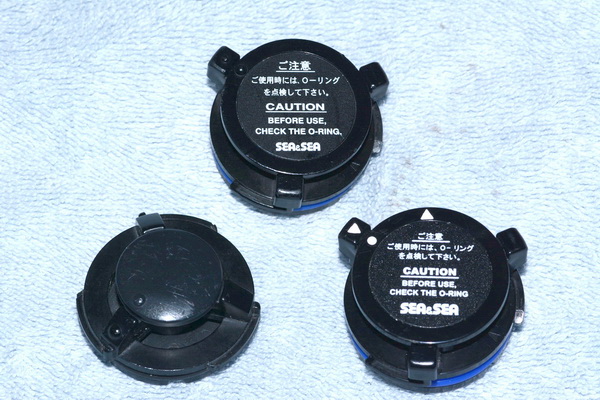
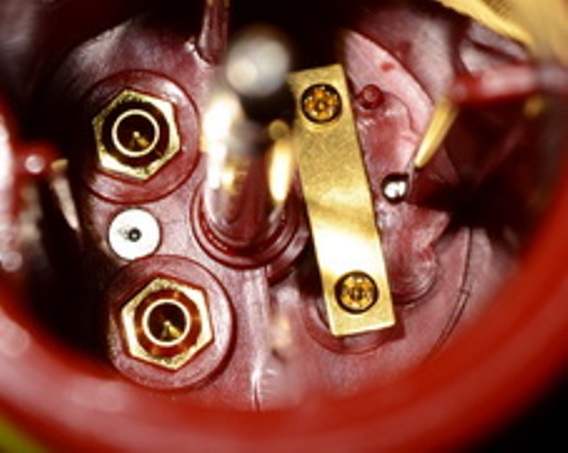
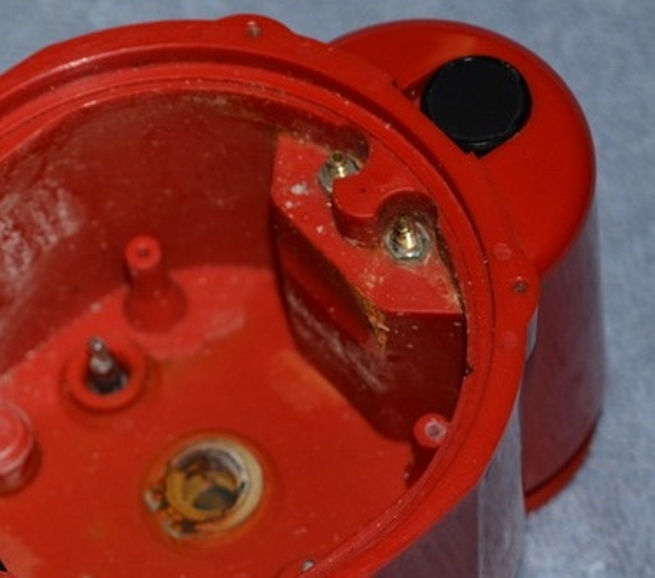
When water enters a strobe’s battery compartment it damages the batteries, in some strobes it also enters and damages the electronic compartment, with usually serious and often irreparable damage.
To help explain the damage, some have claimed that the wet batteries release heat and gas; also that some current strobes have a pressure release valve (1).
However, as these two claims may be of questionable accuracy, let us examine them.
1. Pressure Relief Valve:
I have examined several flooded Inon strobes and found that the black plastic disc at the bottom of the battery compartment, mentioned by some as a possible valve, was not damaged or affected by the water. As this disc has no moving parts, is not connected to anything and is glued firmly to the strobe, it is not a relief valve (Fig 1).
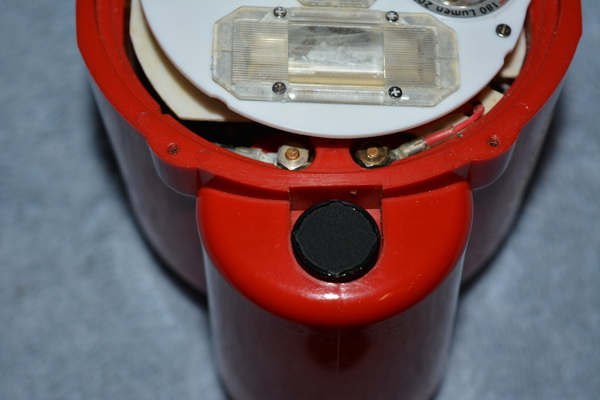
Inon D2000 post flooding, front lens removed. The round black disc is firmly attached to the case, has no discernible function and is not a pressure relief valve. Just above the black disc, note the corroded battery contact nut: the water from the battery case traveled around these battery contacts to flood the electric compartment.
I examined five Inon strobe models: S2000, D180, D2000, Z240 and Z330 strobes and four models of Sea&Sea strobes: the Sub-50 TTL, YS-110 TTL, YS-D1 and YS-D2J. None had a pressure relief valve. The discontinued YS-250 Pro did have such a valve.
For all other available strobes, I used the information I gathered last month to prepare the Wetpixel Underwater Strobe Finder spreadsheet of currently Available Strobes (2); none of the UW strobe ads and specifications mentioned a pressure relief valve.
2. Battery Gas and Heat Release:
To see if gas and heat are released when a battery is immersed in salt water, I put three AA Duracell batteries in an inverted small transparent jar filled with in 4% NaCl dissolved in water (w/v) to trap released gas, and monitored the water temperature with a digital thermometer for three hours.
During the first two hours, the water temperature held steady at 19°C, then rose 1°C during the third hour to 20°C, (68 to 69 F) there was no visible release of gas; the control jar remained at 19°C and the room temp at 19.5°C.
The batteries released turbid yellow-reddish liquid, but did not bubble, swell or deform, something one would expect if gas was being formed inside them.
Conclusions:
1. As AA batteries immersed in 4% salt water released no detectable amount of heat or hot gas, the rumors of their release are unfounded, perhaps carryover information from the discontinued Sea&Sea YS-250, and from lead-acid automobile batteries.
2. No Inon have, Sea&Sea strobes no longer have, and no other UW strobes on the current market claim to have, a pressure relief valve (2). Why not? Because none is needed.
In closing, a hypothetical heat and gas release need not be invoked to explain strobe water damage, as the water and the chemicals released by flooded batteries suffice to explain the damage.
References:
1. Strobe Problems and the Battery Compartment.
http://wetpixel.com/forums/index.php?showtopic=64202, comment posted 16 June 2019; also
comments about discontinued Sea&Sea strobes quoted below. Sea & Sea YS-250 Pro Strobe leaking
http://wetpixel.com/forums/index.php?showtopic=37737&hl=%2Bpressure+%2Brelief+%2Bvalve&do=findComment&comment=261754
The problems with Sea & Sea YS110alpha
http://wetpixel.com/forums/index.php?showtopic=28796&hl=%2Bpressure+%2Brelief+%2Bvalve&do=findComment&comment=201773
Sea&Sea YS-110α Announced
http://wetpixel.com/forums/index.php?showtopic=26213&hl=%2Bpressure+%2Brelief+%2Bvalve
2.Underwater Strobe Finder.
http://wetpixel.com/forums/index.php?showtopic=6501, post of 16 Jun 2019,
with link to Google Sheets spreadsheet:
https://docs.google.com/spreadsheets/d/1otS2RTR47KhaFdBkO6Gd7DDju3CQLEnTT2Wwetay4vE/edit#gid=0