12 hours ago, Interceptor121 said:
No magnification as indicated by nauticam are for a specific lens don’t apply to all lenses equally
CMC-2 with olympus 60mm achieves nothing that the lens can’t do on its own. Those close up lenses have a maximum working distance that works with your lens set at infinity and a minimum working distance that works when your lens is set to the closest
When the wet lens maximum working distance is further away than your camera lens minimum working distance the benefit drops to few cm useful range and this means the lens is not really worth using.
I have tested all the lenses in question and the only one that gives a benefit to the 60mm is the CMC-1 the others have such a minor effect they end up being an hindrance as the increased magnification is none and the ability to focus further away no longer there
In essence with the 60mm you dive with the CMC-2 on the flip diopter off the lens and when you find something really tiny that the camera can’t get close enough to fill the frame use the CMC-1
The olympus camera unfortunately doesn’t have a manual focus guide to tell you when you are at the minimum distance so you need to use other tricks to figure out when you need to use the wet lens
Sent from my iPhone using Tapatalk
Thanks for this real live input on CMC-2 with Zuiko 60mm (I was close to ordering one and spending money for nothing... ). It shows, again and again, that one only knows whether the performance of a new item is as expected, after buying and testing out in real life...
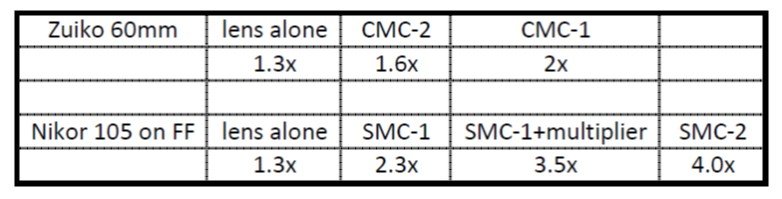
Another thing is that the OPTICAL magnification factors achieved by lens+/-diopters are not yet the entire story, but represent more a milestone, required to avoid total confusion. At same magnification factors (e.g. 1x) the magnification will only be correct, regardless of different sensor formats (FF and MFT (and, of course, APS-C)), when printed out at the size of the sensor (17.3*13mm for MFT; 36*24mm for FF). The size of the images itself will be different, the bigger sensor covering a larger area, but magnification of the object will be identical. Since the images are always scaled up and finally projected/printed at a certain physical size, the final magnification factors are different when th eimages are viewes at the same final size: At 1x magnification a 17mm object will fill out the entire MFT photograph, while it will fill out only half of the FF image...
Here is a second table, that shows the final magnification of an object, when the images are printed out/projected at identical physical sizes (MFT scaled up relative to FF):
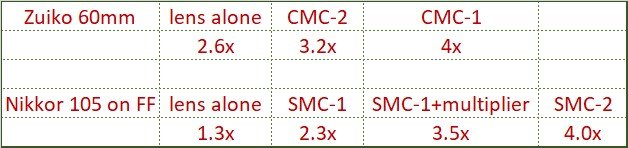
It shows, just in numbers, what you were saying: Zuiko 60mm ALONE (and without any gaps in possible focusable distances) easily covers the macro range up to the maximim achievable with the Nikkor 105+SMC-1 on FX. Accordingly, Zuiko 60mm+CMC-1 covers a similar macro range as Nikkor 105mm+SMC-2...
Hence an UW-photographer on FF needs a macro lens that provides already by itself 2x magnification in air, in order to have the same flexibility as another one with a MFT camera has. With lenses with 1x magnification the many diopters are required...
Numbers are according to the data provided by nauticam and may, as Massimo says, not be correct...
Wolfgang





.jpg.857dbbfbdc4d79d9c6ebf7b4ba96ed1b.jpg)

