



Hello everyone,
I recently used my Olympus TG-6 underwater and would like critique.
Is it preferable that I share the RAW images?
Thank you.
Read-only discussion
Hello everyone,
I recently used my Olympus TG-6 underwater and would like critique.
Is it preferable that I share the RAW images?
Thank you.
20 minutes ago, hedonist222 said:Hello everyone,
I recently used my Olympus TG-6 underwater and would like critique.
Is it preferable that I share the RAW images?
Thank you.
If you are talking about posting them here, I would suggest posting 1200 -1600 pixel (long side) jpegs. Raw files won't display in browser and people are more likely to look at them if they don't need to convert them.
Good point, Chris.
I was suggesting RAW in the hope that maybe someone wanted to edit a photography to demonstrate a point.
I guess I'll convert them to JPG without any editing.
Are you looking more for post-processing techniques, or composition, or more camera-specific things?
You can post a jpg and a link to the raw files too.
33 minutes ago, phxazcraig said:Are you looking more for post-processing techniques, or composition, or more camera-specific things?
You can post a jpg and a link to the raw files too.
Looking for composition in water as a starting point.
Then PP technique as well.
Heres a photograph taken in RAW and converted to a jpg without any PP.
How can I avoid the hotspot?
Exif:
ISO: 100
EV: -0.7
F/6.3
1/125s

I think that it is going to be hard to create an image in the circumstances you found these shrimps in..
When subjects are tucked away, it is very difficult to create a pleasing image. I think my advice would be to try and find another opportunity to take the picture when the shrimps are in a better (easier) position. Good situations to find shrimps are, within anemones, or at night.
adam, I'm referring to the hotspot from the light
I figured the brighter the light, the faster the shutter speed and lower ISO
The hotspot on the right hand bottom of the frame is caused by the position of the light. Simply put, the area that is overexposed is closer to the light. The only way to deal with this would be to reposition the light, or look for subjects that are easier to capture!
If you adjust your camera's exposure to be correct for the area that is overexposed, the shrimps will be underexposed.
adam, thank you
I figured that and was hoping that exposure compensation would compensate for over exposed areas
Bu this has also happened when I have set the light directly over the subject
Like this photograph

As, Adam says, the problem is the proximity of the strobe to the piece of light coloured coral. Meter for that and the shrimps will be very underexposed.
Options might be to crop it out (which might make for a better composition), or use a snoot and only light the shrimps (which would be my preferred option) or see whether there isn't a better angle you can use which avoids a lighter coloured foreground which will light up more than the subject.
Then you could also try using, say, Lightroom to drop the highlights in the portion of the image (yeah, not the same as in-camera work for sure).
That particular shrimp (Thor amboinensis) tends to be, as Adam says, in photographically awkward places. I've found that exploring better angles is key but, even then, it can be extremely difficult. Snoot up!
Thank you, Tim.
Do you suppose using a flash is advantageous over a continuous light LED?
I am using the backscatter macro/wide 4300 in macro mode.
I could try using the lower-brightness modes.
1 minute ago, hedonist222 said:adam, thank you
I figured that and was hoping that exposure compensation would compensate for over exposed areas
Bu this has also happened when I have set the light directly over the subject
Like this photograph
You have a smilier problem here: a very dark subject and a foreground/background which will reflect light much more than the subject. It's not helped by having the strobe right over the subject - and quite high. This is producing back scatter as well. Much better, in this image, to have the strobe at, say, 45 degree to the lens and on the same vertical plane - so it's aimed at the body of the subject. Even then though, there's a gof chance of lighting the foreground more than than the subject.
Again, you might have to underexpose the subject to not overexpose the foreground - then see if in post you can open up the exposure on the subject. Tricky!
But I would suggest different strobe positioning to play around a bit.
1 minute ago, hedonist222 said:Thank you, Tim.
Do you suppose using a flash is advantageous over a continuous light LED?
I am using the backscatter macro/wide 4300 in macro mode.
I could try using the lower-brightness modes.
Not sure there would be much difference between a flash and a continuous light. The issue is one of the camera's sensor not being able to cope and record an extreme exposure contrast.
Trying a lower brightness mode will certainly help although you may then find the subject underexposed - and, as I suggested, you might have go to lightening the subject in LR or some such program.
Sometimes depending on your systems capabilities, you just have to accept that if you shoot x on a background of y it is going to be very tough to get a decent, balanced exposure.
As I suggested in an early reply, have a go with a snoot. Using one means you can just light the subject and leave the foreground/background in ambient light.
Here's an example:
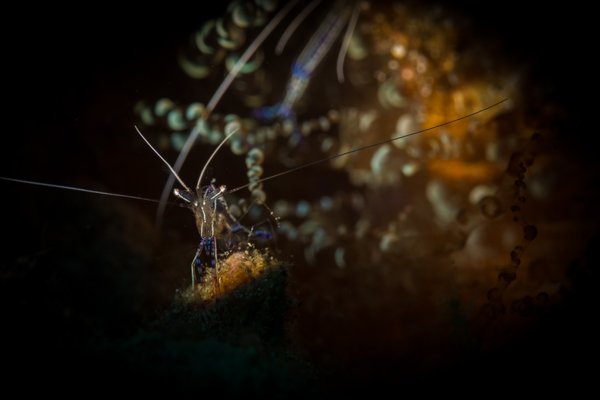
Thanks, Tim.
I also have the backscatter snoot.
Will experiment with it after I've gotten accustomed to the light without a snoot aid.
So that I know how a snoot affects the system - if I use both at the same time, I won't know what affect what has.
Get used to the light as a baseline, then can note how a snoot affects it.
1 hour ago, hedonist222 said:Thanks, Tim.
I also have the backscatter snoot.
Will experiment with it after I've gotten accustomed to the light without a snoot aid.
So that I know how a snoot affects the system - if I use both at the same time, I won't know what affect what has.
Get used to the light as a baseline, then can note how a snoot affects it.
No worries. The snoot will make a huge difference. With that you are really controlling and guiding the light much more than you can with a strobe "blast".
Worth playing around little bit above water (although don't go too mad with the strobe in case of over-heating). But if you use some small household object as a model, say 1" high, 1/2" across and light that with the strobe; then add the snoot and shoot again. You'll see how much you can control the light and the effect by moving the strobe around. You only need one strobe.
Thanks, Tim.
You are a beacon of light.
Pun, decidedly, intended.
LOL, I've been called worse 
I would suggest also that the light you are using seems to have quite the hot spot - you said it was the 4300 macro wide? Which beam option are you using? For shots with everything illuminated maybe try the wide mode and angle it away from your subject a little? How far from the subject is the light, getting it further back should broaden the beam.
4 hours ago, ChrisRoss said:I would suggest also that the light you are using seems to have quite the hot spot - you said it was the 4300 macro wide? Which beam option are you using? For shots with everything illuminated maybe try the wide mode and angle it away from your subject a little? How far from the subject is the light, getting it further back should broaden the beam.
Was using it in macro
Ahh your comment makes sense
I think the macro produces a hot spot because maybe it's intended to be used with the snoot
The snoot has a built in diffuser

Terms of Use Privacy Policy Guidelines We have placed cookies on your device to help make this website better. You can adjust your cookie settings, otherwise we'll assume you're okay to continue.

A worldwide community for underwater imaging.
