Hi imacro.
My answers in front of your questions...
1) how do you pack and travel on plane with the rig? In a carry on luggage, the provided Nauticam case or some special foam protected case?
Several topics on this question alone. Several strategies for travelling with the rig. I, myself, use a Lowepro Computertrek Plus with the housing and camera inside, 2 Inon Z240 strobes, Tokina 10-17 FE, Canon 100mm USM Macro, 180º viewfinder, flat port, mini dome, arms, clamps, focus light and dive computer.
On my wife’s carry-on goes the 8 inch dome, the handles of the housing and the float arms, her and mine regulators, her dive computer and some other bits and bolts.
Both bags weight around 14 kg…. Each…. Over weight, so quite important to keep low profile, a smile in the lips and be polite and gentle. If the bags are weighted, show them that it is photographic equipment, and prey…
When my wife is not travelling with me, the equipment that does not fit my lowepro, goes on checked baggage.
My checked baggage always goes quite bellow the limit (usually 17-18 kg) also so try to explain that the hand luggage is heavy but it is quite fragile and that it is not an attempt to take extra weight.
If all this strategy/talk does not work, I always have with me a fisherman vest with quite big pockets to pass some equipment to the pockets and get at least the backpack under the maximum weight. After passing the control, things get back to the backpack.
2) how do you bring it to the dive boat and keep it safe esp the strobes the whole trip?
To take the equipment to the boat, it depends where I am diving. When going by car, usually I use a plastic box of +- 60 cm x 40 cm x 50 cm with lid. I found it easier to use than cooler bag. That plastic box also can be used as a personnel rinse tank. I also use that box to have the equipment stored at home. So, multi purpose plastic box.
When abroad, I use the handle to transport the rig, and usually a towel from the resort to put the rig on it and cover it to protect it from the sun.
Always with the neoprene cover on the port. For the MiniDome I use a plastic box to protect it as the neoprene cover does not stay in place easily.
3) how do you carry it into the water? Get into the water first and ask someone to hand it to you after?
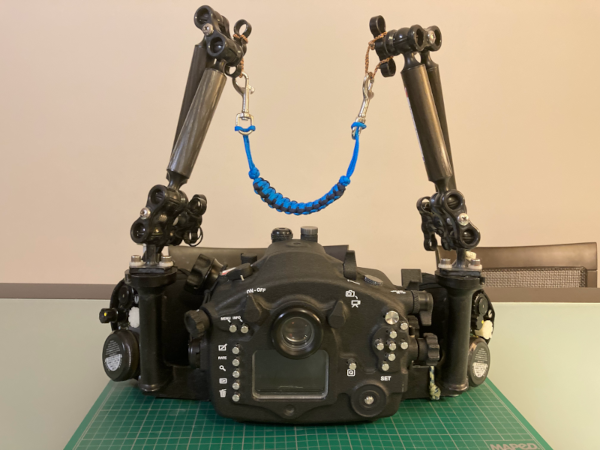
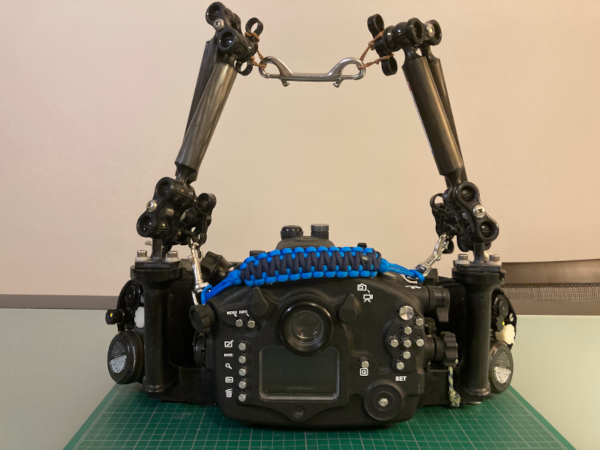
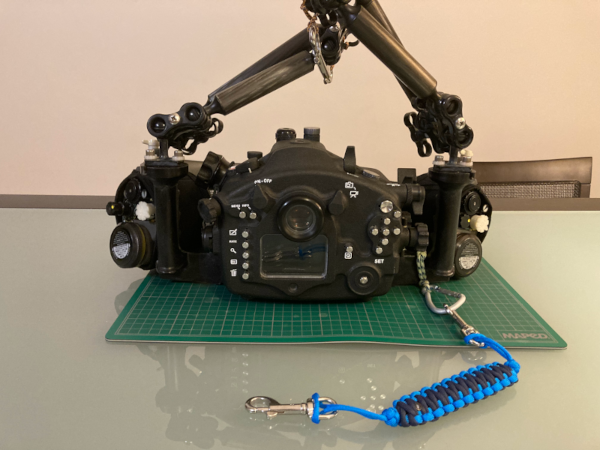
The key here is the handle/lanyard. It is a great tool for transport the housing (as a handle or to take the housing at shoulder). And most important an easy and visual way to receive the housing from the boat man and to give it back in the end of the dive. You should explain to the boat man how do you want him to pass you the housing and how should he grab the housing. This is critical to avoid the housing being handled on the wrong accessories like fiber optics and cables. There are people that prefers to take the neoprene caps with them on the dive, I myself prefer to leave it on the boat, to be one less thing being hanging around on the dive. So, I prepare myself for diving, with my housing close to me (being careful to not damage it), and when ready I pick up my housing, take out the neoprene cap, and I make signal to the boat man I am ready to jump, so he can come to me, and receive the housing to be able to pass it back to me after I jump. I always ask the boat man to pass the rig to me with the port facing outwards the boat to avoid damaging the port against the boat. When passing the rig to the boat man after the dive, I always have the same awareness: to pass it to him with the port facing outwards the boat.
Besides to use the handle on the hand or on the shoulder, I use it too to clip the housing to my BCD. I clip it on a lower part of the housing handle, because that way the handle/lanyard does not get in front of the regulator, mask sand is not in the way to maneuver/positioning the strobes or in front of the different commands of the housing. (see pictures attached) https://www.ebay.co.uk/itm/143983859917
4) do you throw the rig into the gear water bucket in between dives? I’m concerned others will throw their gears in and may damage my rig.
Never, never, never drop the housing in the rinser tank and go away. Put the housing (with the lens cover on) on the clean water and do several pushes on all the buttons, and than take the housing from the bucket and place it in a safe place covered by a towel to protect it from the sun in between dives. If you do not have clean water (not salty), avoid to have the housing getting dry. In that case drop sea water over it 15 to 15 minutes (and keep the housing protected) to avoid the salty water to dry in the housing and get salt crystals formed close to the o-rings, that might increase the risk of flood. But the best is always to have the housing rinsed in plain water.
5) has anyone slipped and dropped their rig while they are on the water surface? Does it actually floaty enough for you to catch it?
Having the housing always clipped to you makes this risk nonexistent. The only moment I do not have the housing clipped to me is when receiving it from the boatman or at the end of the dive to pass it to the boatman. But even on these moments the risk is nonexistent, as the housing is only slightly negative or neutral. If I leave the housing, it does not sinks quickly.