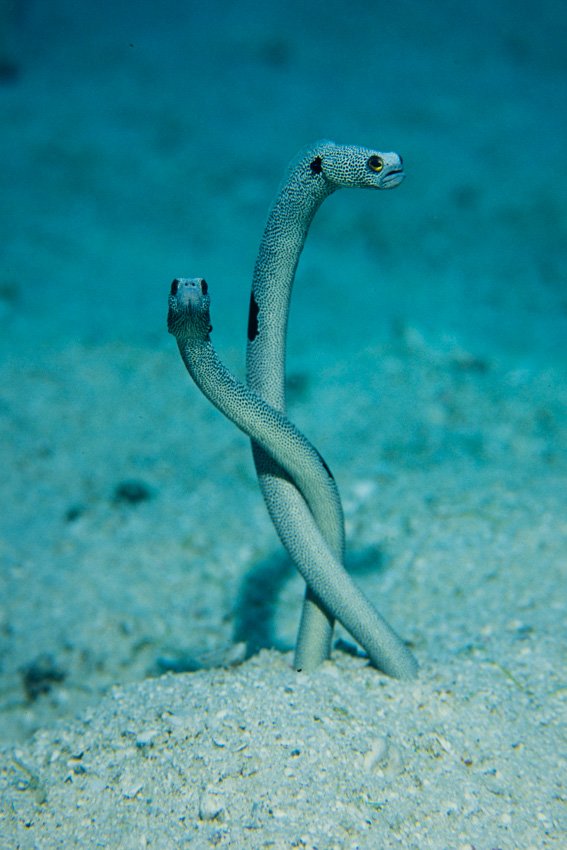
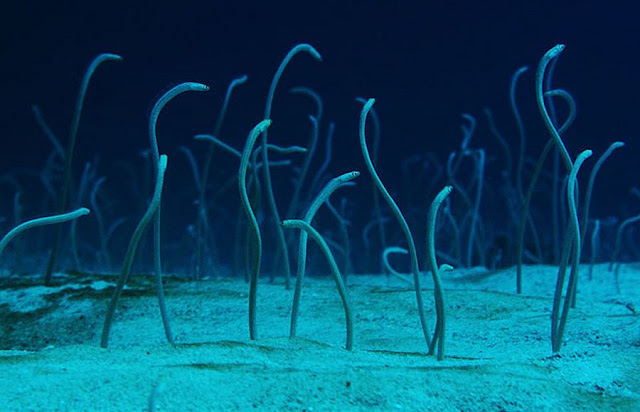
So I have a local patch of White spotted garden eel (Gorgasia maculatus) near me (see image below taken at 15m, not cropped, using only Olympus EPL10, Olympus 60mm, Inon Z330). I've tried getting good images of them but that seems to be a challenge. Main issues are:
Getting close = they duck under at even the slightest movement. Just you exhaling causes them to duck under. I typically need to hold my breath for like 2 mins before they pop out again. Any tips on how to get closer to them? Maybe I should leave my camera on timelapse might be a better solution?
Lighting = from my image below my strobes don't seem to reach them, my read of this is that I am too far away. Would it be okay to push the strobes forward or even get them off camera? From what I've read you gotta keep your strobe behind the plane of the housing). Also when I put my strobes to max, the eels just become really shiny.
Possible compositions = I went online for some inspiration. I noticed that all images that are taken in-situ look like this, the eels are quite far away and not well lit like greenish sort of same as mine. Then all the nice images with good compositions that I like are from aquaria. Does anyone know of engaging images of garden eels taken in the wild that are similar to the ones from aquaria? Maybe some ideas on how to achieve this?
The goal of my post is for me to have a list of things to experiment with when I go back out to the field. Thanks!
There was an article on WP some years (maybe by Alex Mustard?) about placing the camera in the ideal spot close to the eels then using a modified bicycle brake cable to fire the shutter from a distance.
The camera was set up, the diver swam away to the extent of the cable release and then waited for the eels to start to rise again.
The camera being much closer also allowed good flash positioning.
If you are using a macro lens the requirement to keep behind plane of the housing can be relaxed I expect. The requirement is around hot spots as the beam gets close to the edge of the dome , but the narrow angle of view from the macro lens means it is less of an issue, you'll still want the strobes out wide to try to cope with backscatter of course. You could always take up re-breather diving - not blowing bubbles means you are much quieter.
The best result I ever got was by creeping up the down-current edge of a sand bank in a screaming current. That was on open circuit.
Rebreathers, while bubble free, still have a noise of breathing. The time I tried in zero current with a rebreather was not successful.
Given the opportunity, I would try the tripod + cable method Alex used. But that has the disadvantage of not being able to actually compose the shot.
Your three points are exactly correct. They are difficult buggers to capture! Your first shot above looks salvageable to me, if shot in RAW, with careful editing.
I have had limited success as John describes, sneaking up and holding my breath, with strobes raised up high and at full extension forward (like insect antennae). Sometimes they will pop up more quickly than others. It doesn't always work.
is your local patch the back side of Sombrero? That is where I used to find them regularly.
There was an article on WP some years (maybe by Alex Mustard?) about placing the camera in the ideal spot close to the eels then using a modified bicycle brake cable to fire the shutter from a distance.
The camera was set up, the diver swam away to the extent of the cable release and then waited for the eels to start to rise again.
The camera being much closer also allowed good flash positioning.
That is awesome, I'll try to look for that. I feel that would be a fun DIY project to work on. There really needs to be options for underwater remote camera work, i see so many applications for it.
With my old canon G15 you could use the Canon Hack Development Kit (CHDK) and custom program your camera by adding new features. There was feature that triggered the camera when it saw movement, it was primarily used to shoot lightning, but it worked well on animals as a camera trap. Unfortunately there doesn’t seem to be that feature on newer cameras.
Sent from my iPad using Tapatalk
If you are using a macro lens the requirement to keep behind plane of the housing can be relaxed I expect. The requirement is around hot spots as the beam gets close to the edge of the dome , but the narrow angle of view from the macro lens means it is less of an issue, you'll still want the strobes out wide to try to cope with backscatter of course. You could always take up re-breather diving - not blowing bubbles means you are much quieter.[emoji4]
Haha That is the ultimate dream! I wish I could afford a rebreather! I explored it, even if I could get the CCR unit, the maintenance and logistics of it are quite expensive and limited here in the Philippines. Maybe as more people adopt it, it'll become more practical.
Sent from my iPad using Tapatalk
The best result I ever got was by creeping up the down-current edge of a sand bank in a screaming current. That was on open circuit. Rebreathers, while bubble free, still have a noise of breathing. The time I tried in zero current with a rebreather was not successful. Given the opportunity, I would try the tripod + cable method Alex used. But that has the disadvantage of not being able to actually compose the shot.
True true. I also approached down current and from below the slope. They did not seem to freak out as fast haha. Will definitely explore the remote cable. Might try a GoPro on time-lapse and lights first to see if the composition with that technique would be worth all the effort.
Sent from my iPad using Tapatalk
Your three points are exactly correct. They are difficult buggers to capture! Your first shot above looks salvageable to me, if shot in RAW, with careful editing. I have had limited success as John describes, sneaking up and holding my breath, with strobes raised up high and at full extension forward (like insect antennae). Sometimes they will pop up more quickly than others. It doesn't always work. is your local patch the back side of Sombrero? That is where I used to find them regularly.
Yeah, unfortunately i shoot in jpeg most of the time. But have been trying to shoot in RAW to do better post. But I am still at that development stage in learning to edit in RAW. This patch is way up north near Ligpo Island. I prefer it there, less tourists and divers. Its open again so trying to be there every two weeks.
Sent from my iPad using Tapatalk
On 10/31/2021 at 9:04 AM, Pomacentridae said:
Yeah, unfortunately i shoot in jpeg most of the time. But have been trying to shoot in RAW to do better post. But I am still at that development stage in learning to edit in RAW.
Sent from my iPad using Tapatalk
The EPL10 has an option to shoot in RAW + Jpeg, this might be the best option for you at this point in time. you get your JPEG now for photo sharing, you have a RAW that you can play with in post and also revisit it later when you learn how to edit.
On 10/30/2021 at 2:27 AM, TimG said:
There was an article on WP some years (maybe by Alex Mustard?) about placing the camera in the ideal spot close to the eels then using a modified bicycle brake cable to fire the shutter from a distance.
The camera was set up, the diver swam away to the extent of the cable release and then waited for the eels to start to rise again.
The camera being much closer also allowed good flash positioning.
Oh man, I'm going to have to look this up. I think this might be just the thing I am looking to use for a different purpose, one of my goals is to get a great image of a Blue Banded Goby (aka Catalina Goby) but they are super skittish as well. Every time I get close they dart into the substrate.
I had my best luck by choosing the eels that seemed the least skittish to start with, then habituating them slowly and holding my breath as long as possible.
Super picture, Pete!
Here are two suggestions posted in Wetpixel in times long gone:
James suggested in April 2 2004:
"the bicycle brake lever and an extra long shifter.
Gobiodon suggested two waterfilled plastic syringes connected with a long flexible tube, says it works" https://wetpixel.com/forums/index.php?/topic/5089-d70-pole-cam/&tab=comments#comment-32300
Alex Mustard wrote in July 15, 2008 :
“What do you get if you cross a bicyle with a broom? There are some excellent solutions on the market. And mine is no-way near as cool as the Seacam system - which is awesome. But it is less likely to brake the bank. (photo not available) This whole setup cost me $25 USD and consists of a metal broom, and a bicycle brake. And took less than an hour to assemble. (photo not available). The broom ($7) acts as the pole - and by cutting off the bristles I can bolt it to a section of Ultralight arm - which fits between my normal two strobe mounting balls on the housing. (photo not available). Then I attached a plastic bike brake leaver ($5) to the pole and attached a length of break cable ($3) and the lined outer sheath ($8). .." etc Topic 25520
Two good ideas that need to be implemented and used, so we can enjoy lots of Garden Eel photos.
(p
[mention]Kraken de Mabini [/mention] took me a while to get back to the spot with the garden eels but found time over the weekend. I was able to get about 2 meters away, and you can now see the details. Unfortunately, the water was very silty during my trip. Hence the haze.
Gonna ask here in the forums if there is a way to remove silt/haze in post processing.
Also any tips on aiming your strobes at such a far distance (2m) and not hit the particles? My strobe arms are only 14 inches long, i am using a Z330, so I am really hitting the particles between me and the subject.
Sent from my iPhone using Tapatalk
I had my best luck by choosing the eels that seemed the least skittish to start with, then habituating them slowly and holding my breath as long as possible.
How far away were you when you got this? I could only manage about 2 meters away.
Sent from my iPhone using Tapatalk
It was a 105 micro and cropped but I am thinking I must have been within a metre. Like someone said, shoot raw and jpeg until you can process raw, when you can just shoot raw. Get someone to show you; it's easy and takes moments.
20 hours ago, Pomacentridae said:
[mention]Kraken de Mabini [/mention] took me a while to get back to the spot with the garden eels but found time over the weekend. I was able to get about 2 meters away, and you can now see the details. Unfortunately, the water was very silty during my trip. Hence the haze.
Gonna ask here in the forums if there is a way to remove silt/haze in post processing.
Also any tips on aiming your strobes at such a far distance (2m) and not hit the particles? My strobe arms are only 14 inches long, i am using a Z330, so I am really hitting the particles between me and the subject.
Sent from my iPhone using Tapatalk
With a single strobe it's a big ask, you are basically shooting through a big cloud of out of focus particles. If you are already at maximum distance from the housing, not much you can apart from buy longer strobe arms. Also process in RAW - what software do you have?
1 hour ago, ChrisRoss said:
With a single strobe it's a big ask, you are basically shooting through a big cloud of out of focus particles. If you are already at maximum distance from the housing, not much you can apart from buy longer strobe arms. Also process in RAW - what software do you have?
Hi @ChrisRoss,
I am using DXO Photolab 5 and am shooting in RAW. I realize that I seem to be pushing what I can do with my single strobe. From my other post I realize that the gradient was due to my single strobe being at the far RHS.
My next steps would maybe be to buy a second strobe and longer arms.
Cheers,
5 hours ago, Pomacentridae said:
Hi @ChrisRoss,
I am using DXO Photolab 5 and am shooting in RAW. I realize that I seem to be pushing what I can do with my single strobe. From my other post I realize that the gradient was due to my single strobe being at the far RHS.
My next steps would maybe be to buy a second strobe and longer arms.
Cheers,
Certainly a second strobe has some advantages in more than this situation and couple of long arms would relatively inexpensive.