10 hours ago, Interceptor121 said:
In my mind I am thinking WWL-1 up to 2x crop WAPC-C up to 1.5x crop and WACP-1 for full frame I guess this was a very similar thinking for Nauticam too in order to have 3 flavours of what is essentially the same core design.
This is a decent way of thinking about the range. But I don't that the range was developed from an initial strategy, it was very much a case of one product leading to the next, highlight a gap or a need. And the success of one making the next possible.
I have been involved in various points in this story, sometimes integrally and sometimes more peripherally. Of course, from my perspective I see my points forming a direct line, while I am sure there were many turns in the road I know nothing about.
In the early 2010s I had a long chat with Edward @Edward Lai from Nauticam saying that I felt the two under-developed frontiers in underwater photography were underwater optics and high quality underwater lighting (I said the same thing on Wetpixel many times - and my first post on this forum, in 2002?, was about Ivanoff Correctors). This was at the EUDI show in Milan (just checked this was 2013 - (I had remembered Bologna) I don’t go to many dive shows!). I also joked that nobody sensible would get into strobes because there is too much to go wrong and who wants to be responsible for a product with so much to go wrong. And nobody would do optics because it was difficult computationally and prohibitively expensive for a tiny number of people who would appreciate and buy them!
Edward took up the optical challenge and the first product was the SMC close up lens - which does some clever stuff optically maintaining a longer camera to subject distance than normal for the super high magnification and corrects for the water/air interfaces (front and back on SMC and the port) yielding sharper images. We had the prototype of that lens for the Wetpixel Workshops in Lembeh October 2013. An image I took with it on that trip was awarded in the next Wildlife Photographer of the Year.
(As a intreguing aside, I also met Oskar @Oskar@RetraUWT from Retra at that same EUDI show. He was there with a touchscreen housing for an iPad that worked underwater. I don’t remember is I spoke to him about strobes at the same event...)
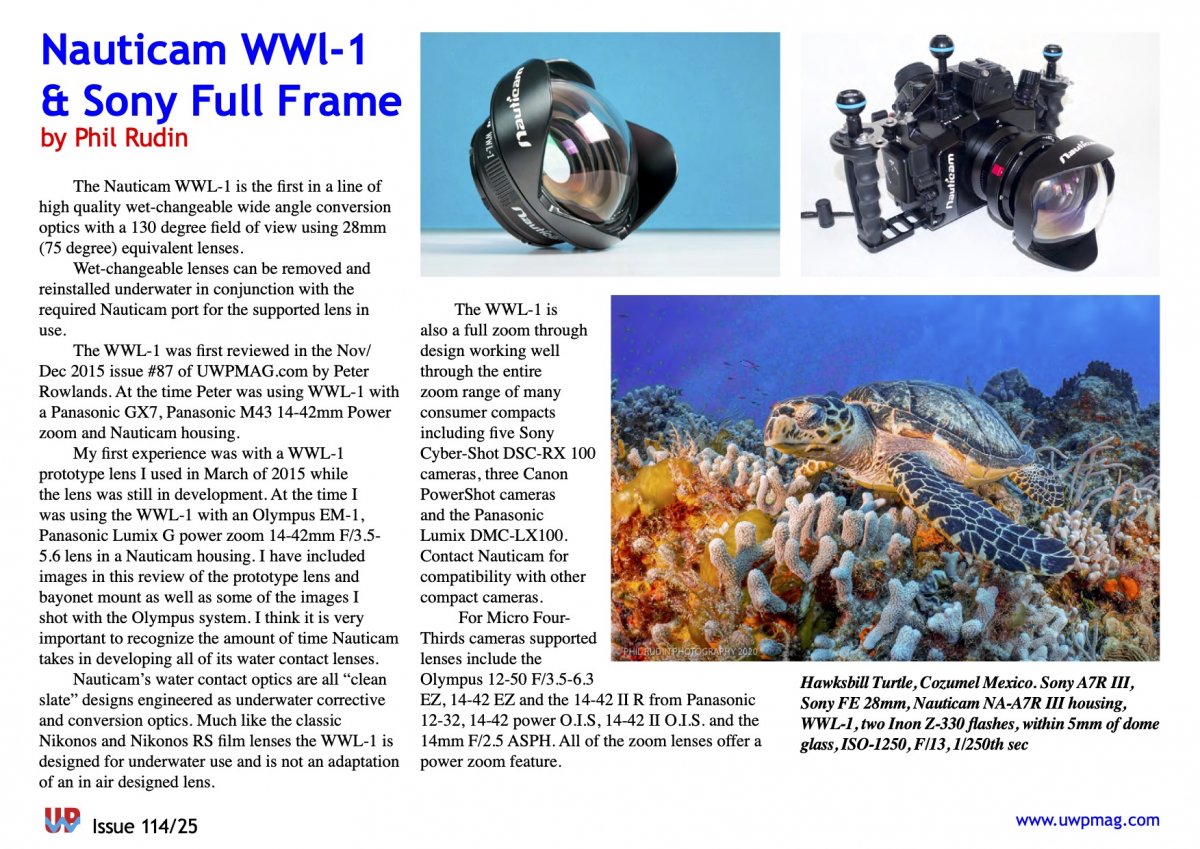
Nauticam produced more macro lenses CMCs and another SMC, with water corrected optics and then ventured into wide angle with the WWL. This was aimed a M43, but after a while it was discovered it that it worked well with the diminutive 28mm on Sony FF. David Cheung (CheungyDiver on Wetpixel , RIP) was the first person I was aware of using one on Full Frame - when I met him in Palau in late 2015.
Myself (and others) wanted to use it on FF SLRs but couldn’t make it work with the lenses. At ADEX 2016 (April) I had the chance to try and persuade Edward face to face to make a WWL for full frame. My book UWP Masterclass had just come out and I may have even written it inside the copy I signed for him! Others like, Jason from Scubazoo, were petitioning similarly.
Edward had a better idea and realised that making a “dry” at the back wetlens - made the design more optimal as there were now 2 less air to water interfaces, just one to worry about at the front. Edward’s first design for SLRs was called the “Dry Lens” to make the point that not having to worry about correcting for the problems of the air to water and then water to air interfaces at the back. I shot this development lens in the Red Sea (November 2016) and was very happy with the results. But ultimately we decided that to be able to persuade users to buy this in addition to their dome ports it needed to have a more obvious optical improvement over their existing lens - so people would notice it from their first dive and tell their friends! The development costs were pretty big and Nauticam did need to sell some, not just make one for me! That said, what would become the WACP was intended as a very low volume product, but would have to sell to people who knew their stuff and already had 230mm domes and all the wide angles.
At the time it was designed for the Nikon 28mm fixed lens. But I was very keen to be able to use a zoom behind it and found the Nikon 28-70mm AF-D worked well. And that became the main development camera lens from there on.
These tests led to Nauticam designing a much larger version of the Dry Lens - which was called the WACP (and renamed WACP-1, when the WACP-2 was introduced). I tested a production ready version of this in the Red Sea in June 2017 and the lens started shipping that summer. By the end of the year Nauticam had real supply problems with the WACP-1 as the demand and sales was way, way higher than expected, driven by word of mouth as people used it, loved it, told others.
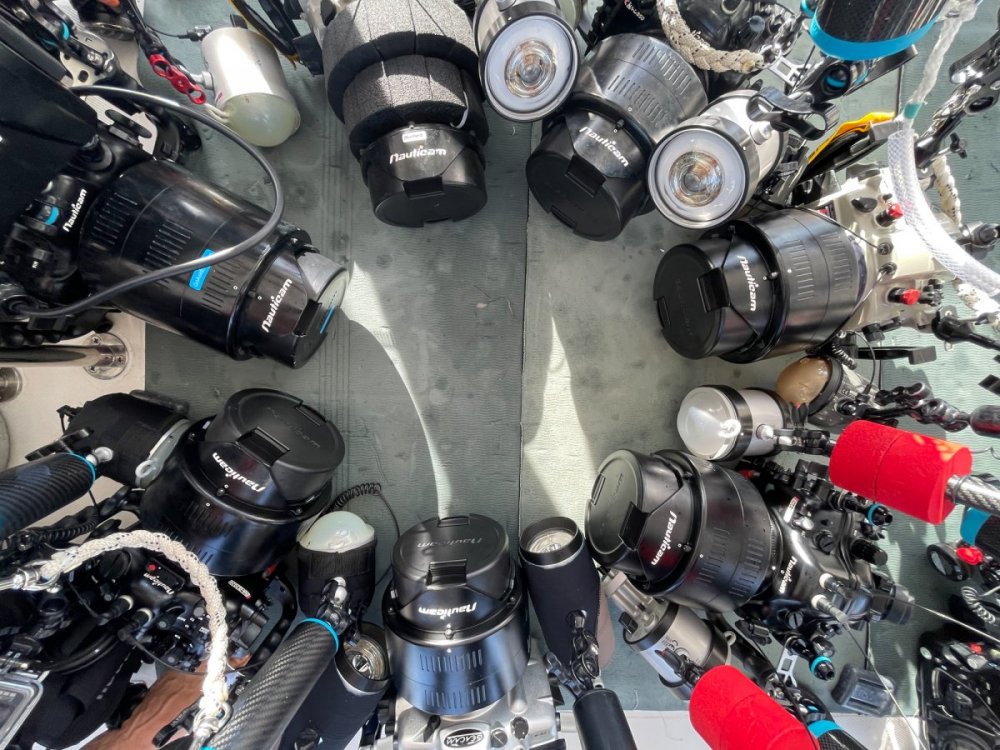
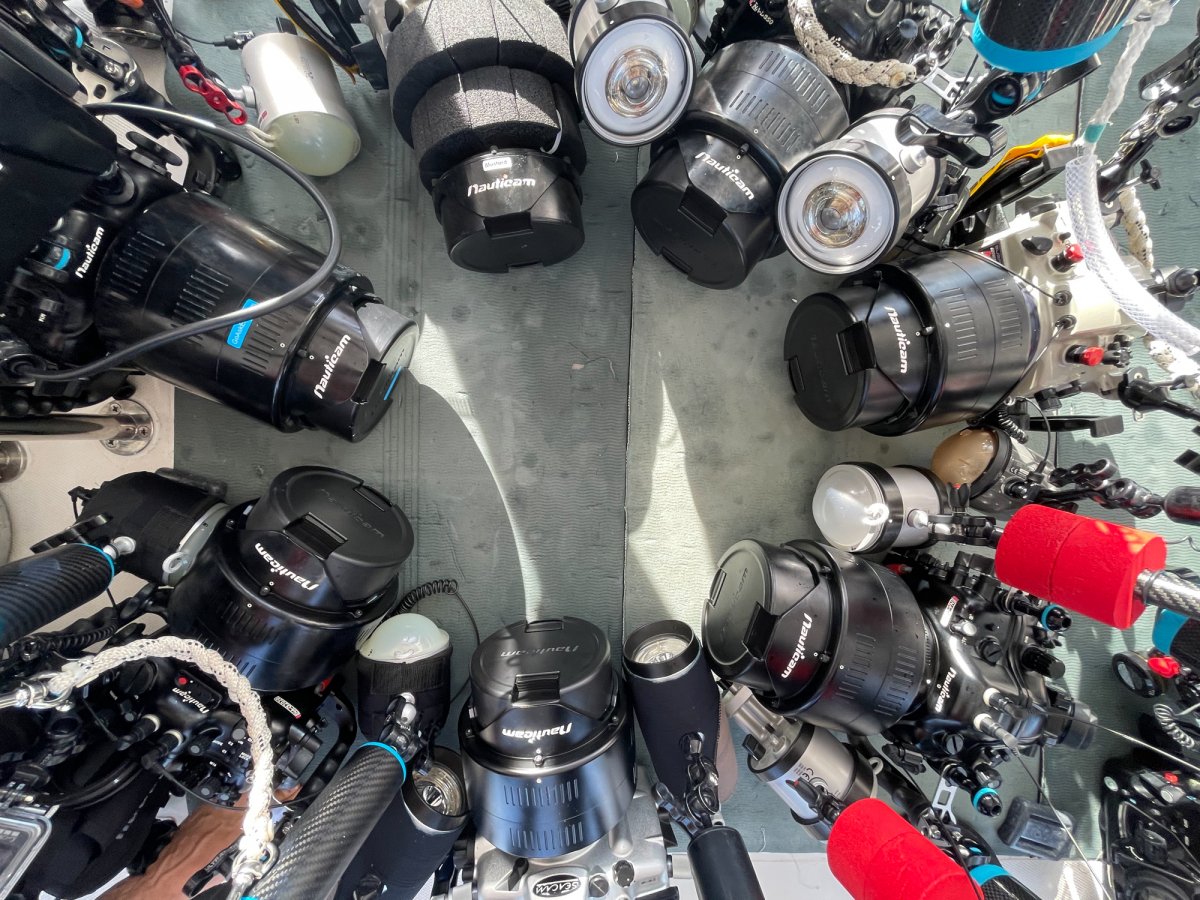
All, bar 1 photographer on this Maldives workshop had WACP-1s. I spot quite a few of those fancy new Retra strobes too.
I have had the WACP-1 since then. But I never gave Nauticam back the original “Dry lens” because it offered better than dome port performance in a very small package. And while a step behind the WACP-1, it was smaller and lighter. I have continued to use it, particularly on trips where I do not expect to use the WACP-1 much, and want to use my luggage allowance for other items. For example I have taken the WACP-1 to Galapagos, Socorro, Maldives, Red Sea, but used the dry lens in Indonesia and Cayman. The zoom combined with the ability to shoot big animals with a more open aperture and therefore to get more strobe on them is great. I always hear people say that with big animal shots the corners don’t matter - which is rubbish - because I don’t want to shoot all my shots as subject surrounded by blue - how dull - how about shots say with foreground, background, or even the animal coming into the frame - and in all those cases corners matter. Also all these places are famed for great schools of fish - and again being able to shoot these more open aperture and have the subject matter filling all of the frame. Furthermore the small form is easier than a 230 dome in currents and much easier for CFWA lighting too as there is less shading.
The WACP-1 is particularly good for unpredictable, big animal diving (Galapagos, Cocos, Socorro, Maldives etc) and delivering professional level image quality on full frame cameras that you know you can send to any client and they won’t have anything with better quality. Nat Geo tested it and Brian Skerry switched to Nauticam housings to shoot it for his major Secrets of Whales Nat Geo/Disney story. I have had 2 images awarded in WPY taken with the WACP-1.
The sales success of the WACP-1 surprised Nauticam and this made the WACP-2 possible. We all feared nobody would buy the WACP-1 because of the price tag. And when after a few months the orders started ramping up, not dying down, Nauticam could not match the demand, it was clear that a tier above the WACP-1 was possible. The WACP-2 is bigger and better. I’ve shot the WACP-2, but don’t want one - simply for luggage weight reasons. Also a major attraction of the WACP-1 was that is was much smaller and easier to light than a big dome, the WACP-2 was not. And also I was more interested in the EMWL, that was developed at the same time as the WACP-2. But they have been lapped up by the booming filming industry with all the commissions they are flooded with as every streaming service wants their own natural history epic! Not many stills photographers are using the WACP-2, but I had two turn up on the same workshop trip last year (there was only 9 people in total)!
So what about that original “Dry” lens? Well that is what is now the WACP-C. It’s damn good, a step up from a dome. Smaller, lighter, cheaper than a WACP-1 and not limited in compatibility like the WWL. But it is step below the WACP-1 - that’s why the WACP-1 was designed. But it is great to have the options.
Well done for getting this far. As I said at the top, this is the history from my perspective (often unaware of the many things that I am sure happened that I wasn’t involved with). I also have tagged Edward and Oskar in this, they are both mentioned in this tale and I tag to give you reassurance I am not misrepresenting things. And perhaps most importantly, I have not done any of the clever work in terms of designing anything. I have simply tested items and give my feedback from the perspective of a user, to help create exactly the products I have long felt underwater photography would benefit from.
I wonder what is coming next?
Alex
Finally, here is Edward’s side of the story from Wetpixel Live - starts around 03:45: