Skip to content

Photography Gear and Technique / Archived topic

Recommend a super macro for TG6?

Started by demonboy ·

  • 25Posts
  • 25Replies

Read-only discussion

Recommend a super macro for TG6?

25 posts
  1. Hi,

    I've been getting some great shots with my TG6 but I'm limited by various factors that prevent me from going super macro. Is it worth buying a wet macro lens for the TG6 or not? If yes, any recommendations? Obviously being my first camera setup I'm not looking to spend hundreds on a lens, unless it's something that I could carry on to my next rig.

    Interested to hear your thoughts and recommendations, thanks.

  2. Can’t imagine that one makes sense considering it already focusses 1cm from the lens if I’m not mistaken. I’ve seen images of costaciellae from the tg6 so magnification seems to be very good out of the box. If you want more you’ll probably need to upgrade to MFT with a 60mm macro and cmc-1. 

  3. I think in Microscope mode you will have more magnification than even the 60 with cmc  but not sure. In microscope mode you can get 5 mm full frame according to the OLY spec, hard to think a diopter can make it better

    Bill


  4. wet macro lenses get more magnification by allowing you to focus closer, if you can already get within 1cm by shooting in microscope mode there is no advantage.  The only advantage would be allowing you to continue to shoot in normal (not microscope mode ) and still focus as close as macro mode - this may avoid some of the limitations in macro mode.  There might be some other workaround to avoid the feature restrictions in microscope mode,

  5. Thank you all for your thoughts. I think it best to continue with the TG6 setup as is, and think about a dedicated macro lens and housing for my A7C some time in the future.

  6. It's a bit counterintuitive, but the A7C won't give you as much magnification as the TG-6. As already mentioned, TG-6 in microscope mode can fill the frame with a 5mm subject - a full-frame camera such as A7C, equipped with a macro lens that allows 1:1 reproduction will give you a frame that is 36mm wide by 24mm tall. An SMC-1 will get you to 2x magnification, so 18x12mm - still quite far from the TG-6. An SMC-2 will give 3x magnification, or 12x8mm frame, so still not matching TG-6's capabilities, and it's extremely difficult to work with. To be sure, the images that you'd get out of that setup are a lot more detailed, but for pure magnification, it's difficult to compete with a small sensor and dense pixels. Basically, the larger camera needs a lot more optical magnification to achieve the same framing, and this is very costly both in terms of the glass required, and depth of field that is achieved in the final result.

    Are you using strobes with your TG-6? If yes, and the problem is achieving proper lighting while getting the lens close enough to the tiny subject, perhaps consider a ring light?

  7. The Mrs has a TG5 and can get closer and bigger images of tiny critters than I can with a CMC on a Olympus 14-40 lens.

    The main limitation with both is getting the camera/housing physically close enough to the critter and to be able to light it when that close. An ideal solution for would be to get a similar sized critter in frame, but 2 to 3 times further away.

  8. I'm using a small Inon strobe and lighting the subject when taking the photo isn't the issue. My main problem is focus hunting, which may be an issue with the cheap Seafrogs housing and the lens getting confused by the plastic lens cover.

    The other issue I think I've introduced is limiting the ISO, which forces a slower shutter speed when in aperture priority. This slower shutter speed introduces strange lighting artefacts, which could also be an issue with the cheap plastic reflecting strobe light where it shouldn't. I think I have it limited to 800 when I should be allowing it to go to 1600.

  9. 10 hours ago, demonboy said:

    I'm using a small Inon strobe and lighting the subject when taking the photo isn't the issue. My main problem is focus hunting, which may be an issue with the cheap Seafrogs housing and the lens getting confused by the plastic lens cover.

    The other issue I think I've introduced is limiting the ISO, which forces a slower shutter speed when in aperture priority. This slower shutter speed introduces strange lighting artefacts, which could also be an issue with the cheap plastic reflecting strobe light where it shouldn't. I think I have it limited to 800 when I should be allowing it to go to 1600.

    The shutter speed should only be a problem when working at wide settings.  The standard approach for macro with the TG-series is to use -ve exposure compensation for the ambient exposure and to ensure that the exposure is 100% flash and the way to do this is to lower the ISO.  If I recall correctly when you have the flash activated in Av setting and you are at full zoom then the shutter speed should bottom out at 1/100.  If you are in Av at f6.3 and 1/100 with ISO 100 there should be little contribution from ambient light unless you are very shallow. 

  10. AFAIK the flat ports in SeaFrogs housing use glass, not plastic, for the front elements, and in general they're too close to the lens to confuse the camera focus. The focus hunting you're experiencing is likely caused by insufficient lighting - are you using a focus light? TGs, like most compacts, are limited to contrast detection for autofocusing, and it needs good lighting to work well.

  11. Good info, @ChrisRoss. However I'm often wanting to close down that aperture and I'm finding when I zoom in and try to select f16 (or whatever the smallest aperture equivalent is when zoomed in), the shutter speed is going well below 1/100. I'll have to dig out some samples of unsuccessful shots along with the camera settings. The flash, btw, is always set at maximum.

    I should add that using exposure compensation with the TG6 is very fiddly, especially when trying to maintain a specific distance on the subject.

    Edited by demonboy
  12. @Barmaglot no, I don't use a focusing light and I've often thought I should because I realise this is I've reason why the AF hunts. Can you recommend any?

  13. 23 minutes ago, demonboy said:

    Good info, @ChrisRoss. However I'm often wanting to close down that aperture and I'm finding when I zoom in and try to select f16 (or whatever the smallest aperture equivalent is when zoomed in),

    Don't do this. The TG-6 has only two physical apertures, f/2 and f/2.8 (at the wide end, I think they're f/5.6 and f/6.3 when zoomed in). The f/8 (f/16 when zoomed in) is achieved via a neutral density filter. It reduces the amount of light reaching the sensor, but doesn't gain you any more depth of field, so when doing flash photography it's useful primarily to darken the background.

    23 minutes ago, demonboy said:

    @Barmaglot no, I don't use a focusing light and I've often thought I should because I realise this is I've reason why the AF hunts. Can you recommend any?

    I use a Weefine Smart Focus 1000, its primary distinguishing feature is an optional snoot lens that can be used to produce a very narrow beam of light, which helps aiming the camera. I've seen FIX Neo 1500 being used, that one has a handy remote control module which you can mount on a tray handle and quickly switch the light between on/off and white/red modes without moving your hands. Overall, most any LED light that you can mount on a ball will work as a focusing aid, it's not a demanding job.

  14. 1 hour ago, demonboy said:

    Good info, @ChrisRoss. However I'm often wanting to close down that aperture and I'm finding when I zoom in and try to select f16 (or whatever the smallest aperture equivalent is when zoomed in), the shutter speed is going well below 1/100. I'll have to dig out some samples of unsuccessful shots along with the camera settings. The flash, btw, is always set at maximum.

    I should add that using exposure compensation with the TG6 is very fiddly, especially when trying to maintain a specific distance on the subject.

    Why are you wanting to close down the aperture?  as Barmagalot says f8 -18 is achieved via ND filter, gives you no depth of field benefit, just sucks up light.  If the ISO is low enough and ambient light is low at depth you might 1/30 is sufficient. 

    On exposure compensation you leave it set at -2 all the time is you are using flash and you could store that in one of the custom modes available.

  15. Hi Chris, I'm aware that the aperture is faked by a filter but am I right in saying that even in aperture priority, the aperture 'closes down' as you zoom in? It's been a couple of months since I last used it and I can't check if this is the case because I don't have the camera in front of me but I am sure if I set it to f8 and then zoom in, it will change to f16.

  16. 25 minutes ago, demonboy said:

    Hi Chris, I'm aware that the aperture is faked by a filter but am I right in saying that even in aperture priority, the aperture 'closes down' as you zoom in? It's been a couple of months since I last used it and I can't check if this is the case because I don't have the camera in front of me but I am sure if I set it to f8 and then zoom in, it will change to f16.

    Yes it closes down as you zoom.  Fully zoomed in you have  f4.9/f6.3 and f18.  I would think that at depth ambient light contribution would be pretty low and the minimum shutter speed should be usable at f6.3.  What flash mode are you using on the TG-6?  Normally cameras have a slow sync setting which you don't want to be using as it tries to get a correct ambient light exposure. 

  17. I tend to leave the strobe on full power, so no TTL, and as far as I'm aware I don't have the camera set to slow sync. When I get back to the camera in a couple of weeks I'll check this.

  18. 22 minutes ago, demonboy said:

    I tend to leave the strobe on full power, so no TTL, and as far as I'm aware I don't have the camera set to slow sync. When I get back to the camera in a couple of weeks I'll check this.

    You can use low power manual triggering on the TG-6 itself for your external strobe and save battery life.  Check some of you shots and maybe post one with the issue.  The shutter speed you actually achieved should be in the EXIF data.

  19. Hi Chris,

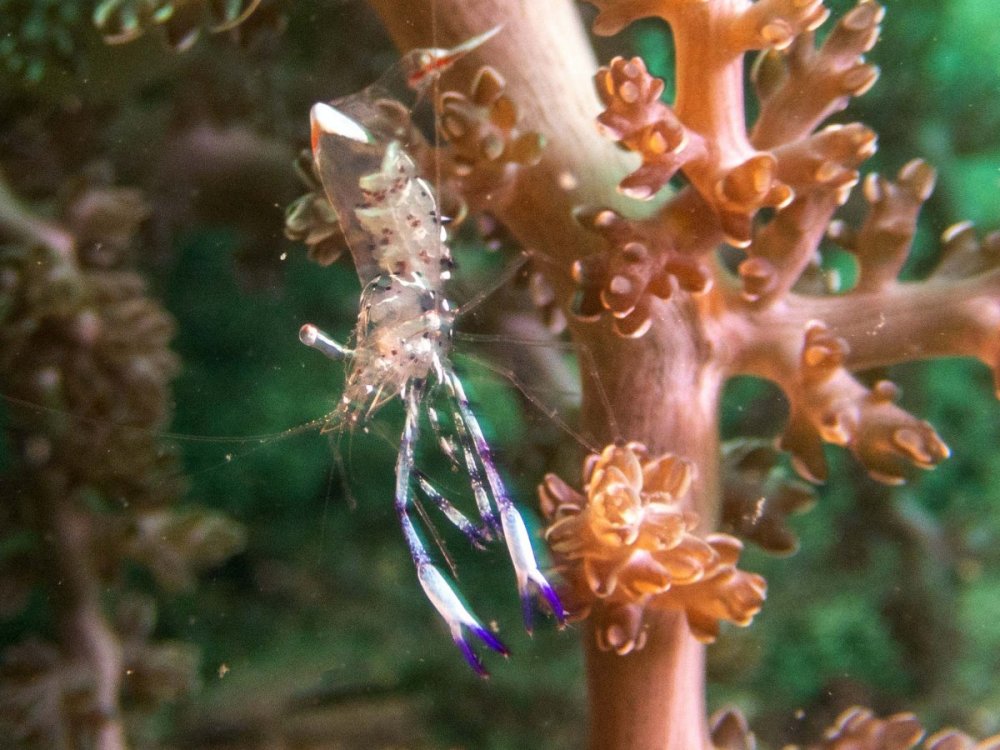
    I've found one image I can use as an example, plus a second for comparison. You can clearly see in the legs there's something strange going on. I don't think this is motion blur as the left edge of the legs are clearly defined (although a comparison of the two images has one at 1/50  and the second, less severe version at 1/80). Wouldn't motion blur have both sides blurred? I've never really examined motion blur in this kind of detail.

    I don't think this is chromatic aberration either. I get some CA with the TG6 that is normally, mostly fixable. The second shot of the same shrimp has mild CA, which is normal for the TG6 in my experience.

    To me this looks like a flash-sync or second curtain effect because it looks like two exposures: one with flash and one without, each capturing the two positions of the legs as they move. Perhaps I am seeing the delay between the internal flash and the external?

    I'd love to know what this is and how I can solve it because I've seen this effect on a few of my shots. 

    shrimp1 = 1/50, f/13, ISO100, exp = 0, spot metering

    shrimp2 - 1/80, f/6.3, ISO100, exp = 0, spot metering

    I've uploaded optimised shots. Let me know if I should upload the originals.
    shrimp1.jpg

    shrimp2.jpg

  20. Looks to me like motion blur. The top shot is much softer across the image than the lower one. And it is shot at a slower shutter speed.

    It could be too that the Pedersen moved at a crucial moment! I've been shooting these seriously the last couple of years and getting them pin sharp is surprisingly tricky. 

Account

Navigation

Search

Search

Configure browser push notifications

Chrome (Android)
  1. Tap the lock icon next to the address bar.
  2. Tap Permissions → Notifications.
  3. Adjust your preference.
Chrome (Desktop)
  1. Click the padlock icon in the address bar.
  2. Select Site settings.
  3. Find Notifications and adjust your preference.