Skip to content

Photography Gear and Technique / Archived topic

Sony FE 28-60mm f/4-f/5.6

Started by Interceptor121 ·

  • 27Posts
  • 27Replies

Read-only discussion

Sony FE 28-60mm f/4-f/5.6

27 posts
  1. I have done some tests on land 

    https://interceptor121.com/2023/01/24/sony-fe-28-60mm-f-4-f-5-6-close-up-tests/

    From what I can see at close range this lens has to be used between f/8 and f/11. This is consistent with Sony own MTF tests

    I would also say this lens will not resolve more than 28 perhaps 30 megapixels even if your camera has 61 megapixels the optical quality is just not there

    You can read my thoughts in the article. I am ok with this performance as I plan to use it with the WWL-1 so f/8 f/11 is the norm.

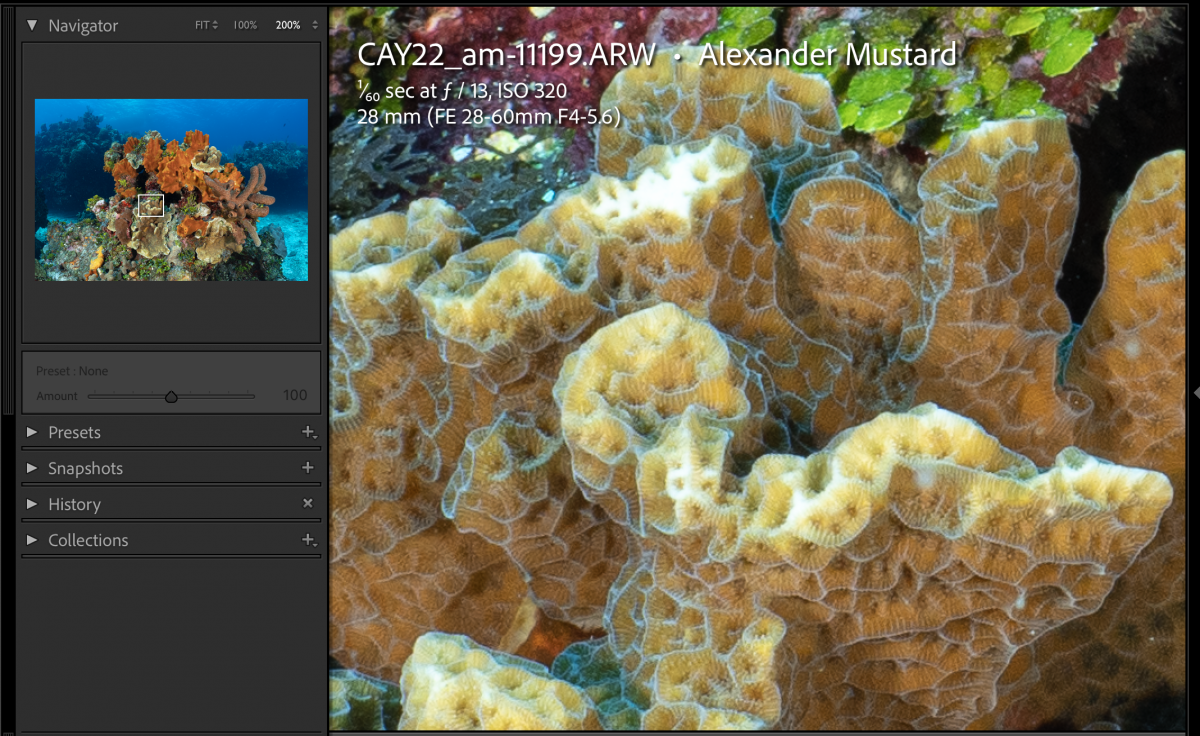
  2. Here is a 61MP file with the 28-60mm & WWL - underwater. Just a screen grab of the unprocessed RAW file zoomed to 200% Lightroom (click on the image to view at full resolution, rather than the downsized version in the forum).

    The picture is there for people to look at and decide for themselves. My opinion is the coral details looks pretty good at 61MP (@ 200%) and there is a lot more than 28MP of underwater detail there to my eyes .520865700_Screenshot2023-01-24at02_13_44.thumb.png.2e17dadf7f4ea1fe0135cf43acbfcd9b.png

    Edited by Alex_Mustard
  3. Here is a 61MP file with the 28-60mm & WWL - underwater. Just a screen grab of the unprocessed RAW file zoomed to 200% Lightroom (click on the image to view at full resolution, rather than the downsized version in the forum).

    The picture is there for people to look at and decide for themselves. My opinion is the coral details looks pretty good at 61MP (@ 200%) and there is a lot more than 28MP of underwater detail there to my eyes .520865700_Screenshot2023-01-24at02_13_44.thumb.png.2e17dadf7f4ea1fe0135cf43acbfcd9b.png

    I compare with shots I take on land with other lenses which are mostly in the GM Sony range or I have some Tamron lenses of both low and high price

    This lens doesn’t come close to any

    When I say the lens doesn’t resolve more than 28 megapixels is because even the other sharper lenses don’t get any closer

    The 24-70 GM II resolves around 39-40 megapixels when used on the A7RIV I would say 28-30 megapixels for the 28-60mm is a good result

    One the issues of this lens is that performance is better at f/8 other lenses peak at f/4 as you close down resolution drops

    In conclusion it is not that is lens is particularly bad but more than no lens fully resolves the sensor and this being a nice lens but still a small and cheap lens drops further back

    I don’t think any wide angle lens in an underwater set up fisheye or not resolves the full sensor lenses don’t even do that on land why would that be possible underwater?


    Sent from my iPhone using Tapatalki

  4. I know 2 reviews and both are quite happy with this lens:
    https://www.digitalkamera.de/Meldung/Labortest_des_Sony_FE_28-60_mm_4-5_6_an_der_Alpha_7C_veroffentlicht/12036.aspx
    https://sonyalpha.blog/2020/12/07/sony-fe-28-60mm-f4-5-6/amp/
    maybe you got a bad one but the lens itself is more than worth every penny  
     

    I know 2 reviews and both are quite happy with this lens:
    https://www.digitalkamera.de/Meldung/Labortest_des_Sony_FE_28-60_mm_4-5_6_an_der_Alpha_7C_veroffentlicht/12036.aspx
    https://sonyalpha.blog/2020/12/07/sony-fe-28-60mm-f4-5-6/amp/
    maybe you got a bad one but the lens itself is more than worth every penny  
     

    The lens is not bad but is far from outstanding you need to compare to other lenses
    Even the articles you post show pretty blurry edges worse than my test
    I guess many people here do not shoot top side and do not own high quality lenses so they can’t see that
    However the macro 90mm is a lens in a different category that gives a better idea of the sensor performance if you have you know
    Besides sony own mft data is pretty weak
    At f/4 the lens mtf for 30 lpmm drops quickly off center and 30 is already a low value corresponding to 2160 lines on the horizontal axis


    Sent from my iPhone using Tapatalk
  5. 21 minutes ago, Interceptor121 said:

    At f/4 the lens mtf for 30 lpmm drops quickly off center and 30 is already a low value corresponding to 2160 lines on the horizontal axis

    But that's what I am referring to. The reviews talk about a much better resolution


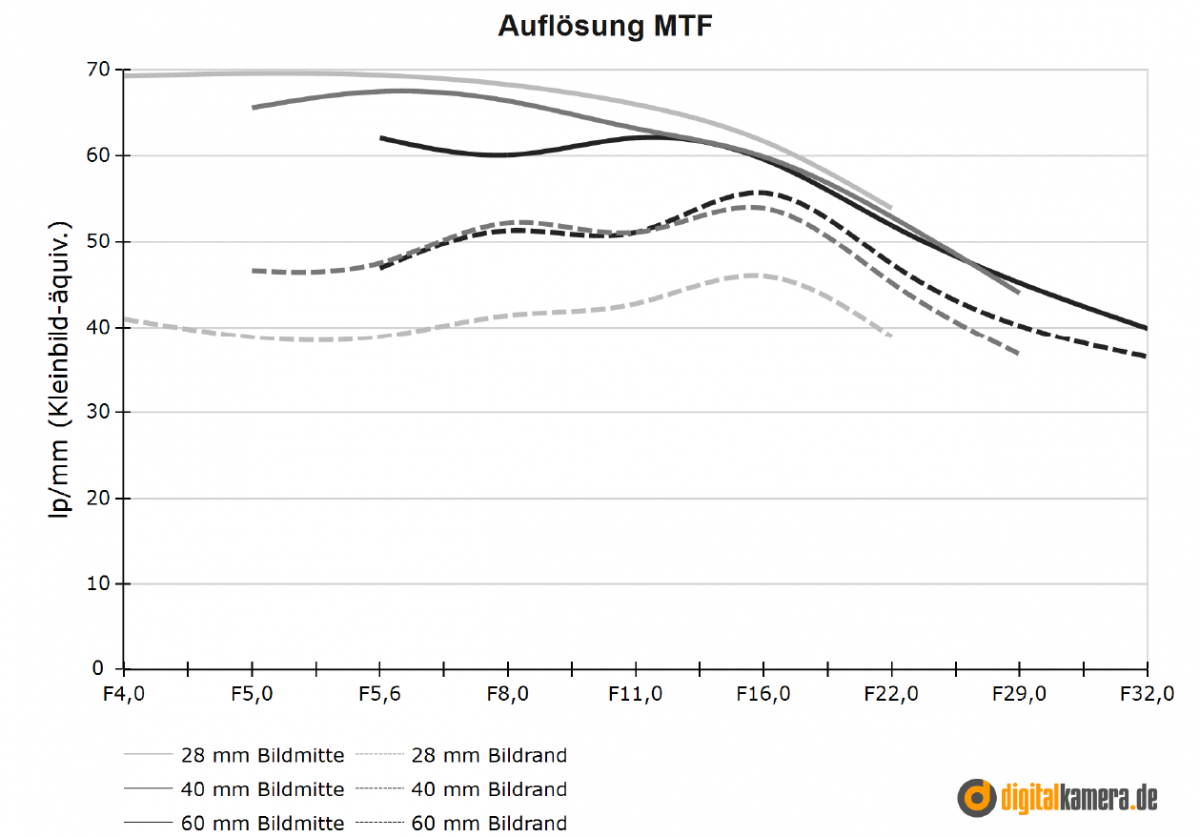
    "In the centre of the image, the very compact zoom lens on the Sony Alpha 7C achieves an exceptionally high resolution for 24 megapixels of almost 70 lp/mm at 28 mm focal length. On the other hand, the edge loss of almost 40 per cent is also quite high, although the edge resolution is good in absolute terms. When zooming in, the resolution decreases in the centre of the image, but increases at the edges."

    image.thumb.png.d7343470c84c459d43dd2ee7e0f470b0.png


  6. 1 hour ago, fruehaufsteher2 said:

    But that's what I am referring to. The reviews talk about a much better resolution


    "In the centre of the image, the very compact zoom lens on the Sony Alpha 7C achieves an exceptionally high resolution for 24 megapixels of almost 70 lp/mm at 28 mm focal length. On the other hand, the edge loss of almost 40 per cent is also quite high, although the edge resolution is good in absolute terms. When zooming in, the resolution decreases in the centre of the image, but increases at the edges."

    image.thumb.png.d7343470c84c459d43dd2ee7e0f470b0.png


    Your chart confirms what I say

    70 lpmm means 70 line pair per mm of the sensor. The Sony sensor is 35.9x24mm so 70x35.9x2=5026 lines divide by 3 and multiply by 2 you get 3350. 

    This means that IF the lens was able to sustain the centre resolution across the frame it would resolve 16.84 megapixels on the A7C

    Now looking at the edges 40 lpmm means 2872 lines if that was the maximum resolution which is like saying 6 megapixels

    So overall on the A7C this lens does not go near the 24 megapixels of the sensor most likely something like 12-14 megapixels

    When you use a sensor with more megapixels the resolution does not grow linearly so you will be looking at max 50% increase for a double in resolution

    For reference this is DxoMark of the 28-70 mm lens you can see that perceived megapixels an overall average across the frame is 27 megapixels on the A7RIV

    https://www.dxomark.com/Lenses/Sony/Sony-FE-28-70mm-F35-56-OSS-mounted-on-Sony-A7R-IV__1326

    This instead is the 24-70 GMII I lens I own will post some shots later

    https://www.dxomark.com/Lenses/Sony/Sony-FE-24-70mm-F28-GM-II-mounted-on-Sony-A7R-IV__1326

    You can see the difference is 12 megapixels 27 to 39 megapixel and again no lense resolves 61 megapixels

    This is the 90mm macro an even better lens

    https://www.dxomark.com/Lenses/Sony/Sony-FE-90mm-F28-Macro-G-OSS-mounted-on-Sony-A7R-IV__1326

    The reality is that no lenses combined with the 61 megapixel sensor resolve the required 134 lpmm

    I can say quite safely that your data is actually totally aligned to what I said. This lens on a 61 megapixels sensor will deliver around 28 megapixels quite good in the centre but weak in the edges

    So most of the discussion about weak edges on the various WWL-1 WACP etc is impacted by the lens being weak at the edges

    In my tests actually the results at f/11 are almost decent at the edges and the centre drop is small I would say f/8 to f/11 is the sweet spot for underwater use my data is better than what your chart shows actually I see a very good improvement stopping down to f/11 I did not get to f/16

    I realise most people are not aware of the fact that a 61 megapixel camera does not resolve near to the sensor limit specifically the A7RIV/V with some lenses resolve less that the older A7RII there are a number of reasons for that including antialiasing etc etc

    Edited by Interceptor121
  7. OK, I got your point.

    But looking at other MTF-charts the resolution of other lenses is, even for the 90mm macro, not much better.

    In my opinion f/11is nearly never used, mostly you go with 5,6 or 6,3 according to the possibility of the lens, and mostly at 28mm - and you always look at the center or the inner third of the picture. So resolution stays within 70-60lp/mm

    The 90mm macro is better, but is below 90lp/mm.

    So I doubt that any problem at taking pictures is due to the resolution of the lens. I wouldn't follow the verdict of saying the 28-60 is a weak one.

  8. 10 minutes ago, fruehaufsteher2 said:

    OK, I got your point.

    But looking at other MTF-charts the resolution of other lenses is, even for the 90mm macro, not much better.

    In my opinion f/11is nearly never used, mostly you go with 5,6 or 6,3 according to the possibility of the lens, and mostly at 28mm - and you always look at the center or the inner third of the picture. So resolution stays within 70-60lp/mm

    The 90mm macro is better, but is below 90lp/mm.

    So I doubt that any problem at taking pictures is due to the resolution of the lens. I wouldn't follow the verdict of saying the 28-60 is a weak one.

    Actually there is a user I have been in touch Shane Smith that shoots the WWL-1 at f/11 his images look great

    I will not use this lens at f/5.6 unless there is blue water or am doing video the starting point will be f/8 and that regardless of the water optic use.

    The 90mm macro is a much better lens because it is also good in the edges

    Other lenses perform much better wide open. I have compared with the 24-70 I own there is a delta of two stops in the edges in the centre the difference is less but the 24-70 is much sharper and homegenous across the frame

    The 28-60mm is a cheap kit lens that fits nicely the use case for water contact optics is not an amazing lens and other than underwater I would not use it in any top side occasion

    Edited by Interceptor121
  9. I agree - I wouldn't use it above water neither. That's because it's difficult to open, the weak minimal f-stop and the small zoom range.

    But the lens itself is underrated with respect to resolution and especially usability with the Nauticam gear options, especially WAPC and WWL.

    Much different to the 16-50 PZ from Sony with is truly a weak lens. For diving I will stay with the 28-60 and asap the 90mm macro.

    At land I use the 24-105/4

  10. In the other thread on Sony A7RV camera, Alex shows enlarged crops of the center of images taken with the Sony 28-60 and WWL-1 and WACP-1. WACP-1 is clearly sharper at an amount that should be easily visible in MTF graphs, if they existed.

    => It is not the lens, but the optics that seems to be rate limiting for the sharpness of the final image.


    Besides this, I doubt that one can transfer the lines/mm, read out from MTF graphs, directly into the number of pixels that are needed to match the resolving power of a lens, using 1 line = 1 pixel: in case the line has (exactly) the thickness of a single pixel, the line of pixels on the sensor needed to be perfectly aligned with the black line on the test-template, in order to depict the line as a line on the digital photo. If not, weird aliasing effects will be depicted on the photo, the lines may even not be visible as lines any more. Clearly more and smaller pixels ("oversampling") are required to depict the lines on the test template in a way so that they can be recognized as lines on the final photo...

    I believe one should multiply the number of pixels, derived by the 1 line=1pixel calculation, at least by a factor of 3 to have  a sensor that matches the resolution of a lens, the higher the factor, the better (in contrast to undersampling, oversampling never ruins the quality of a signal (but it generates more data and bigger files))..


    Wolfgang


  11. 9 minutes ago, Architeuthis said:

    In the other thread on Sony A7RV camera, Alex shows enlarged crops of the center of images taken with the Sony 28-60 and WWL-1 and WACP-1. WACP-1 is clearly sharper at an amount that should be easily visible in MTF graphs, if they existed.

    => It is not the lens, but the optics that seems to be rate limiting for the sharpness of the final image.


    Besides this, I doubt that one can transfer the lines/mm, read out from MTF graphs, directly into the number of pixels that are needed to match the resolving power of a lens, using 1 line = 1 pixel: in case the line has (exactly) the thickness of a single pixel, the line of pixels on the sensor needed to be perfectly aligned with the black line on the test-template, in order to depict the line as a line on the digital photo. If not, weird aliasing effects will be depicted on the photo, the lines may even not be visible as lines any more. Clearly more and smaller pixels ("oversampling") are required to depict the lines on the test template in a way so that they can be recognized as lines on the final photo...

    I believe one should multiply the number of pixels, derived by the 1 line=1pixel calculation, at least by a factor of 3 to have  a sensor that matches the resolution of a lens, the higher the factor, the better (in contrast to undersampling, oversampling never ruins the quality of a signal (but it generates more data and bigger files))..


    Wolfgang


    There is no doubt that the larger optics are better otherwise why would they exist

    However the underwater optics do not improve a lens they just passthrough what is there with a loss

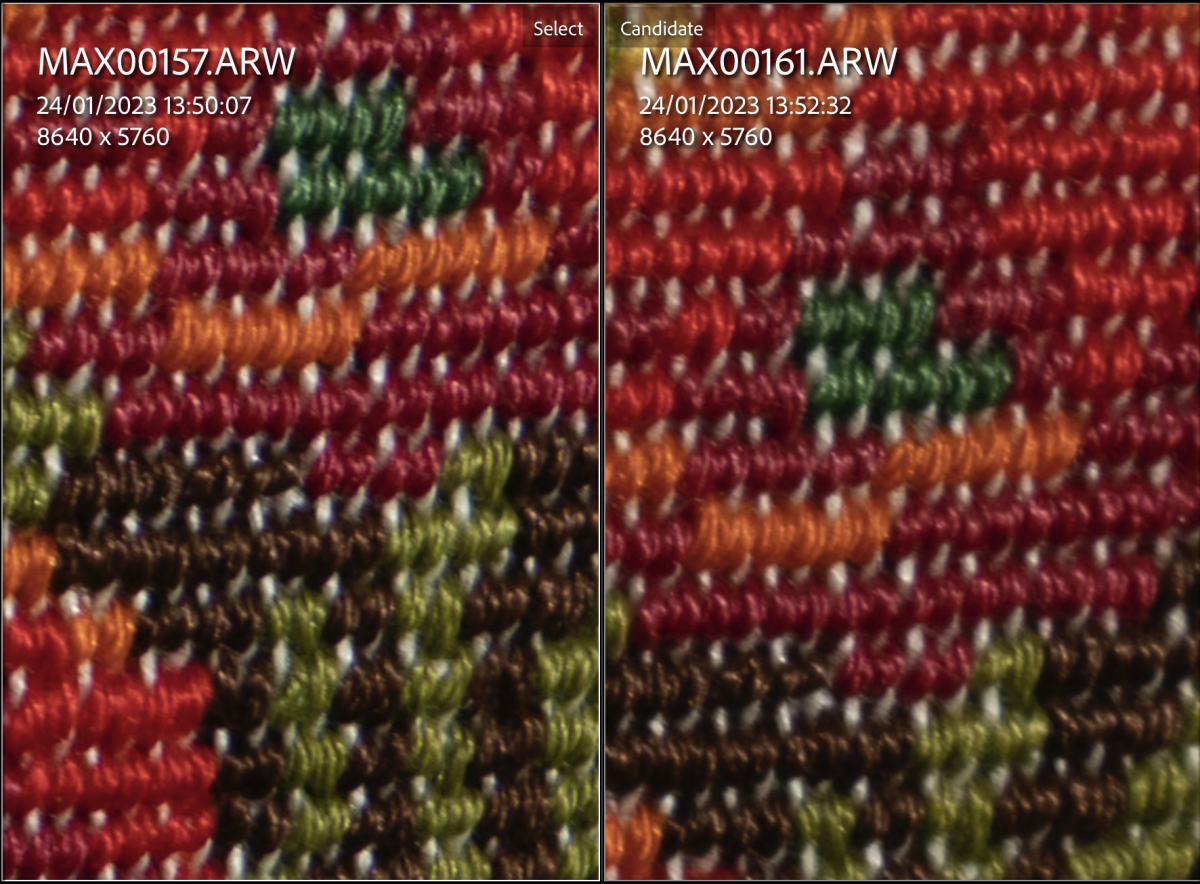
    The 28-60mm is a basic lens. This is a corner of the same target at f/4 with my 24-70GMII vs f/11 of the 28-60mm 

    My view is that if you want to get the best out of larger optics you need to look at better master lenses to start with

    The number of lines that a camera resolves with the sharpest lens available vs the nyquist limit define the maximum resolution you can achieve

    At present the Sony 61 megapixels sensor travels at 94 lpmm which is way below the sensor limit

    There are several reasons for that and if you look at high resolution images you see that there are a number of artefacts false color moire etc that are not full controlled

    So the camera itslef won't reach the sensor limit and when you put it underwater it drops further

    Of course this will look always better than what you had before but in any case underwater image resolution is way below the camera limit. Only in close up situations like macro with less water in between at close range the performance gets close. At wide angle you will always be far away

    Looking at the Sony Nauticam chart I see that there is the tamron 28-75 which is not an amazing lens but  way better than this 28-60mm

    If I was spending the money for the WACP-1 (but I am not) I would try that lens which is also a lens that is good enough for walkaround and is fast at f/2.8. My choice is for portability so am not going there the 28-60mm is ok and I know the limits of the lens are what they are, things will not get better underwater no matter how much I spend but the loss will be less depending on the water contact optic

    Looking at land performance even with WACP-1 I would not dare to go to f/5.6 as default f/8 seems a better starting point as per sony MFT charts


    Screenshot 2023-01-24 at 14.01.02.png

  12. I have updated my blog with full resolution jpegs shot with my A1 and the 28-60mm at 28mm f/4 f/5.6 f/8 f/11 

    For me only f/8 and f/11 are good performance the wider apertures have really mushy corners


  13. What are the images you show in the previous post, Massimo? Sony 26-60mm vs. Tamron 28?

    My point as that it is not the amount of pixels on the sensor, even not the lens that limits the resolution in Alex's images (provided both are in exact focus and same aperture), but the water contact optics...

    Thank you for this interesting arguments and comparisons, I am eager to read further contributions to the tread...


    Regarding the Nyquist theorem, this is a very solid and important basis for the consideration of the digitalization of analogue signals. It must be emphasized, however, that the Nyquist freqency is the lower limit required for beeing able to resolve a periodical sinewave. In practical terms it means if you digitize a periodical sinewave of the frequency x, you need to take a sampling frequency of at least 2x on order to be able to conclude from the digitized signal, that the frequency of the periodical sinewave was x. Much higher sampling sampling frequencies are required to resolve noisy and non-periodical signals in the real world. No theorem exists for those signals, but as a rule of thumb biophysicists recommend to sample noisy analogue signals with at least 5x the highest frequency components that they contain, the higher this factor the better...

    Regarding the impact of the Nyquist theorem specifically on image digitalisation I found this interesting contribution here: https://imb.uq.edu.au/research/facilities/microscopy/training-manuals/microscopy-online-resources/image-capture/nyquist-conditions

    They recommend that "In microscopy terms this means that the pixel size of an image needs to be at least 2.3 times smaller than the object that is being resolved." And note the phrase "...at least...": 2,3x this is not a constant factor and you do not loose any resolution when working with this, when this factor is increased resolution becomes better (although the improvement of resolution will become smaller and smaller with increasing pixels).


    Wolfgang 

  14. @Interceptor121 @Alex_Mustard @Phil Rudin

    Dear fellow underwater photographers

    This is now weeks if not months that I am following up and reading all the posts on the three topics :

    -          the Nauticam WACP-C,

    -          the fisheye and

    -          the recently launched Sony FE 28-60 f/4-f/5.6

    These are great discussions and a lot of insight has been given in addition to my own private exchanges and communications to some of you.

    I am into underwater photography for more than 30 years having started with the Nikonos III then V, moving into analog (slides/positive) SLR into housings. Of course today digital SLR. FYI I'm today using a Sony A1 and a Sony A7rIV in Nauticam housings.

    For the last almost 10 years, if I have upgraded cameras and housings I am still using the same 230, 180, 140 and 100 mm dome ports depending on the lens that I am using ranging from 15 mm Fisheye, 14mm, 20mm, 28mm , zoom12-24 and of course 16-35 in addition to 50 and 90mm Macro . It happens to me that I am using also at 24-70 but very rarely.

    I had made progress in UW photography with the right mentors such as Jim Church, Michael Aw, Heinz-Gert de Couet, Martin Edge, Mark Webster. And I have even some book from Alex Mustard who has published under the 3 topics I mentioned before.

    I have been myself published in some diving magazines (i.e EZ-Dive, Tauchen, Oceans, Plongee) in addition to Travel or general purpose magazines for a total of nearly 60 publications.

    As I am getting older I have been looking at the option of WACP-C just for easier traveling, minimizing what we have to carry to live our passion.

    It is amazing all what the innovation and progress that Nauticam has brought to the field. Really fantastic. I have lived the huge leaps and jump from SUBAL or SEACM to Nauticam.

    However and this is the reason of this long message, for the last 25 years I have not heard anyone complaining about corner softness when using wide angle lenses behind a dome.

    It is a well-known fact, known since Dome ports do exist, simply because it's optical physics. We know about it and we know how to balance it.

    I have not heard in 25 years a single reader of any book or publication complaining about corner softness, but always being amazed by the beauty of the underwater world, which is what we want to communicate as underwater photographers.

    I have not heard of a single publisher refusing images because of corner softness.

    Not a single image in any competition is denied entry because corners are not sharp enough.


    At the end and this is my position today I have decided to not move into the WACP-C and keep my domes. We need to keep in mind that today such progress has been made on camera sensors that we should not have any fears going high on ISO, and closing aperture at F11 to F16, which ensure corner sharpness as we expect. If I could not do it at the age of films (VELVIA, PROVIA 100 or 400) , it happens to me many times today that I soot at 800 if not 1600 ISO with my A1. And images are perfect. Even for my publishers who might be the same as yours.

    I have reached a point today that I do not need a zoom underwater because before diving I almost know which picture I want to take and it drives the choice of my lens, a prime lens of course and not a zoom.

    If there is a direction that Nauticam or any manufacturer should take for the future, it is to develop third party wet lenses, that would mount directly on the housing AND the camera, exactly as Nikon did in the past with the Nikonos  line of lenses. I am not personally dreaming of WACP-1 or -2 or -C, but of an auto focus, camera controlled aperture , prime 15 mm lens exactly as was the Nikonos 15 that I am still using on my Nauticam housings with the right adapters. This would be a real progress.

    Without any arrogance, I believe that zoom lenses for underwater use such as the 28-60 are for recreational underwater photographers, hence they don't care about corner softness or sharpness and would not be ready to pay the price very high of such wet lenses as WACP line. If you are much more into semi professional or even professional UW photography, you go for professional lenses and would apply what I mentioned above.

    Thanks everyone for all the discussions on that 3 topics on Wetpixel, and I am looking forward to any comments on the above.

     Eric

  15. 5 minutes ago, Architeuthis said:

    What are the images you show in the previous post, Massimo? Sony 26-60mm vs. Tamron 28?

    My point as that it is not the amount of pixels on the sensor, even not the lens that limits the resolution in Alex's images (provided both are in exact focus and same aperture), but the water contact optics...

    Thank you for this interesting arguments and comparisons, I am eager to read further contributions to the tread...


    Regarding the Nyquist theorem, this is a very solid and important basis for the consideration of the digitalization of analogue signals. It must be emphasized, however, that the Nyquist freqency is the lower limit required for beeing able to resolve a periodical sinewave. In practical terms it means if you digitize a periodical sinewave of the frequency x, you need to take a sampling frequency of at least 2x on order to be able to conclude from the digitized signal, that the frequency of the periodical sinewave was x. Much higher sampling sampling frequencies are required to resolve noisy and non-periodical signals in the real world. No theorem exists for those signals, but as a rule of thumb biophysicists recommend to sample noisy analogue signals with at least 5x the highest frequency components that they contain, the higher this factor the better...

    Regarding the impact of the Nyquist theorem specifically on image digitalisation I found this interesting contribution here: https://imb.uq.edu.au/research/facilities/microscopy/training-manuals/microscopy-online-resources/image-capture/nyquist-conditions

    They recommend that "In microscopy terms this means that the pixel size of an image needs to be at least 2.3 times smaller than the object that is being resolved." And note the phrase "...at least...": 2,3x this is not a constant factor and you do not loose any resolution when working with this, when this factor is increased resolution becomes better (although the improvement of resolution will become smaller and smaller with increasing pixels).


    Wolfgang 

    The comparison is with the Sony 24-70 GMII

    When it comes to the Nyquist limit for a sensor this is given by 1/(pixelsize*2) or more simply sensor resolution/2/sensor dimension

    In the case of the A1 8640/2/35.9=120 lpmm 

    Some website try to calculate the maximum resolution you can output by using a specific lens this is then compared to other sensors of the same size

    https://www.optyczne.pl/466.4-Test_aparatu-Sony_A1_Rozdzielczość.html

    You can see that in real life trying 3 sharp lenses the camera stops at 91 lpmm (here sharpening is turned off entirely)

    For what concerns your theory that the water contact optic improve matters it can't 

    Any lens you put on the sensor only takes away performance is just a matter of which one takes away less

    So your system is made of sensor, lens, port each of lens and port can only take away performance they can't improve it

    When the resolution limit of the sensor is exceeded for example due to sharpening you get moire you know you got as far as you could

    Normally cameras with lower resolution have antialiasing filters as the lens may outresolve the sensor. Cameras with many megapixels use other forms of filtering.

    So in the case of 28-60 on a camera there is already a certain resolution you can achieve

    At that point the degradation will occur depending on the port with better or worse results depending on the quality of the port but you will never get any resolution that the sensor and lens did not have in the first place

  16. 4 minutes ago, lambee01 said:

    @Interceptor121 @Alex_Mustard @Phil Rudin

    Dear fellow underwater photographers

    This is now weeks if not months that I am following up and reading all the posts on the three topics :

    -          the Nauticam WACP-C,

    -          the fisheye and

    -          the recently launched Sony FE 28-60 f/4-f/5.6

    These are great discussions and a lot of insight has been given in addition to my own private exchanges and communications to some of you.

    I am into underwater photography for more than 30 years having started with the Nikonos III then V, moving into analog (slides/positive) SLR into housings. Of course today digital SLR. FYI I'm today using a Sony A1 and a Sony A7rIV in Nauticam housings.

    For the last almost 10 years, if I have upgraded cameras and housings I am still using the same 230, 180, 140 and 100 mm dome ports depending on the lens that I am using ranging from 15 mm Fisheye, 14mm, 20mm, 28mm , zoom12-24 and of course 16-35 in addition to 50 and 90mm Macro . It happens to me that I am using also at 24-70 but very rarely.

    I had made progress in UW photography with the right mentors such as Jim Church, Michael Aw, Heinz-Gert de Couet, Martin Edge, Mark Webster. And I have even some book from Alex Mustard who has published under the 3 topics I mentioned before.

    I have been myself published in some diving magazines (i.e EZ-Dive, Tauchen, Oceans, Plongee) in addition to Travel or general purpose magazines for a total of nearly 60 publications.

    As I am getting older I have been looking at the option of WACP-C just for easier traveling, minimizing what we have to carry to live our passion.

    It is amazing all what the innovation and progress that Nauticam has brought to the field. Really fantastic. I have lived the huge leaps and jump from SUBAL or SEACM to Nauticam.

    However and this is the reason of this long message, for the last 25 years I have not heard anyone complaining about corner softness when using wide angle lenses behind a dome.

    It is a well-known fact, known since Dome ports do exist, simply because it's optical physics. We know about it and we know how to balance it.

    I have not heard in 25 years a single reader of any book or publication complaining about corner softness, but always being amazed by the beauty of the underwater world, which is what we want to communicate as underwater photographers.

    I have not heard of a single publisher refusing images because of corner softness.

    Not a single image in any competition is denied entry because corners are not sharp enough.


    At the end and this is my position today I have decided to not move into the WACP-C and keep my domes. We need to keep in mind that today such progress has been made on camera sensors that we should not have any fears going high on ISO, and closing aperture at F11 to F16, which ensure corner sharpness as we expect. If I could not do it at the age of films (VELVIA, PROVIA 100 or 400) , it happens to me many times today that I soot at 800 if not 1600 ISO with my A1. And images are perfect. Even for my publishers who might be the same as yours.

    I have reached a point today that I do not need a zoom underwater because before diving I almost know which picture I want to take and it drives the choice of my lens, a prime lens of course and not a zoom.

    If there is a direction that Nauticam or any manufacturer should take for the future, it is to develop third party wet lenses, that would mount directly on the housing AND the camera, exactly as Nikon did in the past with the Nikonos  line of lenses. I am not personally dreaming of WACP-1 or -2 or -C, but of an auto focus, camera controlled aperture , prime 15 mm lens exactly as was the Nikonos 15 that I am still using on my Nauticam housings with the right adapters. This would be a real progress.

    Without any arrogance, I believe that zoom lenses for underwater use such as the 28-60 are for recreational underwater photographers, hence they don't care about corner softness or sharpness and would not be ready to pay the price very high of such wet lenses as WACP line. If you are much more into semi professional or even professional UW photography, you go for professional lenses and would apply what I mentioned above.

    Thanks everyone for all the discussions on that 3 topics on Wetpixel, and I am looking forward to any comments on the above.

     Eric

    I totally agree my point is that as the lens is not sharp in the corners at the outset the whole discussion is a bit irrelevant

    I do not think anyone will develop lenses like the Nikonos but there are adapters for better lenses like the WACP-2 the issue is that while the field of view is much wider than what Nikonos could do those lenses are super heavy

    The good thing about the Sony system is that you can use a Nikonos lens if you wanted too as you do and I would be interested in your comments on that 

  17. Finally tried taking the WWL-1B off the 28-60mm today (stuffing it inside my wetsuit - thank god for front zip and water warm enough to swim in an open wetsuit) to try the lens without WWL and with CMC-1, as recommended by Phil, Massimo, Shane and others.

    The first thing I would say is that it is very easy to carry the CMC on a bayonet in your pocket ready for that "just in case" macro subject. But changing is a faff that you would only do for something special. Not only do you need to remove and store the WWL and then clip on the CMC, but you also need to reposition your strobes and change your camera settings. It is a special subject only option - but a good one to have for special subjects in the right size range.

    The 28-60mm naked is OK, but not remarkable. At 28mm is gets blurred and suffers CA in the corners, but does focus reasonably close. Zooming in to 60mm increases the distance it will focus to - so you actually don't gain that much in picture area (because while you zoom in, you are forced to back away). Minimum focus comparisons below. But nonetheless there will be subjects where this angle of view is idea.

    Fitting the CMC-1 the focus is now very close to the camera and the range of focus is very small. The area of the image is about right for larger nudibranchs. Supermacro subjects will need a crop. The very close working distance is a bit limiting for lighting and might spook some subjects. But the image quality is very good and the field of focus is flat (good image quality right across the frame). 

    Earlier in the week I tried the CMC-1 on the 90mm and it does not work well. The field distortion means that the edges of the image are not sharp when the centre of the frame is. So sadly the 90mm needs the purchase of a different wet lens. 

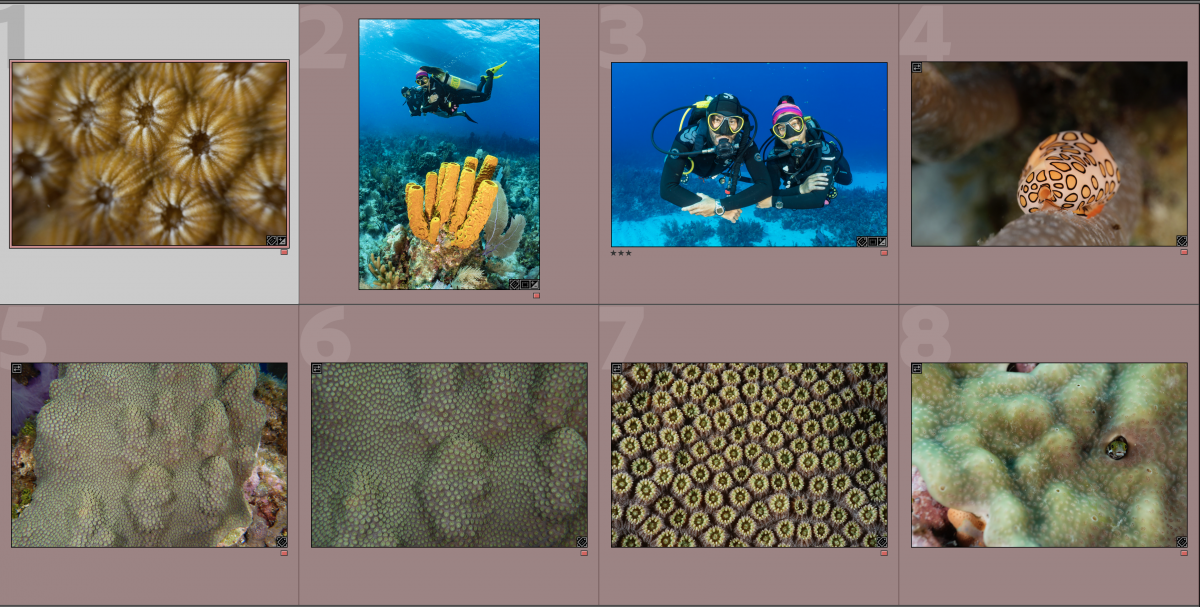
    Screen grab of pictures (click to see bigger):

    1651191221_Screenshot2023-01-24at21_51_22.thumb.png.d933a91ceb59e8b88189c128c2f28727.png

    1, for reference, CMC-1 on 90mm (plane of focus is not flat so image quality degrades away from centre of frame. Image quality poor. 2 & 3, 28-60mm and WWL-1B wide angle photos from the same dive as all the others, I took these quickly for the couple in the pictures, help give a good example of range of shots possible, even if there are gaps in the coverage because of the nature of the lens (these two shots are processed, the rest are unprocessed), 4 & 8, common Caribbean subjects (flamingo tongue and spinyhead blenny) shot with 28-70mm and CMC-1. Flamingo tongue is about idea size subject. The blenny is at minimum focus (max magnification) here, so combo not really powerful enough for supermacro subjects. 5, is 28mm no accessories, 6, same coral, 60mm, no accessories. The magnification gain is less than expected because the minimum focus distance at this focal length is further from the subject. 7, same coral with CMC-1 at 60mm (vignettes at other focal lengths).


  18. 36 minutes ago, Alex_Mustard said:

    Finally tried taking the WWL-1B off the 28-60mm today (stuffing it inside my wetsuit - thank god for front zip and water warm enough to swim in an open wetsuit) to try the lens without WWL and with CMC-1, as recommended by Phil, Massimo, Shane and others.

    The first thing I would say is that it is very easy to carry the CMC on a bayonet in your pocket ready for that "just in case" macro subject. But changing is a faff that you would only do for something special. Not only do you need to remove and store the WWL and then clip on the CMC, but you also need to reposition your strobes and change your camera settings. It is a special subject only option - but a good one to have for special subjects in the right size range.

    The 28-60mm naked is OK, but not remarkable. At 28mm is gets blurred and suffers CA in the corners, but does focus reasonably close. Zooming in to 60mm increases the distance it will focus to - so you actually don't gain that much in picture area (because while you zoom in, you are forced to back away). Minimum focus comparisons below. But nonetheless there will be subjects where this angle of view is idea.

    Fitting the CMC-1 the focus is now very close to the camera and the range of focus is very small. The area of the image is about right for larger nudibranchs. Supermacro subjects will need a crop. The very close working distance is a bit limiting for lighting and might spook some subjects. But the image quality is very good and the field of focus is flat (good image quality right across the frame). 

    Earlier in the week I tried the CMC-1 on the 90mm and it does not work well. The field distortion means that the edges of the image are not sharp when the centre of the frame is. So sadly the 90mm needs the purchase of a different wet lens. 

    Screen grab of pictures (click to see bigger):

    1651191221_Screenshot2023-01-24at21_51_22.thumb.png.d933a91ceb59e8b88189c128c2f28727.png

    1, for reference, CMC-1 on 90mm (plane of focus is not flat so image quality degrades away from centre of frame. Image quality poor. 2 & 3, 28-60mm and WWL-1B wide angle photos from the same dive as all the others, I took these quickly for the couple in the pictures, help give a good example of range of shots possible, even if there are gaps in the coverage because of the nature of the lens (these two shots are processed, the rest are unprocessed), 4 & 8, common Caribbean subjects (flamingo tongue and spinyhead blenny) shot with 28-70mm and CMC-1. Flamingo tongue is about idea size subject. The blenny is at minimum focus (max magnification) here, so combo not really powerful enough for supermacro subjects. 5, is 28mm no accessories, 6, same coral, 60mm, no accessories. The magnification gain is less than expected because the minimum focus distance at this focal length is further from the subject. 7, same coral with CMC-1 at 60mm (vignettes at other focal lengths).


    Thanks Alex

    Results are not surprising. The 28-60mm is a bit short to be useful with wet lenses but at least works perhaps it will be more interesting for video

    As a long term WWL-1 user I can confirm that although you can remove the lens in water this is not always very practical. You need a bayonet on your strobe arms and the lens after all is not small so it does get in the way.

    In most cases I have found that removing the WWL-1 is more useful to shoot the flat port but not necessary for macro more for close up shots for which the CMC-1 is too strong. I use a Subsee 5.

    For the 90mm I am afraid an SMC-1 is necessary or a subsee 10 to combine with that lens. The challenge with the 90mm is that the aperture limit is f/22 how will that work at high magnification I am not too sure. Have you tried it?

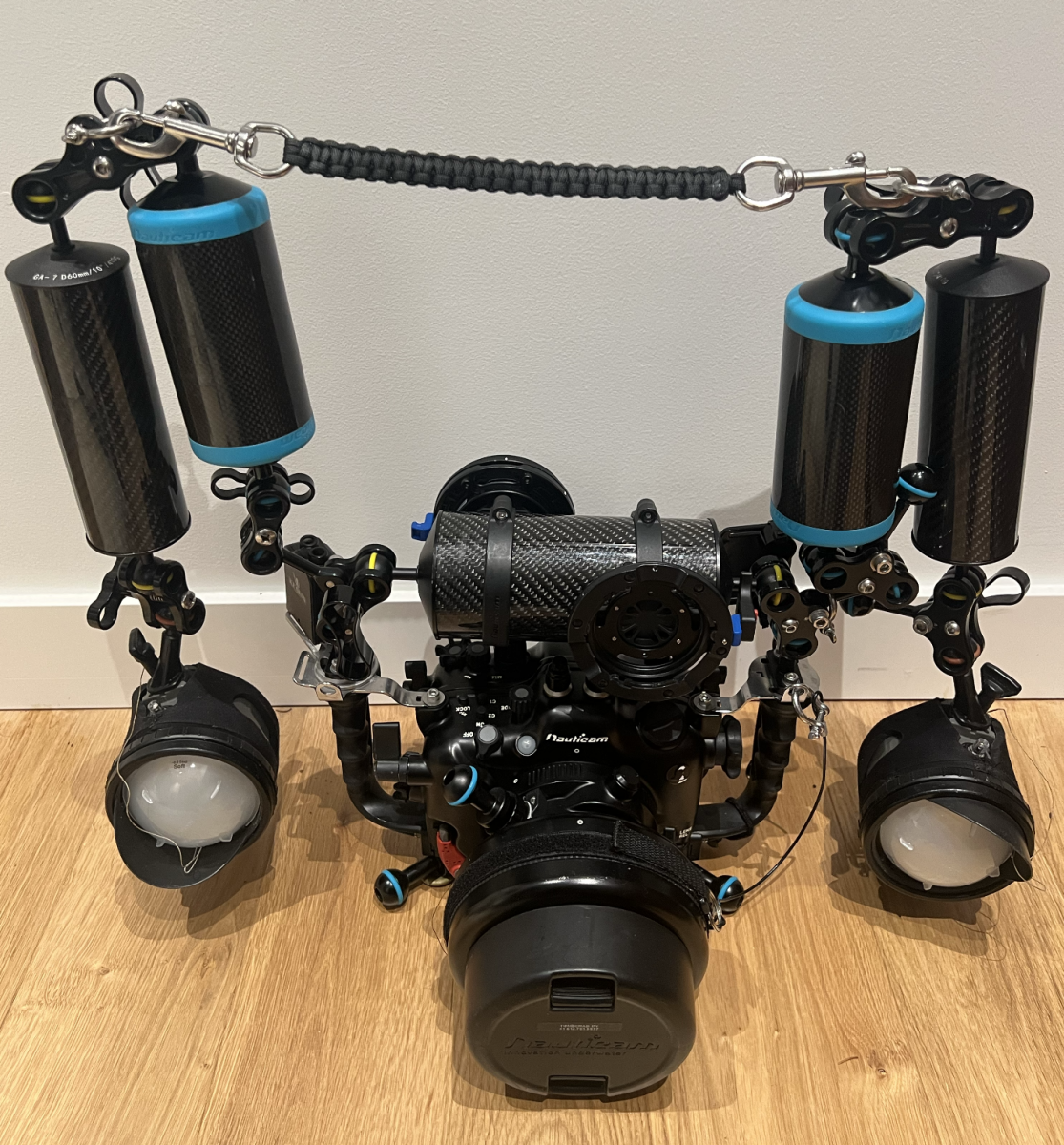
  19. Just two add my two cents, I have been shooting the RX100IV-V + Sony A1 with WWL-1/B CMC-1/2 on these camera's for a long time. In warm water I switch between WWL + CMC a lot (sometimes 3+ times on a dive), in cold water it is harder with dry gloves; but will still do it once or twice on many of my dives. I have a really nice setup with a carbon float arm going horizontally across the top of my Nauticam.

    I used to use the Nauticam 90mm float arm up there with a single bayonette mount (and a second holder on a strobe float arm) but I didn't like how bulky and short it was and inconvenient for the second holder. And the 70mm didn't provide enough lift and looked weird. I felt like goldilocks. 

    But  then found I could get 80mm carbon floats in the right for me (longer) length from Seafrogs super cheap (in comparison) on amazon (quality is good so far). But then, of course, my Nauticam bayonet holders didn't fit. But low and behold if you take 1 part of the 90mm mount + 1 part of the 70mm mount, you guessed it you get 80mm! And it fits super snug and doesn't move at all.  

    All that to say, a big part of switching lenses underwater is the ease of mounting and dismounting the lenses. I have the extension releases for my WWL on both the port and the bayonet mount and I have a custom velcro "leash" for my WWL1-B if I drop it and my port was modified so it sits at a bit of an angle so that the bump for the focus knob (which I removed), doesn't get in the way of the release.

    Below is a pic of the setup, note that I often just use one float arm for each strobe but started playing with some new configs (and I ran out of clamps, so I have some MP clamps in the picture I wouldn't normally have a ball on). 

    Screen Shot 2023-01-24 at 10.47.09 PM.png

    Edited by insomniac — Add media
Nauticam

Account

Navigation

Search

Search

Configure browser push notifications

Chrome (Android)
  1. Tap the lock icon next to the address bar.
  2. Tap Permissions → Notifications.
  3. Adjust your preference.
Chrome (Desktop)
  1. Click the padlock icon in the address bar.
  2. Select Site settings.
  3. Find Notifications and adjust your preference.