Skip to content

Photography Gear and Technique / Archived topic

Large domes and edge sharpness: sources

Started by Interceptor121 ·

  • 33Posts
  • 33Replies

Read-only discussion

Large domes and edge sharpness: sources

33 posts
  1. I have been doing some research on fisheye lenses, domes etc and I do not see a single source to suggest that large domes improve corner sharpness

    The original articles from reefnet scubageek show a correlation between lens working distance (from the lens entrance pupil) and dome radius

    The whole argument is that the radius of the dome needs to be large enough for the lens to be able to focus 

    There are other articles showing that if a lens does not focus close enough you can introduce a diopter to improve matters and that the diopter introduces a loss of depth of field as it should be but I see no reference to edge sharpness

    When I look at sea and sea lens corrector this is a field flattener as used in some telescopes this is used to correct field of curvature and/or coma but introduces astigmastism this is the closest I have seen to address the edges issue

    In addition fisheye lenses are distorted and therefore by definition aggravate the issue of field of curvature

    Can someone point me to a scientific explanation of why using the same lens but different size domes I should achieve better corner sharpness? I am interested in a theoretical model not to real life tests in non repeatable conditions like oceans etc.

    Thank you


  2. There are other articles showing that if a lens does not focus close enough you can introduce a diopter to improve matters and that the diopter introduces a loss of depth of field as it should be but I see no reference to edge sharpness

    I also believe that you will find that using a diopter will also reduce the field of vision of the lens. 


  3. There are other articles showing that if a lens does not focus close enough you can introduce a diopter to improve matters and that the diopter introduces a loss of depth of field as it should be but I see no reference to edge sharpness

    I also believe that you will find that using a diopter will also reduce the field of vision of the lens. 


    Yet this doesn’t relate to edge sharpness which might relate to field of curvature

    As I said no actual model to correlate the two


    Sent from my iPhone using Tapatalk

  4. This is the most accurate explanation I have in my bookmarks. IIRC was posted from Chris or Tim while ago. There are dome and flat port calculators.

    https://oceanity.com.au/articles/view/understanding-flat-port-and-dome-port-theory

    BTW I like this non scientific article:

    https://marinewildlife.co.uk/info/underwater-photography-dome-port-theory-practice/

    Anyway with the correct keywords I think Google Scholar would be plenty of explanations


    Edited by Davide DB
  5. 4 minutes ago, Davide DB said:

    This is the most accurate explanation I have in my bookmarks. IIRC was posted from Chris or Tim while ago. There are dome and flat port calculators.

    https://oceanity.com.au/articles/view/understanding-flat-port-and-dome-port-theory

    BTW I like this non scientific article:

    https://marinewildlife.co.uk/info/underwater-photography-dome-port-theory-practice/

    Anyway with the correct keywords I think Google Scholar would be plenty of explanations


    I have read those. No reference or evidence whatsoever between dome size and edge sharpness

    Dome size and working distance are related, however edges relate to field of curvature normally

  6. Hi Massimo,

    Larger domeports give better edge sharpness, this is a practically proven fact. Still the question about the mechanism is an interesting one...

    I did not research in the Internet, one likely could find it there, but the explanation is straight forward: larger domeports produce larger virtual images (with larger curvature) that are further away. Depth of Field (DOF) increases with the distance of the lens to the subject (d). This increase is not just linear proportional to the distance, but approximately quadratic. This means DOF, in relation to d, increases also, instead of beeing a constant (if linear, DOF then just increases linear with d (and domeport radius) and the %DOF would be the same)...

    I took the simplified formula for calculation of DOF from this Internet side (did not analyze it, just used it): https://www.omnicalculator.com/other/depth-of-field

    For a FF sensor, a circle of confusion of 0.01mm (spread of a dot to a circle that is still regarded to be sharp) and a WA lens with 16mm, I calculated the DOF (in % of the subject distance, d) for different f-numbers. Subject distances between 10 cm and 40 cm were taken, what should cover the range that domeports provide. The table clearly demonstrates the non-linear increase in DOF:

    image.png.67ca5802d6bb55b40a3ac06936af960e.png


    Wolfgang

    Edited by Architeuthis
  7. Hi Massimo,

    Larger domeports give better edge sharpness, this is a practically proven fact. Still the question about the mechanism is an interesting one...

    I did not research in the Internet, one likely could find it there, but the explanation is straight forward: larger domeports produce larger virtual images (with larger curvature) that are further away. Depth of Field (DOF) increases with the distance of the lens to the subject (d). This increase is not just linear proportional to the distance, but approximately quadratic. This means DOF, in relation to d, increases also, instead of beeing a constant (if linear, DOF then just increases linear with d (and domeport radius) and the %DOF would be the same)...

    I took the simplified formula for calculation of DOF from this Internet side (did not analyze it, just used it): https://www.omnicalculator.com/other/depth-of-field

    For a FF sensor, a circle of confusion of 0.01mm (spread of a dot to a circle that is still regarded to be sharp) and a WA lens with 16mm, I calculated the DOF (in % of the subject distance, d) for different f-numbers. Subject distances between 10 cm and 40 cm were taken, what should cover the range that domeports provide. The table clearly demonstrates the non-linear increase in DOF:

    image.png.67ca5802d6bb55b40a3ac06936af960e.png


    Wolfgang

    Actually not at all

    Dome are affected by field of curvature it is much simpler than I thought

    And field of curvature is worst as the radius grows

    The radius of a dome is mostly driven by the lens working distance and the position of the entrance pupil relative to the lens body and size

    Look up petzval field of curvature

    The primary driver of blurred edges is the angle of view as that aggravates the perzval effect

    A case of common misconception really

    Depth of field is unrelated but closing down the aperture limits the issue

    Lens are corrected for field of curvature but adding a dome introduces the issue to a larger extent


    Sent from my iPhone using Tapatalk

  8. Massimo,

    Field curvature is specific and peculiar for every lens, since it depends on the lens design. A lens with field curvature similar to the curvature of the virtual image will perform better behind a dome, while a lens with a field curvature that does not match the curvature of the virtual image, performs not so well. There are even lenses existing with a field curvature opposite to the curvature of the dome and such a lens will perform really bad behind a dome...

    No matter how good the field curvature of a given lens matches the curvature of the virtual image, the principal factor for sharper edges is always DOF, as never a perfect match between field curvature and the dome will exist. Even when there is a perfect match, you still want to have some DOF for subjects outside the image plane...


    Wolfgang

  9. Not the lens whose field of curvature is corrected
    The dome has field of curvature that is not corrected
    For a given angle the field of curvature is the distance of the arc from the circumference which grows with the radius
    Closing the aperture reduces the effect of field of curvature but as larger radius has more this compensates for the larger depth of field
    The most important factor is the field of view wider it is more blur at the edges


    Sent from my iPhone using Tapatalk

  10. Davide DB 's link

    https://marinewildlife.co.uk/info/underwater-photography-dome-port-theory-practice/

    tells that "the virtual image of the dome but it also effectively lies on a sphere concentric with the dome and with a radius of 4 x the radius of the dome. So it is a curved, virtual image, and we try to photograph it with cameras designed to photograph planar subjects, so have to rely on depth of field to ensure that all of the virtual image which we need to be in focus actually is. Unfortunately, this all too often means that the corners are not as sharp as we might like because the depth of field can be insufficient."

    Isn't the problem that a smaller dome will give a stronger curved virtual image? This will lead to greater out-of-DOF problems and as we focus on the center of the virtual image the problem will be greatest at the edges. 

  11. Davide DB 's link
    https://marinewildlife.co.uk/info/underwater-photography-dome-port-theory-practice/
    tells that "the virtual image of the dome but it also effectively lies on a sphere concentric with the dome and with a radius of 4 x the radius of the dome. So it is a curved, virtual image, and we try to photograph it with cameras designed to photograph planar subjects, so have to rely on depth of field to ensure that all of the virtual image which we need to be in focus actually is. Unfortunately, this all too often means that the corners are not as sharp as we might like because the depth of field can be insufficient."
    Isn't the problem that a smaller dome will give a stronger curved virtual image? This will lead to greater out-of-DOF problems and as we focus on the center of the virtual image the problem will be greatest at the edges. 

    The virtual image lies in a different circle so the curvature is the same for the same angle of view
    You can draw two concentric circles with two different radius and draw the same angle of view
    The distance between the chord and and the circumference is larger for a larger circle so this defeats the increased depth of field
    What matters is the angle of view. If you have a super wide lens no matter the size of the dome the distance edge ve chord increases to the point you run out of depth of field
    In practical terms you choose a dome based on the lens ability to focus that pretty much sets the radius and the angle of view of the lens
    You can’t choose too small radius otherwise the lens focuses too far away from the glass
    But it you make it too large you get too far away from your subjects
    It is generally not a good idea having a too wide rectilinear lens. No matter the size of the dome the angle of view makes the edges blurry and if you close the aperture you get to a point where the centre is no longer sharp due to diffraction
    I never go wider than 16mm which for me is the absolute limit


    Sent from my iPhone using Tapatalk
  12. I have found a very detailed source in optics however it doesn’t model underwater scenarios
    Interestingly there is a formula where you can see the role of physical aperture distance from the centre radius of curvature
    This shows that the focus error increases as you go on the edges and decreases as the entrance pupil size goes down so that explains why closing the aperture helps
    However I am not clear about the gaussian focus point and the radius of curvature calculation and how they are impacted by the dome


    Sent from my iPhone using Tapatalk

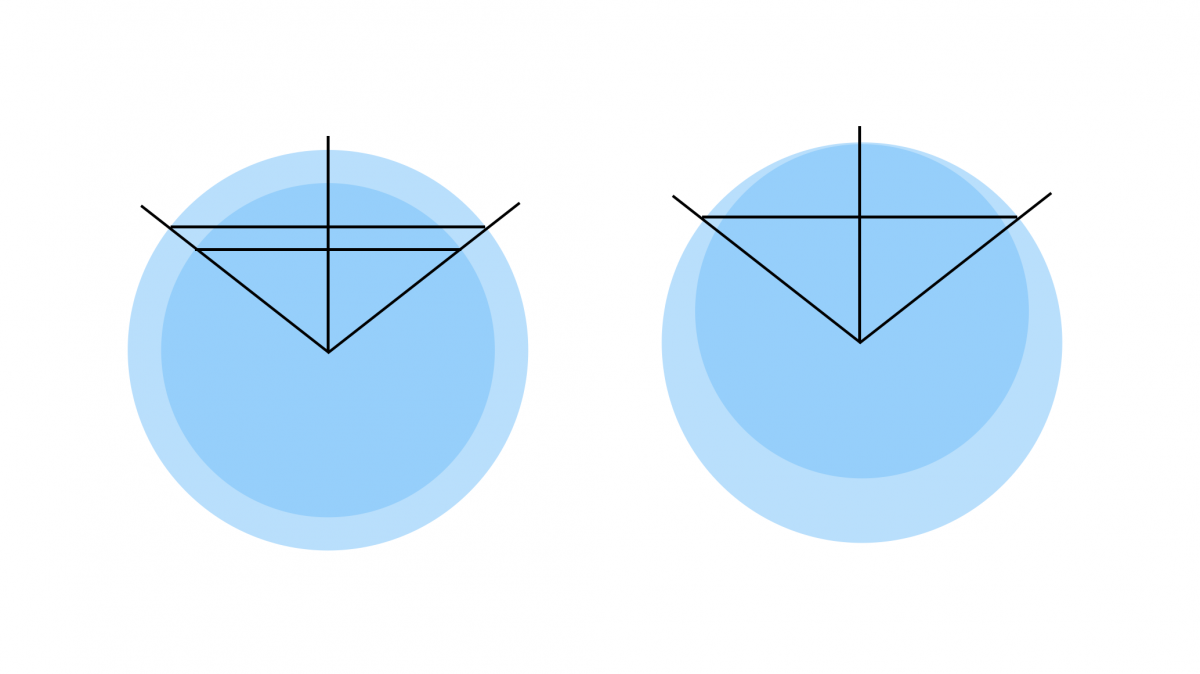
  13. This home made diagram shows how the field of curvature in an underwater dome (left) differs from the classic lens field of curvature (right)


    classic case when the focus point is the same the larger lens is less bent and therefore suffers less from field of curvature

    However underwater due to virtual image the focus point is not in the same position. Is like two concentric circles and infinity is around 4x the radius. As the circle gets bigger for the same field of view the distance from the top of the circumference is larger as the circle grows larger. In addition the chord align to the focus point gets wider and field of curvature grows as you deviate from centre

    I still think that a larger lens may be better but this is not at all the same situation of a lens topside as there is no virtual image there

    I have just written in to some guys that look at telescope optics (this is an issue in long lens astrophotography) to ask what they think about domes.

    Screenshot 2023-02-15 at 20.35.13.png

  14. The performance of a lens behind a domeport depends on several factors as e.g.:


    #1.: Close focus distance of the lens (forcing bigger domes and/or diopters added to the lens).

    #2.: Field curvature of the lens (while this is not very important for general photography (at least I assume so?), it helps, when the field curvature is in line with the curved virtual image that is produced by the dome, while the performance of a lens is bad, when the field curvature even oposes the curvature of the virtual image).

    #3.: Size of the dome. As practical experience by many shows, size of the dome is an important factor. This is, because the DOF in % increases with increasing radius of the dome. I have shown the reasoning in the table above, but I recognize that the table alone is by far too abstract.

    => Therefore I have prepared some (hands-free) figures to illustrate this fact...


    Let us first recapitulate and repeat, how domeports work: they produce a scaled down, upright and curved virtual image of the subjects that we photograph:

    image.png.027b237762c8fea9cd3262356bdac693.png

    Figure 1: The subject, represented by the red arrow, is photographed using two different domeports. Virtual image #1 is produced by a domeport with has twice the radius of the domeport used to produce virtual image #2. Therefore, virtual image #1 is twice as large as virtual image #2 and is also at a distance that is twice as large away from the lens.


    Now let us consider what are the implications for the DOF in absolute terms (in the real world of the subject). Let us assume the real subject is 2 m away from the camera. The smaller domeport produces a virtual image that is 20 cm away from the domeport, the larger domeport an image that is 40 cm away. We photograph the subject through the domeports at f -number 11. From the table given in the post above we see that the DOF for the smaller domeport is 17% of the distance, but for the larger domeport it is not just proportional, but bigger, i.e. 34%. Figure 2 shows the effect on DOFs (relative in %, but also in absolute terms, i.e. meters in the real world):

    image.png.e5ace4d671a8a4705040fc9fda5fd374.png

    Figure 2: Effect of the radius of the dome on DOF and corner sharpness. DOF (both in % of the total distance and also in meters of the real world) is bigger, when the radius of the dome increases. The DOF (marked in violet; region where the circle of confusion does not exceed 0.01 mm) is approx. between 1.3 m - 2 m when using the bigger domeport, while it is approx. 1.6 m - 2 m only for the smaller domeport. Note that the tip of the arrow is sharp (as it is within the DOF) with the larger domeport, while it will be blurred with the smaller one.


    At this stage it it important to state, that all numbers used to produce the illustrations are based on artificial assumption, but nevertheless the example is completely useful to demonstrate the principle...

    I hope I could scatter the confusion, brought about by just showing the pure table and this principle is clear now...


    Wolfgang

    Edited by Architeuthis
  15. 4 hours ago, Architeuthis said:

    The performance of a lens behind a domeport depends on several factors as e.g.:


    #1.: Close focus distance of the lens (forcing bigger domes and/or diopters added to the lens).

    #2.: Field curvature of the lens (while this is not very important for general photography (at least I assume so?), it helps, when the field curvature is in line with the curved virtual image that is produced by the dome, while the performance of a lens is bad, when the field curvature even oposes the curvature of the virtual image).

    #3.: Size of the dome. As practical experience by many shows, size of the dome is an important factor. This is, because the DOF in % increases with increasing radius of the dome. I have shown the reasoning in the table above, but I recognize that the table alone is by far too abstract.

    => Therefore I have prepared some (hands-free) figures to illustrate this fact...


    Let us first recapitulate and repeat, how domeports work: they produce a scaled down, upright and curved virtual image of the subjects that we photograph:

    image.png.027b237762c8fea9cd3262356bdac693.png

    Figure 1: The subject, represented by the red arrow, is photographed using two different domeports. Virtual image #1 is produced by a domeport with has twice the radius of the domeport used to produce virtual image #2. Therefore, virtual image #1 is twice as large as virtual image #2 and is also at a distance that is twice as large away from the lens.


    Now let us consider what are the implications for the DOF in absolute terms (in the real world of the subject). Let us assume the real subject is 2 m away from the camera. The smaller domeport produces a virtual image that is 20 cm away from the domeport, the larger domeport an image that is 40 cm away. We photograph the subject through the domeports at f -number 11. From the table given in the post above we see that the DOF for the smaller domeport is 17% of the distance, but for the larger domeport it is not just proportional, but bigger, i.e. 34%. Figure 2 shows the effect on DOFs (relative in %, but also in absolute terms, i.e. meters in the real world):

    image.png.e5ace4d671a8a4705040fc9fda5fd374.png

    Figure 2: Effect of the radius of the dome on DOF and corner sharpness. DOF (both in % of the total distance and also in meters of the real world) is bigger, when the radius of the dome increases. The DOF (marked in violet; region where the circle of confusion does not exceed 0.01 mm) is approx. between 1.3 m - 2 m when using the bigger domeport, while it is approx. 1.6 m - 2 m only for the smaller domeport. Note that the tip of the arrow is sharp (as it is within the DOF) with the larger domeport, while it will be blurred with the smaller one.


    At this stage it it important to state, that all numbers used to produce the illustrations are based on artificial assumption, but nevertheless the example is completely useful to demonstrate the principle...

    I hope I could scatter the confusion, brought about by just showing the pure table and this principle is clear now...


    Wolfgang

    This is a good discussion I have some comments

    Imagine your first dome is 6 inches. The virtual image of the target at 2 meters will be at 17.7 from the surface of the dome

    You then need to add the distance between the focal plane and the entrance pupil this is 130mm for the Canon 8-15mm and the radius of the dome inside the port which is 76.2mm

    Your total working distance from the sensor plane is now 177+130+76=383mm

    At f/11 your depth of field for such working distance for a 15mm lens is 61cm with the far limit at 86cm

    86cm is above the infinity point which lies at 177+130+203=510mm in effect an aperture of f/5.6 already covers the infinity point

    So actually everything is in focus with the 6" dome

    With the 10" dome the working distance is 285+130+127=542mm here with f/11 the depth of field is 2.34m and the far point is at 2.64m which is again beyond the infinity point

    The lens would reach the virtual infinity point even a f/4

    So actually there is no benefit in this use case. I guess the confusion is about the fact that the entrance pupil is not the focal plane

    Now let's look at another example

    I am standing with the camera in the same position so the focal plane is in a fixed point this is NOT the entrance pupil

    I have a 10" dome and am focussing right on it my virtual distance is 0.5cm

    Add the 130+127 inside the housing I get 262mm

    At f/11 the depth of field is 22cm my far limit is at 41cm this is way below the infinity point which still lies at 612mm. In order to get to 612mm I need f/18

    Now I switch to the 6" dome my space inside the housing is still 130+76mm my object as my dome is smaller is 10 cm away which is 4.8cm

    Add it all up 130+75+48=253mm which is less than 262mm but not so much less

    At f/11 I have 20cm depth of field and by f/18 I am beyond the infinity point as well with the smaller dome 

    In conclusion the issue with the graphs and calculation is that the working distance is calculated from the entrance pupil as lenses are not that small and domes are also not that small once you add back the space in the housing back to the sensor plane the benefits are not as much as you would think even when you jump from 6 to 10

    So depth of field is not really the issue here. Why does the image with the large dome look better (assuming that it does)

    Going back to the Canon 8-15mm the 6" dome has infinity at 20.3cm from the dome while the 10" dome has infinity at 35.5cm from the dome. The small domes compresses the image more and for me this means spatial resolution is reduced.

    The larger dome will show more detail at distance if you think about it the 10" dome will have a virtual image at 20.3 when the physical distance is 66cm. So the larger dome displays better far away details in the image however if there are no important far away details in the image because is dark, the visibility is poor etc the gap between the large and small dome closes

    A dome port increase depth of field it does not decrease it. The issues are elsewhere field of curvature and spherical aberrations all are corrected by stopping down the lens... but I have not found a way to quantify those

    I look forward to some challenge in my reasoning...



    Edited by Interceptor121
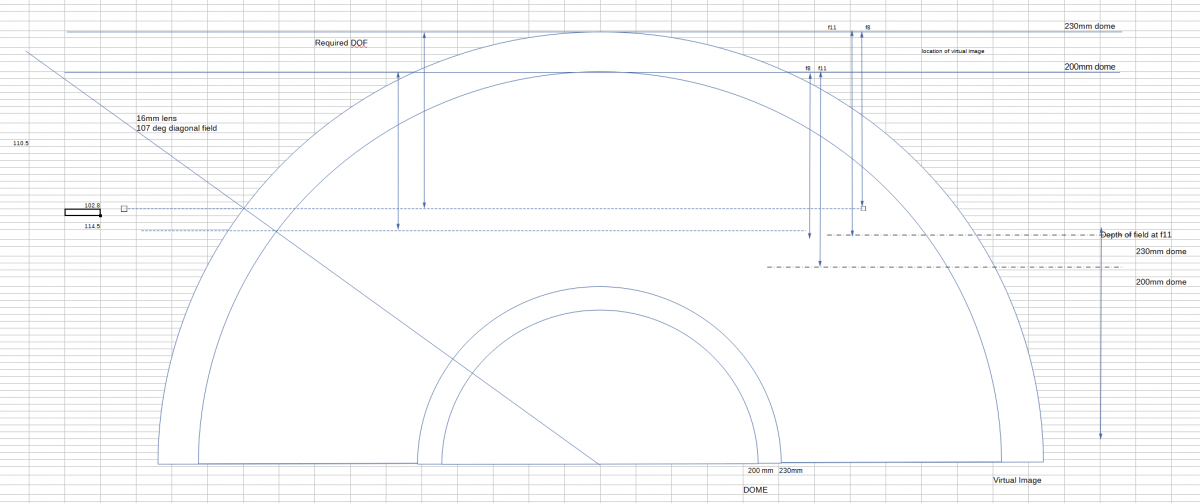
  16. This is scale drawing of a 200 and 230mm dome along with the virtual images for an object at 0.5m distance.  Virtual image location as calculated on the oceanity dome calculator.  The assumption is a 16mm lens (16-35mm f4) with the entrance pupil at centre of curvature, using a entrance pupil location I found on Panotools website being 79mm from lens flange.  Focusing distance is calculated from 44 + 79 + virtual image radius.  44 is EOS flange distance and 79mm entrance pupil distance.

    Required DOF is depicted as the vertical distance between the virtual image and the intersection of a line representing the edge of field of a 16mm lens (diagonal) 48.5° from vertical and the virtual image, for both domes.

    The calculated depth of field at the focus distance calculated as above is plotted on the RHS for both domes at f8 and f11.  This shows the virtual image lies within the DOF available for both f8 and f11.  This of course assumes that the virtual image remains circular and concentric to the dome.

    Note that the virtual image may not stay circular.  This website says:  " Also note that the virtual image is curved. Since the dome is spherically symmetric, every object at infinity will produce a virtual image at the same distance from the dome, regardless of the object's direction. Hence, 'infinity' is mapped onto a sphere that is concentric with the dome but has a larger radius. Extended objects that are closer than infinity produce virtual images that are more flattened, but still wrapped onto a curved surface. "

    https://www.scubageek.com/articles/wwwdome

    Here is the scale diagram:

    image.thumb.png.94a6e9e5dcd103d73ea059f14f8c8e73.png

    There seems to be other issues causing the dome corner softness.  Potentially it may be the change in shape of the virtual image?  For that to be the cause the virtual image would need to be closer to dome as it wraps around.

    EDIT:

    I had the wrong angle of view for a 16mm, correct diagonal field is 107 deg.  The end result is f8 is barely adequate for depth of field.

    Edited by ChrisRoss — Correct the field of view
  17. 28 minutes ago, ChrisRoss said:

    This is scale drawing of a 200 and 230mm dome along with the virtual images for an object at 0.5m distance.  Virtual image location as calculated on the oceanity dome calculator.  The assumption is a 16mm lens (16-35mm f4) with the entrance pupil at centre of curvature, using a entrance pupil location I found on Panotools website being 79mm from lens flange.  Focusing distance is calculated from 44 + 79 + virtual image radius.  44 is EOS flange distance and 79mm entrance pupil distance.

    Required DOF is depicted as the vertical distance between the virtual image and the intersection of a line representing the edge of field of a 16mm lens (diagonal) 48.5° from vertical and the virtual image, for both domes.

    The calculated depth of field at the focus distance calculated as above is plotted on the RHS for both domes at f8 and f11.  This shows the virtual image lies within the DOF available for both f8 and f11.  This of course assumes that the virtual image remains circular and concentric to the dome.

    Note that the virtual image may not stay circular.  This website says:  " Also note that the virtual image is curved. Since the dome is spherically symmetric, every object at infinity will produce a virtual image at the same distance from the dome, regardless of the object's direction. Hence, 'infinity' is mapped onto a sphere that is concentric with the dome but has a larger radius. Extended objects that are closer than infinity produce virtual images that are more flattened, but still wrapped onto a curved surface. "

    https://www.scubageek.com/articles/wwwdome

    Here is the scale diagram:

    image.thumb.png.7d6b038d0e456ebcd70918e018d6ba51.png

    There seems to be other issues causing the dome corner softness.  Potentially it may be the change in shape of the virtual image?  For that to be the cause the virtual image would need to be closer to dome as it wraps around.

    Focus distance is flange + Entrance Pupil + internal distance from EP to dome + Virtual image

    The virtual image starts from the dome not from the entrance pupil

    There are other pieces of research indicating that a dome increases depth of field which is clear as infinity comes closer and the lens covers it

    The source of softness are field of curvature and spherical aberrations. 

    Both are cured by reducing the physical aperture i.e. stopping down the lens. You are not stopping down to increase depth of field but to reduce aberrations as you already had the required depth of field

    https://photographylife.com/what-is-spherical-aberration

    Field of curvature also is reduced by stopping down the lens

    https://photographylife.com/what-is-field-curvature

    Stopping down the lens too much makes the corners potentially sharp but reduces the resolution in the centre

    At some point you just have to live with the edges not being too sharp or suffer a loss of overall resolution

    Most modern mirrorless lenses peak at f/5.6 on a high resolution sensor so going f/14 - f/16 reduces the resolution significantly

    I try to stay between f/5.6 and f/11 and live with the edges as they are 


  18. 6 hours ago, Interceptor121 said:

    Focus distance is flange + Entrance Pupil + internal distance from EP to dome + Virtual image

    The virtual image starts from the dome not from the entrance pupil


    Yes, I know the diagram includes in calculating the radii to the virtual image  but I didn't describe it well.  Assume that the entrance pupil is at 0-180° line at the base of the hemisphere.

    A secondary issue is that even though the depth of field as calculated is "in focus" the resolution is not as good as the centre so you can add that into other abberations

    I edited the original post as I had the wrong diagonal field of view and uploaded a new image.  The analysis shows that f8 just barely covers the required depth  of field.


    Edited by ChrisRoss
  19. So to see how a smaller dome fares I drew up to scale the setup for the shark image in this link that discusses the S&S correction lens.  The example image was taken at f8 with a Canon 17-40mm f4 lens which has a entrance pupil to lens flange dimension of 74 mm.  The dome is a Zen 170mm with 110 mm radius and this assumes entrance pupil at centre of curvature, the diagonal field is 103.7°.  The subject distance is assumed to be 1m and the average of an 8 and 9 inch dome is assumed in the Oceanity dome calculator.   Focus distance is 44 + 74 + 110 + 207 = 435mm.  You can see strong blur in the corner of the image.  

    https://uwaterphoto.com/?p=839

    The setup at f8 shows that the corners are just outside the depth of field at f8 and come into the the depth of field at f11.

    image.thumb.png.8fd5747df4c7f07f8a4718946be475e6.png

    The dome is a rather small segment of a hemisphere as shown here but is adequate to accomodate a 17mm lens with the entrance pupil properly placed without vignetting.


  20. So to see how a smaller dome fares I drew up to scale the setup for the shark image in this link that discusses the S&S correction lens.  The example image was taken at f8 with a Canon 17-40mm f4 lens which has a entrance pupil to lens flange dimension of 74 mm.  The dome is a Zen 170mm with 110 mm radius and this assumes entrance pupil at centre of curvature, the diagonal field is 103.7°.  The subject distance is assumed to be 1m and the average of an 8 and 9 inch dome is assumed in the Oceanity dome calculator.   Focus distance is 44 + 74 + 110 + 207 = 435mm.  You can see strong blur in the corner of the image.  
    https://uwaterphoto.com/?p=839
    The setup at f8 shows that the corners are just outside the depth of field at f8 and come into the the depth of field at f11.
    image.thumb.png.8fd5747df4c7f07f8a4718946be475e6.png
    The dome is a rather small segment of a hemisphere as shown here but is adequate to accomodate a 17mm lens with the entrance pupil properly placed without vignetting.
     

    The issue here is that the camera working distance is 28cm
    A lenses like this one commands a very large radius to focus on the glass most likely in the region of 15cm so you are looking ideally at 12” dome
    Dome size is driven by working distance lens construction and positioning of entrance pupil
    The most important characteristic of a lens is to be able to focus close otherwise when you wrap it in a dome there is very little range for focus and as consequence depth of field
    Depth of field however is a consequence not the driver
    With rectilinear lenses optimised for flat frame field of curvature becomes predominant and this is why edges blur
    With a fisheye lens focussing at 15cm and subject to barrel distortion field of curvature appears to be countered by the distortion that goes in the opposite direction
    When I shoot my canon 8-15mm I get better edges underwater than I get to n land and this is because the dome increases depth of field and the lens distortion counters the field of curvature at least this is my theory
    For clarity I would not recommend anyone a small dome for a lens that can focus at 28cm in fact I wouldn’t recommend getting that lens at all
    Unfortunately even on mirrorless most rectilinear lenses focus between 25 and 28 cm requiring ideally 12” domes or a radius of >15cm


    Sent from my iPhone using Tapatalk
AOI

Account

Navigation

Search

Search

Configure browser push notifications

Chrome (Android)
  1. Tap the lock icon next to the address bar.
  2. Tap Permissions → Notifications.
  3. Adjust your preference.
Chrome (Desktop)
  1. Click the padlock icon in the address bar.
  2. Select Site settings.
  3. Find Notifications and adjust your preference.