1 hour ago, Interceptor121 said:
The issue here is that the camera working distance is 28cm
A lenses like this one commands a very large radius to focus on the glass most likely in the region of 15cm so you are looking ideally at 12” dome
Dome size is driven by working distance lens construction and positioning of entrance pupil
The most important characteristic of a lens is to be able to focus close otherwise when you wrap it in a dome there is very little range for focus and as consequence depth of field
Depth of field however is a consequence not the driver
With rectilinear lenses optimised for flat frame field of curvature becomes predominant and this is why edges blur
With a fisheye lens focussing at 15cm and subject to barrel distortion field of curvature appears to be countered by the distortion that goes in the opposite direction
When I shoot my canon 8-15mm I get better edges underwater than I get to n land and this is because the dome increases depth of field and the lens distortion counters the field of curvature at least this is my theory
For clarity I would not recommend anyone a small dome for a lens that can focus at 28cm in fact I wouldn’t recommend getting that lens at all
Unfortunately even on mirrorless most rectilinear lenses focus between 25 and 28 cm requiring ideally 12” domes or a radius of >15cm
Sent from my iPhone using Tapatalk
I'm not sure I follow your arguments here, my 12-40 Oly zoom focuses at 20cm and performs really well in a 170mm dome.
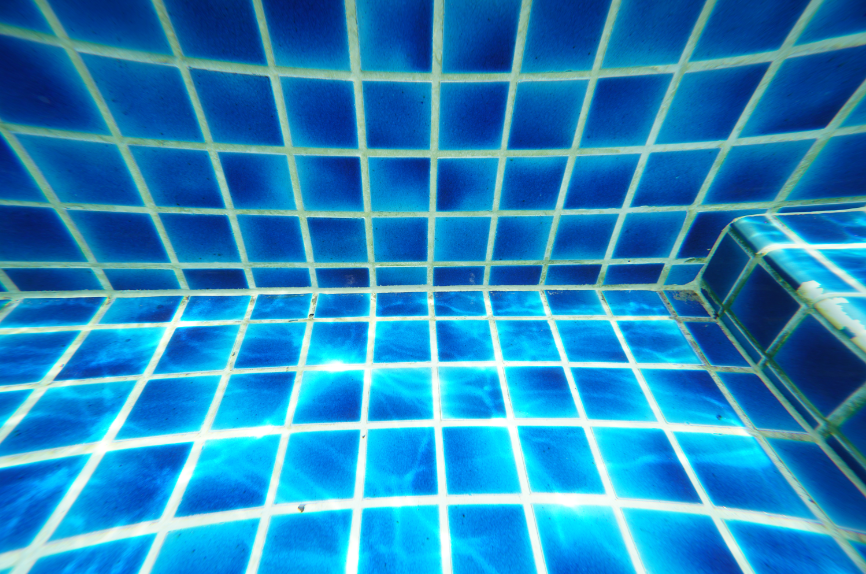
On fisheyes, I took these shots first a Panasonic 7-14 at f4 and 8mm, second a Panasonic 8mm fisheye focusing really close so I have something out of focus at f4.5. You can see the in focus area is a straight band at a constant perpendicular distance to the sensor plane. The out of focus field is pretty uniform closer than this band across the frame.

The out of focus area in the fisheye is close to circular around the in focus part. So the depth of field extends radially out from the entrance pupil. The lighting is not perfect but it shows what is happening.
I would suggest that part of the reason fisheyes work so well is that in focus area is a hollow sphere centred on the entrance pupil, roughly the same shape as the virtual image. It is almost like they were designed with a dome port virtual image in mind.
It's not perfect of course and the in focus area is probably not a symmetric circle and possibly neither is the virtual image so you need to stop down to get good corners but not as much as you do with rectilinear lenses. And no doubt there are other aberrations from imperfect placement, chromatic aberration etc that add into this.