Skip to content

Photography Gear and Technique / Archived topic

Downsizing to smaller rig - suggestions

Started by OCNDiver ·

  • 22Posts
  • 22Replies

Read-only discussion

Downsizing to smaller rig - suggestions

22 posts
  1. I am looking to downsize to a mirrorless or micro 4/3 system. I currently dive with a Nikon D850. After adding all the ports, lenses, and strobes this rig is really heavy. Total weight on land is between 32-35 pounds. In the water it's neutral, but difficult to manage. 

    I'm looking for a much smaller system. I'm 5'2" and 115 lbs. I've had surgery on both shoulders in recent years for rotator cuff repairs. After my most recent trip to the Philippines I had alot of shoulder pain carrying my rig. The boatman were very helpful, but in the end the weight of the rig took it toll. 

    Thank you

    OCNDiver

  2. A Sony A7C in a Nauticam housing with flat port and WWL-1B should weigh about 10 pounds before you add strobes, and you get to stay on full frame. An A1/A7 series system will add about 3 pounds to that due to a slightly heavier body and larger housing.

  3. I use an M4/3 system.  It ain't light, but it's nowhere 32 lbs, either.  The OM-1 is a fine camera, but being used to a full frame system, I suspect the Nikon, Canon, and Sony systems will be awfully tempting for you; the bodies are all within a few ounces of each other, but of course the 4/3 lenses are smaller and lighter.  As to a "much" smaller system, the TG-6 is peerless for macro, not so much for anything wide without external optics, which are still small and relatively inexpensive.  My partner uses a TG-6 on a tray with a Backscatter flash and a focusing light, and it, together with accoutrements, uses half of her carry-on and goes in the overhead without any rotator cuff risk.    

  4. If you’re considering moving to a DX or MFT system it would certainly be worth checking exactly how much weight you save by changing the camera, port, housing and lens as part of the total system. 

    In previous discussions of this issue the view has often been that the saving isn’t as great as you might perhaps expect. Presumably, you would want to reuse all the arms, clamps and strobes which can still be significant weight factor.

    I seem to recall too that there are mirrorless housings which weigh more than the broad FX equivalent. 

  5. Downsizing to smaller formats has the advantage of smaller domes and lighter and cheaper lenses.    For the particular case of the WWL-1 and Sony you can match optics size and weight of smaller formats.

    Exactly how much lighter you can make it depends on your subjects and the lenses/domes you need to use with them.  Start from the subject and work backwards to the dome and lens needed for various formats and stick all the data in a spreadsheet to compare costs and weights.

  6. 5 hours ago, OCNDiver said:

    I am looking to downsize to a mirrorless or micro 4/3 system. I currently dive with a Nikon D850. After adding all the ports, lenses, and strobes this rig is really heavy. Total weight on land is between 32-35 pounds. In the water it's neutral, but difficult to manage. 

    I'm looking for a much smaller system. I'm 5'2" and 115 lbs. I've had surgery on both shoulders in recent years for rotator cuff repairs. After my most recent trip to the Philippines I had alot of shoulder pain carrying my rig. The boatman were very helpful, but in the end the weight of the rig took it toll. 

    Thank you

    OCNDiver

    The easy answer, I suppose, is M43.  The cameras, housings, lenses and ports are all smaller.  But it might also be possible to stay with full frame mirrorless with careful planning of camera, housing and ports.  Once upon a time I might have advocated a DX format, but those are not so popular anymore, so choices are limited.

    What housing and ports do you normally take now?

  7. For wide angle I am using the Nikon 8-15 mm fisheye with Kenko teleconverter.  I have a Zen 170mm glass dome port plus 30mm extension ring. I use Sea and Sea YS2 strobes. 

    For macro I am using Nikon 105mm plus SMC-1 diopter. I usually use only one strobe and/or Backscatter Mini flash with snoot when shooting macro

    Years ago, I had a Sony NEX 5N APS-C camera. I loved that little camera. I wish I still had it. 

    OCN Diver


    Edited by OCNDiver
  8. I started to suggest you look at something lie a Nikon Z7 II, but I don't think there is a Nikon that is going to significantly improve the weight issue.  If they were still doing aps-c you could use the 8-15 and move to a 100 or 140 dome, and use the much lighter weight 85mm macro lens, and that would save some weight and size, but at least for now, Nikon is not doing that format.   A Sony R7 is a lot lighter than the D850 and from what I read, it does well with the canon 8-15 lens and I am sure there is a suitable macro.  But the reality is that for the most part, a full frame camera, whether DSLR or mirrorless, is going to require full-frame sized lenses, which means large ports.

    But in the end, I am not sure if there will be enough of a weight savings to matter.  Even knocking off 2-3 pounds isn't going to make that much difference and will cost a lot of $ and require learning a new system.  To see a real difference you probably need to go to micro 4/3 body and lenses.  Even then, I am not sure what the real difference would be.

    Supposedly, Nikon has some major announcement planned for the next couple of days.  perhaps whatever that is will provide an appealing choice.  Unlikely, but maybe.


  9. 3 hours ago, OCNDiver said:

    Years ago, I had a Sony NEX 5N APS-C camera. I loved that little camera. I wish I still had it. 

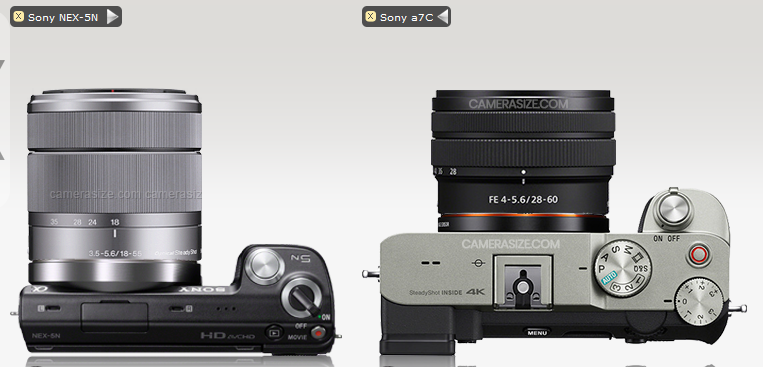
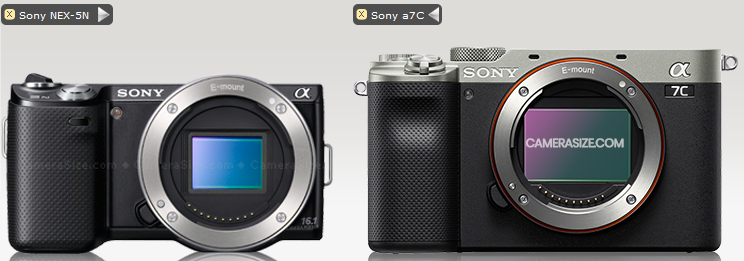
    A7C has a 24MP full-frame sensor in a similar sized body.

    image.png.90fa712b400a31ae925673d16d86921a.png

    image.png.6d2cd23681efc6f9160c079b3748186d.png

  10. various suggestions here.  i know one diver who went from a full frame nikon in seacam to Z6 and went with Isotta housing specifically to reduce weight and size and is quite happy with it.  The Nauticam housing is significantly larger,

    macro option there is a 105mm so similar port size ad lens weight.

    if you were to go with olympus you could definitely use an 8-15 on a metabones for full frame fisheye to about a 26mm rectilinear lens horizontal field of view.  people generally use the canon lens to adapt - not sure if you could do the same with a nikon lens. 

    macro would be the 60mm macro; a decent little lens, AF on the OM-1 is pretty decent but not up to DSLR standards, but with the 2x crop factor you can frame up the same field of view as your 105mm with a wet lens more or less without any accessories.  2.0x equivalent with the olympus lens vs  2.3X FOR 105mm plus SMC.   Weight is 135 gr compared to the Z 105mm at 635gr. 

    to really get the weight down, all the compoments ideally should contribute.   You need to go into the fine print to get the weight savings you are after. 

    Edited by ChrisRoss
  11. 11 hours ago, OCNDiver said:

    For wide angle I am using the Nikon 8-15 mm fisheye with Kenko teleconverter.  I have a Zen 170mm glass dome port plus 30mm extension ring. I use Sea and Sea YS2 strobes. 

    For macro I am using Nikon 105mm plus SMC-1 diopter. I usually use only one strobe and/or Backscatter Mini flash with snoot when shooting macro

    Years ago, I had a Sony NEX 5N APS-C camera. I loved that little camera. I wish I still had it. 

    OCN Diver


    Hi OCN diver,

    As you describe your current rig, I am not sure that a change to APS-C or MFT will lead to really substantial savings in size/weight, at least not for WA, that would be worth a complete change of system:

    #1.: WA: you could change to the Nauticam 140 domeport (MAYBE even to Zen DP100, but I am not sure whether this will give good IQ with FF). Then you are in a similar size/weight class as APS-C with Tokina 10-17 or MFT with Canon 8-15. The Nauticam Nikon housing is taller (both FF and APS-C), compared to Nauticam for MFT, but when one adds all the rest, the difference is probably not worth the change to another system. Nauticam housings for Sony are considerably smaller and come close to the MFT ones.

    E.g. I am changing now from Nauticam/Oly EM1-II to Nauticam/Sony A7RV. I have used the Canon 8-15mm fisheye in the past with Nauticam domeport 140 and Zen DP100 and plan to use it also with FF. The entire rigs are very comparable with respect to size/weight, camera housings are not much different, same domeports and similar extensions (the angle of view is different between MFT and FF, however)

    The hughe difference between bigger and smaller sensors in WA come, when one uses rectilinear WA lenses. Then your Zen DP170 is the standard for smaller sensors, while the bigger 230 domeport (sometimes even the 250 version) are standard for FF...

    #2.: Macro: Here the difference is big. I have both the MFT 60mm and 45mm macrolenses and the FF Canon EF 100mm macrolens. While a (Nauticam) macro rig with Zuiko 60mm or Pana 45mm is really small and handy, the Canon lens, adapted to be used on Olympus EM1-II (with N120 port and extensions) makes the biggest and heaviest rigg I ever took under the water...


    => In case you want to save substantial size/weight, I would consider a radical approach, like using a small and smart camera (Sony A7c, Olympus EP-L) with only one small standard zoom lens and wetoptics for WA and macro (the usability for macro is, however, restricted and you loose the flexibility of a camera system). One also should look for a small and light housing then (e.g. Isotta)...

    => other alternatives are compact cameras, the better ones bringing little savings in size/weight compared to a small system camera like 7c or EP-L. On the other end is the Oly TG, that is really small, but so is IQ (there is no free lunch nowhere :dunno:)...


    Wolfgang


    Edited by Architeuthis
  12. Like Chris said above, it is worth comparing housing brands and the weights of specific parts.  Just as an example, the weight of the latest Aquatica 67mm flip diopter holder is 275g, while the Nauticam version is 142g.

  13. I moved from a DSLR in a Subal housing to an Olympus M43 OM10 in a Nauticam housing.

    Rather than splash on lens and ports, I use the kit lens behind a flat port with CMC and WWL1. The entire rig including wet lenses, 2 Inon strobes, batteries and chargers fits in a single Lowepro bag which weighs 18kg fully loaded, so a bit heavy to lift into a locker. The only part of the camera system that goes in the hold are my locline strobe arms (because they are too bulky, they don't weight much) and the spares kit.

    This compares to the previous DSLR where about 15kg of camera went in the hold, similar weight in the carry on bag. The old Subal housing was probably heavier than the equivalent Nauticam, so that may account for 1kg. 

    What I like

    • 1 less checked bag on any trip. I now travel with 1 checked bag, 1 carry on and no excess baggage costs.
    • Wet lenses are great, I can do macro and wide angle on the same dive.
    • No stress about camera system going astray with baggage and insurance not covering camera kit in checked bags.
    • More compact on the dive.
    • Out of the housing, its a really light camera for general use (Though I also have a TG6 for general use, and as a backup)
    • Never needing to change the port or lens between dives or overnight.
    • Less time spent in the camera room. More time spent in the bar.

    What I miss

    • The DSLR viewfinder was clearer than the EVF, especially in low light.
    • I could use a bit more reach on some macro shots. The CMC needs to be really close.
    • Battery life. An OM10 battery lasts about 2.5 dives and 300 shots using the EVF. (The DSLR battery would last 4+ dives and 1000+ shots)

    What I don't miss

    • Resolution. Unless you are into pixel peeping, the massive resolution of many chips is way more than needed.
    • Corner sharpness is no different to many WA+dome setups, but with a WWL you can't fettle corner sharpness by messing with  domes and spacing. 

    What next

    • I am half considering an EWML kit, but that would push me onto another checked bag and hence undo what I have gained (unless I left the WWL at home)
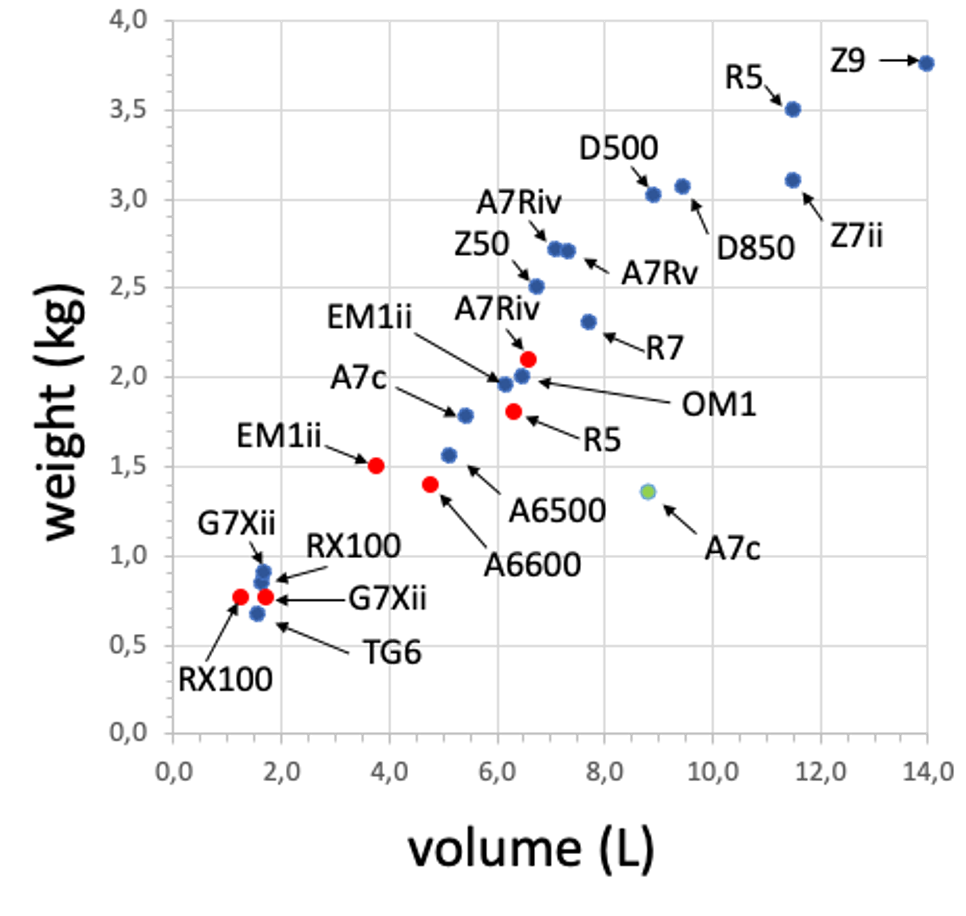
  14. I have added some cameras to a graph that I have already posted in the past. It shows the relation between volume and weight (in air) of the sheer housing (Blue: Nauticam, Red: Isotta, Green: Seafrog). Viewing the graph I must correct my statement above that compact cameras are not much different to "smart" system cameras: according to the recommendation of Frueaufsteher2 one can see that there is a gap between compact and system cameras, the former beeing considerably smaller/lighter. The difference from high-end compact to TG-6 is, surprisingly to me, much less than I was suspecting:


    1878006955_Picture2.thumb.png.ad2c72fbaf10b99ec9a431b8d5d9f898.png

    To the sheer camera the lenses, (dome)ports, arms, flashes, viewfinder etc. have to be added. These are very similar except lenses plus (domeports), which are:

    #1a.: WA with wetoptics/WACPs: The compacts allow smaller wetlenses (as Fruehaufsteher2 recommends), but for the system cameras the situation is similar for all formats: WWL-1 (if compatible) or WACPs...

    #1b.: WA with fisheye lenses (Nikon, Canon and Tokina (anly MFT and APS-C)): when used with Nauticam 140, the situation is almost identical for all system cameras, no matter which sensor size. Also with DP100, but it is not granted that the small dome will perform perfect on FF...

    #1c.: WA with domeport: for MFT and APS-C the 170 and 180 domeports are the ones of choice, while for FF the 230 (or 250) are the one to consider. MAYBE one can get away with 170/180 on FF, when using only mild WA (e.g. the Sony 20-70mm f/4).

    #1b and #1c are, of course not applicable to compact cameras.


    #2.: Macro: here the weight/size of the lenses/ports increase dramatically with sensor size. MFT systems make very handsome macro rigs. I cannot say about compacts with macro diopters, but the normal range zoom lenses of system cameras with diopter have very close working distances only and the potential is limited...


    Wolfgang


    Edited by Architeuthis
  15. Wow I missed this amazing work

  16. When they came out, I was very intrigued by the design of the Sony A6XXX and A7C for underwater use.  But they are no longer in production as far as I know and there have been no sensor or processor upgrades to them.  I guess they are not formally discontinued but Sony stopped producing them in 2020 0r 2021 and has not restarted.  Nauticam still lists housings for those cameras, though.  Since their production status is unclear, it is hard to recommend them as a new purchase.

    I have never used or even seen one of these, so I have no opinion, but in the ultra lightweight realm there is something that looks kind of interesting.   The Olympus EPL 10 in an AOI polycarbonate housing, with the 8mm fisheye and 60mm macro Olympus lenses.  This appears to be a very small and light package and the EPL 10 does use the 16mp sensor, so pretty good for MFT.

    As far as i can tell, there is no provision for a 30mm macro or any other fisheye or wide lens except the mediocre 9-18 or the kit zoom with a wide lens.  But still,  it is a very small and light package.  Maybe it is crap.  I don't know.

    Along the same lines, AOI makes housings for a few other MFT bodies and some other lenses and the size and weight might similar?

  17. 4 hours ago, Architeuthis said:

    I have added some cameras to a graph that I have already posted in the past. It shows the relation between volume and weight (in air) of the sheer housing (Blue: Nauticam, Red: Isotta, Green: Seafrog).


    1878006955_Picture2.thumb.png.ad2c72fbaf10b99ec9a431b8d5d9f898.png


    Wow. The world needs people like you. Great! 

  18. I appreciate all the suggestions. Alot to think about here. Thank you.

  19. At present, I think that a great alternative for underwater photography are the mirrorless cameras of small size and with APS-C sensor, such as: Canon 50D, Nikon Z50, Nikon Z30 .... as long as suitable underwater housing will be developed for them.

Account

Navigation

Search

Search

Configure browser push notifications

Chrome (Android)
  1. Tap the lock icon next to the address bar.
  2. Tap Permissions → Notifications.
  3. Adjust your preference.
Chrome (Desktop)
  1. Click the padlock icon in the address bar.
  2. Select Site settings.
  3. Find Notifications and adjust your preference.