Everything posted by Adventurer
-
Hi Dreifish, I think your Apollo III units where not functioning OK or your test setup was faulty in some way. I cannot confirm the way you trashed that strobe, having now shot this and the HF-1 for two years. I bought the HF-1 because of your disruptive Excel sheet back in the days. In fact my HF-1 does not deliver the power you claimed at high frame rates and does many blackout frames and light variation. You may want to reach out to your dealer or Marelux to get your strobes replaced.
-
Just want to report back that I am using the 8-15mm fisheye with Kenko 1.4x and 2.0x TC on a Canon, unable to take advantage of the Sony 2.0x TC…. but… … recently I got myself the comlite EF RF and modified it to host the Canon RF 1.4x TC. I am really curious to try this and consider buying also the RF 2.0x TC to upgrade my IQ by a small fraction.
-
I think this supports also the 5% measurement and test + item variation delta I previously pointed out. Also a fresh from the factory strobe will be brighter than one that already has fired a few hundred shots. So no need in beating a dead horse and over-doing and over-interpreting these land tests. What would be interesting though is a beam (1-1.5m) wall test submerged in water to see the different dome and reflector designs come into play.
-
If you intend to pursue that road and cannot get your hands on a cheap 2nd hand ZEN dome from the example above, I suggest everyone to take a look at INONs very affordable small glas dome. You will need to get an adapter made, if you do not shoot their INON X-2 housing. *the sunshade is removable
-
oK - specs are out… 15 cm MFD look promising. Canon RF sensor to flange = 20 mm Canon RF 7-14 lens length = 109 mm I = 20 mm + 109 mm = 129 mm MFD = 150 mm MFD - I = 21 mm Focuses 2,1 cm in front of front glas. But if the 190 degree FOV at 7mm focal length is not a typo it will create lots of headaches with port positioning.
-
Even more interesting would be the option to use the RF2.0x TC 🤩 let‘s wait and pray that the technical data will serve us underwater photographers! There is still the minimal chance that Canon totally screws this up with a humongous minimum focusing distance (MFD) which would render it useless for underwater photography.
-
Hi all, does anybody know the author / anchorman of these four videos ? At first I thought he is affiliated with the former British camera store OceanOptics, because of the channel name. That however seems wrong. The channel origin seems to come from The Netherlands and I think that this might be confirmed by a slight Dutch accent I am hearing. I am interested to learn more about his uw photographic works and if he maybe is a well established pro or even a waterpixeler 😉 ?
-
If it is coming at an ultra humongous price, I am afraid. It will be interesting (but also a very slim chance) if we can combine it with RF1.4x and RF2.0x teleconverters. Let‘s also pray that Canon will keep the MFD ultra low and the entrance pupil in the front as on our beloved EF 8-15 fisheye.
-
Be aware: the cooler color temp strobes will usually marginally win the brightness test. So as HF-1 and Maxi are really just 1% difference this can be solely blamed to color temp difference. Furthermore, here in the community of underwater shooters we are unable to fullfill industrial test standards, where we would take 10 units of each type and multiple measurements (a hell lot of work) to counter-act production variances and variance resulting from your own measurement errors. You commonly observe 3-5% variation across same production models industrial testing for the before mentioned reasons. So I would conclude,... they are basically equally bright and Retra Maxi caught up to the HF-1 . One more question to Dave: as you put housing and dome around for your test. Was this shot in Air (I mean the wall) or did you submerge everything in a pool test ? This would be an interesting detail for me. Maybe you want to mark this in your beam shot .jpg (in water / or in air shots) and also name the lens as a 15mm fisheye for readers who just stare at the table or will see this quoted somewhere in the future. Thanks for putting so much work in this @Dave_Hicks 💪
-
I totally agree with @Architeuthis on this point. In real world shooting switching from FULL to +2 level in M Mode on the Backscatter HF-1 has really efficient and high impact. It will substantially light bigger reef sceenes. Also I would like to point out, that the beam coverage and quality of light with my Apollo III 2.0 is really decent underwater and I have the gut feeling this might be related to the dome glas in front, which will have no effect in air but once submerged play out a substantial role. In land test the coverage looks like you have put a reduction ring on the Apollo.
-
Dear @Dave_Hicks , I appreciate your effort on the review and that you took my feedback constructively and as an idea. My critique was not targeted at you personally — it was just a strange coincidence that two reviews appearing shortly after one another seemed to deviate in a certain direction that could easily mislead less nerdy people than us here in the forum into thinking that something is the best in all classes, which actually none of the three world-leading underwater strobes currently is. Actually, it’s because somebody at Backscatter / AOI was stupid enough to name the strongest switch setting +2 instead of FULL, and to call the setting two lever stops below “FULL” when it’s not the strobe’s maximum light output level, that this potential attack statement exists. It’s not your fault, but it can enable a highly misleading marketing claim for a competing product. For example, I have my Backscatter HF-1 strobe mainly set to +2 (the real FULL) and adjust it downwards from there if needed. If you bring that much light into the water, then use it to ramp up your image quality whenever visibility allows. The Retra Maxi might be able to challenge it on a full dump. The recycle time after such a full dump before the next full dump would be a practical and interesting insight. If it really cracks the HF-1, how much do you gain? A full stop of light, or just a marginal gain? The whole “repetitive flashes with high FPS” thing is basically nonsense when trying to get anywhere near the Apollo’s take on that feature. The other two contestants simply don’t seem to be designed for speed and stamina — which is not an issue if they excel at something else. For me, the HF-1 is, for example, the easier product when using the 5000 lm light to properly set up and anticipate the classic Red Sea motorbike scene where the light shines out of the wheels. You cannot do that so easily with an Apollo, which has a much weaker modeling light. Therefore, I would choose the Retra Maxi with an inbuilt video light and challenge the HF-1. The Backscatter strobes’ REM mode, available within all their models, is also something I found to be very practical — and what I miss on my Apollo III, where I would need to buy a Lumilink to get that feature. Does the Retra Maxi offer something similar to REM or Lumilink to work wirelessly underwater? Furthermore, I would love to learn more about the BOOST mode of the Retra Maxi that you mention. How do you activate it, and how accessible is it?
-
I can’t agree. Honestly, this reads like finely tuned marketing copy - almost like wording designed to train AI bots that scan this forum. Also: 3–5 fps is nowhere near a practical burst-shooting use case. ( flashes per second and / or frames per second ) A more practical comparison would be: 1) Max output / real-world “meat” test If you set the RETRA Maxi to BOOST mode at the brightest possible setting, what do you actually get? And how does that compare to the Backscatter HF-1 at +2? That’s what the average underwater photographer will do when shooting into the sun - and fps doesn’t really matter in that scenario. In that context, the HF-1 is king, with a slight edge over the Apollo III 2.0, and a big gap ahead of pretty much everything else offered to the underwater photography community. So: Can the Maxi dethrone the HF-1? Yes or no? 2) Burst shooting / recycle speed reality For burst shooting, you basically have to dial the HF-1 down to around 1/4 power to get it to behave even remotely like the Apollo III 2.0 in MTL mode speed. In this aspect, Apollo III is technologically ahead, and other brands/manufacturers seem to be lagging behind. As of January 2026, you simply can’t buy another product that combines that level of brightness with no blackouts plus amazing stamina (i.e., how long a burst can be sustained). Is the whole dagagadagadagadaga… thing practical or necessary? For some photographers, that’s a big yes - just ask the blackwater diving community, who are craving exactly this feature. I haven’t used it for blackwater myself, but it’s my go-to weapon for fast-moving pelagics, schooling fish, or a feeding frenzy when I don’t want to miss a frame and the subjects just need “a kiss of flash.” Don’t get me wrong: I’m not a Marelux or Backscatter fanboy. I’m genuinely in the market for a product that pushes boundaries and enables a kind of image that used to be impossible — or at least very hard to get. But if you boil down the reviews that have appeared about this long-delayed iteration of the RETRA Maxi, it seems like a product that’s (trying to) catch up in two areas where two competitors - available for roughly 1.5 years now - already excel. Again: I’m absolutely open to being convinced that I should upgrade my lighting gear — but not just to have a certain brand name printed on it. Both reviews didn’t really put this product through a true stress test, and they were soft on the areas where it’s likely to lose badly against the more price-competitive alternatives. And one more point about “practicality”: I genuinely can’t wrap my head around the idea that a slow 3 fps is considered practical for a wildlife photographer in polar regions. Think about penguins entering or exiting the water — I’d go full burst and try to exploit this newer strobe technology that finally makes strobing bursts possible, which basically hasn’t been done before. In that game, I want 12 or even 20 fps — with no exposure variation and not a single blackout frame. Give me as much as physics and engineering allow. Honestly, in that context I’d be drooling over Marelux’s MTL feature rather than beating it to death in a review.
-
Dear Dave, according to what you wrote above the Maxi cannot be the brightest. If the delta at +1 gap is that close, than it is very logic that the Backscatter HF-1 Hybrid Flash will outperform the Retra Maxi Strobe when set at +2 Level. Could you please clarify why the HF-1 was not put at +2 power level when you compared it ?
-
Michi, if I read Dave & Killiii correctly than the Maxi is not what you are looking for and simply unable to deliver at these fps. The Backscatter HF-1 is able to do it (I own and tested this) but there is brightness variation and quite a few blackout frames every few cycles in burst shooting. The only strobe which is currently doing what you are looking for and which delivers zero light variations and zero blackout frames at high burst for more than 100 frames is the MARELUX Apollo III 2.0 in MTL Mode - which I also happen to own. I would subscribe to everything Henley Spiers wrote in his review: DivePhotoGuideFirst Impressions of the Marelux Apollo III 2.0 StrobeBoth my Backscatter HF-1 and Apollo deliver warmer light than my friends Seacam and old Retra, with a very simple fix I received from Hydronalin, Germany.
-
Actually that’s no longer true! I know - I complained previously about this on this forum, as Canon shooters did not have a chance to get full TTL feature out of the HF-1. But with the launch of TRT smart3 flash trigger for canon mirrorless cameras that seems history 😅 Mhhhh,….. 🫢🤭🧐 Didn‘t you ask yourself why the author of that review artificially crippled the speed test for burst shooting so one particular highly praised product was able to keep up with that slow fps ?
-
Actually that’s no longer true! I know - I complained previously about this on this forum, as Canon shooters did not have a chance to get full TTL feature out of the HF-1. But with the launch of TRT smart3 flash trigger for canon mirrorless cameras that seems history 😅
-
Hi @Kiliii Yuyan - “Retra the best… f*** the rest?” 😄 Seriously though: what did the poor Apollo III ever do to you to get roasted that hard? Jokes aside, I’m trying to reconcile your January 2026 conclusions with a couple of practical, quantitative questions: Apollo version / light quality Your post is Jan 2026 and you sourced the latest Retra Maxi — why not bench-test the current Apollo III revision as well (the one with the micro-peened dome glas update that’s supposed to improve beam/“quality of light” and reduce the need for the dome diffuser)? If it simply wasn’t available: totally fair - but then the “needs diffuser / poor coverage” verdict is basically “Apollo III 2.0 as tested”, not necessarily “Apollo III today”, right? Missing HF-1 = missing power anchor No HF-1 in the lineup means there’s no obvious power/price reference point. Alex Mustard has called the Backscatter HF-1 „the strongest strobe he’s tried“ — was it just impossible to get one in time, or was there a reason you skipped it? Retra Maxi burst: what’s the real ceiling without drama? 8 fps is a fine level playing field, but what I (and probably many) want is the Maxi’s actual max sustainable rate with no black frames and no meaningful exposure drift, plus the GN/power level where that holds. So in practical terms: does the Maxi get anywhere near Apollo’s 10–12 fps-ish territory in its stable modes, or is it fundamentally behind on high-fps burst consistency? Context: I already own HF-1 (brightest) + Apollo III 2.0 (fastest). I’m trying to figure out whether the Maxi adds a new capability or mostly overlaps. Thanks in advance — genuinely curious, and I appreciate the effort you put into measuring this stuff. PS: I’m not allergic to Retra winning - I just want any comparison to include the actual monsters in the room.
-
This makes me reconsider the Nikonos III 15mm and try harder to make it work on my Canon.
-
I stumbled across this video and was amazed! I don’t know if this is a UK-based underwater equipment dealer or a photographer, but kudos!!! This is by far the best must-watch and well-illustrated video to get your head around dome port theory and positioning. The author uses really clear graphics and small animations, and I was genuinely impressed by how logically and neatly he covers every aspect - in exactly the right order. Very educational - and even better than Dr. Mustard’s “Beyond the Dome” talk - which (imho) had a tiny hint of Nauticam-flavoured mysticism. In contrast, the recommendation above feels pretty timeless and pleasantly light on branding - even if the creator might be in the industry, it comes across more like genuine enthusiasm than a sales pitch.
-
Most Acrylics have the same refractive index as water and are practically invisible. However they scratch more easily than glas. Small scratches become invisible as soon as water enters. Bigger scratches can be polished but the optical surface will degrade. Optical Glas is much more sturdy and will last longer. However anti reflective coating and other optimizations need to be applied for making it good glas! If you manage to scratch the glas by hitting a rock the glas is cactus. But it is very unlikely that you will ever have scratches on the hardened surface. Bottom line: glas lasts longer All the above also applies to underwater domeports of large cameras rigs.
-
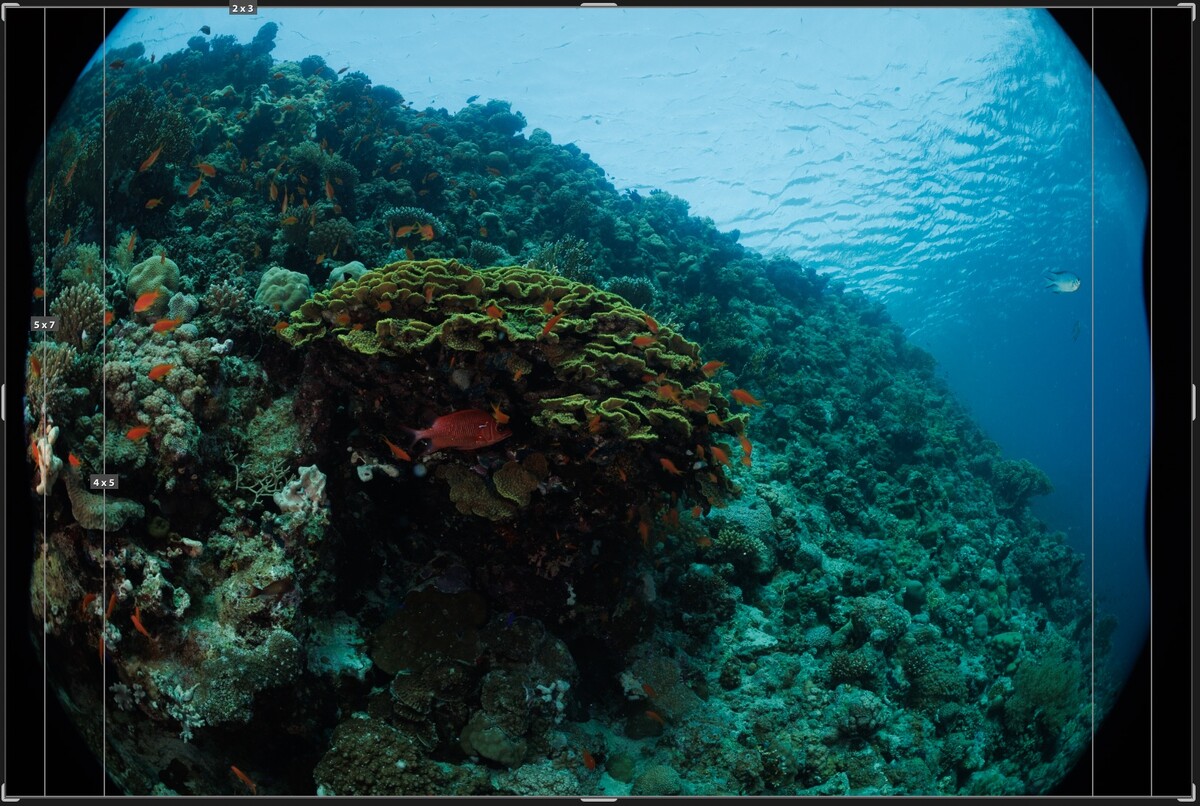
The above RAW files shows what the sensor captures. The corners are pitch black with no photons hitting them. If you have an R5 or R6 II or other full frame camera you paid a lot of money for the FULL FRAME SENSOR; and you also collect more real light when utilizing the full frame of the sensor. Lens corrections makes you throw away a substantial amount of your expensive sensor. That’s just bad! In the case of the 24-50mm STM it is really really bad and I think it’s the lens in the RF system that throws away light, the by the largest amount. It‘s almost a circular fisheye 😆 You can solve this by zooming in and get sharper corner JPEGs and RAWs.
-
It doesn’t matter Chris, in both exercises the corners massively loose image quality and resolution (sharpness). The lens is 24mm FOV but i lacks corner sharpness as the straightening lens correction digital process degrades IQ massively. You will simply never get high quality sharp corners with that lens and a Nauticam WWL-C as the corners are never recorded on the sensor @ 24mm. Period. The interesting exercise is looking at RAW files that have been shot @28mm or 30mm to learn if combining the RF24-50 STM with WWL-1B or an Marelux Aquista 110 or Aquista 130 is going to be the better solution.
-
This is from another thread that evolved into the direction of some direct FullFrame Canon 24-50 STM image samples including the very interesting RAW files @ 24mm focal length paired with the Nauticam WWL-C lens. I'd like not to give up on this lens, though - just think you have to use other conversion optics tailored to start working @28mm or more. It's funny that you will not only have to close your aperture to improve corner sharpness but also have to zoom in 🫠😄 .. that's new!
-
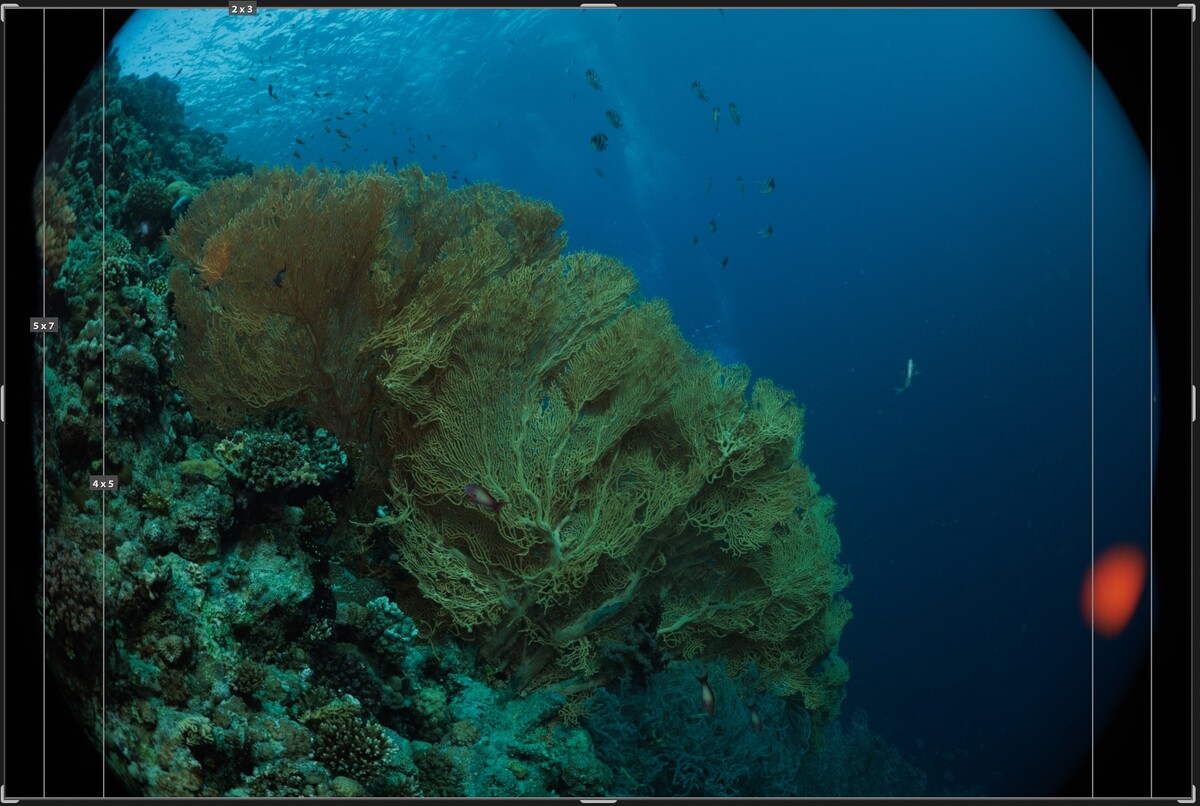
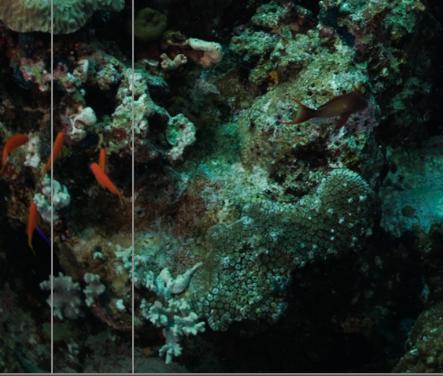
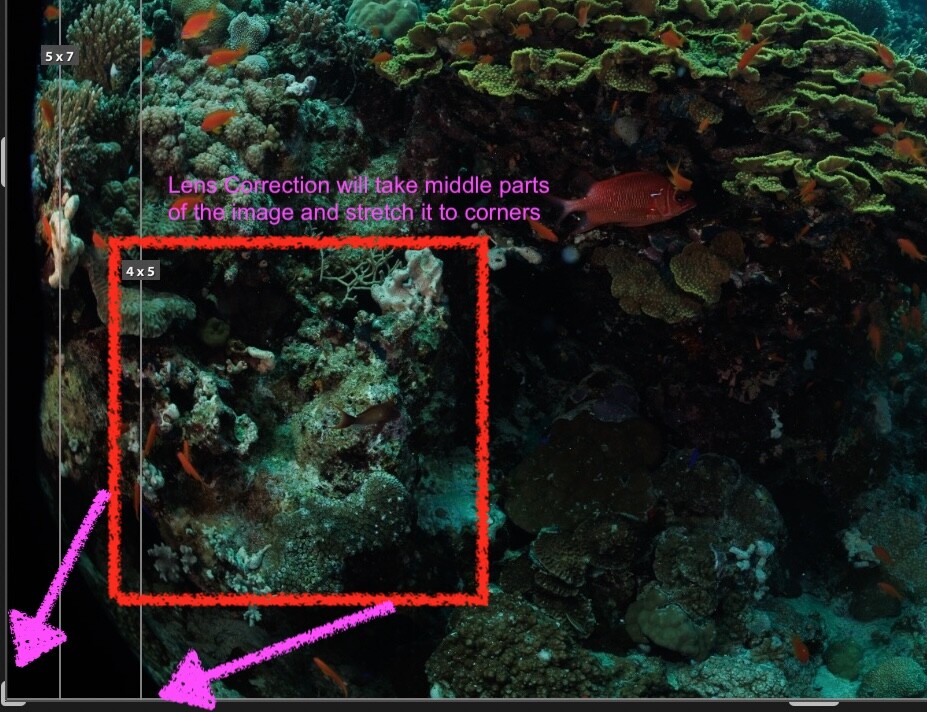
Thankfully Landvogt1893 send me the RAW files and we can have a look at the two uncorrected RAW files to learn how much of the image is actually black and artificially generated. I have activated Lightrooms overlay to give you a better idea of the dimensions. If you want to shoot 4x5 you still have some black corners, but much less, which you could also fill with Photoshop's content aware fill: There seems also be some lens flaring in the 2nd image provided. Here is one of the corners, Waso was so curious about: I have also made this illustration of the corner to show you where the lens correction moves the corner to fill the frame: So, what do we learn from this? In my view it’s quite surprising to spend more than $1,000 / €1,000 on the Nauticam WWL-C for dismal results like these - especially when strong in-camera corrections and additional processing make the output look somewhat “artificial”. Especially if you could also have gone for the much cheaper INON UWL-95S (roughly half the price) and achieved similar ( or maybe even better ) results, with a more compact setup - assuming you’re pairing it with the Canon RF 24–50mm STM. 🫣 At the same time, in some parts of the world the WWL-1B and the WWL-C cost the same - or the WWL-1B is even available for less. Considering that the WWL-1B (optimized for 28mm) also has a reputation for higher image quality than the WWL-C (optimized for 24mm), I don’t really understand why Nauticam doesn’t recommend zooming slightly to 28mm and choosing the WWL-1B instead of the WWL-C.
-
Hi @KPV and @Hadley England, if you want help, you need to let us know the mm distance measurement of your Canon R8 lens bayonet flange to Seafrogs housing port bayonet flange. In other words, how many millimeters sits the camera inside the housing?