




-
I recently looked at a Sony 28–60mm RAW file and was surprised to find that this lens also relies heavily on lens corrections and produces completely black corners on a full-frame sensor. I had always thought this kit lens was somewhat “holy” because it has a strong reputation for delivering very sharp corners, especially among underwater shooters using it with Nauticam water-contact correction optics.
-
You’re right — sorry. I got a bit carried away. That said, I’d genuinely like to hear more thoughts on strobe design philosophy from people who owned the Retra Pro Max II and then moved to the Maxi. Did anyone here make that switch? If so: what did you feel you sacrificed (if anything), and what did you gain? More broadly, do you think the future of strobes is primarily Li-ion (18650 / 21700) — and that dual-AA designs will slowly phase out? For my own journey (INON S-220 -> Apollo III 2.0 -> Backscatter HF-1), it’s a bit like driving a good electric car: once you’ve experienced the convenience, it’s hard to go back. The ability to shoot most of a dive day — sometimes multiple days — without opening the battery compartment is a genuinely pleasant experience. Just to put some numbers on “stamina” (manufacturer-rated flashes; conditions obviously vary), here’s what I’ve found listed at/near full power: Retra Pro Max II: 300 flashes Backscatter HF-1: 375 flashes (BOOST +2) INON S-220: 500 flashes (FULL)* Retra Maxi: 550 flashes (FULL) Apollo III 2.0: 800 flashes (FULL M) * Reality check from my dives: I still swap batteries in my INON S-220 before a third dive if I don’t want to risk running out during that dive. So the 500 flashes on the INON maybe archived in a lab type test but in practical diving I feel it lasts substantially less than the new 21700/18650 strobes. With Li-ion strobes, I can often shoot for several days without changing batteries. Working theory: part of the difference might be standby consumption during the dive (keeping the capacitors topped up / ready between flashes). If that’s true, the higher-capacity 18650/21700 designs could have a real advantage here.
-
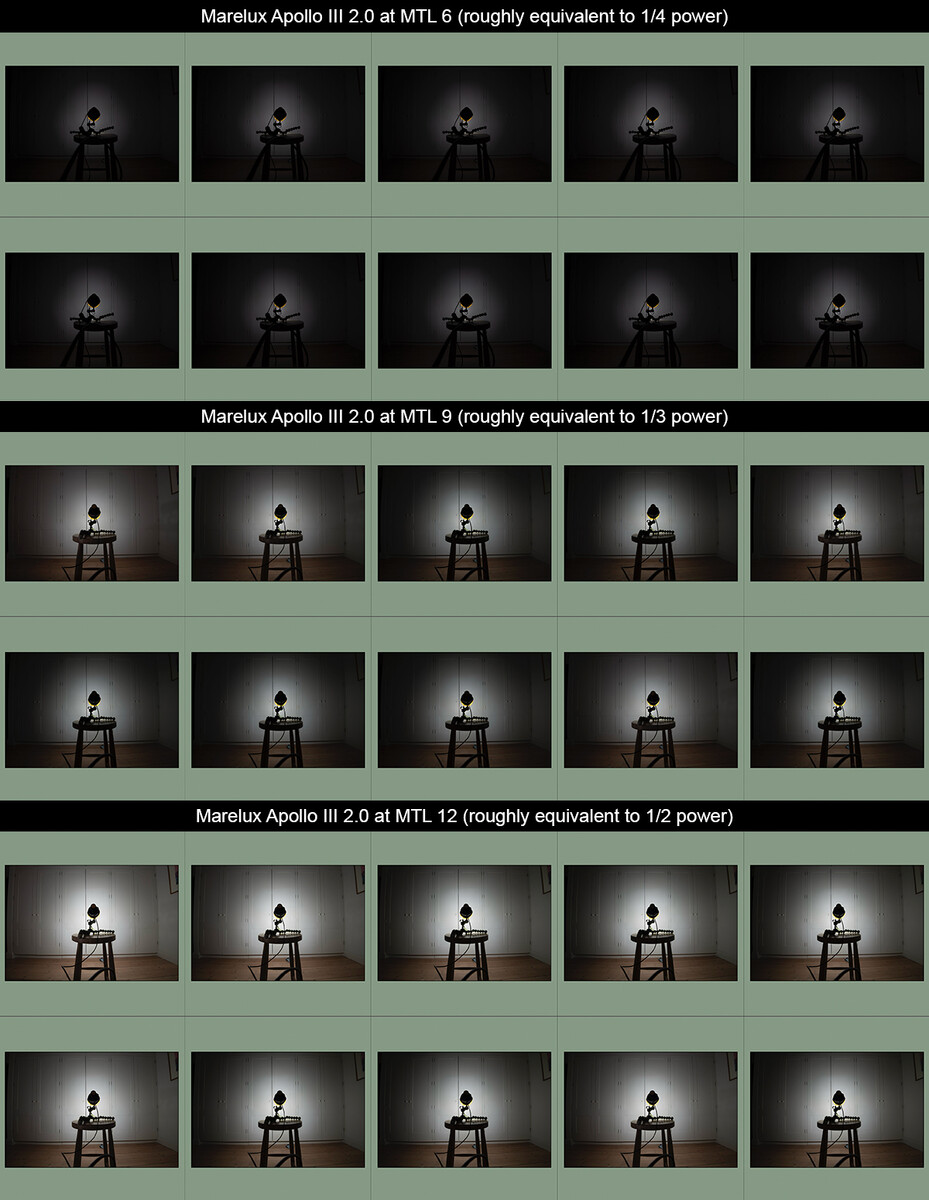
Thanks Dreifish, the above is something I did notice on the HF-1 but not on the Apollo III 2.0 that I happen to own. This is why I recommended to get your strobe checked. I am aware that the 2.0 in official documents just refers to the wireless protocol but from what you describe, I would not rule out that there is also other improvements in the product or the chance that you received a „Monday model“ series, as we say in Germany. The findings in Kiliis and Henley Spiers reviews that included Apollo also point into that direction, that it‘s not flawed. Have a look at the Henley wall projection MTL 12 (full power in fast mode, that is): source: DivePhotoGuide.com The variations or blackouts I get on my two HF-1 strobes (and the HF-1 of my friend) are extreme compared to the Apollo III 2.0 - pretty much like the the Retra and OneUW blackouts and light variations in the DPG reviews. I used the fully charged recommended batteries that are in the Backscatter manual for the fast shooting high fps test. Another potential conflict I would like to put the spotlight on is the fps you can set in the cameras vs what the strobe manufacturers guarantee you. I think MARELUX will grant you 10 fps solid according to their manual in full MTL power. But like your camera I just have the option available to to do 7 fps or 12 fps on my R6 Mark II. That said, the Apollo‘s kept up with Zero blackout frames @ 12 fps. I explored that mystical feature further by digging into the real net frame rate that our Canon cameras will offer. Canon says the fine wording „up to“ depending on settings and batteries used etc. When shooting a stop watch on my iPhone at the high fps setting I found that the camera actually varies in speed between 10.5 to 12 fps in series burst shooting with strobes. This explains to me why the Marelux Apollo III strobes on my desk seem to be able to easily keep up with this pace. It looked like camera and strobes could do this endlessly forever so I stopped the test after a few hundred RAW .CR3 frames and seconds. Coming back to the HF-1 and blackout frame behavior there is also a 2nd source online confirming my experience with the other pretty fast strobe in the leading gang,… Nicolas Remy digged into the high fps possibilities of the HF-1 and also confirmed blackout frames and light Variations, which I do not experience with Apollo III 2.0 in MTL. Have a look: Full HF-1 review on: theunderwaterphotographyclub Hybrid Flash HF-1 Table 2: Hybrid Flash recycle times and number of flashes at the three most powerful settings (source: Backscatter) Power Setting Burst Speed Light Decrease Between Shots Number of Flashes Before a Black Frame Frequency of Black Frames After First One Total Number of Shots Taken Comment 1/4 10fps Smooth 9 Every 2–3 shots 49 1/4–0.5 f-stops 10fps Smooth 14 Every 2–3 shots 42 1/8 10fps Very smooth 43 None 43 1/4 8fps Smooth 16 Every 4 shots 37 1/4 6fps Very smooth 24 None 37 Decrease during first 24 shots, then stable 1/2 5fps Smooth 5 Every 1–2 shots 26 1/2 4fps Very smooth 7 Every 3 shots 25 1/2 3fps Very smooth 13 None 25 Decrease during first 13 shots, then stable F 3fps Noticeable 2 Every second shot 15
-
This article and illustrations will get you wrap your head around it: Understanding Flat Port and Dome Port TheoryOne of the key features of underwater photography is the dome port. Despite it's ubiquity, it's effects are largely misunderstood or at the very least, poorly explained. In this post I'm going to ta Also this interactive tool will help understanding what happens in Mis-position: Dome Port Virtual Image VisualiserA dome port like the one you see above will cause light rays to diverge. In air, this effect is negligible. When underwater, this effect is extremely pronounced. This is simply due to the different re
-
Chris, no, please stop rehearsing this wrong and changing what was previously articulated correctly. Two persons who reviewed the Apollo have written in their review that they considered „some sort of settings“ to be better to conduct their review - for some unknown reasons to the public. In these settings the Apollo is not allowed to out-perform the competing products. This is why they were able to win, not because of altered batteries or other reasons etc. And furthermore it‘s not just one person (me) giving data and honest review about the Apollo III 2.0 strobe. I never publicly reviewed the Apollo or HF-1 strobes. I just used them and can confirm what Henley Spiers wrote in his DPG review about them, which is a neutral undistorted review which really tried to find the performance limit of the Apollo III 2.0 product. About HF-1: several people and reviews have reported light intensity variation and black frames when trying to conduct high frame rate shooting, for which Dr. Alex Mustard (and me) recommend the 1/4 (or lower) power level on the HF-1 manual switch. This is not a better or worse than fact -Iit is just a very practical piece of information when you want to apply faster frame rate shooting onto subjects in the wild. For me: I prefer reliability instead of luck when trying to nail a certain rare rapid behavior shot in the wild. I want the wildlife subject to be my incalculable factors - not my strobes. This is why I choose the Apollo III 2.0 over the Backscatter HF-1 when trying to get that specific job done right. The RETRAs do not seem to behave better than the HF-1 in this discipline which basically rules them out of the equation for me. I would need to get my hands on a RETRA Maxi myself, but already the very thorough and critical review of Dave Hicks and also the retra-enthusiasitic review of Kilii Yuyan show that the Maxi is not going to work as a high fps strobe or at least trying to play in that product category. Both reviews give appropriate credit to it in the maximum strobe output category where it goes head to head with the Backscatter HF-1 though. Looking at HF-1 pricing and RETRA Maxi in February 2026 you will have to pay a few hundred dollars / euros more to have RETRA written on it. What do you get for this? I see the following: 1.) RETRA Bluetooth cellphone App to check the status of your strobe (nice!) 2.) silver instead of black design 3.) nicer underwater buoyancy (almost neutral) archived by a much more beefy design (makes it less easily fit in your backpack) what you sacrifice: 1.) 365 EUR (HF-1 price in EU vs MAXI) 2.) an easily accessible boost mode to make it perform brighter than HF-1 or Apollo III 2.0 3.) Backscatter‘s very practical & handy REM (remote mode) feature, which allows you to wirelessly control strobe power without cables.
-
No please do not get me wrong. I am not saying anything is better. The HF-1 is a tick stronger than my Apollo III 2.0 when put to +2 mode and you do not want to utilize burst shooting. But when you want high fps strobe burst shooting it seems to me that no other manufacturer has mastered this technology than Marelux. Maybe also the other competing companies did just not aim their design at this particular discipline. And I just want to say that I have noticed that this particular aspect of the product seems to get downplayed in many reviews or comments during the last 1.5 years. Most reviewers seem to have adapted their testing ground to an fps level or use case that the competitor products still can cope with. The only guy who can not be critiqued for being an Ambassador and having written a fair independent review about the Apollo III is Henley Spiers on DPG. Many others seem downplay the aspect and image opportunity of high fps strobe shooting, even if they found the product to perform that decently during their tests. I own and paid both strobes (HF-1 and Apollo III) and think their are both great tools where they go stellar in different disciplines. My impression is that for some reason I do not understand there seems to be some kind of Marelux or Apollo bashing going on or beeing popular to say - and just few people credit this brand of having introduced a new piece of tech that others still need to catch up to. The whole thing with the high fps downplay reminds me of my old Hugyfot housing, when that brand introduced vacuum systems on their housings as the only manufacturer around. Everybody else was making fun about them for this and said „our housings also seal without this“. Look now 20 years later and vacuum valves and pumps on housings are a standard. Especially on brands that were shouting Extra loud against them in the period were they did not sell this technology.
-
That seems a bit different from what you said in the video. I actually stumbled across it again while trying to find Dr. Alex Mustard’s Marelux Apollo review. It’s not easy to locate, because the review is kind of “hidden” under a subtle title and isn’t as heavily keyworded or clearly titled as the RETRA strobe episodes on The Underwater Photography Show. As a regular viewer and big fan of the show, I’d like to suggest something: maybe you could give the Marelux “Apollo S” and “Apollo III (revisited)” strobes their own dedicated episode, so they’re covered as fairly and prominently as the Retras and Krakens—which have been episode headliners, sometimes with less overall content. Anyway,... Thanks to ChatGPT I was able to pull out a well formatted and still exact quote from the videos transcript. This is actually where you 100% confirm my experience with the Apollo III 2.0 ... The Backscatter HF-1 on quarter power will approx the same at 1/4 power as the Apollo III 2.0 at FULL in MTL - It will hold it's stamina at 12fps .CR3 RAWs for approx 1000 frames. And the Apollo holds its stamina: it can keep up at around 12 fps shooting CR3 RAW bursts for roughly 1,000 frames. In my case, the limiting factor is my camera buffer * — not the Apollo III strobe. With the HF-1 set to 1/4 power and trying the same kind of burst, the strobe quickly starts producing blackout frames or underexposed frames every few shots. * Well,... if you cross 1000 shots the battery cells in any strobe also become a limiting factor. When there is talk about power drain, I can confirm that firing above 800 shots will drain strobe batteries... but not light output provided in MTL by the strobe. That is until you cross a critical battery level signaled by the strobe indicator light going yellow or purple.
-
@Alex_Mustard Didn't you shoot Apollo S strobes, not Apollo III 2.0 in blackwater ? From what I understand smaller sized Apollo S are supposed to be much weaker than HF-1. I just recall you not finding the MTL mode when you had Apollo III 2.0 in the Red Sea with Oceanic Whitetips? You must have gotten distracted by the lovely bouncing batteries, you were so enchanted about 😏
-
Great Job and some very inspirational imaging in the video! The complete system is quite a canon though. 😂 Question: I noticed the test person shooting the OS-3 most times had two aiming lights coming out of the OS-3. Could you find out if it the HF-1 was used in spot-light mode or will the flood light also produce these two beams? Furthermore, can the crossing of these two beams (paralax) be used for something, such as finding the optimal working distance for the OS-3 + HF-1 ? I assume this would be where the beams cross? "Crossing The Streams" https://www.youtube.com/watch?v=wyKQe_i9yyo
-
Hi Dreifish, I think your Apollo III units where not functioning OK or your test setup was faulty in some way. I cannot confirm the way you trashed that strobe, having now shot this and the HF-1 for two years. I bought the HF-1 because of your disruptive Excel sheet back in the days. In fact my HF-1 does not deliver the power you claimed at high frame rates and does many blackout frames and light variation. You may want to reach out to your dealer or Marelux to get your strobes replaced.
-
Just want to report back that I am using the 8-15mm fisheye with Kenko 1.4x and 2.0x TC on a Canon, unable to take advantage of the Sony 2.0x TC…. but… … recently I got myself the comlite EF RF and modified it to host the Canon RF 1.4x TC. I am really curious to try this and consider buying also the RF 2.0x TC to upgrade my IQ by a small fraction.
-
I think this supports also the 5% measurement and test + item variation delta I previously pointed out. Also a fresh from the factory strobe will be brighter than one that already has fired a few hundred shots. So no need in beating a dead horse and over-doing and over-interpreting these land tests. What would be interesting though is a beam (1-1.5m) wall test submerged in water to see the different dome and reflector designs come into play.
-
If you intend to pursue that road and cannot get your hands on a cheap 2nd hand ZEN dome from the example above, I suggest everyone to take a look at INONs very affordable small glas dome. You will need to get an adapter made, if you do not shoot their INON X-2 housing. *the sunshade is removable
-
oK - specs are out… 15 cm MFD look promising. Canon RF sensor to flange = 20 mm Canon RF 7-14 lens length = 109 mm I = 20 mm + 109 mm = 129 mm MFD = 150 mm MFD - I = 21 mm Focuses 2,1 cm in front of front glas. But if the 190 degree FOV at 7mm focal length is not a typo it will create lots of headaches with port positioning.
-
Even more interesting would be the option to use the RF2.0x TC 🤩 let‘s wait and pray that the technical data will serve us underwater photographers! There is still the minimal chance that Canon totally screws this up with a humongous minimum focusing distance (MFD) which would render it useless for underwater photography.


Important Information
Terms of Use Privacy Policy Guidelines We have placed cookies on your device to help make this website better. You can adjust your cookie settings, otherwise we'll assume you're okay to continue.