Skip to content

Architeuthis

Members
  • Joined

  • Last visited

  • Country

    Austria

Everything posted by Architeuthis

  1. I must admit we have not been on the "housereef" yet. The weather allowed diving with boat every day. This time I will not leave out this muck diving place (I have heard several positive comments about this place)... It is certainly not easy to keep up with the whalesharks, even with good fins. They are not moving and seem to rest, but still they glide with considerable speed through the water. E.g. at the second last photo of the feeding shark: it did not seem to move, but look at its dorsal fin and the air bubbles made at the water/air interface... Best luck I had at spots where there was a lot of krill in the water (resulting in even worse visibility). There I could swim with several sharks at once, sometimes even for few minutes, while they were feeding...
  2. Hi Caolla, How was Zanzibar? For us it It was the first time in Tanzania. First we considered Zanzibar, but then heard (and read) that the island is full with tourists and also divers - so we decided to go to Mafia (this was also recommended by two other divers that have been both in Zanzibar and Mafia previously)...
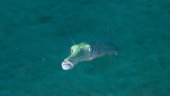
  3. Mafia Island is located in the Indian Ocean, off the East African coast of Tanzania. I learned about Mafia Island from reports of several scubadivers in internet platforms, who consider it an “insider tip”. In November/December 2024 three divers (Lisi, Franz and me) set out towards Mafia in order to experience firsthand the diving and possibilities for UW-photographers. Mafia Island is not difficult to reach via international flights from Vienna/Austria to Dar es Salaam/Tanzania. From there, the travel continues with a short 30’ flight via domestic airline. The airport in Kilindoni, the largest village of the island, is small and, accordingly, the airplanes are small too (the photo shows the main building of the airport and, to the left, the nose of the aircraft that brought us there). By default, only 15kg of luggage, including the cabine luggage, are allowed in the small aircraft. It is very positive to note, that one can book extra luggage in advance by EMail with the domestic “Coastal Airline” (https://coastal.co.tz/), in order to avoid unpleasant surprises when arriving with masses of unannounced luggage. This way, our extensive diving and photo equipment was “nullo problemo” (in order to avoid overload of the aircraft, we had to book an extra seat in advance, that remained empty). There are several resorts located on Mafia Island, but only a single one, “Big Blue Mafia Island Diving Centre” (https://bigblumafia.com/) is perfectly positioned within the Mafia Island Marine Park, where most of the diving spots are located (the marinepark fee, that has to be paid for every single day of the stay once upon entrance, is worth every single cent). This resort is owned and managed by Maura, an Italian, who is the friendly contact person for booking and payment. She is married to a local diving instructor, native to the island, who runs the diving base (their son is working as diving guide, one can say it is a true family enterprise; also the other instructors, guides and employees contributed to a very pleasant stay including safe and wonderful diving). Accommodation is simple, but corresponds to western standards, comprising tasty half (or, when required, full) board and aircondition. Cleaning and freeing the huts from mosquitoes with pesticides is done twice per day. At this point it is appropriate to mention that effective repellants and malaria prophylaxis are strongly recommended by our Austrian tropical medicine specialists. Diving is done using Dhow style boats, that provide plenty of space for the few divers. They are made from heavy tropical woods and are powered by an outboard engine. When winds allow, the boats are also able to sail along silently and swiftly. Chole Bay is the heart of the natural reserve and accordingly most diving spots are located within the bay. Depending on weather, diving spots outside the bay can be dived also. Since the tidal range within Chole Bay is substantial, departure times for the two-tank boat dives are dominated by the tide, are highly variable from day to day and were between 05:00 AM and 14:30 PM during the two weeks of our stay. Despite careful consideration of tidal times, substantial currents are possible. At low tide the visibility within the bay can be pretty modest (as low as 4-5m), but at high tide and also outside the bay it can be remarkably good (up to 30m). Taken together, the diving conditions are certainly not easy for UW-photographers. This is more than compensated by outstanding biodiversity and abundance of species that guarantee the presence of great motifs in high number, rewarding those that take up the challenge. School of common blue-striped snappers (Lutjanus kasmira), outside Chole Bay. Sony A7R5, WACP-C, Sony 28-60mm @28mm, 1/160s, f/10, ISO 100, 2* HF-1 (4500K diffusers): Also inside Chole Bay, the quality of hard coral is good. Sony A7R5, Canon 8-15mm @15mm, 1/100s, f/10, ISO 100, 2* HF-1 (4500K diffusers): Attracted by me, since I was using the macro setup (when I was equipped with the fisheye lens, mating Nembrothas were almost guaranteed), a giant Potato Grouper (Epinephelus tukula) shows up inside the bay. Sony A7R5, Sony 90mm macro, 1/200s, f/9, ISO 100, 2* HF-1 (4500K diffusers): The diving comprises plenty of motifs for wideangle photography, but Chole Bay can be regarded as a true macro destination for UW-photographers as well: Numerous nudibranch species can be encountered around Chole Bay. Noteworthy to state, our stay coincided with the mating season of the Golden Nembrotha (Nembrotha aurea). These seaslugs are hermaphrodites and mating takes place by connecting the sexual organs, located on the right side of the body, with each other in order to transfer the sperm. Sony A7R5, Sony 90mm macro, SMC-1, 1/250s, f/14, ISO 100, 2* HF-1 (4500K diffusers): Blue Pseudoceros flatworm (Pseudoceros bifurcus) moves leisurely over hard coral. Sony A7R5, Sony 90mm macro, SMC-1, 1/200s, f/14, ISO 100, 2* HF-1 (4500K diffusers): Shrimp city is a coral block located inside Chole Bay that is not only populated by countless camel shrimps (Rhynchocinetes durbanensis), but also glassfish, damselfish, anthias, muray eels and groupers. Sony A7R5, Sony 90mm macro, 1/250s, f/13, ISO 100, 2* HF-1 (4500K diffusers): Longnose Hawkfish (Oxycirrhites typus) sitting on black coral. Sony A7R5, Sony 90mm macro, 1/200s, f/13, ISO 100, 2* HF-1 (4500K diffusers): Reef octopus (Octopus cyaneus) peeks out curiously from its shelter. Sony A7R5, Sony 90mm macro, 1/200s, f/18, ISO 100, 2* HF-1 (4500K diffusers): A report about diving at Mafia Island cannot be complete without whale sharks (Rhincodon typus). Outside the marinepark, between the African eastcoast, where the impressive Rufiji river ends up in the Indian Ocean, and the west coast of Mafia Island, the Mafia channel is formed. The high input of biomass from the Rufiji river delta causes plankton to bloom within this strait. This results not only in poor visibility (6-10m; and hence (again) challenging conditions for UW-photography), but, at certain times of the year, whale sharks gather for feeding. Snorkeling excursions by boat are offered and we were able to spot up to 15 different whale sharks on a single day (including a touching encounter with a female shark, closely accompanied by her half-grown up offspring). Whaleshark feeding on krill. Sony A7R5, WACP-C, Sony 28-60mm @31mm, 1/200s, f/7.1, ISO 200: Whaleshark fading away into the blue. Sony A7R5, Canon 8-15mm @15mm, 1/250s, f/6.3, ISO 250: It was an unforgettable diving trip and fond memories will endure. We already have booked flights and resort for another two weeks in November 2025, in order to visit again this little paradise… 😊
  4. I am sure that this camera is not for me. Besides this, this camera has a fixed 35mm lens. I am not sure whether wet lenses exist to make the camera useful for UW, 35mm alone is not really phantastic (if no wetlenses fit, I doubt that someone will ever make a housing)... A Sony A7cR e.g. has the same sensor, is much cheaper, has similar size&weight and, with the 28-60mm lens, goes very well with different wet lenses the way just as compact cameras are normally used (in addition, all other lens/domeport combinations would work as well as this is a real interchangeable lens camera)...
  5. I am using two HF-1 with Sony A7R5 and I am happy with them for photography (most of the time I use them with the 4500K diffusers). A clear upgrade to my former Z330s (I personally have no problems with the extra size and weight - some change in buoyancy trim of the setup in the beginning and never looked back)... What regards video, these 5000 lumen lights are o.k. for me, but I do almost no video. Clearly, these video lights are an "emergency" solution and no dedicated videographer would work with them (o.k., before the HF-1s, I did the (very occasional) video with a single Weefine 3400 lumen focuslight and this was plenty for macro)... Maybe the UW-Technics hybrid flash that Sokrates cites are a better solution, but I believe I would prefer a separate solution with dedicated video lights in case I would make serious videos. In case the HF-1s would be smaller and lighter without video lights, I would prefer them without them, but I doubt that the omission of these LEDs would have a significant effect on size and/or weight ... Wolfgang
  6. My personal feeling is that FF (especially with Sony, but also the other brands) is the real unwanted orphan child what regards lens choice for UW: No native zoom fisheye (and when (now discontinued) adapted is available, just the choice between circular and 180° diagonal - nothing like the (now discontinued) Tokina 10-17mm for APS-C. Meager selection in true macro lenses. Regarding lens selection for UW photography, MFT is clearly the king...👍 This is opposed by 61 Mpixel, 14-bit raw images (and S/N ratio clearly deserves to be digitized at 14-bit resolution) with 4x the maximum light gathering capability (and according dynamic range)... I went the opposite route, upgrading from Olympus EM1II to Sony A7R5. Regarding IQ, I do not look back, I certainly will not "downgrade" to MFT in the midrange (maybe some (remote) day when I have become old and weak, no longer being able to carry a FF rig) , but I clearly miss the lens choice for UW (I am eagerly awaiting new lenses for UW to come out)... Wolfgang
  7. It seems that it is out of stock again. Do'nt buy from the link you cite - this is a scam. The publisher (Seifert Verlag) says it will be available soon again (whatever time span this means... https://www.thalia.at/shop/home/artikeldetails/A1016387878?ProvID=11010473&gad_source=1&gad_campaignid=18314731113&gclid=CjwKCAjw7MLDBhAuEiwAIeXGIRJkX749hu4b_qWX7l2nSAKZMgTjtuEKkIXfuR0atEDPaE4wYQcteRoCCW0QAvD_BwE). In the meantime one can buy it second hand, e.g. here: https://www.antiquari.at/shop/product_info.php?products_id=54867
  8. It seems that the MFO-3 is working similar to a "speed booster", e.g. the Metabones 0.71x Canon EF to MFT. I used it with Tokina 10-17mm on MFT and it not only "speeds" up the aperture, but also improves IQ (better sharpness). I wonder whether the MFO-3 also has an impact on IQ?
  9. See here for info on internal resistance of batteries: https://data.energizer.com/pdfs/batteryir.pdf Internal resistance is measured as the voltage drop under load and this drop is smaller with black Eneloops compared to the white ones (less voltage means slower charging up). So this is essentially the same coin, but the different sides are viewed from different perspectives...
  10. Here a link to a comparison of Eneloop white and black with alkaline batteries (by Panasonic, no other NiMh accus are mentioned): https://www.panasonic.com/sg/consumer/energy-solutions/battery/rechargeable-battery-learn/article/eneloop_pro.html?srsltid=AfmBOorLhUvSrvP5lDzmxA6c5RAOdMLn817I0YwOQFbFv0xLK1uig5MI The conclusions are similar to the ones by ChatGPT (longevity vs. power). The advantage in flash charging time was also tested and the black Pros charge approx. 20% faster compared to the whites (they give no numbers; estimated from the graph "Faster flash charging and longer life")... If the numbers in continuous discharge current, given by ChatGPT are real (1-2A for white vs. 3A for black), this means the current that can be supplied by the battery continuously without leading to damage of the battery (I guess). At a given voltage, the output current depends entirely on the internal resistance of the flash (law of Ohm: Current (A) = Voltage (V) / Resistance (ohm)). During charging, when the load on the batteries is high, the voltage of the accus goes down a little (also depending how freshly charged the accu is), the black ones maintain their original voltage (1.5 V) a little bit better compared to the white ones, leading to the approx. 20% faster charging time...
  11. I use exactly the same fishing floats as you show in the last photo. I order them here, for 2,20 Euro each (no problem, at least in EU, but you have to order a lot to be in balance with shipping costs (I guess 15-25 Euro within EU, depending on location): https://engelnetze.com/en/float-cd-250g-buoyancy-91x45mm-14mm-center-hole/?_gl=1*1sv2od3*_up*MQ..*_gs*MQ..&gclid=CjwKCAjw4K3DBhBqEiwAYtG_9LUz0wqqiSOspGiHNOOJMt1FDejaZ_UqQt0JOrV_Lkc2fyx0BXNM7BoCbGUQAvD_BwE Also these here are nice to use (currently 1,79 Euro each): https://engelnetze.com/en/float-y30-270g-buoyancy-67x109mm-14mm-center-hole/?_gl=1*19hzov0*_up*MQ..*_gs*MQ..&gclid=CjwKCAjw4K3DBhBqEiwAYtG_9LUz0wqqiSOspGiHNOOJMt1FDejaZ_UqQt0JOrV_Lkc2fyx0BXNM7BoCbGUQAvD_BwE They are closed cell foam and hence can also be cut e.g. into two halves and still will not suck water (I also use halves of both types of floats for fine tuning). One can drill a 25mm hole in the middle, for easily putting the flash arm through. With a little force, one can use them also as they are (but sometimes an O-ring of the arm gets loose then and has to be fixed again). I never had Stix floats, but I think they are at least of the same, if not better, quality since these floats are used in hundreds if not thousands to balance the nets of commercial fishermen. This type of floats is designed for the surface, but is good enough for recreational scubadiving as well (up to approx. 50m; they will compress a little beyond 30-40, but with the types I have linked this compression is small & reversible (I once ordered bigger ones ("float T"/680g buoancy, but these are too weak and collapse upon pressure and hence cannot be recommended). Lisi and me use them now since years at full satisfaction, little signs of usage until now... => For technical diving I would take floats that are made from material that is more robust and tolerates greater depth than PVC, e.g. these here (I did never test them out, so cannot say about real life performance, especially #1 and #2 will have to be tested out whether they withstand the pressure at the depths where you dive): #1.: PE and PP, more robust than PVC (good for high pressure cleaner, but they do not say up to what depth). Only available up to 100g flotation: https://engelnetze.com/en/solid-pe-and-pp-floats/?_gl=1*4uqk5e*_up*MQ..*_gs*MQ..&gclid=CjwKCAjw4K3DBhBqEiwAYtG_9A5H5eSfHAZdPf3BwBY_HWtA9AYhgVUmAZx7k1p0HSrG3AEtzDdxKhoCI7wQAvD_BwE #2.: EVA floats. Robust and available between 160-8500g buoancy: https://engelnetze.com/en/eva-floats/?_gl=1*s8r69f*_up*MQ..*_gs*MQ..&gclid=CjwKCAjw4K3DBhBqEiwAYtG_9A5H5eSfHAZdPf3BwBY_HWtA9AYhgVUmAZx7k1p0HSrG3AEtzDdxKhoCI7wQAvD_BwE #3.: Dedicated Deep Sea Trawl Floats (rated between 400-1800m, depending on type; will do it for you in any case 😋 ). Available 780-17600g, probably they have to be cut into pieces: https://engelnetze.com/en/deep-sea-trawl-floats/?_gl=1*1lck9m3*_up*MQ..*_gs*MQ..&gclid=CjwKCAjw4K3DBhBqEiwAYtG_9A5H5eSfHAZdPf3BwBY_HWtA9AYhgVUmAZx7k1p0HSrG3AEtzDdxKhoCI7wQAvD_BwE Wolfgang
  12. In case one can find a good hold, where I can be sure not to harm any UW life, it may be a good method. In most cases I do not dare to place my left arm on the substrate and hold the setup firmly against it - then the setup is quite labile. In addition, not seldom the critters (e.g. gobies) by themselves are moving. At least then C-AF&tracking works quite good with the A7R5 (and also with Oly EM1II). I am not sure I could achieve equally good AF results by moving the camera, even when I have a solid hold...
  13. 500x vs. 2100x charging is the maximum under optimum conditions (and what the company claims, so probably also under optimum conditions one can subtract some percentage). I fear most of us do not treat the batteries like little gems and the outcome is accordingly. At least, according to my limited and subjective experience, the white batteries are at least 4x more reliable compared to the black ones and under comparable conditions (I treat my batteries always the same), maybe the black ones are even more sensitive to bad treatmjent. The white ones have only little and, to me, unimportant trade-offs compared to the black ones... I am also interested to know whether "better" models exist (to me "better" means the battery is least prone to failure), but the Eneloops have a very good reputation...
  14. For me, it is not worth testing out seemingly cheaper alternatives to the Eneloops ("buy cheap, buy twice"). As long as they are intact, the black Eneloop Pros are a tick better for use in camera flashes compared to the white ones: 2500 mAh (black) vs. 1900 mAh (white). Therefore I started with the black ones, but after multiple diving holidays I not seldom had problems with single bad batteries, that were close to the end of their life cycle. This is, because the black ones can only be charged up to 500x, while the white ones are >4x more durable (up to 2100x; se e.g. here: https://www.panasonic.com/global/energy/products/eneloop/en/lineup.html#batterylineup). Since I switched to the white ones (not in order to save money, but the aim is to reduce troubles), bad batteries are much more seldom....
  15. I like to have a manual focus gear to complement AF, but it is not really essential. Sometimes, when very close and/or using diopter, it can take quite a while until AF comes into the appropriate range (A7R5 and Sony 90mm). Then I quickly adjust to the coarse range by hand and let C-AF&tracking do the rest... It also depends on the lens used: It works well with Sony 90mm macro or the adapted Canon 100mm IS macro on A7R5, but it is practically useless with Zuiko 60mm and EM1II (turning the AF wheel leads only to very small changes in AF position; only usable for fine-tuning AF position)...
  16. I take approx. 70-200 photos/dive. Usually on the same day I transfer the better files to my notebook via LRc (about 40% keeper rate estimated). These photos I take home for later processing in LRc/PS. The usable photos, which are further processed, are assigned ratings, starting with 1*. From the processed photos I select 80-150 per dive trip to assemble a slide show. About 70%-80% remain unprocessed/unrated and are deleted from the disc. All processed photos (also the RAW files) are kept on a NAS server (that is backed up every night to another NAS server). => still too many files that are stored and never ever used for anything, but it would break my heart to delete them...😄 Wolfgang
  17. Very interesting, but as praised, it is more a replacement of the old 90mm G lens, rather than a new, additional, option increasing the palette of available focal lengths. I see myself investing $$$$ for the new macro lens plus port (this time I will try to get the shortest N100 port available and use N100 extensions (in case doable)) and in the end I will have have, more or less, similar results as right now (90mm Sony macro lens with dedicated N100 port)...😁 (but who knows, maybe the new lens offers new exciting features, e.g. more native magnification, similar to 90mm lens + SMC-1?) Wolfgang
  18. Has someone tested the Nauticam closeup lenses (that are believed (by most of us, including me) to be of the highest optical quality) and can report what their refractive power in dioptries (UW as well as OV (some manufacturers still give refractive power in dioptries OV)) is (so that one could compare them easily to other diopters)?
  19. I wished Nauticam working together with a third party lens company (like e.g. Tamron, Sigma, Viltrox, Laowa etc.. etc...). The lens company produces an AF equipped zoom lens that is just a proto-lens and is not required to make in-focus photos OV. Nauticam produces a small and smart port for this lens where the front glass is an optical element that complements the proto-lens to become a water corrected 15-35mm (f/4 or f/5.6) zoom fisheye lens (similar to the Nikonos lenses modifications done by Seacam or Isaac Szabo)...😃 => I do not think that development and construction of such an item is more elaborated compared to development and construction of WACPs/FCPs etc. (a lot of old patents/plans for water corrected lenses already exist; maybe even one of the optical engineers of the old Nikonos lenses is still alive and willing to participate). Especially series production of the port should be simpler (I also guess the number of items produced/sold would be quite high)... => When I consider the boring multiplicity and redundancy of lenses that are produced by third party companies (e.g. 85mm portrait lenses, but also many other focal lengths), I imagine it is hard for them to make profit. Such a unique proto-lens may be a very welcome product for their portfolio...
  20. Thank you for these industrious testings, RomiK... 👍 From your test photos under controlled environment, I conclude that the 8-15mm/2xTC/140mm combo is at least as good as 28-60mm/WACP-C, maybe even a tick better (you agree?). The differences are subtile, I am glad to see that the 8-15/2xTC combo can keep up with modern wetlens solutions... I derived to similar conclusions based on my own photos, but these were just UW photos of different subjects at different times and conditions, by far no control... #1.: Concerning your listing of costs and the Canon 8-15mm combo, I think it is fair to add that the N100/N120 adapter, 140mm dome, both N120 extensions and Sony 2x TC are universal and can be used for various other occasions, both UW and OW as well (even the Canon 8-15mm with Metabones is fun to use over the water)... With the WACP-C combo, one is left with a bold chunk of optical glass that is dedicated to its purpose plus one universal N100 30mm extension and a mediocre 28-60mm lens (o.k. the charm of the 28-60mm lens for OW use is its size, but I personally prefer the Sony 20-70mm that is bigger, but still not excessive, and provides clearly better IQ, both OW and UW) => I would say one gets a lot more with the Canon 8-15mm combo (also the 180° diagonal FOV, what the WACP-C cannot deliver) for a simlar amount of money... #2.: I am surprised to see that the Canon 8-15mm performs optically better behind the rectilinear 180mm domeport, compared to WACP-C, maybe even a tick better compared to 8-15mm behind hemispherical 140mm domeport. This is completely unexpected for me, but in line with my observations when I used the Canon 8-15mm behind 140mm and rectilinear 170mm domeports with MFT cameras, where the smaller sensor scans only the central 25% area within the image circle. IQ with 170mm domeport there was at least as good compared to the 140mm, if not better (just comparison of regular UW photos, no controlled environment)... Wolfgang P.S.:At present, my WACP-C stays a lot at home, when I go for scuba travel (I am a big fan of 180° diagonal and miss it with the WACP-C; I also find the 8-15(2xTC/140mm rig more manageable OV and UW). Not enough time has passed, but maybe I will put my WACP-C in classified to help finance an EMWL some day...😊
  21. Hi Tim, I am currently using version 6.1.4.22653. The icons for LRc became worse (ambivalent symbols for the potentiometers, e.g. for adjusting temperture, tint, heigths etc.. etc.. even without text explanation). Furthermore at present I am not able to assign user presets (e.g for my new Tamron 35-150mm f/2-f/2.8, that I use over the water) to buttons of my Loupedeck CT (maybe the next software upgrade may solve this problem)... See the embedded screenshot for what I mean with ambivalent symbols for potentiometers: Since long I gave up complaining at the user service - I think this is just lost time...☹️
  22. Hi chemsdiving, For Canon EF lenses, Nauticam recommends the use of the Canon EF to Canon R adapter (see here: https://drive.google.com/file/d/1wjedtgAP1MCgmCFUYGYrGC7I_J7GPCiH/view) and then the appropriate extension, according to the Canon EF cards (see here: https://drive.google.com/file/d/1J-d1Phs2q3ZU3vu0TMNaUQtwJ8Pr_VG_/view) For the 140mm and 230mm fisheye domes (approximate hemispheres) Nauticam recommends a 30mm N120 extension w/o TC and 50mm with the Kenko 1.4x TC (see link above)... They do not recommend to use the Canon 8-15mm with the 180mm domeport, which is not a hemisphere but a smaller section of a sphere, optimized for rectilinear WA lenses. The extension should remain the same (30mm w/o TC and 50mm with 1.4x TC), longer extension (as required for optimal positioning) will result in vignetting and shorter extension is even worse (for theoretical optimum positioning of the lens)), but the optical quality may not be good enough (best is to inquire at Nauticam)... Wolfgang P.S.: I was using the Canon 8-15mm with the Nauticam 140mm fisheye domeport and with the Zen 170mm domeport (similar to the Nauticam 180mm domeport) with MFT cameras with the same extension for both domeports and the results were pleasing for both. The larger FF sensor may be different, however...
  23. The maximum magnification of Sony 90mm plus MFO-2 remains 1:1?
  24. I case you go by car to the places where you make your UW photos, there is no argument against the 230mm dome. Even the Nauticam 250mm dome, which has a larger radius of curvature and is optimized for not-extreme rectilinear WA lenses (as you are planning to use), may be an option in case such a large dome does not interfere with making the photos (i.e. it is in the way)... A 8.5" acryl dome, as you write, corresponds to 216 cm (what radius of curvature does the 8.5" dome have compared to the 180mm domeport (the 180mm port has a radius of 110mm)?). It is not granted that the lenses you write about, work well with the 180mm domeport (in case the radius of the 8.5" is similar to the 180mm domeport there should not be much difference): Best is to ask Nauticam US about it, usually they answer reliably and quickly ... (Not every lens works well together with a domeport (highest optical quality is not an indicator). (i) the lens has to be able to focus at a close distance, since the domeport produces a virtual image that is few dm away from the domeport. (ii) this virtual image is curved and a lens that has field curvature that fits approximately the curvature of the virtual image works best with an, even smaller, domeport (field curvature is a property that is not really desired for high quality over the water lenses) Wolfgang
  25. As probably most here, I started with pure screen (basic setup with initial investment) and was happy... Then I acquired a used Nauticam housing and the former owner gave me also his 45° viewfinder along with the housing. Few dives for learning how to deal with 45°, then never looked back... Superior for macro and also my clear preference for WA. Especially in shallow water, when the sun is shining, the screen is often invisible in practice, but the viewfinder works. The muscles in the neck will thank you for using a 45° viewfinder.. One of the view exceptions when a 45° viewfinder is suboptimal is when making photos vertically downwards (e.g. rotational panning). Also with EMWL (I do not have one, but am thinking about it) it may be better to use the screen on the back, since my camera (A7R5) has the possibility to flip and mirror image the screen image (unfortunately not the image in the EVF). This allows to use EMWL without the expensive, clumsy and heavy "relay" unit (or the additional "inverting" 45° viewfinder). Wolfgang

Important Information

Terms of Use Privacy Policy Guidelines We have placed cookies on your device to help make this website better. You can adjust your cookie settings, otherwise we'll assume you're okay to continue.

Account

Navigation

Search

Search

Configure browser push notifications

Chrome (Android)
  1. Tap the lock icon next to the address bar.
  2. Tap Permissions → Notifications.
  3. Adjust your preference.
Chrome (Desktop)
  1. Click the padlock icon in the address bar.
  2. Select Site settings.
  3. Find Notifications and adjust your preference.